%20%20--%3E%0A%3Csvg%20version%3D%221.1%22%20id%3D%22Layer_1%22%20xmlns%3D%22http%3A%2F%2Fwww.w3.org%2F2000%2Fsvg%22%20xmlns%3Axlink%3D%22http%3A%2F%2Fwww.w3.org%2F1999%2Fxlink%22%20x%3D%220px%22%20y%3D%220px%22%0A%09%20width%3D%2239px%22%20height%3D%2240px%22%20viewBox%3D%220%200%2039%2040%22%20enable-background%3D%22new%200%200%2039%2040%22%20xml%3Aspace%3D%22preserve%22%3E%0A%3Cpath%20fill%3D%22%23FFFFFF%22%20d%3D%22M38.5%2C7H28.2v26h10.3V7z%22%2F%3E%0A%3Cpath%20fill-rule%3D%22evenodd%22%20clip-rule%3D%22evenodd%22%20fill%3D%22%23FFFFFF%22%20d%3D%22M26.1%2C25.5c0%2C5.8-4.1%2C7.5-12.9%2C7.5C3.9%2C33%2C0%2C31.2%2C0%2C25.2v-1.1h11.6%0A%09v2.4c0%2C0.7%2C0.1%2C1.4%2C1.2%2C1.4c1%2C0%2C1.2-0.4%2C1.2-1.3v-0.9c0-1.6-0.9-1.6-3.5-2.2C2.2%2C21.7%2C0%2C19.7%2C0%2C15.3v-0.9C0%2C9.3%2C5.5%2C7%2C12.9%2C7%0A%09c10.2%2C0%2C12.8%2C2.6%2C12.8%2C7.4v1.8h-11v-2.9c0-0.6-0.4-1.1-1.2-1.1c-0.6%2C0-1.2%2C0.4-1.2%2C1.1v0.9c0%2C1.5%2C0.9%2C2%2C3.3%2C2.5%0A%09c8%2C1.6%2C10.5%2C3.3%2C10.5%2C7.5V25.5z%22%2F%3E%0A%3C%2Fsvg%3E%0A)
Ole Miss’s CFP Coaching Chaos Has a Precedent … and a Title
In this story:
The word “unprecedented” has been frequently attached to the Mississippi coaching situation in the College Football Playoff, with Lane Kiffin out after leading the Rebels all season and Pete Golding in. But there is a men’s basketball precedent. Steve Fisher has been there and done that, with a national championship to show for it.
“It kind of blew everybody away,” says Fisher, now 80 years old. “Including myself.”
Thirty-six years ago at Michigan, Bill Frieder was Kiffin and Fisher was Golding. Michigan athletic director Bo Schembechler was a football guy making a major basketball decision. Ole Miss athletic director Keith Carter is a basketball guy making a major football decision.
Will it work out as well for the Rebels as it did for the Wolverines? We’ll see. Golding is four wins away from giving Fisher company in the Emergency Head Coach Hall of Fame.
Believe it or not, Michigan’s NCAA title run amid upheaval was even wilder than what Ole Miss is trying to navigate. The timing was worse. Fisher’s future was more uncertain. And with a No. 3 seed that equates to being between No. 9 and No. 12 overall, as opposed to the Rebels’ No. 6 seed, the team was a longer shot to win it all.
“The chaos that surrounded it was like none other,” Fisher says.

Yet the result was the first and only men’s basketball title in Michigan history. Here’s how it went down:
On Selection Sunday, March 12, 1989, the Wolverines learned they were paired with No. 14 seed Xavier that Friday in the first round in Atlanta. On Tuesday, Purdue coach Gene Keady turned down the Arizona State job. Frieder was the next man on athletic director Charles Harris’s list. Frieder told Harris he was interested, but wanted to get through the tournament before committing. Harris responded that he had 20 minutes to take it or leave it.
Frieder accepted the job, with the caveat that he would start after the Wolverines’ season ended. Later that day, Fisher naively informed Frieder that Keady had turned down Arizona State. Frieder explained the rest of the story—he was going to be the coach of the Sun Devils, and he was flying to the desert that night for an introductory press conference the following day, March 15. He told Fisher, his assistant for seven seasons, to lead the team to Atlanta, and Frieder would fly in separately from Arizona to meet them there.
When Frieder got to Arizona, he started calling his Michigan players in the wee hours of Wednesday morning to tell them personally that he was leaving. (Center Terry Mills says his phone rang at about 3 a.m. ET.) Meanwhile, Schembechler’s secretary called Fisher and told him to be in the Michigan AD’s office at 7 a.m.
“That’s when I figured that Bo wasn’t going to let Bill coach the tournament,” Fisher says.
Fisher’s instinct was correct. After putting Frieder’s top assistant in charge and telling the team, Schembechler made his now-famous pronouncement: “A Michigan man is going to coach Michigan.” He told Frieder that he was out, effective immediately, in a phone call that morning.
But Fisher was only the interim coach, with no guarantee that he would keep the job. In fact, he thought it wouldn’t happen—he talked to his wife, Angie, about three options: going after the head coaching job at Illinois State, his alma mater; pursuing the opening at Western Michigan; or following Frieder to ASU as an assistant.
When he and the team got to the Detroit airport for the flight to Atlanta, they were swarmed by media members. This was pre–9/11, which meant just about anyone could walk in and go to airline departure gates. TV crews shined their lights on the players and asked them how they felt about the sudden departure of their coach.
“It was a shock to us,” says Mills, who is the current radio analyst for Michigan basketball. “We thought, ‘O.K., we’ve got to grow up here.’ But we were young and dumb and didn’t know any better. We had been used to Fish’s voice—he pretty much ran practices—so we weren’t too worried about it.”
The public was not accustomed to Fisher’s voice. When he took the podium for the NCAA press conference the day before the Xavier game, he dryly said, “For those who don’t know me, I’m Steve Fisher.”
Meanwhile, Schembechler said he would conduct a national search for a new coach. Speculation centered on Pete Gillen, the coach Fisher would face in that first-round game. Other names being bandied about included Rick Pitino (who would end up at Kentucky two months later) and Dave Bliss (whose career took an infamous turn after a murder within his Baylor team).

As Michigan prepared for Xavier, the entire saga took its oddest and most awkward twist: Frieder showed up in Atlanta. He bought a plane ticket, got a hotel room downtown and purchased a ticket for the game, sitting not far behind the Wolverines’ bench. After a crush of fans and media members descended upon him, Frieder moved to a baseline seat closer to the Musketeers’ bench.
Mills said Frieder even went to the team’s hotel and hung out in the lobby, talking to players. Fisher said he and Frieder spoke by phone daily during the tournament, and the former coach called players as well to offer feedback on their performances and coaching tips for the next game.
But the Michigan run almost never got started. In addition to the seismic coaching upheaval, the Wolverines were coming off a blistering loss at home on Senior Day to Illinois, a result that was so embarrassing that Mills says several players stayed in the locker room for hours afterward. “We didn’t want to show our faces,” he says.
Fisher says he wasn’t nervous for the opener against Xavier—“I knew I was ready to be a head coach”—but the Wolverines struggled most of the game. Fisher made one deft coaching move, inserting little-used backup guard Demetrius Calip, and he made some key plays that helped Michigan sneak by, 92–87. Then tournament serendipity entered the picture.
Sixth-seed Alabama was upset by No. 11 South Alabama, gifting the Wolverines a favorable second-round matchup. After winning that one, they were on to the Sweet 16 in Lexington, Ky., to face No. 2 seed North Carolina—a team that had been Michigan’s nemesis. The Tar Heels eliminated a Frieder-led Wolverines teams from the tournament the previous two seasons.
Michigan got the better of Carolina this time, though, a breakthrough that changed the tenor of Fisher’s interim candidacy. He told Angie after the game, “We’re going to get the job.”
But Schembechler stayed mum. Even after the Wolverines blew out No. 5 seed Virginia—which had upset No. 1 Oklahoma—to reach the Final Four, Fisher was left to wait and wonder.
In Seattle for the Final Four, Michigan faced the last No. 1 seed still standing—Illinois, the team that crushed the Wolverines on Senior Day. “They were the best team,” Fisher says. “If you play a seven-game series, they probably beat us more times than we beat them.”
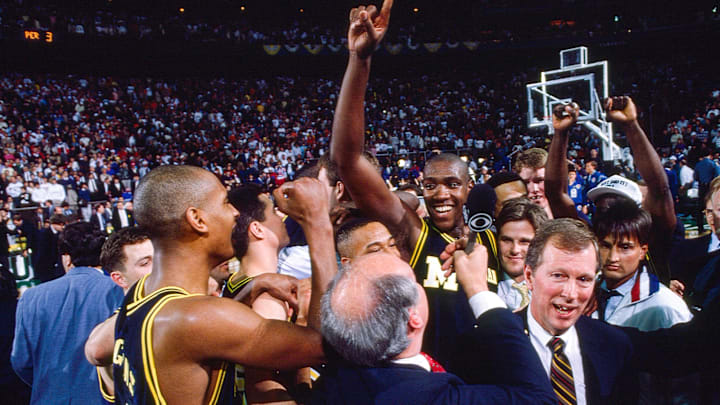
But in a one-game tournament setting, Michigan got its payback. A tense, back-and-forth battle ended with a Sean Higgins putback with a second left, sending the Wolverines to the national championship game against fellow No. 3 seed Seton Hall. They won in overtime, capping Fisher’s six-game run for the ages.

“I’ve never heard of an undefeated coach getting fired,” Mills said at the time, predicting that Schembechler would soon remove the interim label from Fisher’s job title. Yet even then, it took a week for Bo to make it official.
Fisher went on to coach eight full seasons at Michigan, taking the Fab Five to consecutive Final Fours. He was fired in 1997 amid fallout from booster Ed Martin allegedly paying players, which led to sanctions on the Wolverines’ program. Fisher resurfaced at San Diego State in 1999 and built the program up from the ashes, with a remarkable run of 11 straight seasons with more than 20 wins.
But the only national title he ever won was as an interim coach.
“Who goes on a run like that and wins a championship?” Mills asks today. “That’s what they make movies about.”
Golding gets his chance to replicate history starting Saturday, against heavy underdog Tulane in the CFP first round. The road goes uphill from there, with the winner of that game facing No. 3 seed Georgia in the Sugar Bowl quarterfinals. Beyond that could loom No. 2 Ohio State and No. 1 Indiana.
The scruffy, occasionally profane 41-year-old couldn’t have less in common with the prim Fisher, but circumstances have tied them together. Golding said this week that practice has been his “safe code” away from the tumult that has riled up Rebels fans, an opportunity to “do ball” as he’s accustomed. The former Nick Saban assistant frequently references his time in Tuscaloosa and even occasionally throws in an “a’ight” that is straight from the Saban dialect.
“There’s a lot of buy-in right now to make sure we’re doing everything that we can control in order to give ourselves our best chance to win the football game,” Golding said Monday. “And then at that point, you got to spot the ball and go play.”

The former defensive coordinator does have one distinct advantage that Fisher did not enjoy in 1989—he’s already been hired as the full-time head coach of the Rebels.
“Pete is writing his first chapter,” Fisher says of Golding. “I was writing my audition. But I would just say, don’t change who you are. Don’t try to reinvent the wheel. Just be yourself and give everyone the responsibilities they already had—plus a little more.”
For the moment, Golding is the most popular man in Oxford—mostly because of who he’s not, which is the vilified Lane Kiffin. That carries plenty of pressure, though, as Ole Miss tries to win the divorce and take its talented team deep into the playoff. A loss to Tulane would be devastating.
For what it’s worth, the Rebels have a bunch of former Michigan basketball players in their late 40s and early 50s now rooting for them. They’ve been down a similar road, and it ended with one of the most improbable stories in March Madness history. They’d like to see Ole Miss’s players experience that.
“I’m an Ole Miss fan right now,” Mills says. “I’m cheering for them. They just have to come together for one another.”
More College Football from Sports Illustrated
Listen to SI’s new college sports podcast, Others Receiving Votes, below or on Apple and Spotify. Watch the show on SI’s YouTube channel.
 Add us as a preferred source on Google
Pat Forde is a senior writer for Sports Illustrated who covers college football and college basketball as well as the Olympics and horse racing. He cohosts the Others Receiving Votes podcast for SI and is a regular contributor to the Tony Kornheiser Show podcast. He previously worked for Yahoo Sports, ESPN and The (Louisville) Courier-Journal. Forde has won 28 Associated Press Sports Editors writing contest awards, has been published three times in the Best American Sports Writing book series, and was nominated for the 1990 Pulitzer Prize. A past president of the U.S. Basketball Writers Association and member of the Football Writers Association of America, he lives in Louisville with his wife. They have three children, all of whom were collegiate swimmers.
Follow ByPatForde