%20%20--%3E%0A%3Csvg%20version%3D%221.1%22%20id%3D%22Layer_1%22%20xmlns%3D%22http%3A%2F%2Fwww.w3.org%2F2000%2Fsvg%22%20xmlns%3Axlink%3D%22http%3A%2F%2Fwww.w3.org%2F1999%2Fxlink%22%20x%3D%220px%22%20y%3D%220px%22%0A%09%20width%3D%2239px%22%20height%3D%2240px%22%20viewBox%3D%220%200%2039%2040%22%20enable-background%3D%22new%200%200%2039%2040%22%20xml%3Aspace%3D%22preserve%22%3E%0A%3Cpath%20fill%3D%22%23FFFFFF%22%20d%3D%22M38.5%2C7H28.2v26h10.3V7z%22%2F%3E%0A%3Cpath%20fill-rule%3D%22evenodd%22%20clip-rule%3D%22evenodd%22%20fill%3D%22%23FFFFFF%22%20d%3D%22M26.1%2C25.5c0%2C5.8-4.1%2C7.5-12.9%2C7.5C3.9%2C33%2C0%2C31.2%2C0%2C25.2v-1.1h11.6%0A%09v2.4c0%2C0.7%2C0.1%2C1.4%2C1.2%2C1.4c1%2C0%2C1.2-0.4%2C1.2-1.3v-0.9c0-1.6-0.9-1.6-3.5-2.2C2.2%2C21.7%2C0%2C19.7%2C0%2C15.3v-0.9C0%2C9.3%2C5.5%2C7%2C12.9%2C7%0A%09c10.2%2C0%2C12.8%2C2.6%2C12.8%2C7.4v1.8h-11v-2.9c0-0.6-0.4-1.1-1.2-1.1c-0.6%2C0-1.2%2C0.4-1.2%2C1.1v0.9c0%2C1.5%2C0.9%2C2%2C3.3%2C2.5%0A%09c8%2C1.6%2C10.5%2C3.3%2C10.5%2C7.5V25.5z%22%2F%3E%0A%3C%2Fsvg%3E%0A)
Most Reliable Players of the Tournament
Most Reliable Players of the Tournament
Frank Kaminsky, F, Wisconsin
Which team will end up with the big confetti shower at the end of the NCAA Tournament? Time will tell. In the meantime, here are some of the most reliable players heading into the Big Dance. Kaminsky is arguably the nation's top player in his senior stellar season, and likely the most reliable as well. He's scoring over 18 points per game while shooting nearly 56 percent from the field, including 41 percent from the three-point line. Kaminsky is also the unquestioned leader of a Wisconsin team poised to make a tournament run.
Jahlil Okafor, C, Duke
Okafor has shown time and time again why he's considered to be a near-lock for the No. 1 overall pick in the upcoming NBA Draft. He has an extremely effective low post game—on both sides of the floor—that makes him capable of taking over a game if a team can't match up down low. Expect Duke to feed Okafor early and often in the tournament.
Jerian Grant, G, Notre Dame
Grant has battled back from academic issues to lead Notre Dame's explosive offensive attack. There's no questioning what Grant can do on the court, where he averages close to 17 points and seven assists per game. When games get tight, the Fighting Irish will put the ball in his hands.
D'Angelo Russell, G, Ohio State
Russell started this season with no hype, and has earned any and all recognition through his play on the court. Russell can fill it up with the best—he averages 19.2 points per game—but he's an even better passer than scorer. Though he's only a freshman, Russell will be trusted with making the right play in key moments for the Buckeyes.
Delon Wright, G, Utah
Wright's impressive all-around play has the Utes in the tournament for the first time since 2009. He gives his team a little bit of everything—scoring, rebounds and assists. If Utah makes any noise in the postseason, it will start and end with the level at which Wright performs.
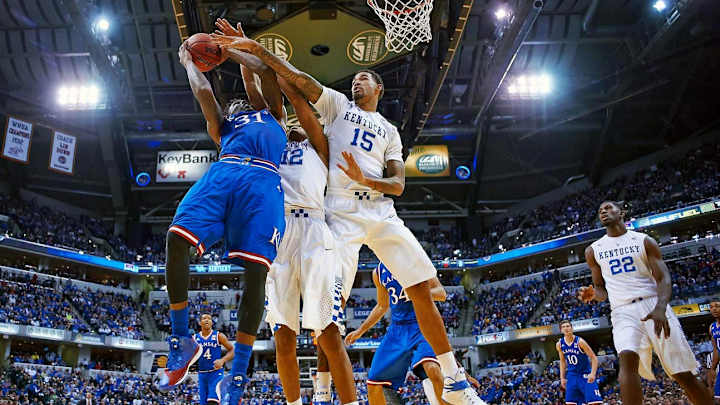
Willie Cauley-Stein, F, Kentucky
Cauley-Stein may not play the most minutes because of Kentucky's platoon attack, but he makes an impact nearly every second he's on the court. Cauley-Stein's shot-blocking prowess makes him the ultimate back-line defender for the Wildcats. His consistency on the defensive end will hinder any team's offensive gameplan.
Seth Tuttle, F, Northern Iowa
Tuttle's offensive mastery has Northern Iowa back in the tournament for the first time since 2010. He almost always has the ball in his hands, and Tuttle justifies his high usage by consistently making shots. He's shooting over 61 percent from the field, and he's also shown a little range, making 18 threes at a 43 percent rate.
Karl-Anthony Towns, F, Kentucky
Towns is the latest in a line of Kentucky freshman with NBA-ready talent. He plays under 21 minutes a game, but Towns is every bit the shot-blocker and rebounder as his teammate Cauley-Stein. And Towns is also efficient on offense, shooting nearly 56 percent.
Buddy Hield, G, Oklahoma
Hield is one of the nation's smartest players, and the leader of the Sooners' offense. He simply has a nose for the basket. Expect Oklahoma to call Hield's number any time they need a basket in a close game.
Kyle Wiltjer, F, Gonzaga
Wiltjer won a national championship in 2012, but that was when he played sparingly as a bench player in Kentucky. In his first season on the court with Gonzaga, Wiltjer has more than justified his decision to transfer. As the focal point on offense, he scores nearly 17 points a game, while shooting 47 percent from three. The more he gets the ball, the more he delivers.
Dez Wells, G-F, Maryland
Wells is the go-to player for a top-10 team in the country. He's capable of raising his game when the stakes are high, as he did with a 26-point effort in a recent win over Wisconsin. Wells is also a clutch performer, and he'll be a focal point of any success Maryland has in the tournament.
Malcolm Brogdon, G, Virginia
With other Virginia stars Justin Anderson and London Perrantes battling injuries, Brogdon has become even more important for the Cavaliers' success. He averages nearly 14 points a game and also picks up around four rebounds, but his ability to defend and play both ends of the floor makes him a truly reliable cog for the Cavs.
Ryan Arcidiacono, G, Villanova
Arcidiacono, the co-Big East player of the year, has helped Villanova become a serious championship contender. The 6'3" guard isn't afraid to let it fly from the three-point line, attempting over four a game and converting at a 37 percent rate. His shooting could swing a game or two in Villanova's favor during the tournament.
T.J. McConnell, G, Arizona
McConnell may not be as talented as his backcourt mate Stanley Johnson, but his experience and energy makes him slightly more reliable. The Wildcats' senior leader, McConnell is the consummate teammate. He averages about 10 points per game, as well as six assists.
Frank Mason III, G, Kansas
Mason will be an integral part of any Jayhawks success, especially with frontcourt stars Perry Ellis and Cliff Alexander dealing with injury and eligibility issues, respectively. Mason has a steady hand in the backcourt. Even with his small frame, he's an adept scorer, and Mason also pitches in significantly with assists and on the glass.
Montrezl Harrell, F, Louisville
Harrell is the emotional leader of the Cardinals, and a feared opponent for everyone else. The fiery Harrell averages close to a double-double, at 15.8 points and 9.4 rebounds per game. He brings a consistent energy to his teammates every night, which helps to set the tone for one of the nation's top teams.
Georges Niang, F, Iowa State
Niang is the do-it-all forward for the Cyclones. Named first-team All-Big 12 by The Associated Press, Niang averaged over 15 points, five rebounds and three assists this season. The play of Niang and his backcourt counterpart Monte Morris could carry Iowa State deep into the tournament.
Quinn Cook, G, Duke
Cook is not the biggest name on the Duke roster, but he's an invaluable part of the team's success. Cook is relied on heavily, playing about 36 minutes a game for the Blue Devils. His long-range shooting—just over 40 percent from three—gives the rest of the Duke offense room to operate. His leadership at the guard position offsets the inexperience of freshmen Okafor and Tyus Jones.
Ron Baker, G, Wichita State
Baker and Shockers point guard Fred Van Vleet are both a big part of the team's success, but Baker pulls the slightest bit ahead because of his all-around game. Baker is averaging 15 points and over four rebounds per game. He's also shooting 39 percent from three, but both Baker and Van Vleet will be needed if Wichita State wants to make the Final Four.
Joseph Young, G, Oregon
Young isn't talked about much, and Oregon sits right outside the top-25, but Young is the kind of scorer that commands attention. He plays over 36 minutes per game and scores nearly 20 points while doing so. If Young gets hot, he can swing a tournament game all by himself, and the Ducks could sneak up on some opponents.
 Add us as a preferred source on Google