
Takeaways From Alabama Basketball's 2026 Players Era Performances
In this story:
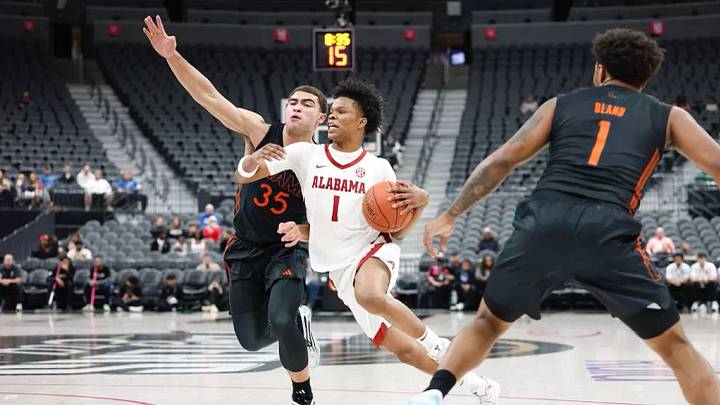
No. 15 Alabama fell to No. 17 Miami 87-81 on Friday night in Las Vegas. This was the Crimson Tide's third and final game at the Players Era in Las Vegas.
The Crimson Tide first played and lost to Baylor 68-63 on Tuesday before taking down Kansas State 104-91 on Thursday.
There was a lot to learn from Alabama's performance this week. Here are five takeaways.
Rebounding is Becoming a Disaster
All offseason long, UA head coach Nate Oats' vision of getting a bigger team was very clear. 12 of Alabama's 15 players on the roster are at least 6-foot-6. The Tide has been running a 12-man rotation (when healthy) to start the year, and 10 of them meet that height mark.
Alabama made these changes because it was getting bullied down low on both sides of the ball, especially on the glass. It has been a major reason for the Crimson Tide's losses in past NCAA Tournaments over the years. It's what hasn't gotten Oats and company over the hump and to the national championship.
Alabama has shown flashes of improvement on the glass this season, but for the most part, it is still a disaster. Baylor had 18 offensive rebounds and 17 second-chance points, with a large majority of each category coming in the second half and in crunch time. Kansas State logged 19 offensive boards and, like Baylor, also scored 17 second-chance points. Miami had 17 offensive rebounds and 21 second-chance points.
Even though it's only been eight games, Alabama is approaching a season-long narrative that the rebounding just won't be fixing. One suggestion: centers Collins Onyejiaka and TJ St. Louis aren't part of the rotation, but trying them out can't hurt the rebounding numbers anymore. Even if it's just a game or two to test the waters.
"We found out a lot about us and some good came out of it, but a lot of stuff to work on," Oats said during the postgame press conference. "The biggest thing is we're going to have a hard time winning games against good teams if we can't rebound the ball very well. We got out-rebounded by 17...It's just really hard to win against a good team when the second-chance points are 21-6.
"Obviously, it comes down to some physicality, technique and are you strong enough, big enough, athletic enough. But mainly it comes down to the want-to. The guys who want to go get rebounds tend to get them, and we, for whatever reason, haven't done a good enough job of it. It's on me as a head coach to figure out a group that could rebound better. Try to get them on the floor. Figure out offensive fits with a group that will rebound better."
Defense is on the Rise
In addition to rebounding, being more consistent defensively was another goal for Oats when adding size this offseason. It has worked a good bit, as Alabama came into Saturday 11th in the country in blocks per game with 6.6.
Alabama didn't meet this mark in the first two games, but forwards like Brandon Garrison and Jamarion Davis-Fleming were affecting shots down low. They really made things difficult for Baylor, which shot 10 of 33 from two-point range. Davis-Fleming stood out at Players Era on both sides of the ball, which is quite impressive considering he missed multiple games with a leg injury coming into Las Vegas.
Alabama held Kansas State to 13 of 48 from deep, as its defense was solid once again. Freshmen Anderson Diaz and Jaxon Richardson showed some really promising signs on that side of the ball, with the latter serving as a starter. Diaz won the Hard Hat award after earning the most blue-collar points (deflections, dives, hustle stats that aren't on the official sheet).
Alabama couldn't stop Miami from scoring in the first half, as it recorded 52 points. But the intensity was significantly more apparent during the second half as the Tide made a comeback. The Hurricanes only had 35 points in the second period.
It's important to note that defending without fouling was a bit of an issue, as Baylor logged 26 free-throw attempts, Kansas State had 37 and the Hurricanes also had north of 20.
"I thought the biggest positive was our defense, when we decided we wanted to be a very good defensive team," Oats said. "I thought the Baylor game, the defense was pretty solid. We almost held them under one. Our offense was the problem that game more than our defense. K-State: too many fouls, too many O-boards, too many points off our turnovers, but our half-court defense was pretty good. Tonight, in the second half, our defense was good.
"We showed we're capable of being a much better defensive team than what we've been showing the first five games. But we didn't do it for 40 minutes in any of the three games, and to me that's a leadership deal. I've got to do a better job stressing it, making sure that our guys understand that winning is not easy at this level. It's extremely hard... We've got a stretch here that our defense can't show up for 20 minutes. It can't even show up for 36 minutes, it's got to show up for 40 minutes and we're yet to do it."
The Turnovers Problem
As previously stated, Alabama's personnel looks a lot different, as nine newcomers have had to adapt to Oats' system, which is one of, if not the fastest-paced in the country. What's been good over the past three games is that the ball has been moving, but sometimes it's been one pass too many or simply just a poor decision during a rush.
Baylor really slowed Alabama down all night long on Tuesday, and it resulted in the Crimson Tide committing 13 turnovers, with the Bears scoring 15 points off them. UA took it a step further against Kansas State, as its 21 turnovers were among the most in the Oats era. The Wildcats tallied 20 points off the Tide's giveaways.
Alabama came into Friday night averaging 14.0 turnovers per game, which ranks 292nd of 365 Division I programs. Ball security was a bit better against Miami, but there was still much more room for improvement.
Solid Scoring Distribution
For years, Alabama has had one player lead the pack in scoring for a majority of games, including Brandon Miller, Mark Sears and Labaron Philon Jr. Amari Allen has served as that player this year, but his playmaking combined with the Tide's unselfish form of basketball created a plethora of scoring options during the Players Era event.
This was most evident against Kansas State, as nine players tallied between 8 and 14 points: Qayden Samuels, Amari Allen, Aden Holloway, Drew Fielder, Brandon Garrison, Cole Cloer, London Jemison, Anderson Diaz and Jamarion Davis-Fleming. A team doesn't need one player to score 20 every night, and Alabama showed that it could thrive with the ball in several players' hands when scoring 104 points against the Wildcats.
Alabama had a different high-scorer in each Players Era game: Allen (18 vs. Baylor), Samuels (14 vs. Kansas State) and Garrison (20 vs. Miami). This is something to continue building on, as the more weapons the better in this NBA-style offense.
Poor Second-Half Starts
Here's another area that Alabama struggled in last season that is still showing inconsistency. Oats preached it countless times last year that the Tide wasn't coming out of the locker room strong, even when it had a commanding lead.
Alabama trailed 29-24 at halftime against Baylor. Four minutes later, Baylor was up by 14 points. The Crimson Tide led Kansas State by 16 at halftime, and at the first media timeout, UA and the Wildcats were at an even 10-10 score to start the second period. On the lighter side, Miami was up 12 at the break, but Alabama had more points in the second half.
Poor second-half starts play a big role in many of Alabama's losses last season. What's good about non-conference play is that the Tide can learn from this and build on it, even though it is tough to simulate in practice.
That said, the SEC has looked great to start the season, as every single team is currently above .500. Six SEC programs, including Alabama, are in the latest AP Top 25. In other words, Alabama can't afford to begin the second period sluggish. It may not be able to catch up to its opponent.
Sign up to our free newsletter and follow us on Twitter/X, Facebook, YouTube, Instagram, TikTok for the latest news.
 Add us as a preferred source on Google

Hunter De Siver is the lead basketball writer for BamaCentral and has covered Crimson Tide football since 2024. He previously distributed stories about the NFL and NBA for On SI and was a staff writer for Missouri Tigers On SI and Cowbell Corner. Before that, Hunter generated articles highlighting Crimson Tide products in the NFL and NBA for BamaCentral as an intern in 2022 and 2023. Hunter is a graduate from the University of Alabama, earning a degree in sports media in 2023.
Follow HunterDeSiver