%20%20--%3E%0A%3Csvg%20version%3D%221.1%22%20id%3D%22Layer_1%22%20xmlns%3D%22http%3A%2F%2Fwww.w3.org%2F2000%2Fsvg%22%20xmlns%3Axlink%3D%22http%3A%2F%2Fwww.w3.org%2F1999%2Fxlink%22%20x%3D%220px%22%20y%3D%220px%22%0A%09%20width%3D%2239px%22%20height%3D%2240px%22%20viewBox%3D%220%200%2039%2040%22%20enable-background%3D%22new%200%200%2039%2040%22%20xml%3Aspace%3D%22preserve%22%3E%0A%3Cpath%20fill%3D%22%23FFFFFF%22%20d%3D%22M38.5%2C7H28.2v26h10.3V7z%22%2F%3E%0A%3Cpath%20fill-rule%3D%22evenodd%22%20clip-rule%3D%22evenodd%22%20fill%3D%22%23FFFFFF%22%20d%3D%22M26.1%2C25.5c0%2C5.8-4.1%2C7.5-12.9%2C7.5C3.9%2C33%2C0%2C31.2%2C0%2C25.2v-1.1h11.6%0A%09v2.4c0%2C0.7%2C0.1%2C1.4%2C1.2%2C1.4c1%2C0%2C1.2-0.4%2C1.2-1.3v-0.9c0-1.6-0.9-1.6-3.5-2.2C2.2%2C21.7%2C0%2C19.7%2C0%2C15.3v-0.9C0%2C9.3%2C5.5%2C7%2C12.9%2C7%0A%09c10.2%2C0%2C12.8%2C2.6%2C12.8%2C7.4v1.8h-11v-2.9c0-0.6-0.4-1.1-1.2-1.1c-0.6%2C0-1.2%2C0.4-1.2%2C1.1v0.9c0%2C1.5%2C0.9%2C2%2C3.3%2C2.5%0A%09c8%2C1.6%2C10.5%2C3.3%2C10.5%2C7.5V25.5z%22%2F%3E%0A%3C%2Fsvg%3E%0A)
Frozen Four Overtime Rules, Explained
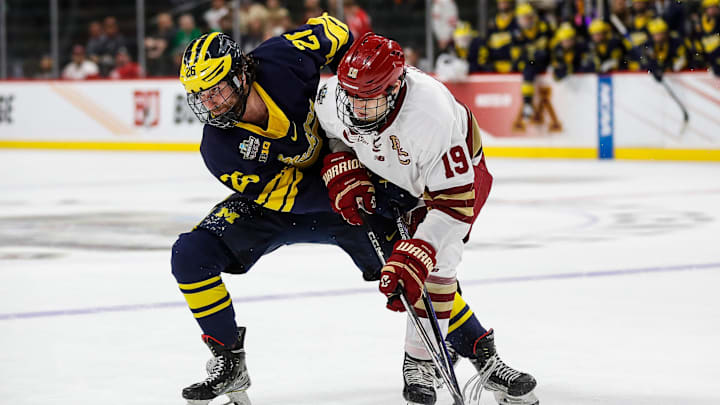
College hockey's overtime rules surprisingly can vary by conference, but once the NCAA men's ice hockey tournament (which culminates in the Frozen Four) begins, things change and the entire tournament uses one, standardized rule set.
That being said, fans of the NHL will likely be very familiar with the rules.
The final four teams are set as Western Michigan, Penn State, Denver and Boston University have all advanced to the semifinals, which will take place on April 10 in St. Louis at the Enterprise Center.
The Nittany Lions are here for the first time in program history, needing overtime to dispatch of the UConn Huskies.
That game ended with 2:04 left in overtime, when Penn State punched in a goal to win the game 3–2. But depending on your preferred collegiate hockey conference, those overtime rules may have seemed a bit different.
How Do Frozen Four Overtime Rules Work?
With conferences allowed to set up their own rules for overtime in the regular season, there are a number of different situations a team may find itself in at the end of regulation.
In some conferences, games may end in a tie. In others, games go straight to a shootout. Some conferences use a modified 3-on-3 overtime period. (A new NCAA rule mandates the use of a shootout if an overtime period ends with the score tied.)
But in the Frozen Four, things look very similar to NHL overtime rules.
According to the official NCAA hockey rulebook:
- If a game is tied after regulation, then teams will play another full 20-minute period of overtime at 5-on-5
- The overtime period is sudden-death style, meaning the first team to score wins the game
- If no team has scored in the first overtime period, the game will continue into a second overtime, and then a third, and so on until a team scores to win
As mentioned, these rules are extremely similar to those used in the Stanley Cup Playoffs in the NHL, so hockey fans are pretty familiar with them. It certainly provides some high-stakes, high-intensity moments.
The last national championship contest to need overtime was in 2023. Quinnipiac's Jacob Quillian needed just 10 seconds of overtime to sneak a goal by Minnesota goalie Justen Close. The win gave Quinnipiac the first title in program history.
Recent Frozen Four Champions
Program | Year |
|---|---|
Denver | 2024 |
Quinnipiac | 2023 |
Denver | 2022 |
UMass | 2021 |
No Frozen Four | 2020 |
Minnesota Duluth | 2019 |
Minnesota Duluth | 2018 |
Denver | 2017 |
North Dakota | 2016 |
Providence | 2015 |
More on Sports Illustrated
 Add us as a preferred source on Google
Nathan Cunningham is a writer for Sports Illustrated and Minute Media. Throughout his career, he has written about collegiate sports, NFL Draft, Super Bowl champions, and more. Nathan has also been featured in FanSided and 90Min. Nathan loves colorful uniforms, mascots and fast-break pull-up 3-pointers. He graduated from BYU in 2016 with a degree in journalism.