%20%20--%3E%0A%3Csvg%20version%3D%221.1%22%20id%3D%22Layer_1%22%20xmlns%3D%22http%3A%2F%2Fwww.w3.org%2F2000%2Fsvg%22%20xmlns%3Axlink%3D%22http%3A%2F%2Fwww.w3.org%2F1999%2Fxlink%22%20x%3D%220px%22%20y%3D%220px%22%0A%09%20width%3D%2239px%22%20height%3D%2240px%22%20viewBox%3D%220%200%2039%2040%22%20enable-background%3D%22new%200%200%2039%2040%22%20xml%3Aspace%3D%22preserve%22%3E%0A%3Cpath%20fill%3D%22%23FFFFFF%22%20d%3D%22M38.5%2C7H28.2v26h10.3V7z%22%2F%3E%0A%3Cpath%20fill-rule%3D%22evenodd%22%20clip-rule%3D%22evenodd%22%20fill%3D%22%23FFFFFF%22%20d%3D%22M26.1%2C25.5c0%2C5.8-4.1%2C7.5-12.9%2C7.5C3.9%2C33%2C0%2C31.2%2C0%2C25.2v-1.1h11.6%0A%09v2.4c0%2C0.7%2C0.1%2C1.4%2C1.2%2C1.4c1%2C0%2C1.2-0.4%2C1.2-1.3v-0.9c0-1.6-0.9-1.6-3.5-2.2C2.2%2C21.7%2C0%2C19.7%2C0%2C15.3v-0.9C0%2C9.3%2C5.5%2C7%2C12.9%2C7%0A%09c10.2%2C0%2C12.8%2C2.6%2C12.8%2C7.4v1.8h-11v-2.9c0-0.6-0.4-1.1-1.2-1.1c-0.6%2C0-1.2%2C0.4-1.2%2C1.1v0.9c0%2C1.5%2C0.9%2C2%2C3.3%2C2.5%0A%09c8%2C1.6%2C10.5%2C3.3%2C10.5%2C7.5V25.5z%22%2F%3E%0A%3C%2Fsvg%3E%0A)
Memories From the Ryder Cup We’ll Never Forget
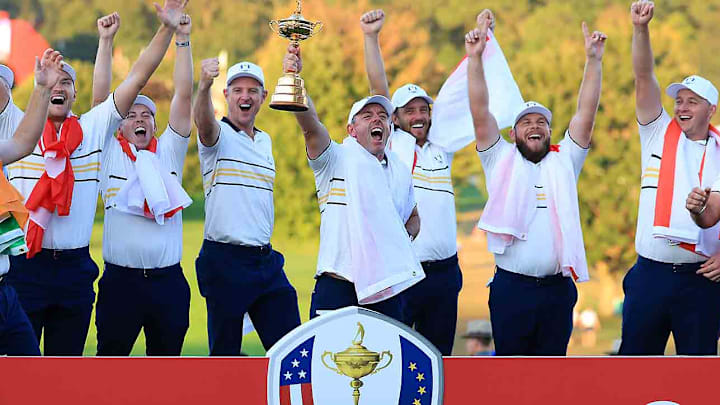
FARMINGDALE, N.Y. — The 45th Ryder Cup is in the books. The aftermath will live in history, and our team on the ground was there to witness it all unfold, from Europe's dominance in the team sessions to the spirited U.S. rally on Sunday that fell just short.
We asked each member of our team to share a brief story that they’ll remember for the week, and it’s telling that three out of four are tales from the opening morning. There really is no scene in golf quite like it (there’s also no earlier wake-up call). Those moments, when the Ryder Cup is about to begin and anything seems possible, tend to endure. Below are their stories.
Fans Arrived Early
It was 6:30 a.m. on Friday and the sun was barely peaking through the crowds when already fans began to fill the grandstand—at the 17th tee.
It would be some five hours before any golf would take place in front of those sitting there, but a giant broadcast of the Ryder Cup could be viewed beyond the green and the first hole was adjacent to the tee, allowing for a glimpse of what was happening as the event was to begin.
Thousands had streamed in before dawn just to be there to see a total eight players hit a tee shot over the span of an hour. It’s an amazing scene and just the start of what would last for another 12 hours. —Bob Harig
The First Tee Shots
Unlike my colleagues, I had never been to a Ryder Cup. So getting up at 4 a.m. on Day 1 to ensure a spot at the first tee was a rite of passage.
There were a few too many VIP spots in the grandstands that never filled, but the general admission area overflowed with humans and the energy belied the time of day. Impressive. There were two deafening roars when Bryson DeChambeau smashed the opening tee shot near the green and minutes later holed a birdie putt, putting the U.S. 1 up in the first match and ... well, as an American let’s pretend the Ryder Cup ended right there. —John Schwarb
In Defense of the Envelope Rule
The pre-Ryder Cup talk of Keegan Bradley being a playing captain only reinforced how absurd the notion really is. Those days are long gone. But it was fitting, in a way, because a Ryder Cup that began with an antiquated idea ended with what might be another: The final scheduled singles match, between Europe’s Viktor Hovland and Harris English of the U.S., was halved before it started because Hovland was injured.
“The rule has to change,” Bradley said. “I think it's obvious to everybody in the sports world, in this room. Nothing against Viktor. But that rule needs to change by the next Ryder Cup.”
Does it, though? This might seem ridiculous, sappy, or both, but I like the weird relics of an age when we did not take sports so seriously. Nobody thinks ties are an acceptable outcome anymore, yet Ryder Cup matches frequently end in ties, and Europe’s celebration began Sunday when Shane Lowry clinched a tie, ensuring that the 2023 winners would retain the Cup. That rule is a lovely and logical quirk.
You can make a strong argument that if a player is injured, he forfeits his match. It happens in tennis all the time. The current rule gives teams an opening to fake injuries when they have a lead and don’t like a particular matchup. But since that never actually happens (the Americans accept that Hovland is really hurt), I think I like the rule. It is built on an implicit assumption of fair play. We don’t need to solve every potential problem in sports down to the 73rd place after the decimal point just in case it comes up someday. —Michael Rosenberg
A Different Perspective on Day 1
Dance music was pumping through speakers around the massive first-hole grandstands Friday morning. The sun was just breaking through. At the top of the bleachers, I stood among a throng of my media brethren in a section the PGA had reserved for the press. But I felt antsy. It was a long way down to the action, and I wanted to see and feel the opening holes. So before any players arrived at the tee, I bounded back down the metal stairs and waded into the fans en route to the first green, for a view of what I thought might be an opening eagle putt. But that ropeline was stuffed with fans, so instead I moseyed up to the tee on hole No. 2, shot the breeze with the marshals, and watched the opening to the 45th Ryder Cup unfold on the jumbotrons. The roars and intensity and chaos would soon come straight to me, and I'd stroll along within that swirl for the rest of the morning.
Bryson DeChambeau smoked his tee shot to the front of the green, Justin Thomas chipped up and Bryson drilled the birdie putt. Bethpage was rocking. DeChambeau came storming up the path, strutting and high-fiving fans. The U.S. was 1 up, right on schedule. What could possibly go wrong? —Jeff Ritter
When you’re already 1 up pic.twitter.com/812IZsz9L4
— Jeff Ritter (@Jeff_Ritter) September 26, 2025
More Golf Coverage on Sports Illustrated
 Add us as a preferred source on Google
Jeff Ritter was the managing director of SI Golf. He has more than 20 years of sports media experience, and previously was the general manager at the Morning Read, where he led that business’s growth and joined SI as part of an acquisition in 2022. Earlier in his career he spent more than a decade at SI and Golf Magazine, and his journalism awards include a MIN Magazine Award and an Edward R. Murrow Award for sports reporting. He received a bachelor’s degree from the University of Michigan and a master’s from Northwestern University’s Medill School of Journalism.
Follow Jeff_Ritter
Bob Harig was a senior writer covering golf for Sports Illustrated. He has more than 25 years experience on the beat, including 15 at ESPN. Harig is a regular guest on Sirius XM PGA Tour Radio and has written two books, “DRIVE: The Lasting Legacy of Tiger Woods” and “Tiger and Phil: Golf’s Most Fascinating Rivalry.” He graduated from Indiana University where he earned an Evans Scholarship, named in honor of the great amateur golfer Charles (Chick) Evans Jr. Harig, a former president of the Golf Writers Association of America, lives in Clearwater, Fla.
Follow bobharig
John Schwarb was a senior editor for Sports Illustrated covering golf. Prior to joining SI in March 2022, he worked for ESPN.com, PGATour.com, Tampa Bay Times and Indianapolis Motor Speedway. He is the author of The Little 500: The Story of the World’s Greatest College Weekend. A member of the Golf Writers Association of America, Schwarb has a bachelor’s in journalism from Indiana University.
Follow johnschwarb
Michael Rosenberg is a senior writer for Sports Illustrated, covering any and all sports. He writes columns, profiles and investigative stories and has covered almost every major sporting event. He joined SI in 2012 after working at the Detroit Free Press for 13 years, eight of them as a columnist. Rosenberg is the author of "War As They Knew It: Woody Hayes, Bo Schembechler and America in a Time of Unrest." Several of his stories also have been published in collections of the year's best sportswriting. He is married with three children.