%20%20--%3E%0A%3Csvg%20version%3D%221.1%22%20id%3D%22Layer_1%22%20xmlns%3D%22http%3A%2F%2Fwww.w3.org%2F2000%2Fsvg%22%20xmlns%3Axlink%3D%22http%3A%2F%2Fwww.w3.org%2F1999%2Fxlink%22%20x%3D%220px%22%20y%3D%220px%22%0A%09%20width%3D%2239px%22%20height%3D%2240px%22%20viewBox%3D%220%200%2039%2040%22%20enable-background%3D%22new%200%200%2039%2040%22%20xml%3Aspace%3D%22preserve%22%3E%0A%3Cpath%20fill%3D%22%23FFFFFF%22%20d%3D%22M38.5%2C7H28.2v26h10.3V7z%22%2F%3E%0A%3Cpath%20fill-rule%3D%22evenodd%22%20clip-rule%3D%22evenodd%22%20fill%3D%22%23FFFFFF%22%20d%3D%22M26.1%2C25.5c0%2C5.8-4.1%2C7.5-12.9%2C7.5C3.9%2C33%2C0%2C31.2%2C0%2C25.2v-1.1h11.6%0A%09v2.4c0%2C0.7%2C0.1%2C1.4%2C1.2%2C1.4c1%2C0%2C1.2-0.4%2C1.2-1.3v-0.9c0-1.6-0.9-1.6-3.5-2.2C2.2%2C21.7%2C0%2C19.7%2C0%2C15.3v-0.9C0%2C9.3%2C5.5%2C7%2C12.9%2C7%0A%09c10.2%2C0%2C12.8%2C2.6%2C12.8%2C7.4v1.8h-11v-2.9c0-0.6-0.4-1.1-1.2-1.1c-0.6%2C0-1.2%2C0.4-1.2%2C1.1v0.9c0%2C1.5%2C0.9%2C2%2C3.3%2C2.5%0A%09c8%2C1.6%2C10.5%2C3.3%2C10.5%2C7.5V25.5z%22%2F%3E%0A%3C%2Fsvg%3E%0A)
Fact or Fiction: Oakmont Is the Best U.S. Open Course
Welcome back to SI Golf’s Fact or Fiction, where we wish our own grass could grow like U.S. Open rough—with a small army of staff to maintain it.
Once again, we’re here to debate a series of statements for writers and editors to declare as “Fact” or “Fiction” along with a brief explanation. Responses may also (occasionally) be “Neutral” since there's a lot of gray area in golf.
Do you agree or disagree? Let us know on the SI Golf X account.
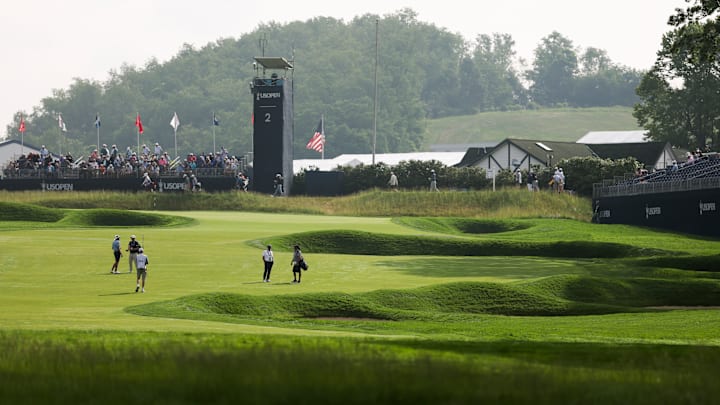
Oakmont Country Club is hosting the U.S. Open for a record 10th time this week. This is the best spot for our national championship.
Bob Harig: FICTION. It’s a great place, no doubt. And will return often as an anchor site. But Pebble Beach is the best place. It’s our St. Andrews. And could easily host the championship more frequently.
John Pluym: FICTION. I love Pebble Beach. The views are incredible. I’ll never forget Tom Watson’s chip-in on 17 to take the lead and deny Jack Nicklaus his fifth U.S. Open title. No doubt, Oakmont is a great stage and a massive test for the players. And the church pews bunker on No. 3 is iconic. It just doesn’t beat Pebble Beach.
Jeff Ritter: FACT. Pebble may look a little better on TV, but we see it every year for the Pro-Am. Oakmont is the best stage for this particular championship and a U.S. Open here just feels bigger, badder and tougher. Just how it’s supposed to be.
John Schwarb: FACT. Like Jeff said, Pebble Beach is too familiar. Oakmont comes into our consciousness once every 10 years or so and instantly reminds us what big-time championship golf is. And it’s no coincidence that all but one Oakmont U.S. Open winner has won multiple majors.
Scottie Scheffler has one major this season (PGA Championship) and two more wins, including the Memorial Tournament. Rory McIlroy has one major this season (Masters) and two more wins, including the Players Championship. If the season ended today, McIlroy is the PGA Tour Player of the Year.
Bob Harig: FACT. But barely. Both have a major. Both have a signature event. But McIlroy also has the Players, which is the next best thing to a major. That breaks the tie although there are a lot of other factors that can still come into play.
John Pluym: FICTION. Scheffler has been dominant in three of the past four tournaments. He’s the best player in the world, and it’s not debatable. Yes, Rory completed the Grand Slam. But his game seems to be in the toilet since winning the Masters. And let’s not forget: He barely hung on to win at Augusta.
Jeff Ritter: FACT. That Players win in particular tips the scales slightly to McIlroy. But by Sunday we may need to re-litigate this question.
John Schwarb: FICTION. When two players have such similar top-line feats, you have to look deeper and McIlroy’s poor PGA and failing to make the weekend in Canada hurt him if we’re handing out trophies today. Whereas Scheffler has reestablished his aura with three wins in his last four starts.
Last week McIlroy explained his silence at the PGA Championship and noted it was within his rights as post-round interviews are not mandatory in pro golf. The leagues and majors should make it mandatory.
Bob Harig: FICTION. It’s great in theory, not so great in practice. While the players should understand there is an obligation, making them do it can lead to bitterness. They might not give great answers, they might pull a Marshawn Lynch. It’s better for them to understand they should do it rather than making them do it.
John Pluym: FACT. It should be mandatory to speak after the final round. Imagine if Jack Nicklaus didn’t speak after finishing as a runner-up 19 times in majors? Losing is tough. Still, the fans want to hear from the players after their round, win or lose.
Jeff Ritter: FACT. They don’t need to make it mandatory every round, of course. But maybe the top 10 players in each field are required to speak once post-round? It feels like the road is leading us there at this point.
John Schwarb: FICTION. Like Bob said, you hope players realize it’s an obligation and that media are the pipeline to the fans. But I’d never want it to become a mundane exercise and let’s be honest—when players don’t talk, that’s often content for us too. But players should know that it’s always better to speak.
Phil Mickelson is playing in this week’s U.S. Open off the last year of eligibility from his 2021 PGA win at Kiawah. If he doesn’t play his way into next year’s U.S. Open, when he’s 55, the USGA should grant him one final special exemption.
Bob Harig: FACT. But only if he shows form. Mickelson would help himself if he makes the cut here and performs well at the British Open next month. Even his LIV performances could help. It’s unlikely he will get one, as he technically already did in 2021. But it’s worth considering.
John Pluym: FICTION. Mickelson left for LIV. He made his choice. Despite his push to unify both tours, I have a hard time giving him the benefit of the doubt, and I would not favor him receiving a special exemption.
Jeff Ritter: FACT. The USGA dishes out exemptions for special cases, and even though these days he’s more likely to appear on a milk carton than a leaderboard, Phil’s career record and history at this event is worth a little farewell tour. And yes, I’m assuming next year would indeed be his last.
John Schwarb: FACT. Next year’s U.S. Open is at Shinnecock Hills, where Phil had one of his agonizing runner-ups and one of his least dignified moments. I hope Phil can keep playing his way in but in lieu of that, this would be a delicious spot for one final invite.
The RBC Canadian Open’s sudden-death playoff Sunday lasted four holes—all being the par-5 18th—and the hole location was changed after the first two tries so the players could continue there but with a different look. That’s the best way to handle sudden-death playoffs for regular Tour events.
Bob Harig: FICTION. Just use another hole. It’s so simple. I realize there are TV and spectator concerns. But they aren’t breaking down the broadcast booth in the first moments after 72 holes are complete and certainly there is time for fans to scramble out to another hole. It’s a far better alternative.
John Pluym: FICTION. The best option is for the players to play four different holes. It could be the final four holes. Sudden-death playoffs should create drama, not boredom. Watching the players play the same hole four consecutive times was like watching paint dry.
Jeff Ritter: FICTION. The best option for TV viewers would be sudden death on the best holes the course has to offer. For on-site logistics, I understand why replaying an 18th hole is ultimately how it works. But once we’ve played it three times I’d almost rather watch this than see a fourth attempt.
John Schwarb: FICTION. This was a novel twist but half-baked—why not move the tee as well as the hole location? On the broadcast it was suggested that the players wouldn’t have been prepared for that so it couldn’t happen, but a sudden-death playoff is gimmicky already. Let’s watch players think through an entirely different hole under pressure if we’re going this route—which we shouldn’t anyway, with apologies to the 18th-hole suite owners.
 Add us as a preferred source on Google
John Schwarb was a senior editor for Sports Illustrated covering golf. Prior to joining SI in March 2022, he worked for ESPN.com, PGATour.com, Tampa Bay Times and Indianapolis Motor Speedway. He is the author of The Little 500: The Story of the World’s Greatest College Weekend. A member of the Golf Writers Association of America, Schwarb has a bachelor’s in journalism from Indiana University.
Follow johnschwarb
Bob Harig was a senior writer covering golf for Sports Illustrated. He has more than 25 years experience on the beat, including 15 at ESPN. Harig is a regular guest on Sirius XM PGA Tour Radio and has written two books, “DRIVE: The Lasting Legacy of Tiger Woods” and “Tiger and Phil: Golf’s Most Fascinating Rivalry.” He graduated from Indiana University where he earned an Evans Scholarship, named in honor of the great amateur golfer Charles (Chick) Evans Jr. Harig, a former president of the Golf Writers Association of America, lives in Clearwater, Fla.
Follow bobharig
Jeff Ritter was the managing director of SI Golf. He has more than 20 years of sports media experience, and previously was the general manager at the Morning Read, where he led that business’s growth and joined SI as part of an acquisition in 2022. Earlier in his career he spent more than a decade at SI and Golf Magazine, and his journalism awards include a MIN Magazine Award and an Edward R. Murrow Award for sports reporting. He received a bachelor’s degree from the University of Michigan and a master’s from Northwestern University’s Medill School of Journalism.
Follow Jeff_Ritter
John Pluym is the managing editor for NFL and golf content at Sports Illustrated. A sports history buff, he joined SI in April 2022 after having spent 10 years at ESPN overseeing NFL coverage. Pluym has won several awards throughout his career, including honors from the Society of News Design and Associated Press Sports Editors. As a native Minnesotan, he enjoys spending time on his boat and playing golf.
Follow vjohn427