%20%20--%3E%0A%3Csvg%20version%3D%221.1%22%20id%3D%22Layer_1%22%20xmlns%3D%22http%3A%2F%2Fwww.w3.org%2F2000%2Fsvg%22%20xmlns%3Axlink%3D%22http%3A%2F%2Fwww.w3.org%2F1999%2Fxlink%22%20x%3D%220px%22%20y%3D%220px%22%0A%09%20width%3D%2239px%22%20height%3D%2240px%22%20viewBox%3D%220%200%2039%2040%22%20enable-background%3D%22new%200%200%2039%2040%22%20xml%3Aspace%3D%22preserve%22%3E%0A%3Cpath%20fill%3D%22%23FFFFFF%22%20d%3D%22M38.5%2C7H28.2v26h10.3V7z%22%2F%3E%0A%3Cpath%20fill-rule%3D%22evenodd%22%20clip-rule%3D%22evenodd%22%20fill%3D%22%23FFFFFF%22%20d%3D%22M26.1%2C25.5c0%2C5.8-4.1%2C7.5-12.9%2C7.5C3.9%2C33%2C0%2C31.2%2C0%2C25.2v-1.1h11.6%0A%09v2.4c0%2C0.7%2C0.1%2C1.4%2C1.2%2C1.4c1%2C0%2C1.2-0.4%2C1.2-1.3v-0.9c0-1.6-0.9-1.6-3.5-2.2C2.2%2C21.7%2C0%2C19.7%2C0%2C15.3v-0.9C0%2C9.3%2C5.5%2C7%2C12.9%2C7%0A%09c10.2%2C0%2C12.8%2C2.6%2C12.8%2C7.4v1.8h-11v-2.9c0-0.6-0.4-1.1-1.2-1.1c-0.6%2C0-1.2%2C0.4-1.2%2C1.1v0.9c0%2C1.5%2C0.9%2C2%2C3.3%2C2.5%0A%09c8%2C1.6%2C10.5%2C3.3%2C10.5%2C7.5V25.5z%22%2F%3E%0A%3C%2Fsvg%3E%0A)
A Super Bowl-inspired look at potential neutral-site World Series locations

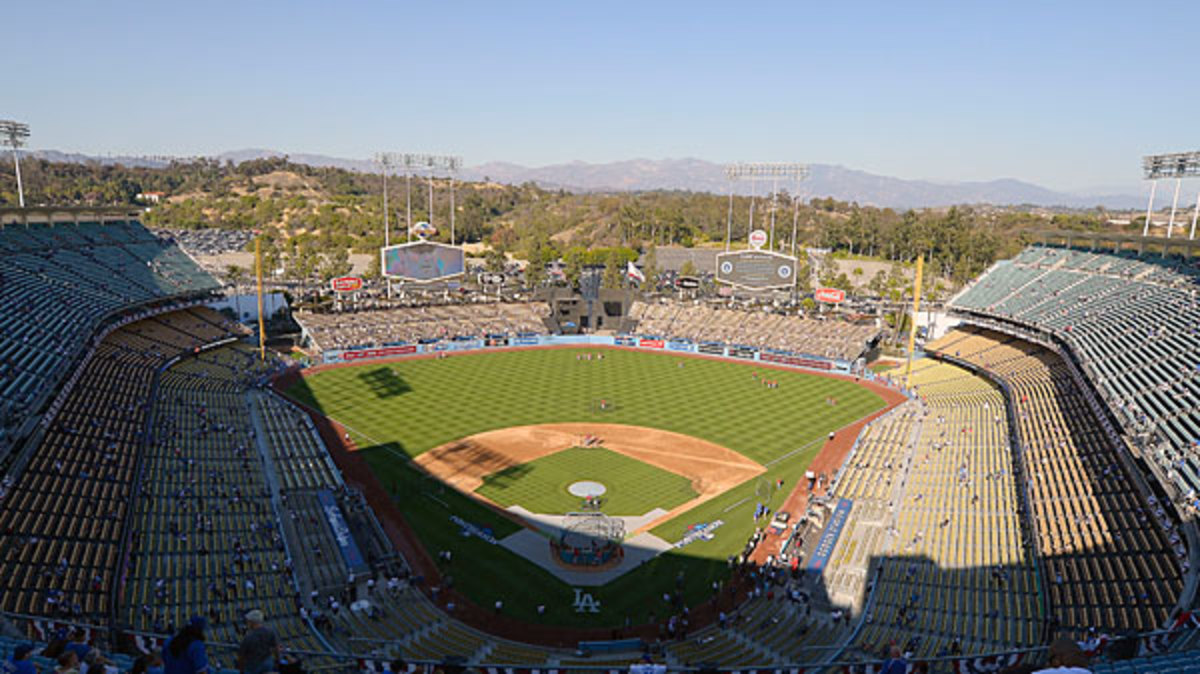
Dodger Stadium has not had a World Series game since 1988, but it would be a perfect fit as a neutral-site host. (Mark J. Terrill/AP)
On Tuesday, Tom Verducci offered up 10 ideas he termed "conversation starters" about how to change baseball in ways both large and small. Among them was the notion of playing the first two games of the World Series at a neutral site. With the Super Bowl, America's most celebrated neutral-site championship, about to be played on Sunday in New Jersey between teams from Denver and Seattle, that got us thinking about where the best places for a neutral site World Series might be.
VERDUCCI: Baseball's State of the Union: Some ways to improve the game
More than half of the Super Bowls, 27 of 48 thus far, have been played in just three cities, Miami (10), New Orleans (10), and Los Angeles (7, five at the Rose Bowl in Pasadena and two in the L.A. Coliseum). Using that as a guide, we only need a handful of host cities for potential neutral-site World Series games.
The primary consideration for a neutral site World Series would be the weather. Though six teams play in retractable domes, and the Rays play in a permanent one, if you're going to have a neutral location World Series game, you're going to want to have it somewhere that the game can be played (and watched) comfortably outdoors. Here, then, is a list of the mean and average low temperatures on Oct. 23 (the date of Game 1 of last year's World Series) for every major league city in the Unites States listed from warmest to coldest (all temperatures in Fahrenheit, source: weather.com):
City | Mean | Avg Low |
|---|---|---|
Miami | 78 | 74 |
Tampa | 75 | 66 |
Phoenix | 74 | 62 |
Houston | 70 | 61 |
Anaheim | 69 | 57 |
Los Angeles | 68 | 57 |
San Diego | 66 | 59 |
Arlington | 65 | 55 |
Oakland | 62 | 54 |
San Francisco | 61 | 53 |
Atlanta | 61 | 52 |
Baltimore | 58 | 49 |
Washington | 58 | 49 |
St. Louis | 57 | 47 |
Kansas City | 56 | 47 |
Philadelphia | 54 | 44 |
Cincinnati | 54 | 44 |
Seattle | 52 | 45 |
New York | 52 | 44 |
Boston | 52 | 44 |
Chicago | 52 | 44 |
Cleveland | 52 | 43 |
Detroit | 50 | 41 |
Milwaukee | 50 | 40 |
Pittsburgh | 50 | 39 |
Denver | 47 | 31 |
Minneapolis | 46 | 37 |
You didn't need that chart to know that Minneapolis, Milwaukee, Detroit, Chicago and Boston weren't going to make the cut. It's an unfortunate reminder that the game's two oldest and most beloved ballparks, Boston's Fenway Park and Chicago's Wrigley Field, the latter of which celebrates its 100th birthday this year, would not be favored for a neutral-site World Series (which, in my opinion, is reason enough to abandon an already-questionable idea).
What that chart does is give us 11 cities in which the average Oct. 23 temperature is above 60 degrees. From those, we can quickly eliminate Tampa, which will soon be the only artificial surface field remaining in the major leagues as well as the only permanent dome. It's also fairly easy to drop Miami from the list, as baseball would be better off without both Marlins owner Jeffrey Loria and giving his lime-green eyesore of a ballpark center stage at the World Series.
Two more difficult cuts come in the Bay Area, where Oakland's Insert-Sponsor-Here Coliseum gets the bump due to its recent sewage issues and Mount Davis. That doesn't feel like a big loss until you realize that, among active parks, only Fenway Park (9) and Dodger Stadium (8) have hosted more World Series than the Coliseum (6). San Francisco's AT&T Park, meanwhile, gets the cut simply because it would be unfair to eliminate the A's home park and not the home park of the team that has been instrumental in preventing them from moving to a new, baseball-only stadium. It hurts to lose splash-down home runs and triples alley, but San Francisco is also closest to that 60-degree cuttoff, along with Atlanta, making it an easier decision.
If we eliminate Atlanta as well, we get six cities that have an average Oct. 23 temperature of 65 degrees or higher: the three southern California stadiums, the two Texas stadiums and Phoenix's Chase Field. All are excellent choices and could host the vast majority of the neutral-site World Series games. Dodger Stadium, obviously, has the most historic appeal, having hosted eight previous Fall Classics dating back to 1963. San Diego's Petco Park would be the novelty venue given that it is the only of the six that has never hosted a World Series (the Padres' two pennants came while they were playing at Jack Murphy-cum-Qualcomm Stadium).

Cliff Corcoran is a contributing writer for SI.com. He has also edited or contributed chapters to 13 books about baseball, including seven Baseball Prospectus annuals.