%20%20--%3E%0A%3Csvg%20version%3D%221.1%22%20id%3D%22Layer_1%22%20xmlns%3D%22http%3A%2F%2Fwww.w3.org%2F2000%2Fsvg%22%20xmlns%3Axlink%3D%22http%3A%2F%2Fwww.w3.org%2F1999%2Fxlink%22%20x%3D%220px%22%20y%3D%220px%22%0A%09%20width%3D%2239px%22%20height%3D%2240px%22%20viewBox%3D%220%200%2039%2040%22%20enable-background%3D%22new%200%200%2039%2040%22%20xml%3Aspace%3D%22preserve%22%3E%0A%3Cpath%20fill%3D%22%23FFFFFF%22%20d%3D%22M38.5%2C7H28.2v26h10.3V7z%22%2F%3E%0A%3Cpath%20fill-rule%3D%22evenodd%22%20clip-rule%3D%22evenodd%22%20fill%3D%22%23FFFFFF%22%20d%3D%22M26.1%2C25.5c0%2C5.8-4.1%2C7.5-12.9%2C7.5C3.9%2C33%2C0%2C31.2%2C0%2C25.2v-1.1h11.6%0A%09v2.4c0%2C0.7%2C0.1%2C1.4%2C1.2%2C1.4c1%2C0%2C1.2-0.4%2C1.2-1.3v-0.9c0-1.6-0.9-1.6-3.5-2.2C2.2%2C21.7%2C0%2C19.7%2C0%2C15.3v-0.9C0%2C9.3%2C5.5%2C7%2C12.9%2C7%0A%09c10.2%2C0%2C12.8%2C2.6%2C12.8%2C7.4v1.8h-11v-2.9c0-0.6-0.4-1.1-1.2-1.1c-0.6%2C0-1.2%2C0.4-1.2%2C1.1v0.9c0%2C1.5%2C0.9%2C2%2C3.3%2C2.5%0A%09c8%2C1.6%2C10.5%2C3.3%2C10.5%2C7.5V25.5z%22%2F%3E%0A%3C%2Fsvg%3E%0A)
‘Bull Durham: The Musical’ Continues Baseball’s Role of History Preserver
The World Series opens Friday with an updated version of The Natural in play, the role of Roy Hobbs, the mysterious slugger-pitcher from somewhere in Middle America, being reprised by a muscular manchild from Japan. The mythic contours of the game—baseball as our spiritual sports obsession—have rarely been more in evidence than in the chimerical (one could almost say comical) versatility of the Los Angeles Dodgers’ Shohei Ohtani, who is scheduled to get at least one pitching start against the Toronto Blue Jays and expected to blast at least one seamed orb out of the confines of either Dodger Stadium or the Rogers Centre.
The Natural, from 1984, was just one of five baseball films—all successful and well-executed in their own ways—that emerged from the diamond-deep decade of the 1980s. Its mythic cousin is Field of Dreams (1989), whose rewatches still have grown men weeping at the sight of long-dead ballplayers emerging from cornfields looking for a game of catch. Eight Men Out (1988) and Major League (1989) were somewhat polar opposites, the former a John Sayles-directed account (fairly accurate) of the World Series scandal of 1919, the latter a raucous comedy with a cover of the Troggs’ “Wild Thing” as its musical heartbeat and the voice of the immortal Bob Uecker intoning “Just a bit outside” after a pitch from Charlie Sheen’s character threatened to leave the zip code.
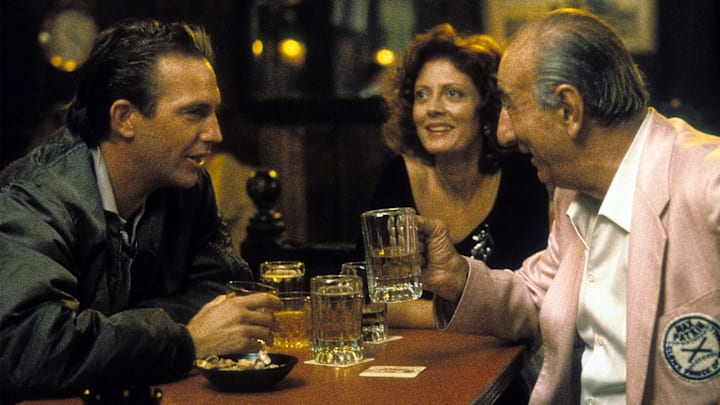
But Bull Durham, from 1988, was the best of the lot, smartly touching all the bases of the others—myth, low locker-room humor, superstition, baseball lore—and covering them with a layer of grit thanks to writer-director Ron Shelton, who lived the minor league life for five years, and, as a middle infielder for the Class A Stockton Ports, co-led the California League with 29 doubles in 1969. You can look it up.
And now Durham has resurfaced as both a musical and a meta enterprise, trying to make it to The Show, in this case Broadway, just as Shelton’s protagonists were doing back in Durham, North Carolina, where the batting-practice balls are snow-white.. Bull Durham: The Musical is in a one-month run at the Paper Mill Playhouse in Milburn, N.J., a stop-off for shows that sometimes make it to the Great White Way. (The final performance is Nov. 2, a day after a scheduled Game 7 of the World Series.) The 80-year-old Shelton could be resting comfortably on the laurels (and royalties) of the movie version, as well as White Men Can’t Jump (1992) and Tin Cup (1996), among other films and shows he either wrote, directed or did both. But Shelton is no lollygagger. You can’t take the minor league ethos out of the man, the eternal battle to strive and succeed, to get to The Show, just as his fictional creations, Crash Davis and Eby Calvin “Nuke” LaLoosh, were doing in the movie version of Durham.
”I never dreamed that 37 years after the movie, I’d be working on something related to Bull Durham,” Shelton said by Zoom from an apartment near Los Angeles. (He and his wife, the actress Lolita Davidovich, lost their home in the Palisades Fire in January.) “But it’s an honor. There is something, of course, in the idea that baseball is at the heart of America, this collective Church of Baseball, [the title of both a song from the musical and a book Shelton wrote about getting Bull Durham to the screen] something that makes it timeless, mythic.”
Shelton has a perfect double-play partner in the person of Susan Werner, a multi-talented singer-songwriter (and guitar player and pianist) who wrote the music and lyrics. Werner’s fervid cult following does not come from baseball, but the producers reached out to her because she weaves a story with virtually every song she writes going back to her small-venue roots in the early 1990s. She is perfect for Durham in that she’s a major league talent, who, in terms of general name recognition, still plays in the minors.
Plus, she has kind of A League of Their Own background. Growing up on a farm in Iowa, “I was the girl throwing the tennis ball against the base of the barn,” says Werner. “I played softball with my cousins in the cornfield. It was about as wholesome as you could get, and when this opportunity came along it just felt to me like big, sloppy, honest American fun. It felt familiar.”
From time to time Werner would reach out to Shelton for a brief outline she needed to complete a song. “I would ask Ron, ‘Hey, what would Nuke say in this situation,’ and I’d get back an email with language so specific that it was easy to transform it into lyrics,” says Werner. But much of the baseball namechecking came from her own knowledge of the game. “And by the end of the first week he’s giving in,” sings Annie Savoy, the Susan Sarandon character played charmingly in the musical by theater veteran Carmen (no relation to John) Cusack, “and by the end of September he’s Tony Gwynn.”
Several tweaks and updates keep the material fresh, such as Annie now embracing analytics and Bill James, along with Emily Dickinson, William Blake and in-season coitus. Still, making it to Broadway will be no base on balls in the park. The success of the movie (Durham made about $50 million on a budget of about $9 million) will help, of course, as will some of its still-familiar touchstones. (Alas, the bathtub scene between Annie and Crash is gone.) And if it won’t be an easy ride, well, Shelton is accustomed to bumpy ones, aside from those he took on buses as a minor league infielder trying to get promoted in an organization with players like Brooks Robinson, Davey Johnson, Mark Belanger and Bobby Grich in front of him. If there’s a villain in Durham it’s The Organization, which strangles the dreams of players like Crash while wringing everything it can get out of them, but Shelton has mostly fond memories of the Orioles of the late 1960s. (“The best organization in baseball,” he says.) It took years off his life to get Durham made and it never would’ve reached the screen, says Shelton, had Kevin Costner not been a smash in No Way Out, which convinced Orion Studios that Costner, as Crash, could carry a movie. That’s Hollywood: A film about a Russian spy and a D.C. murder greenlights a film about minor league baseball.
The best thing that Durham has going for it is a certain timeless quality. If it ever leans toward sentimentality, there is Crash to say “Shut up” when the batboy tells him to get a hit. And if it ever gets too cynical, there is coach Larry Hockett visiting the mound to remind everyone that “Candlesticks always make a nice gift,” a moment preserved, needless to say, in the musical.
Back in the real world, the 2025 World Series may well be defined by the Ruthian presence of Ohtani, who need only tear the cover off a ball to reach the mythical status of Roy Hobbs. But we can also expect those other moments that tie us to the past. Photos and videos of 3-year-old Vladimir Guerrero Jr., now the Blue Jays starting first baseman, for example, playing ball with his Hall of Fame father. Or comparisons of Toronto’s DH/outfielder George Springer’s hitting heroics to those of Joe Carter Jr., who 32 Octobers past sent a pitch from Philadelphia’s Mitch “Wild Thing” Williams into the left field bleachers, a three-run walkoff dinger that gave the Blue Jays their second straight World Series title.
They haven’t been back since and now they’re here, staring into the smiling face and terrifying batting stance and pitching arm of Ohtani. We like the idea of baseball as a continuum, a preserver of our history, and here’s hoping that Bull Durham, with its pitch-perfect sense of the sublime and the ridiculous, can make it to The Show.
More MLB on Sports Illustrated
 Add us as a preferred source on Google
Special Contributor, Sports Illustrated As a member of the Basketball Hall of Fame, it seems obvious what Jack McCallum would choose as his favorite sport to cover. "You would think it would be pro basketball," says McCallum, a Sports Illustrated special contributor, "but it would be anything where I'm the only reporter there because all the stuff you gather is your own." For three decades McCallum's rollicking prose has entertained SI readers. He joined Sports Illustrated in 1981 and famously chronicled the Celtics-Lakers battles of 1980s. McCallum returned to the NBA beat for the 2001-02 season, having covered the league for eight years in the Bird-Magic heydays. He has edited the weekly Scorecard section of the magazine, written frequently for the Swimsuit Issue and commemorative division and is currently a contributor to SI.com. McCallum cited a series of pieces about a 1989 summer vacation he took with his family as his most memorable SI assignment. "A paid summer va-kay? Of course it's my favorite," says McCallum. In 2008, McCallum profiled Special Olympics founder Eunice Shriver, winner of SI's first Sportsman of the Year Legacy Award. McCallum has written 10 books, including Dream Team, which spent six seeks on the New York Times best-seller list in 2012, and his 2007 novel, Foul Lines, about pro basketball (with SI colleague Jon Wertheim). His book about his experience with cancer, The Prostate Monologues, came out in September 2013, and his 2007 book, Seven Seconds or Less: My Season on the Bench with the Runnin' and Gunnin' Phoenix Suns, was a best-selling behind-the-scenes account of the Suns' 2005-06 season. He has also written scripts for various SI Sportsman of the Year shows, "pontificated on so many TV shows about pro hoops that I have my own IMDB entry," and teaches college journalism. In September 2005, McCallum was presented with the Curt Gowdy Award, given annually by the Naismith Memorial Basketball Hall of Fame for outstanding basketball writing. McCallum was previously awarded the National Women Sports Foundation Media Award. Before Sports Illustrated, McCallum worked at four newspapers, including the Baltimore News-American, where he covered the Baltimore Colts in 1980. He received a B.A. in English from Muhlenberg College in Allentown, Pa. and holds an M.A. in English Literature from Lehigh University. He and his wife, Donna, reside in Bethlehem, Pa., and have two adult sons, Jamie and Chris.