%20%20--%3E%0A%3Csvg%20version%3D%221.1%22%20id%3D%22Layer_1%22%20xmlns%3D%22http%3A%2F%2Fwww.w3.org%2F2000%2Fsvg%22%20xmlns%3Axlink%3D%22http%3A%2F%2Fwww.w3.org%2F1999%2Fxlink%22%20x%3D%220px%22%20y%3D%220px%22%0A%09%20width%3D%2239px%22%20height%3D%2240px%22%20viewBox%3D%220%200%2039%2040%22%20enable-background%3D%22new%200%200%2039%2040%22%20xml%3Aspace%3D%22preserve%22%3E%0A%3Cpath%20fill%3D%22%23FFFFFF%22%20d%3D%22M38.5%2C7H28.2v26h10.3V7z%22%2F%3E%0A%3Cpath%20fill-rule%3D%22evenodd%22%20clip-rule%3D%22evenodd%22%20fill%3D%22%23FFFFFF%22%20d%3D%22M26.1%2C25.5c0%2C5.8-4.1%2C7.5-12.9%2C7.5C3.9%2C33%2C0%2C31.2%2C0%2C25.2v-1.1h11.6%0A%09v2.4c0%2C0.7%2C0.1%2C1.4%2C1.2%2C1.4c1%2C0%2C1.2-0.4%2C1.2-1.3v-0.9c0-1.6-0.9-1.6-3.5-2.2C2.2%2C21.7%2C0%2C19.7%2C0%2C15.3v-0.9C0%2C9.3%2C5.5%2C7%2C12.9%2C7%0A%09c10.2%2C0%2C12.8%2C2.6%2C12.8%2C7.4v1.8h-11v-2.9c0-0.6-0.4-1.1-1.2-1.1c-0.6%2C0-1.2%2C0.4-1.2%2C1.1v0.9c0%2C1.5%2C0.9%2C2%2C3.3%2C2.5%0A%09c8%2C1.6%2C10.5%2C3.3%2C10.5%2C7.5V25.5z%22%2F%3E%0A%3C%2Fsvg%3E%0A)
Road to U.S. volleyball gold paved with pair of inspiring comebacks

BEIJING -- There are no fairy tale endings when a good man dies brutally and senselessly, nothing a victory in an Olympic final can alter.
The gold in a gold medal does not alchemize into a balm that can soothe the pain of the Bachman volleyball family that lost a patriarch, a father and a husband.
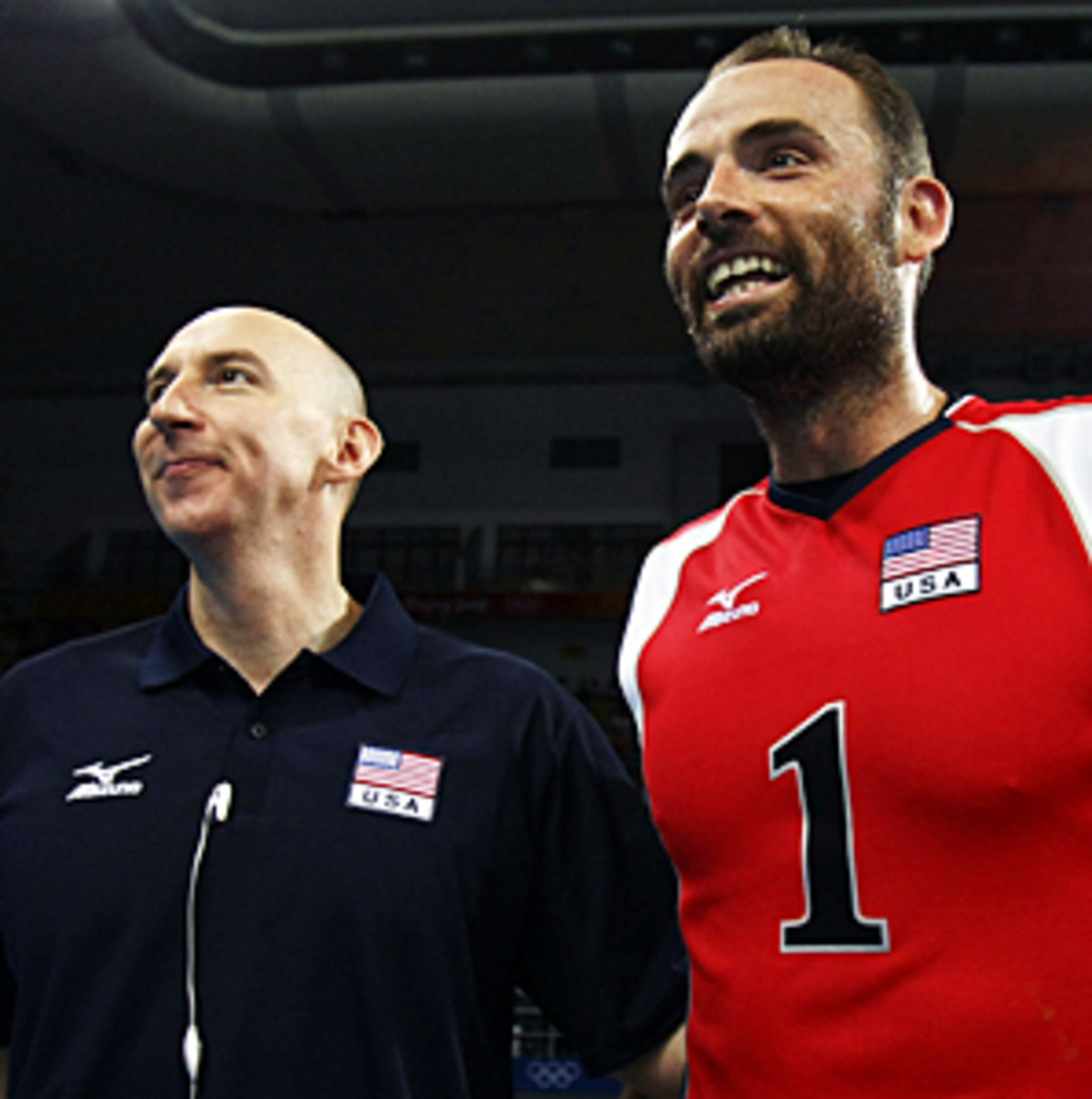
United States men's coach Hugh McCutcheon, Todd Bachman's son-in-law and husband of former Olympic player Wiz Bachman, could not have been any more forthright and graceful in fronting for a family that was racked by an unspeakable grief, all the while coaching the U.S. men's volleyball team brilliantly. There was the private McCutcheon, who needed to hold his family together in the wake of the death of his father-in-law by a knife-wielding man in Beijing, and the public one, who knew tactically how to exploit Brazil's lack of physicality in helping bring Team USA its first Olympic championship since 1988. The IOC does not award gold medals to coaches, but McCutcheon has earned something more precious: the thanks of a nation who witnessed a man treat triumph and tragedy with equanimity.
But the one troubling aspect of the story of the Americans' four-set win over Brazil -- beyond the media's inclination to reduce it to a quickie tale of redemption before hopping a taxi for the second half of the Dream Team final -- is that the story of a grieving coach subsumed the superb work he and his players did in restoring U.S. volleyball to a semblance of the hegemony it enjoyed in '80s.
So before you move on to another corner of PlanetSport -- and nothing is as over as the Olympics once the flame is extinguished -- consider another story: the tale of Lloy Ball.
If you know the name of any American indoor volleyball player, you probably know his. He isn't even close to being Karch Kiraly-famous, but his name has seeped into corners of the American sporting consciousness simply because it feels like he has been around since, oh, the Ming Dynasty.
Ball joined the national team 15 years ago at age 21 when everything from his height -- he's 6-8, huge for a setter -- to his personality was oversized. Ball had been to three previous Olympics prior to Beijing; indeed the only common thread of those disappointing teams, as he is quick to point out, was him. After leaving the national team following Athens, his comeback in '07 raised eyebrows. As McCutcheon said after his team had survived a tense five-setter against Russia in the semifinals, "There was risk in his returning to the team. I think there was undue pressure placed on him in his career that I assured wouldn't be there under us. I told him that I don't need you to lead or be the captain; just to set the ball ... The risk on our part was if we went down the path of having Lloy set again and we didn't get on the podium. Fool me once, shame on (you). Fool me four times, I'm not sure what happens after that."
For the one-time wild child of volleyball, Beijing would mean never finding out. He secured his legacy with a mature and measured performance that included his usual assortment of sets, dinks and, in the fifth set in the semifinals, a point-saving, over-the-shoulder diving dig that was the most impressive dig of the tournament. The gold-medal experience left him speechless ... or as speechless as Ball ever gets.
"I always made fun of people after they'd win an NBA championship or something and say, 'I don't know what to say, it hasn't sunk in yet,'" Ball said. "But I'd say, 'That's kinda stupid. Why would you say that?' Now here I am saying the exact same thing ... I don't think until I get home and sit on my big sofa in front of the TV with the medal still around my neck, a cold beer in hand, and realize that after this long time I'm [an] Olympic champion, that it'll sink in ... It's always one thing to be called an Olympian. You're an Olympian for life. But to be called a gold medalist, I don't know what goes on top of a cherry on a banana split, but it goes on top of that."
Ball, MVP and Best Setter at the 2008 World League final, will continue to play professionally in Russia. But even though setter is the one position that is relatively ageless -- "It's not physically demanding like the opposite or outside [hitters]; it's more of an intellectual thing," he said -- he ruled out a return for London 2012. There will be no drive for five.
"I think it would be very prideful, very greedy, for me to try to continue with this team," Ball said. "[Reserve setter] Kevin Hansen is going to lead this team into the next [Olympics]. This time, as I bow out, it will be more gracefully and without a return."

Along with the pages of Sports Illustrated, you'll find senior writer Michael Farber in the Hockey Hall of Fame. Farber joined the staff of Sports Illustrated in January 1994 and now stands as one of the magazine's top journalists, covering primarily ice hockey and Olympic sports. He is also a regular contributor to SI.com. In 2003 Farber was honored with the Elmer Ferguson Award from the Hockey Hall of Fame for distinguished hockey writing. "Michael Farber represents the best in our business," said the New York Post's Larry Brooks, past president of the Professional Hockey Writers' Association. "He is a witty and stylish writer, who has the ability to tell a story with charm and intelligence." Farber says his Feb. 2, 1998 piece on the use and abuse of Sudafed among NHL players was his most memorable story for SI. He also cites a feature on the personal problems of Kevin Stevens, Life of the Party. His most memorable sports moment as a journalist came in 1988 when Canadian Ben Johnson set his controversial world record by running the 100 meters in 9.79 seconds at the Summer Olympic Games, in Seoul. Before coming to Sports Illustrated, Farber spent 15 years as an award-winning sports columnist and writer for the Montreal Gazette, three years at the Bergen Record, and one year at the Sun Bulletin in Binghamton, NY. He has won many honors for his writing, including the "outstanding sports writing award" in 2007 from Sports Media Canada, and the Prix Jacques-Beauchamp (Quebec sportswriter of the year) in 1993. While at the Gazette, he won a National Newspaper award in 1982 and 1990. Sometimes Life Gets in the Way, a compendium of his best Gazette columns, was published during his time in newspapers. Farber says hockey is his favorite sport to cover. "The most down-to-earth athletes play the most demanding game," he says. Away from Sports Illustrated, Farber is a commentator for CJAD-AM in Montreal and a panelist on TSN's The Reporters (the Canadian equivalent of ESPN's The Sports Reporters in the United States, except more dignified). Farber is also one of the 18 members on the Hockey Hall of Fame selection committee. Born and raised in New Jersey, Farber is a 1973 graduate of Rutgers University where he was Phi Beta Kappa. He now resides in Montreal with his wife, Danielle Tétrault, son Jérémy and daughter Gabrielle.