%20%20--%3E%0A%3Csvg%20version%3D%221.1%22%20id%3D%22Layer_1%22%20xmlns%3D%22http%3A%2F%2Fwww.w3.org%2F2000%2Fsvg%22%20xmlns%3Axlink%3D%22http%3A%2F%2Fwww.w3.org%2F1999%2Fxlink%22%20x%3D%220px%22%20y%3D%220px%22%0A%09%20width%3D%2239px%22%20height%3D%2240px%22%20viewBox%3D%220%200%2039%2040%22%20enable-background%3D%22new%200%200%2039%2040%22%20xml%3Aspace%3D%22preserve%22%3E%0A%3Cpath%20fill%3D%22%23FFFFFF%22%20d%3D%22M38.5%2C7H28.2v26h10.3V7z%22%2F%3E%0A%3Cpath%20fill-rule%3D%22evenodd%22%20clip-rule%3D%22evenodd%22%20fill%3D%22%23FFFFFF%22%20d%3D%22M26.1%2C25.5c0%2C5.8-4.1%2C7.5-12.9%2C7.5C3.9%2C33%2C0%2C31.2%2C0%2C25.2v-1.1h11.6%0A%09v2.4c0%2C0.7%2C0.1%2C1.4%2C1.2%2C1.4c1%2C0%2C1.2-0.4%2C1.2-1.3v-0.9c0-1.6-0.9-1.6-3.5-2.2C2.2%2C21.7%2C0%2C19.7%2C0%2C15.3v-0.9C0%2C9.3%2C5.5%2C7%2C12.9%2C7%0A%09c10.2%2C0%2C12.8%2C2.6%2C12.8%2C7.4v1.8h-11v-2.9c0-0.6-0.4-1.1-1.2-1.1c-0.6%2C0-1.2%2C0.4-1.2%2C1.1v0.9c0%2C1.5%2C0.9%2C2%2C3.3%2C2.5%0A%09c8%2C1.6%2C10.5%2C3.3%2C10.5%2C7.5V25.5z%22%2F%3E%0A%3C%2Fsvg%3E%0A)
Wooden stood as man of constancy

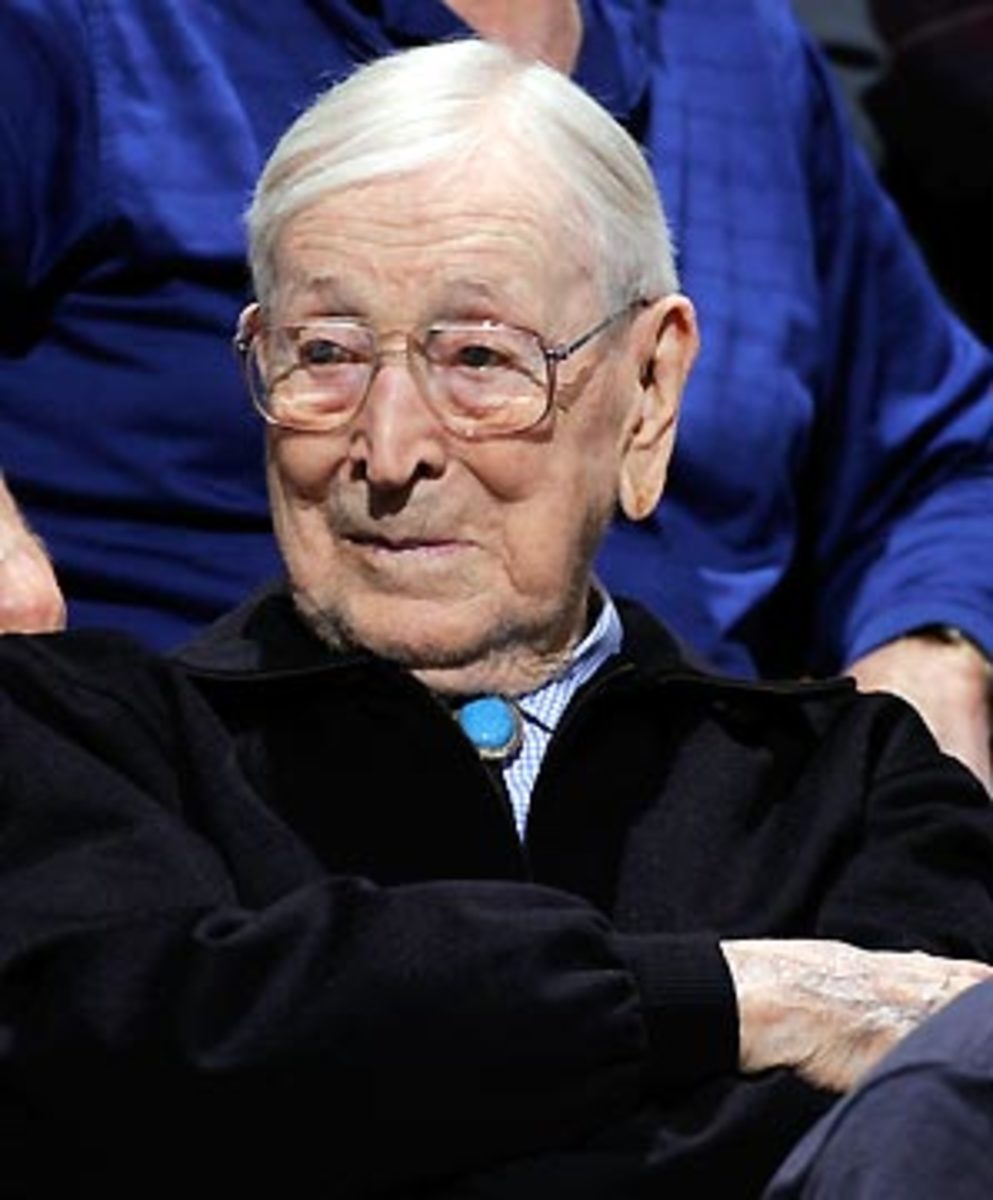
What I remember most clearly from the John Wooden Basketball Encounter in 1984 -- attaching the word "camp" apparently wasn't special enough for the organizers and Wooden would never have allowed the word "fantasy"-- was the moment when the Wizard of Westwood first walked into the gym. There were about 40 of us, ranging in age from 35 to 65, sitting at attention in the bleachers at Pepperdine's Firestone Fieldhouse. We were like a gaggle of high school freshmen waiting for the first glimpse of The Coach, the half-man/half-god who would lead us to glorious victory and impart the secrets of manhood in the process.
"There he is," someone whispered as Wooden -- looking impossibly owlish, impossibly coach-like, impossibly Wooden -- strode into the gym in his spry, tippy-toed walk. Wooden, who was then 74, carried a large framed document, his famed Pyramid of Success, the subject of his first lecture.
"This is what I came for," said a man next to me, scrambling for pen and paper.
Frankly, that is not what I had come for. I was doing a story for SI, was excited to play some pickup ball 3,000 miles from home and last, but certainly not least, I wanted to hear what a man widely considered the best ever in his field had to say about things like the fast break and the 2-2-1 press. The whole Wooden pyramid struck me as one pile of clichés built upon another, all that hackneyed headmaster stuff crammed into some convenient configuration.
I have to confess on this, the day after John Wooden's death, that it still strikes me as that.
But I can tell you this: Wooden's belief in it was absolute, and his ability to communicate it was remarkable. Over three days I watched a few dozen men, all of them successful in life, follow him around the gym, soaking up whatever nuggets he threw out. The scene had to be what it was like around the center square in Athens when Socrates was dishing out philosophical nuggets like so much confetti and all those would-be Platos spread open their hands and tried to catch them.
I didn't know the Wizard of Westwood (a nickname he hated, by the way, because it suggested magic and not hard work) nearly as well as my colleague, Alex Wolff, did and can't add much to Alex's memorable obituary. I ran into him from time to time, never sure what to say beyond. "Wow, I really enjoyed myself at your basketball camp." But over the years I came to know Wooden more from what people said about him, particularly Bill Walton.
I almost never talked to Walton when somehow, some way, he would conjure up Wooden's name. Yet for a long time the two of them had a strained relationship. At the Encounter at Pepperdine, Wooden was quite careful with his opinions, particularly when this reporter was around, so I was frankly astonished when he said, in a response to some question or another, "I'll take [Kareem Abdul-] Jabbar over Walton any day of the week, on the court and off the court." Wooden never cared for Walton's political opinions and probably never quite got over the fact that Walton had defied him from time to time when they were together at UCLA. Plus, Wooden loved "Lewis." That's what he always called Abdul-Jabbar, who came to Westwood in 1965 as Lew Alcindor.
But Wooden and Walton grew closer as the years went by, and I'm certain that what Walton came most to appreciate about Wooden was the fact that he never changed. The things that Wooden was talking about in 2010 were exactly the things he was talking about when the red-haired rebel played for him in the late '60s and early '70s. In a world where even the best among us change their morals and their manners to fit the times, John Wooden remained that delightful anachronism, a relevant relic, a man of constancy.

Special Contributor, Sports Illustrated As a member of the Basketball Hall of Fame, it seems obvious what Jack McCallum would choose as his favorite sport to cover. "You would think it would be pro basketball," says McCallum, a Sports Illustrated special contributor, "but it would be anything where I'm the only reporter there because all the stuff you gather is your own." For three decades McCallum's rollicking prose has entertained SI readers. He joined Sports Illustrated in 1981 and famously chronicled the Celtics-Lakers battles of 1980s. McCallum returned to the NBA beat for the 2001-02 season, having covered the league for eight years in the Bird-Magic heydays. He has edited the weekly Scorecard section of the magazine, written frequently for the Swimsuit Issue and commemorative division and is currently a contributor to SI.com. McCallum cited a series of pieces about a 1989 summer vacation he took with his family as his most memorable SI assignment. "A paid summer va-kay? Of course it's my favorite," says McCallum. In 2008, McCallum profiled Special Olympics founder Eunice Shriver, winner of SI's first Sportsman of the Year Legacy Award. McCallum has written 10 books, including Dream Team, which spent six seeks on the New York Times best-seller list in 2012, and his 2007 novel, Foul Lines, about pro basketball (with SI colleague Jon Wertheim). His book about his experience with cancer, The Prostate Monologues, came out in September 2013, and his 2007 book, Seven Seconds or Less: My Season on the Bench with the Runnin' and Gunnin' Phoenix Suns, was a best-selling behind-the-scenes account of the Suns' 2005-06 season. He has also written scripts for various SI Sportsman of the Year shows, "pontificated on so many TV shows about pro hoops that I have my own IMDB entry," and teaches college journalism. In September 2005, McCallum was presented with the Curt Gowdy Award, given annually by the Naismith Memorial Basketball Hall of Fame for outstanding basketball writing. McCallum was previously awarded the National Women Sports Foundation Media Award. Before Sports Illustrated, McCallum worked at four newspapers, including the Baltimore News-American, where he covered the Baltimore Colts in 1980. He received a B.A. in English from Muhlenberg College in Allentown, Pa. and holds an M.A. in English Literature from Lehigh University. He and his wife, Donna, reside in Bethlehem, Pa., and have two adult sons, Jamie and Chris.