%20%20--%3E%0A%3Csvg%20version%3D%221.1%22%20id%3D%22Layer_1%22%20xmlns%3D%22http%3A%2F%2Fwww.w3.org%2F2000%2Fsvg%22%20xmlns%3Axlink%3D%22http%3A%2F%2Fwww.w3.org%2F1999%2Fxlink%22%20x%3D%220px%22%20y%3D%220px%22%0A%09%20width%3D%2239px%22%20height%3D%2240px%22%20viewBox%3D%220%200%2039%2040%22%20enable-background%3D%22new%200%200%2039%2040%22%20xml%3Aspace%3D%22preserve%22%3E%0A%3Cpath%20fill%3D%22%23FFFFFF%22%20d%3D%22M38.5%2C7H28.2v26h10.3V7z%22%2F%3E%0A%3Cpath%20fill-rule%3D%22evenodd%22%20clip-rule%3D%22evenodd%22%20fill%3D%22%23FFFFFF%22%20d%3D%22M26.1%2C25.5c0%2C5.8-4.1%2C7.5-12.9%2C7.5C3.9%2C33%2C0%2C31.2%2C0%2C25.2v-1.1h11.6%0A%09v2.4c0%2C0.7%2C0.1%2C1.4%2C1.2%2C1.4c1%2C0%2C1.2-0.4%2C1.2-1.3v-0.9c0-1.6-0.9-1.6-3.5-2.2C2.2%2C21.7%2C0%2C19.7%2C0%2C15.3v-0.9C0%2C9.3%2C5.5%2C7%2C12.9%2C7%0A%09c10.2%2C0%2C12.8%2C2.6%2C12.8%2C7.4v1.8h-11v-2.9c0-0.6-0.4-1.1-1.2-1.1c-0.6%2C0-1.2%2C0.4-1.2%2C1.1v0.9c0%2C1.5%2C0.9%2C2%2C3.3%2C2.5%0A%09c8%2C1.6%2C10.5%2C3.3%2C10.5%2C7.5V25.5z%22%2F%3E%0A%3C%2Fsvg%3E%0A)
Biggest? Best? Funniest? Nah. But no one can do what Shaq did

Still, I'm going to say this:
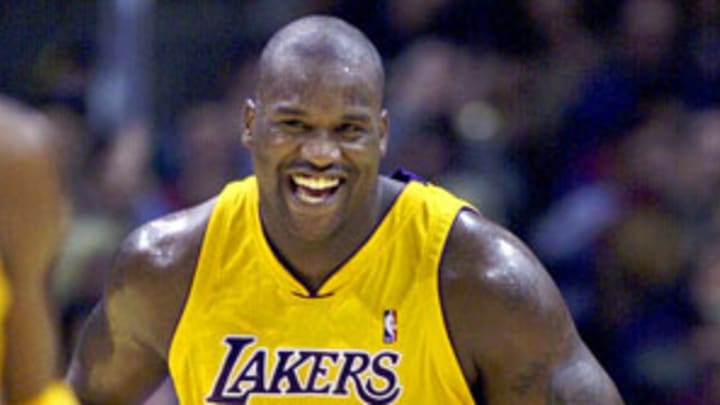
There will never be another Shaquille O'Neal. There will be (and has been) bigger players, and there may even be outright funnier players (though not many), but it was the combination of the two that made Shaq sui generis. "Nobody roots for Goliath," Wilt Chamberlain once said, and that was true ... until Shaq came along.
It figures that he would announce his retirement via Twitter. He was among the first athletes to put the "social" in social media. Shaq was the world's biggest circus clown (that's a compliment) and brought an antic sense to his profession that surpassed that of any athlete I ever covered. Kevin McHale was close -- the Boston Celtics forward once told me how complete his life would've been had he invented the phrase "cement pond" from "The Beverly Hillbillies" -- but McHale was a supporting player on teams led by Larry Bird, and, with Bird around, you couldn't get too antic. Shaq, by contrast, was always The Man in Charge, the Jester in Chief, his teams running on Diesel fuel.
I remember at least one analysis that rated O'Neal the greatest center ever, and that is plainly ridiculous. I put him fifth, behind, in some order, Chamberlain, Bill Russell, Kareem Abdul-Jabbar and Hakeem Olajuwon. The same qualities that made Shaq irresistible off the court -- should we call it his inclination to be "child-like" or should we call it "immaturity?" -- conspired to limit his productivity. No matter what his claims to the contrary, he never worked as hard as he should've in the offseason, and he broke down too often and probably too soon.
But when Shaq was at his best -- in his first 14 seasons when he averaged 26.2 points per game -- no center besides Chamberlain and Abdul-Jabbar was as dominant at the offensive end. Yes, he had a certain brute force to his game -- no elegant skyhooks a la Kareem -- but he was an underrated passer with a court sense that rivaled that of another great pivotman, Bill Walton. I'm not sure anyone has ever dominated a Finals for three straight years the way that Shaq did during the Lakers' first three-peat that began in 2000. Had he been so inclined, and had he not had the talented Kobe Bryant as a teammate, I truly believe that Shaq could've averaged 50 a game against the Pacers, the 76ers and the Nets.
It was during the Nets series that Shaq began a memorable press conference with this statement: "So I was in the bathroom taking a [blank] when Rick Adelman comes on and ..." He then took a potshot -- a potty-shot really -- at the then-Sacramento Kings coach for complaining about the refereeing in the just-concluded Western Conference finals. It didn't matter that Adelman had a point or that Shaq himself would've been complaining the loudest had his Lakers come out on the short end. He had us at "So I was in the bathroom."
My favorite Shaq moment goes back to his rookie year when we were working on a book together, the first of many about The Big Subject. (Jackie MacMullan is working on another right now.) I was told that Shaq couldn't be interviewed that day because he was sleeping, but I insisted that I had to see him. I went up to his room and there he was, stretched out in all his 85-inch, 320-pound glory, completely covered by a sheet.
"Put the tape recorder by the pillow," he mumbled. And I spent the next 30 minutes at his side, asking questions and watching the sheet go up and down as Shaq answered them.
He was always bigger than life, even when you couldn't see him.

Special Contributor, Sports Illustrated As a member of the Basketball Hall of Fame, it seems obvious what Jack McCallum would choose as his favorite sport to cover. "You would think it would be pro basketball," says McCallum, a Sports Illustrated special contributor, "but it would be anything where I'm the only reporter there because all the stuff you gather is your own." For three decades McCallum's rollicking prose has entertained SI readers. He joined Sports Illustrated in 1981 and famously chronicled the Celtics-Lakers battles of 1980s. McCallum returned to the NBA beat for the 2001-02 season, having covered the league for eight years in the Bird-Magic heydays. He has edited the weekly Scorecard section of the magazine, written frequently for the Swimsuit Issue and commemorative division and is currently a contributor to SI.com. McCallum cited a series of pieces about a 1989 summer vacation he took with his family as his most memorable SI assignment. "A paid summer va-kay? Of course it's my favorite," says McCallum. In 2008, McCallum profiled Special Olympics founder Eunice Shriver, winner of SI's first Sportsman of the Year Legacy Award. McCallum has written 10 books, including Dream Team, which spent six seeks on the New York Times best-seller list in 2012, and his 2007 novel, Foul Lines, about pro basketball (with SI colleague Jon Wertheim). His book about his experience with cancer, The Prostate Monologues, came out in September 2013, and his 2007 book, Seven Seconds or Less: My Season on the Bench with the Runnin' and Gunnin' Phoenix Suns, was a best-selling behind-the-scenes account of the Suns' 2005-06 season. He has also written scripts for various SI Sportsman of the Year shows, "pontificated on so many TV shows about pro hoops that I have my own IMDB entry," and teaches college journalism. In September 2005, McCallum was presented with the Curt Gowdy Award, given annually by the Naismith Memorial Basketball Hall of Fame for outstanding basketball writing. McCallum was previously awarded the National Women Sports Foundation Media Award. Before Sports Illustrated, McCallum worked at four newspapers, including the Baltimore News-American, where he covered the Baltimore Colts in 1980. He received a B.A. in English from Muhlenberg College in Allentown, Pa. and holds an M.A. in English Literature from Lehigh University. He and his wife, Donna, reside in Bethlehem, Pa., and have two adult sons, Jamie and Chris.