%20%20--%3E%0A%3Csvg%20version%3D%221.1%22%20id%3D%22Layer_1%22%20xmlns%3D%22http%3A%2F%2Fwww.w3.org%2F2000%2Fsvg%22%20xmlns%3Axlink%3D%22http%3A%2F%2Fwww.w3.org%2F1999%2Fxlink%22%20x%3D%220px%22%20y%3D%220px%22%0A%09%20width%3D%2239px%22%20height%3D%2240px%22%20viewBox%3D%220%200%2039%2040%22%20enable-background%3D%22new%200%200%2039%2040%22%20xml%3Aspace%3D%22preserve%22%3E%0A%3Cpath%20fill%3D%22%23FFFFFF%22%20d%3D%22M38.5%2C7H28.2v26h10.3V7z%22%2F%3E%0A%3Cpath%20fill-rule%3D%22evenodd%22%20clip-rule%3D%22evenodd%22%20fill%3D%22%23FFFFFF%22%20d%3D%22M26.1%2C25.5c0%2C5.8-4.1%2C7.5-12.9%2C7.5C3.9%2C33%2C0%2C31.2%2C0%2C25.2v-1.1h11.6%0A%09v2.4c0%2C0.7%2C0.1%2C1.4%2C1.2%2C1.4c1%2C0%2C1.2-0.4%2C1.2-1.3v-0.9c0-1.6-0.9-1.6-3.5-2.2C2.2%2C21.7%2C0%2C19.7%2C0%2C15.3v-0.9C0%2C9.3%2C5.5%2C7%2C12.9%2C7%0A%09c10.2%2C0%2C12.8%2C2.6%2C12.8%2C7.4v1.8h-11v-2.9c0-0.6-0.4-1.1-1.2-1.1c-0.6%2C0-1.2%2C0.4-1.2%2C1.1v0.9c0%2C1.5%2C0.9%2C2%2C3.3%2C2.5%0A%09c8%2C1.6%2C10.5%2C3.3%2C10.5%2C7.5V25.5z%22%2F%3E%0A%3C%2Fsvg%3E%0A)
Serena's run to Olympic final showcases her power, dominance
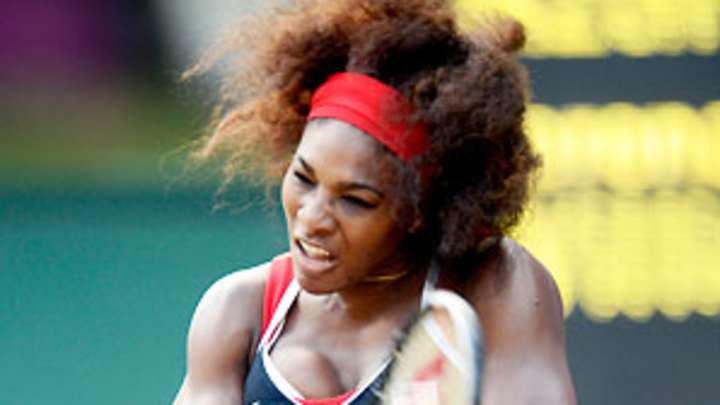
WIMBLEDON, England -- Let's zig where everyone else zags. Let's buck convention. Let's go outside the service box, as it were. Let's talk Serena Williams and restrict the discussion to her tennis. No mention of her conduct or her personality. No review of injuries and ailments or fashion or boyfriends or hobbies or outrageous quotes. No digression into themes of race, or anything outside the courts. Just tennis.
We usually wait for a player to win a title before offering a glowing coronation. But regardless of how Williams fares in her gold-medal match Saturday against Maria Sharapova at the London Olympics, we ought to pause and acknowledge the dizzying level of tennis.
On the day after Memorial Day, Williams lost her first-round match at the French Open to Virginie Razzano of France. The match ended in Parisian sunset and it seemed a fitting image. Serena was in her 30s, almost two years removed from her last major title, and unable to get away with flaws such as hitting off her back foot or positioning herself too deep in the court. She had come to Paris in shape and with plenty of match play, so she couldn't attribute the defeat to tennis' equivalent of ring rust. I watched that match alongside one former Grand Slam champion. She remarked that "if Serena didn't win Wimbledon, she would never win another Slam again."
Williams would, of course, win Wimbledon. As she's done for much of the past decade, she made a mockery of the WTA rankings, picking apart higher-seeded opponents. She was the favorite to win each time she took to the lawns, and each time she delivered. Her success was predicated on her serve. Serena tallied more aces than any player in the draw, men included. (Men who are not only bigger but also play best-of-five sets.) She lasered her shots and motored around the court and played defense on the rare occasion the points demanded as much. While Williams did her best work from the backcourt, she also made inroads at the net. And then she did it again in doubles. She won that title too.
In her downtime between Wimbledon and the Olympics, she hopped over to Stanford, Calif., to pick off a few more wins. (While she was paid handsomely for her effects, she also salvaged an event that was looking at the grim possibility of trying to sell fans and sponsors on Marion Bartoli as a headliner. Oops, we veered from strictly tennis...) Continuing to dial in her serves, she added another title and another layer of confidence. She didn't drop a set.
Here, back in London, she has dominated play the way green dominates the color scheme of grass. We're often pressed for superlatives trying to describe Roger Federer and his artistry. What about Serena and her power? When words fail us, we turn to numbers. In five matches, Williams has dropped a total of 16 games, fewer than two per set. At one point, she won 17 straight games. On Wednesday, she beat Vera Zvonareva, a former world No. 2, 6-1, 6-0. On Thursday, it was Caroline Wozniacki's turn in the wrecking yard. The top-ranked player in the world a year ago, Wozniacki mustered three games, unable to come up with anything resembling an answer for Serena's power. And she didn't even seem surprised afterward. Serena? She played one point with her left hand, as if seeking a challenge. Williams also told a small group of reporters that wasn't altogether satisfied with her level of play.
On Friday, after waiting around past tea time for Federer to close out Juan Martin del Potro 19-17 in their titanic third set, Williams took Centre Court to face Victoria Azarenka, the WTA's No. 1. Azarenka, though, was less an opponent than an innocent bystander. The first set was 6-1 and somehow that scoreline shortchanges the level of dominance. Williams again blended the power of her serve with accuracy. She teed off on Azarenka's offerings. She played like the grass-court expert she is. Azarenka -- we repeat: the WTA's No. 1-ranked player -- barely lasted an hour, dispatched 6-1, 6-2.
Even Serena had to concede afterward: "I kind of was blind today. I didn't even know where I was going. But you're playing the best player in the world, you got to play well."
While she's still playing doubles too, she meets Sharapova for the gold medal on Saturday. Unless Serena's level of play drops radically, she will win the most precious medal here. For now, we note that through five rounds, this has been an Olympic performance.
 Add us as a preferred source on Google
Jon Wertheim is a senior writer for Sports Illustrated and has been part of the full-time SI writing staff since 1997, largely focusing on the tennis beat, sports business and social issues, and enterprise journalism. In addition to his work at SI, he is a correspondent for “60 Minutes” and a commentator for The Tennis Channel. He has authored 11 books and has been honored with two Emmys, numerous writing and investigative journalism awards, and the Eugene Scott Award from the International Tennis Hall of Fame. Wertheim is a longtime member of the New York Bar Association (retired), the International Tennis Writers Association and the Writers Guild of America. He has a bachelor’s in history from Yale University and received a law degree from the University of Pennsylvania. He resides in New York City and Paris with his wife, who is a divorce mediator and adjunct law professor. They have two children.