%20%20--%3E%0A%3Csvg%20version%3D%221.1%22%20id%3D%22Layer_1%22%20xmlns%3D%22http%3A%2F%2Fwww.w3.org%2F2000%2Fsvg%22%20xmlns%3Axlink%3D%22http%3A%2F%2Fwww.w3.org%2F1999%2Fxlink%22%20x%3D%220px%22%20y%3D%220px%22%0A%09%20width%3D%2239px%22%20height%3D%2240px%22%20viewBox%3D%220%200%2039%2040%22%20enable-background%3D%22new%200%200%2039%2040%22%20xml%3Aspace%3D%22preserve%22%3E%0A%3Cpath%20fill%3D%22%23FFFFFF%22%20d%3D%22M38.5%2C7H28.2v26h10.3V7z%22%2F%3E%0A%3Cpath%20fill-rule%3D%22evenodd%22%20clip-rule%3D%22evenodd%22%20fill%3D%22%23FFFFFF%22%20d%3D%22M26.1%2C25.5c0%2C5.8-4.1%2C7.5-12.9%2C7.5C3.9%2C33%2C0%2C31.2%2C0%2C25.2v-1.1h11.6%0A%09v2.4c0%2C0.7%2C0.1%2C1.4%2C1.2%2C1.4c1%2C0%2C1.2-0.4%2C1.2-1.3v-0.9c0-1.6-0.9-1.6-3.5-2.2C2.2%2C21.7%2C0%2C19.7%2C0%2C15.3v-0.9C0%2C9.3%2C5.5%2C7%2C12.9%2C7%0A%09c10.2%2C0%2C12.8%2C2.6%2C12.8%2C7.4v1.8h-11v-2.9c0-0.6-0.4-1.1-1.2-1.1c-0.6%2C0-1.2%2C0.4-1.2%2C1.1v0.9c0%2C1.5%2C0.9%2C2%2C3.3%2C2.5%0A%09c8%2C1.6%2C10.5%2C3.3%2C10.5%2C7.5V25.5z%22%2F%3E%0A%3C%2Fsvg%3E%0A)
Teddy Bridgewater's 2013 opener was a definitive statement about his 2014 draft value

Teddy Bridgewater is making the "Best College Player" argument a lot more interesting. (Joe Robbins/Getty Images)
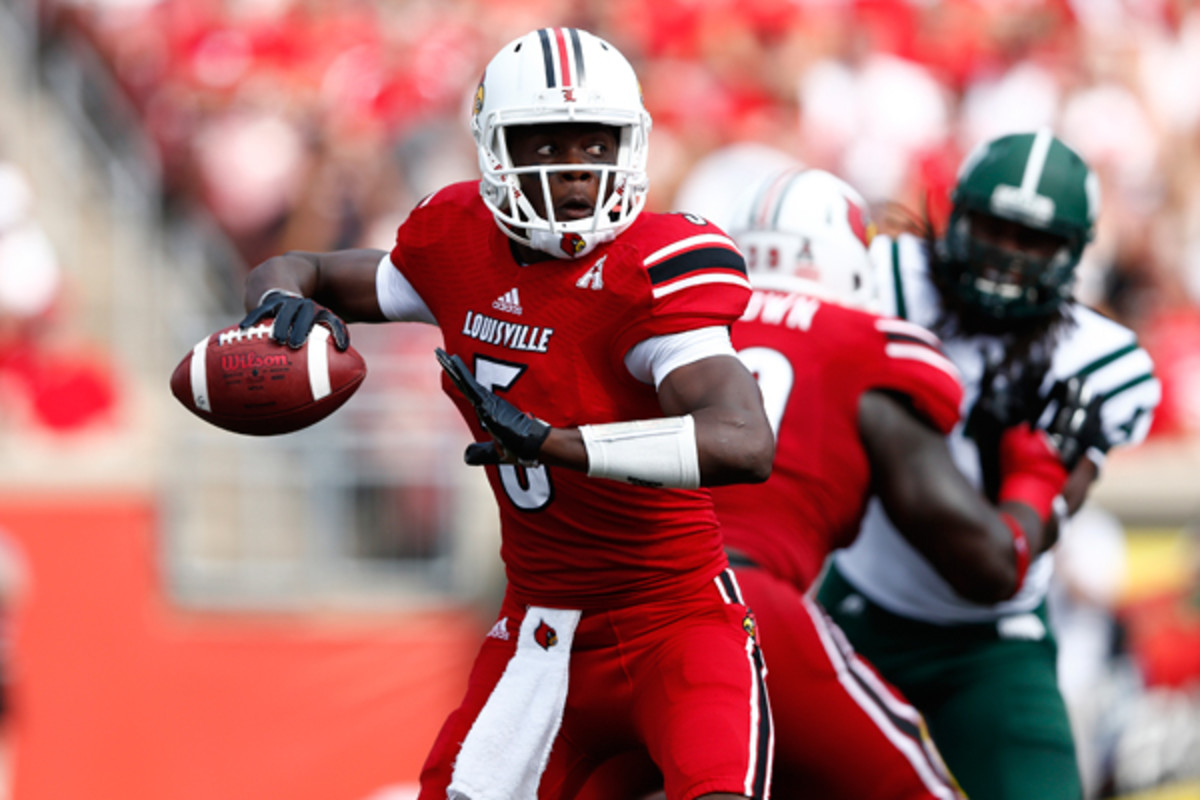
Going into the 2013 NCAA season, the general consensus among draft analysts was that South Carolina defensive end Jadeveon Clowney was by far the best player who could possible make himself available for the 2014 NFL draft. The only way that Louisville quarterback Teddy Bridgewater would be the first overall pick if both Bridgewater and Clowney were available, conventional wisdom said, was if the first team drafting desperately needed a quarterback. While I have no doubt as to Clowney's NFL potential -- he is the most dominant collegiate defender I have seen since Ndamukong Suh -- there is an argument to take Bridgewater first.
After studying Bridgewater's 2012 tape intently, and reviewing his five-touchdown performance against Ohio on Sunday, I'm not sure the divide between Bridgewater and Clowney is as large as some believe. That's more about how valuable I believe Bridgewater will be to his NFL team than it is any knock on Clowney. Based on what I've seen, i think that Bridgewater has the opportunity to provide some unique benefits as a pro.
First, let's get the obvious out of the way -- Ohio's defense was in no way prepared for Louisville's offense, and as a result, Bridgewater had several easy completions to wide-open receivers. His stat line (23 of 28 for 355 yards, five touchdowns, and one interception) should be seen in that context.
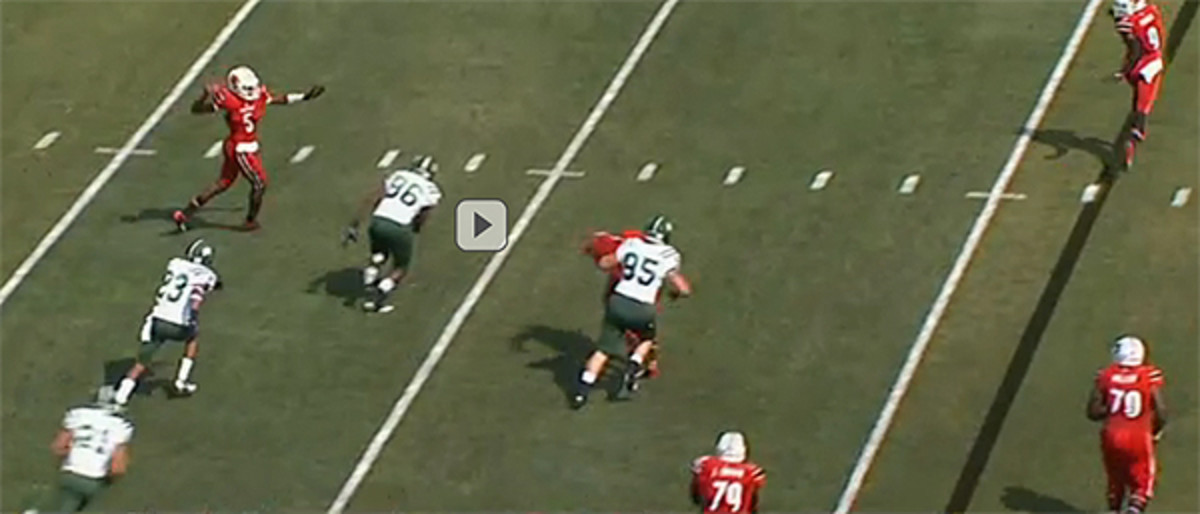
However, even on those easier scores, Bridgewater showed an impressive command of the mechanics common to the best and most consistent quarterbacks. His first touchdown, a 34-yard strike to receiver Damian Copeland with 11:13 left in the first quarter, had him rolling left -- away from his throwing momentum, and out of the grasp or two potential pass rushers. On the move, Bridgewater kept his eyes downfield, retained a high shoulder carriage (he didn't drop his throwing balance on the run), and delivered an arcing bomb downfield. Yes, Copeland had an easy catch, but this play epitomized why I've compared Bridgewater at times to an developing Aaron Rodgers. Rodgers has a rare ability to keep an optimal throwing focus when he's flushed out of the pocket, and I see the same attribute in Bridgewater's game. The picture shows how he's set up for accuracy and velocity on that running throw.
Touchdown #1: On the move to his left, Bridgewater is mechanically set to make a deep throw downfield.
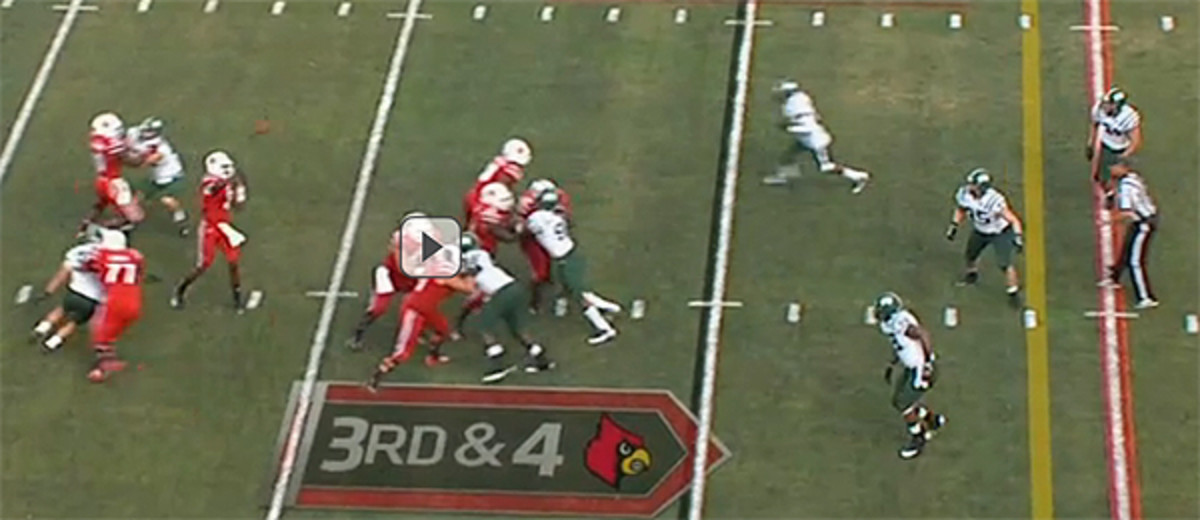
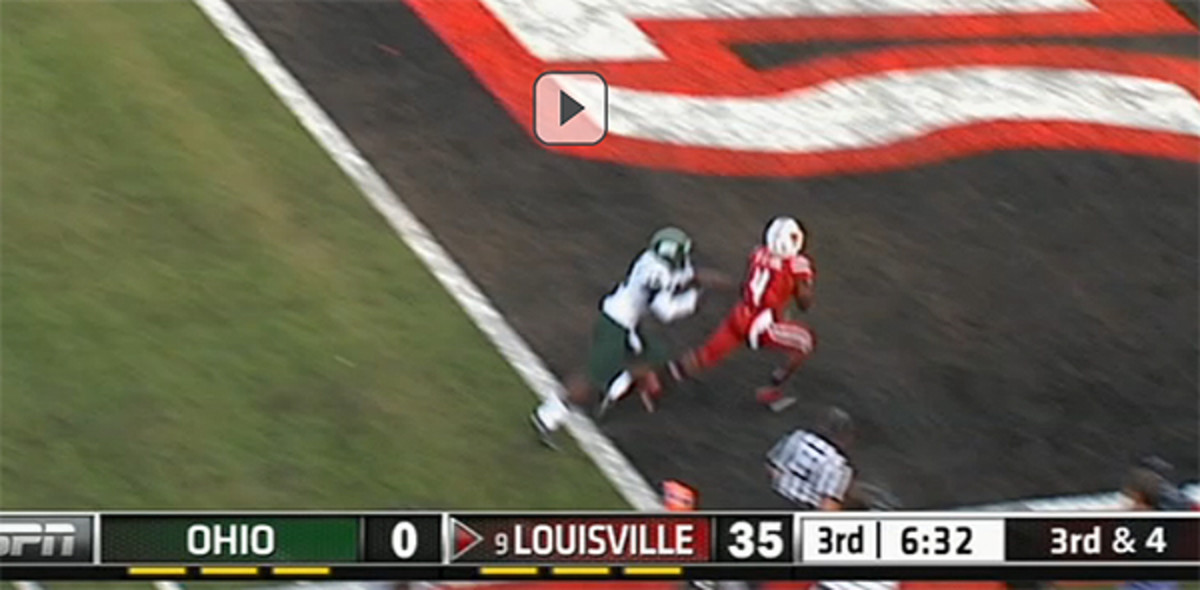
But it was the third-quarter score to Robert Clark that impressed me the most. It was third-and-4, and the Cardinals had converted all six of their previous third-down chances. This time, Bridgewater set himself up well for a decisive shot play. He hit Clark right on time, over the defender, with a beautiful 25-yard touchdown pass that combined arc, velocity, and accuracy. There are several quarterbacks currently starting in the NFL who can't time fade routes this well, and Bridgewater's understanding of mechanics is the key. He doesn't fall away from the throw as many quarterbacks do -- instead, he rolls to shift his weight and maintains his balance in a way that makes repeatable throws possible. This is the hallmark of consistency.
Bridgewater takes the time to set himself for the throw despite pressure from behind...
...and a perfectly-timed throw to Robert Clark is the result.
"He studies the game and studies the receivers and he does a great job of checking and taking what the defense gives him," Louisville coach Charlie Strong said after the 49-7 win. "It was just fun to watch Teddy. It's just amazing how he keeps getting better and better."
The strength of competition argument is one that will dog Bridgewater all season, but I don't think it will affect his NFL prospects as much as it may damage his Heisman Trophy hopes. Most NFL evaluators will tell you that opponent strength is a huge variable in college football, and as a result, the best you can do in that regard is to isolate a player's skill sets and analyze him in that vacuum.
For those who wish to see Bridgewater succeed against a better defense, there's always his 2013 Sugar Bowl performance against Florida.
Bridgewater earned game MVP honors in Louisville's 33-23 upset win over the Gators, performing well under pressure despite a baptism of fire from then-Florida and now Chicago Bears linebacker Jon Bostic, who hit him so hard after a deep sideline throw that Bridgewater's helmet was knocked off his head.
“Every morning, when I feel under my chin, I remember that hit. He left me with a scar,” Bridgewater said months later.
If Bridgewater was a hothouse flower, he wouldn't have done what he did after that hit. He finished his day completing 20 of 32 passes for 266 yards, two touchdowns, and one interception. Both of his scoring throws traveled more than 15 yards in the air against a defense that had not allowed a touchdown pass of that type all season.
If there's one thing NFL scouts will look to see from Bridgewater when assessing his future as a franchise quarterback, it's his relative efficiency against the blitz. In the Sugar Bowl win, per ESPN Stats & Info, Bridgewater was 15 of 18 and averaged 11.6 yards per attempt when facing four or fewer rushers, and 5 of 14 with a 4.1 YPA average when blitzed.
It's a small sample size, but based on what I saw in the Ohio game, I think Bridgewater's making better decisions in shorter spans of time, which would help him clean up the difference between blitz and no blitz. Again, the vacuum, and how he performs in it.

SI.com contributing NFL writer and Seattle resident Doug Farrar started writing about football locally in 2002, and became Football Outsiders' West Coast NFL guy in 2006. He was fascinated by FO's idea to combine Bill James with Dr. Z, and wrote for the site for six years. He wrote a game-tape column called "Cover-2" for a number of years, and contributed to six editions of "Pro Football Prospectus" and the "Football Outsiders Almanac." In 2009, Doug was invited to join Yahoo Sports' NFL team, and covered Senior Bowls, scouting combines, Super Bowls, and all sorts of other things for Yahoo Sports and the Shutdown Corner blog through June, 2013. Doug received the proverbial offer he couldn't refuse from SI.com in 2013, and that was that. Doug has also written for the Seattle Times, the Washington Post, the New York Sun, FOX Sports, ESPN.com, and ESPN The Magazine. He also makes regular appearances on several local and national radio shows, and has hosted several podcasts over the years. He counts Dan Jenkins, Thomas Boswell, Frank Deford, Ralph Wiley, Peter King, and Bill Simmons as the writers who made him want to do this for a living. In his rare off-time, Doug can be found reading, hiking, working out, searching for new Hendrix, Who, and MC5 bootlegs, and wondering if the Mariners will ever be good again.