%20%20--%3E%0A%3Csvg%20version%3D%221.1%22%20id%3D%22Layer_1%22%20xmlns%3D%22http%3A%2F%2Fwww.w3.org%2F2000%2Fsvg%22%20xmlns%3Axlink%3D%22http%3A%2F%2Fwww.w3.org%2F1999%2Fxlink%22%20x%3D%220px%22%20y%3D%220px%22%0A%09%20width%3D%2239px%22%20height%3D%2240px%22%20viewBox%3D%220%200%2039%2040%22%20enable-background%3D%22new%200%200%2039%2040%22%20xml%3Aspace%3D%22preserve%22%3E%0A%3Cpath%20fill%3D%22%23FFFFFF%22%20d%3D%22M38.5%2C7H28.2v26h10.3V7z%22%2F%3E%0A%3Cpath%20fill-rule%3D%22evenodd%22%20clip-rule%3D%22evenodd%22%20fill%3D%22%23FFFFFF%22%20d%3D%22M26.1%2C25.5c0%2C5.8-4.1%2C7.5-12.9%2C7.5C3.9%2C33%2C0%2C31.2%2C0%2C25.2v-1.1h11.6%0A%09v2.4c0%2C0.7%2C0.1%2C1.4%2C1.2%2C1.4c1%2C0%2C1.2-0.4%2C1.2-1.3v-0.9c0-1.6-0.9-1.6-3.5-2.2C2.2%2C21.7%2C0%2C19.7%2C0%2C15.3v-0.9C0%2C9.3%2C5.5%2C7%2C12.9%2C7%0A%09c10.2%2C0%2C12.8%2C2.6%2C12.8%2C7.4v1.8h-11v-2.9c0-0.6-0.4-1.1-1.2-1.1c-0.6%2C0-1.2%2C0.4-1.2%2C1.1v0.9c0%2C1.5%2C0.9%2C2%2C3.3%2C2.5%0A%09c8%2C1.6%2C10.5%2C3.3%2C10.5%2C7.5V25.5z%22%2F%3E%0A%3C%2Fsvg%3E%0A)
NFL Refs Keep Botching Critical Games That Decide the Playoff Race
In this story:
“It’s absolutely a catch, Mike. He gets control, two feet down and then takes an additional step which completes the catch. This is a touchdown.”
That was NBC rules analyst Terry McAulay on Oct. 27, during a Week 8 game between the Packers and the Steelers. He was talking about a catch by Roman Wilson on which the Steelers’ wide receiver elevated in the back of the end zone, secured the ball, planted his left and then right foot, and then started to scuttle backward before Carrington Valentine swiped his arm and knocked the football loose.
You can watch the play here:
Roman Wilson’s first career NFL touchdown. #Steelers #NFL pic.twitter.com/vJYfxY5sPD
— Blitzburgh (@Blitz_Burgh) October 27, 2025
Nearly everyone—even in the wholly divided wasteland of social media replies—seemed to agree this fit the definition of a touchdown catch even if there was, eventually, a loss of possession. It feels like a touchdown. It looks like a touchdown. Had the Supreme Court taken up this case, even at a time when we seemingly cannot figure out the true meaning of any single, solitary word due to its confounding origins in 1790s Quaker literature, I am confident it would be deemed a catch. As a society, we were prepared to move forward into a new age of understanding.
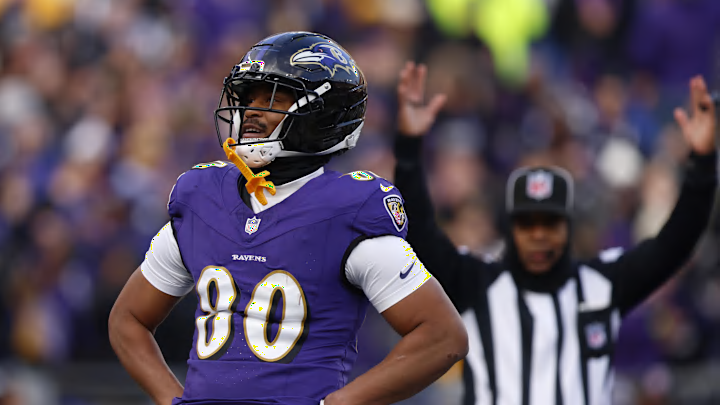
And then, en route to a 27–22 Pittsburgh victory, Sunday’s Ravens-Steelers crew slammed a frosty pint glass on the counter, punched a hole in the juke box and asked us all to take a look at Isaiah Likely.
“One, two, that will stand,” CBS’s Tony Romo said as Likely caught a football with a little over two minutes to play in the final quarter of a one-score game between the AFC North’s two leaders.
While Romo should not be the arbiter of anything, Likely secured the ball and put two feet down. As his momentum was carrying him toward a third step, the ball was jarred out of his fingertips. The call was reversed upon review and a handful of plays later, the Ravens lost possession on downs. Baltimore would go on to lose the game.
Here’s a clip of that play:
This go ahead touchdown to Isaiah Likely was ruled incomplete for the Ravens...
— Underdog (@Underdog) December 7, 2025
Thoughts 😬pic.twitter.com/5IHm9eICha
While we can maybe, possibly, if we squint hard enough understand the officials’ rational in this particular scenario (the crew told Ravens coach John Harbaugh that Likely failed to get a third step down, thus completing the all-nebulous football move) it does not change the fact that this week has been a complete and total embarrassment in terms of the way officiating can rise up and strangle a game like an unkempt vine. The scourge of bad calls that have increased this past week in prime time, stand-alone or critical early-window games have erased any common sense benefit of the doubt, which creates a whirlwind of skepticism and misinformation, leading to what we saw on Sunday where Romo—right or wrong—is fanning the flames of officiating malpractice. That’s right, folks, we’re barreling toward another Super Bowl that is about nothing but officiating.
Instead of reveling in what could be a playoff field stacked with new faces—a rare opportunity in the increasingly predictable Mahomes-Burrow-Jackson-Allen monolith world—the NFL is having to reckon with the fact that at least four teams’ seedings, if not actual playoff berths, have hinged on egregious game-altering calls.
Turn back the clock to Sunday Night Football between the Commanders and Broncos, when a phantom false start tumbled directly into an incorrect application of the intentional grounding rule.
The NBC SNF crew disagreed with consecutive penalties against the Commanders on the final drive of regulation vs the Broncos.
— Awful Announcing (@awfulannouncing) December 1, 2025
Rules analyst Terry McAulay: "This is absolutely not (intentional) grounding, guys." 🏈🦓🎙️ #NFL #SNF pic.twitter.com/lRzZhfqEGG
Then go to this week’s Thursday Night Football, when Cowboys tight end Jake Ferguson was called for an offensive pass interference that was, essentially, a misinterpreted inside swim move that is a common vehicle for pass catchers to get open. This was another call where the in-booth rules analyst very clearly states that it was incorrect.
Jake Ferguson called forOPI on this play really changesthe outcome of this game @Rate_the_Refs what do you think pic.twitter.com/WBoAWVhqxS
— Tanner Phifer (@TannerPhifer) December 5, 2025
Let’s not forget a Texans-Colts game on Nov. 30 in which there were so many calls that seesawed the momentum of this game that not all of them could be contained in a single pool report (a reporters’ ability to ask a representative of the crew what in the hell was going on out there). Two of those calls came before an extra point that we didn’t have the actual ability to tell whether or not it was good.
After a missed delay of game penalty and a phantom defensive holding penalty helped set up a Houston TD with an optical illusion PAT, J.J. Watt advises Colts fans to grab a drink.
— Michael Hurley (@michaelFhurley) November 30, 2025
Good color analysis, imo. pic.twitter.com/CEqjksRnsM
Which brings us back to Ravens-Steelers. Romo promised us as the broadcast was coming to an end that we’d be talking about Likely’s catch all week, and I’m afraid he’s wrong again. The league’s ecosystem contains so many of these bad and consequential calls that they are merely a depth of the ocean in which all things football exist. If you’d like to go full James Cameron and mine the bottom third of this bleak darkness, you would discover the kind of truths that would make your skin crawl (and maybe a secret society, but who knows). It’s always been there, just waiting for us to piece it all together. Literally any game is capable of being officiated into nothingness before it is buried underneath hundreds more that cause us to forget.
It remains incredibly ridiculous for the league to ad nauseum trumpet its parity while forcing coaches at the risk of monetary fines to accept the conclusion that games coming down to an official’s call was somehow the fault of the team for not winning by more. Hogwash! The NFL has done everything in its power to manufacture parity but has not improved the mechanism that now defines who wins and loses those games inside increasingly tight margins.
Those moments of sweet, sweet understanding, like the Wilson touchdown, should form the basis of a reimagined officiating in which the rulebook gets stripped to the ground and handed back to common sense-minded editors with an eye on maximizing the kind of play that doesn’t require constant interruption and meddling from officials in the first place. While I am loath to hold up any institution as an example, there is a segment of judges who believe that certain liberties, for example, are so obvious and entrenched in our day-to-day life that almost anyone would agree to their truths. So true, that you don’t even need to write them down and define them. So true that you don’t have to legislate them. Why can’t we apply that same framework to the most popular sport in the country, in which every game costs more to stage, produce, film and outfit in technology than it would to build the Taj Mahal? Why is this still happening multiple times a week?
Sadly, football has become like everything else. So popular and so aggressively, painfully legislated, that the rules fail to become rules and are simply a roadmap with all avenues pointing toward becoming the person who photoshops poor Ron Torbert into different colored striped uniforms to indicate which team he’s clearly favoring. Sometimes, complaining really is the only option at our disposal. At least in this case. At least when all parties involved show no interest in changing their reality.
More NFL From Sports Illustrated
 Add us as a preferred source on Google
Conor Orr is a Senior Writer for Sports Illustrated with more than 15 years of experience covering the NFL. His work has been cited in Best American Sportswriting and has won a PFWAA award. Prior to Sports Illustrated, he covered both the Giants and Jets for The Star-Ledger. Conor lives in New Jersey with his amazing wife and three children.
Follow author