%20%20--%3E%0A%3Csvg%20version%3D%221.1%22%20id%3D%22Layer_1%22%20xmlns%3D%22http%3A%2F%2Fwww.w3.org%2F2000%2Fsvg%22%20xmlns%3Axlink%3D%22http%3A%2F%2Fwww.w3.org%2F1999%2Fxlink%22%20x%3D%220px%22%20y%3D%220px%22%0A%09%20width%3D%2239px%22%20height%3D%2240px%22%20viewBox%3D%220%200%2039%2040%22%20enable-background%3D%22new%200%200%2039%2040%22%20xml%3Aspace%3D%22preserve%22%3E%0A%3Cpath%20fill%3D%22%23FFFFFF%22%20d%3D%22M38.5%2C7H28.2v26h10.3V7z%22%2F%3E%0A%3Cpath%20fill-rule%3D%22evenodd%22%20clip-rule%3D%22evenodd%22%20fill%3D%22%23FFFFFF%22%20d%3D%22M26.1%2C25.5c0%2C5.8-4.1%2C7.5-12.9%2C7.5C3.9%2C33%2C0%2C31.2%2C0%2C25.2v-1.1h11.6%0A%09v2.4c0%2C0.7%2C0.1%2C1.4%2C1.2%2C1.4c1%2C0%2C1.2-0.4%2C1.2-1.3v-0.9c0-1.6-0.9-1.6-3.5-2.2C2.2%2C21.7%2C0%2C19.7%2C0%2C15.3v-0.9C0%2C9.3%2C5.5%2C7%2C12.9%2C7%0A%09c10.2%2C0%2C12.8%2C2.6%2C12.8%2C7.4v1.8h-11v-2.9c0-0.6-0.4-1.1-1.2-1.1c-0.6%2C0-1.2%2C0.4-1.2%2C1.1v0.9c0%2C1.5%2C0.9%2C2%2C3.3%2C2.5%0A%09c8%2C1.6%2C10.5%2C3.3%2C10.5%2C7.5V25.5z%22%2F%3E%0A%3C%2Fsvg%3E%0A)
Already a Queer Icon, Amber Glenn Is Chasing Milan Olympic Dreams Next
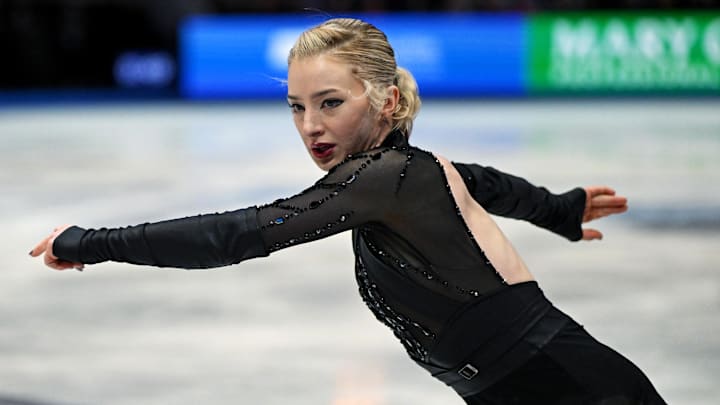
Amber Glenn did not even really want to go to Beijing. Sure, she had dreamed of it the way every child dreams of competing in the Olympics—on the same level as becoming President or learning to fly. But the highest realistic honor she envisioned for her figure skating career as a kid was performing on television, which she’d done at 14. So when she came out of nowhere at 21 to finish second at the 2021 national championships and in a flash everyone around her started talking about her as a Beijing hopeful, she didn’t quite know what to think.
“Those were quite uncertain times due to a certain virus going on in the world,” she says. “So I was suddenly a topic of, Oh, this could happen, and I was really fresh. I hadn’t proven myself internationally or really in the country, except for one time, so I didn't have the expertise or experience that came with all the hype and buzz of the ’22 Games.”

Her likeness was everywhere. Delta Air Lines—which facilitated Glenn’s SI interview—named her one of its six “Delta team ambassadors.” Team USA advertised her as one of the faces of Beijing.
Then, midway through a disappointing performance at the 2022 U.S. championships, which also served as the qualifying event for the U.S. Olympic team, Glenn tested positive for COVID-19 and withdrew. She was named an alternate. She was crushed. She feared she had gotten ahead of herself. She feared her career might end in failure.
So why, four years later, with Milan 2026 just six months away, winner of the last two national titles and a slew of grand prix events, has she agreed to put herself in the same situation—doing promotional work for a team she has not yet made? (She is again a Delta athlete, along with para alpine skier Andrew Kurka, para snowboarder Amy Purdy, snowboarder Bea Kim, para nordic skier and biathlete Dani Aravich, sled hockey player Declan Farmer, bobsledder Elana Meyers Taylor, cross-country skier Jessie Diggins and figure skaters Maia and Alex Shibutani.)
“I think I finally have the belief in myself,” she says now. “Now I’m able to get excited with them. I’m not anxious. Well, of course, I'm anxious. But I’m not scared. I’m excited. And the energy is—I get to embrace it rather than fear it.”
It took a lot for Glenn, now 25, to get to this point. The spring after she didn’t make the Olympic team, Glenn moved from Texas, where she’d lived all her life, to Colorado Springs, Colo., to train at a U.S. Olympic training site. She had come out as pansexual in 2019 and has battled an eating disorder, anxiety, depression and ADHD; as she matured, she felt more able to be open about who she is.
“I’m a lot more—I don’t want to use the word stable, but a lot more content with just my overall life,” she says. “Like, I have a dog, I have a place, I know my neighbors, I have friends. I’m able to balance life and being a pro athlete at the same time. And I think that’s the biggest difference.” (Her Schipperke, Ukima, is “my lovely daughter,” she says. “Every day I get to come home to that smiling face. She does what I call ‘happy spins.’ She’s like her mama: She spins around when she gets happy.”)

Women’s figure skating is so often considered to be a sport of teenagers; Glenn sees herself as part of a generation showing that adults can thrive on the ice, too. She has reflected that she never really had skating mentors as a child, because everyone around her was her own age, so she has decided to be that person for the younger skaters.
In 2015, she assigned herself to counsel Isabeau Levito, then 8, at a camp, helping her find a Team USA jacket that fit and lending her a pair of earrings; when Levito mentioned her gratitude at a press conference later, Glenn burst into tears. “It’s more than just medals,” Glenn says now. “It’s just the impact in being a good human and a good teammate that matters the most to me.”
After she did not make the team in 2022, she decided to focus on that element of her career. The perspective shift has helped her manage pressure on the ice, she says. A poor skate is less of a failure if her presence and attitude help inspire people.
Glenn opened up her season with a Nebelhorn Trophy win in Germany in September. This week, she will compete at Cup of China—the second of six Grand Prix regular season events in the lead-up to Milan 2026—alongside other U.S. figure skating hopefuls Alysa Liu and Madison Chock and Evan Bates.
“This time, I feel like it really is my goal,” she says of the Olympics. “It’s my dream. It’s my dream to compete on the biggest stage in the world, and to be able to share my message of being an advocate for mental health, for the queer community, and be able to speak about the things that I’m passionate about. And when you’re on a big stage, people tend to listen a bit more. And of course I want to go there because of my sport—but it’s also because I want to inspire a young generation of athletes.”
Maybe even some who never thought much about competing at the Olympics.
 Add us as a preferred source on Google
Stephanie Apstein was a senior writer covering baseball and Olympic sports for Sports Illustrated, where she started as an intern in 2011 and has since covered a dozen World Series and three Olympics. She has twice won top honors from the Associated Press Sports Editors, and her work has been included in the Best American Sports Writing book series. She graduated from Trinity College with a bachelor’s in French and Italian, and has a master’s in journalism from Columbia University.
Follow stephapstein