%20%20--%3E%0A%3Csvg%20version%3D%221.1%22%20id%3D%22Layer_1%22%20xmlns%3D%22http%3A%2F%2Fwww.w3.org%2F2000%2Fsvg%22%20xmlns%3Axlink%3D%22http%3A%2F%2Fwww.w3.org%2F1999%2Fxlink%22%20x%3D%220px%22%20y%3D%220px%22%0A%09%20width%3D%2239px%22%20height%3D%2240px%22%20viewBox%3D%220%200%2039%2040%22%20enable-background%3D%22new%200%200%2039%2040%22%20xml%3Aspace%3D%22preserve%22%3E%0A%3Cpath%20fill%3D%22%23FFFFFF%22%20d%3D%22M38.5%2C7H28.2v26h10.3V7z%22%2F%3E%0A%3Cpath%20fill-rule%3D%22evenodd%22%20clip-rule%3D%22evenodd%22%20fill%3D%22%23FFFFFF%22%20d%3D%22M26.1%2C25.5c0%2C5.8-4.1%2C7.5-12.9%2C7.5C3.9%2C33%2C0%2C31.2%2C0%2C25.2v-1.1h11.6%0A%09v2.4c0%2C0.7%2C0.1%2C1.4%2C1.2%2C1.4c1%2C0%2C1.2-0.4%2C1.2-1.3v-0.9c0-1.6-0.9-1.6-3.5-2.2C2.2%2C21.7%2C0%2C19.7%2C0%2C15.3v-0.9C0%2C9.3%2C5.5%2C7%2C12.9%2C7%0A%09c10.2%2C0%2C12.8%2C2.6%2C12.8%2C7.4v1.8h-11v-2.9c0-0.6-0.4-1.1-1.2-1.1c-0.6%2C0-1.2%2C0.4-1.2%2C1.1v0.9c0%2C1.5%2C0.9%2C2%2C3.3%2C2.5%0A%09c8%2C1.6%2C10.5%2C3.3%2C10.5%2C7.5V25.5z%22%2F%3E%0A%3C%2Fsvg%3E%0A)
Klinsmann continues to experiment tactically ahead of summer Gold Cup

With three matches before the CONCACAF Gold Cup, the United States tested itself once more against top European opposition in two March friendlies. Manager Jurgen Klinsmann continued to experiment in a 3-2 loss to Denmark and a 1-1 draw with Switzerland, with the same mixed results that have characterized his tenure.
After trying a three-back system against Chile in January, the U.S. returned to variations of a 4-4-2 against Panama and in the two most recent matches. It seems the foray into playing with three center backs is over for now, with the diamond midfield returning to the forefront after the Switzerland match in particular.
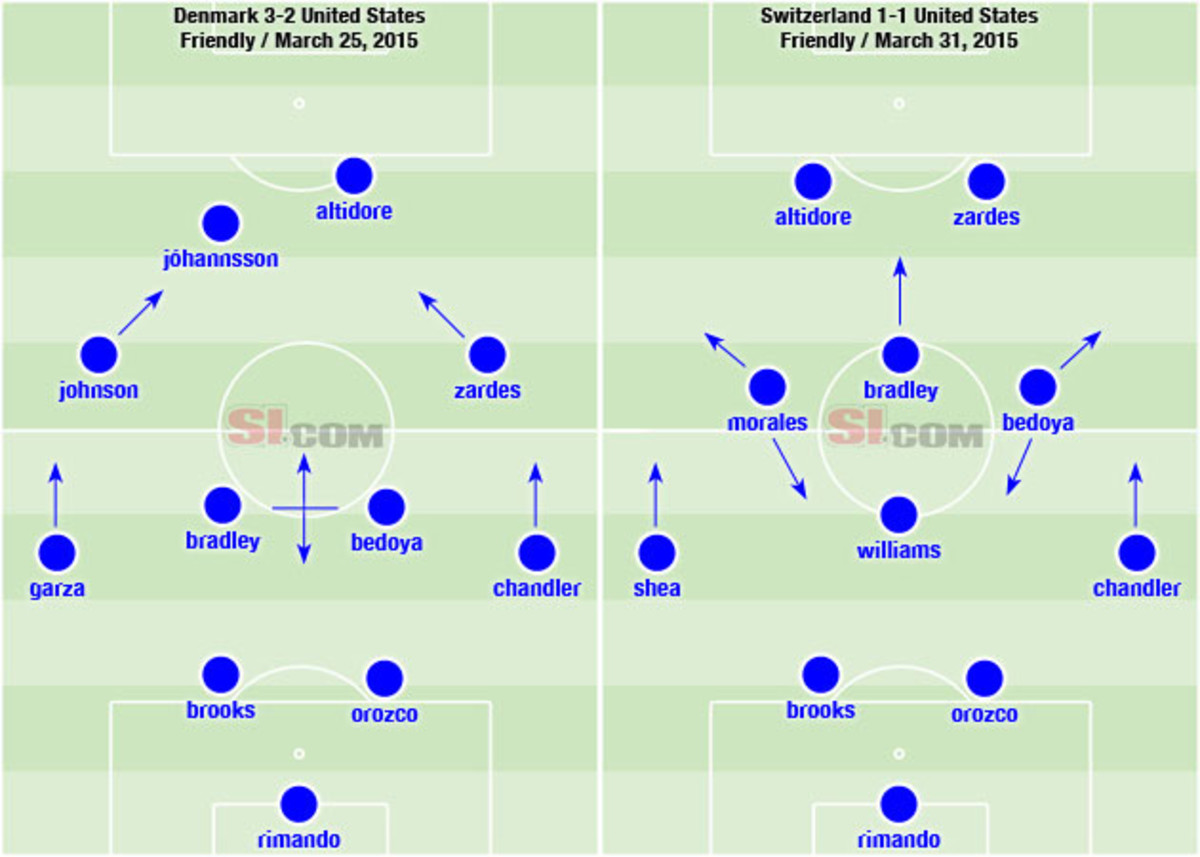
Against Denmark, Michael Bradley and Alejandro Bedoya comprised the central-midfield double pivot, in theory allowing one at a time to step forward and complement inside movements from the wingers. One of two forwards, usually Aron Jóhannsson, also pulled into midfield.
USMNT misses chance to fully change tone, course with Switzerland lapses
In the second match, Klinsmann gave Danny Williams his first cap in a year, underneath Bradley at the point of the diamond. However, Bradley’s return to the primary playmaking role again demonstrated the team’s lack of a true No. 10.
The void was more obvious in the first match, as the U.S. forced play vertically toward its forwards and down the wings.
The Americans had no choice but to play direct, as their steadiest presence in the No. 10 space was normally a forward dropping deep.
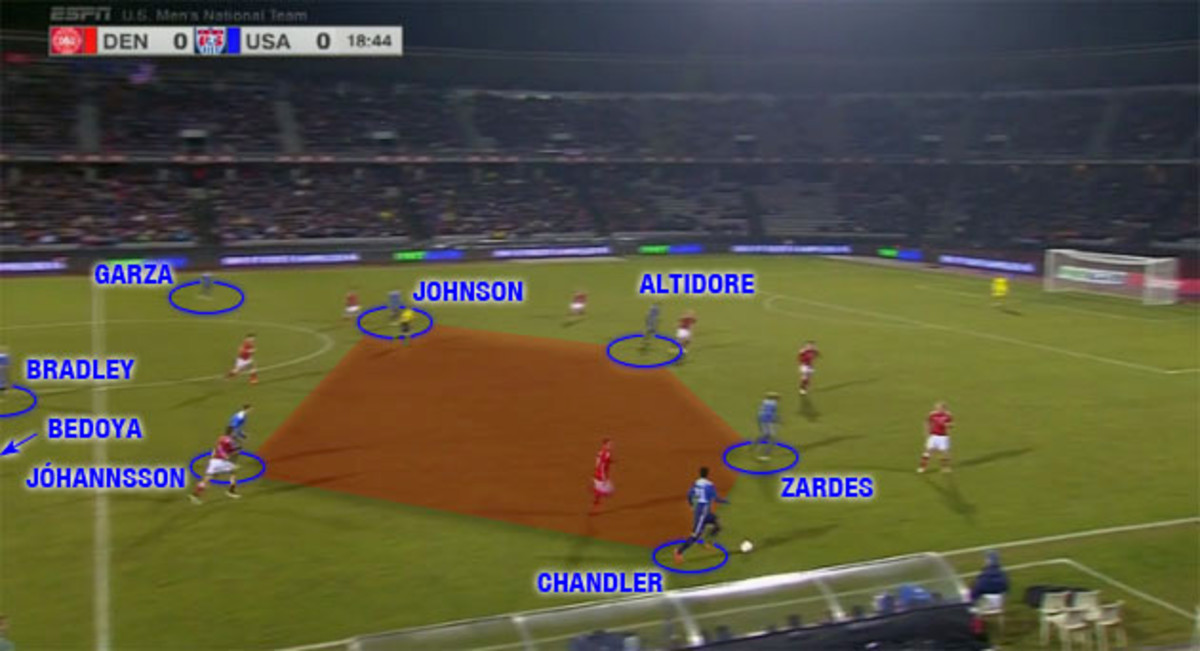
On the opening goal against Denmark, Jóhannsson dropped almost level with the holding-midfield block to effect a one-two with right back Timmy Chandler. As Chandler advanced, with no option ahead of him where a playmaker would normally reside, he lumped a hopeful ball forward.
USA improves, but indiscipline, late concession lead to Switzerland draw
Altidore latched onto it, fought off a defender and finished well, but the goal seemed to come out of nowhere because it did—it wasn’t the result of sustained pressure or a rehearsed team build-up.
On the right, Chandler offered the U.S. an option for getting into the attacking third, helped by Bedoya pulling wide as Gyasi Zardes concentrated on forward runs toward the penalty area instead of providing an outlet for possession.
Against Switzerland in the second match, the U.S.’s diamond midfield matched up well against the host side’s similar system. Bradley became the focal point again, in a free role underneath Altidore and Zardes, who played in his natural forward position after an invisible match at right wing.
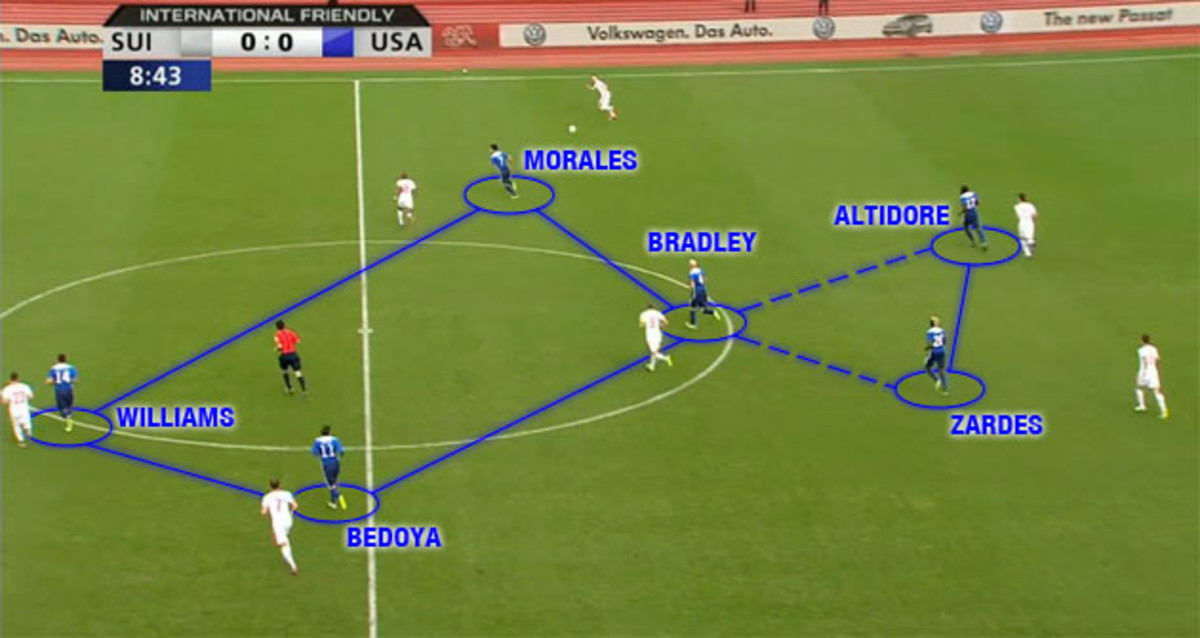
Playing a diamond midfield gave the U.S. a better organizational framework defensively, as Bradley could pop up between the forwards, who split to prevent simple passes across the Swiss back line. The rest of the midfielders matched up one-for-one, with Williams holding his own against Xherdan Shaqiri.
Not finding success centrally, Shaqiri pulled wide too often and disrupted Switzerland’s own attacking organization. He, and the rest of the team, did much better after switching to a traditional 4-3-3 at halftime.
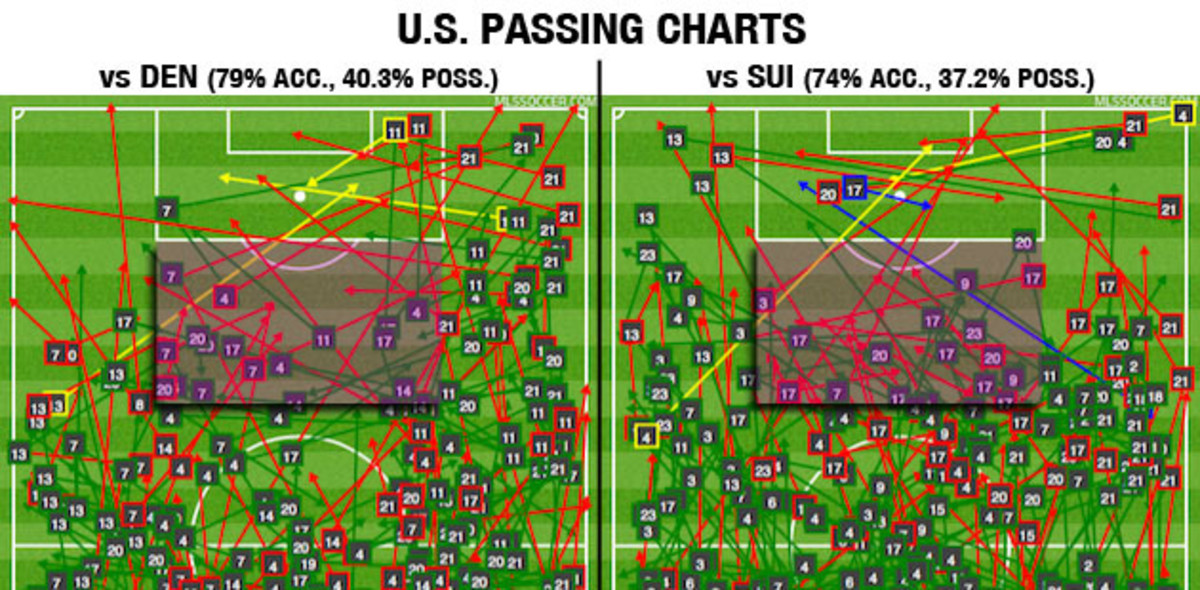
Despite seemingly being in more control against Switzerland than Denmark, the U.S. actually kept less possession, attempted fewer passes and connected on a lower percentage of its attempts in Zurich.
Outplayed once again, Klinsmann's USA sees repeated theme in Denmark
Even with Bradley in a higher role, the U.S. struggled to penetrate the Swiss penalty area from central areas. Service into the box came from the flanks again, and players aimed a remarkably low number of passes from Zone 14 (directly on top of the 18-yard box) into the area.
The problem has plagued the U.S. frequently since the World Cup, as Klinsmann cannot seem to find a playmaker capable of pulling the strings in attack the way Michael Krohn-Dehli did for Denmark.
The highest number of individual touches in Zone 14 in Aarhus came from the forwards pulling back, which meant they could not get into more dangerous scoring areas.
Defensively, the U.S. again conceded multiple goals in the final 10 minutes, dropping what would have been (in competitive matches) all three points against Denmark and two against Switzerland.
Even accounting for the multiple substitutions stunting the team’s rhythm in both games and Altidore’s foolish red card against Switzerland, the pattern remains the same: the U.S. cedes control of the match to the opposition and ends up picking the ball out of its own goal.
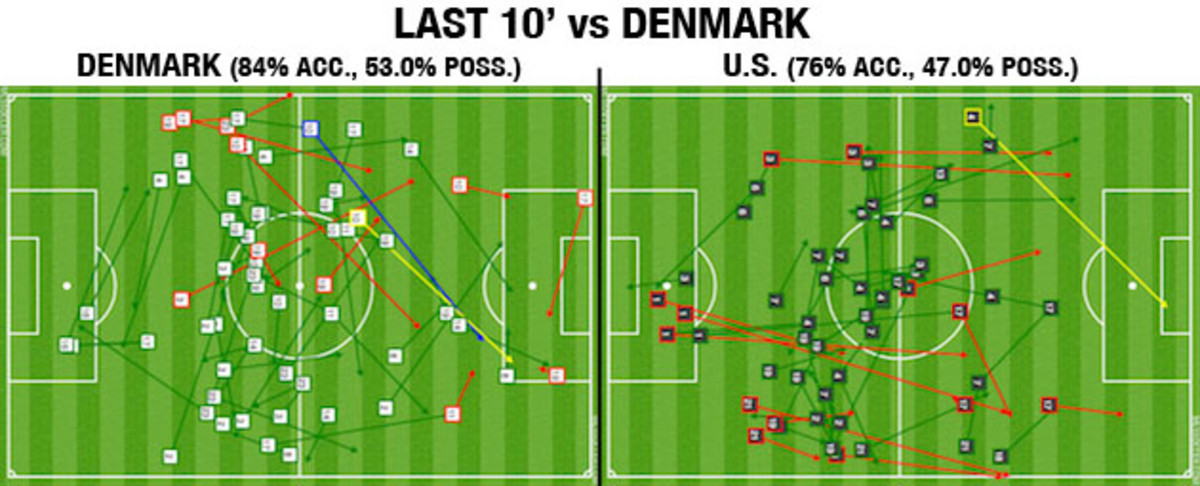
Against Denmark, possession remained near 50-50 after the 80th minute, but the Danes were more efficient with the ball. They completed eight percent more of their attempted passes than the U.S.
The U.S. struggled to kill off the clock, alternating between calm circulation in the middle—the central midfielders and center backs completed 93 percent of their passes during the crucial time frame—to aimless vertical balls from wide players.
Meet Tom King, one of USSF's most important people behind the scenes
An inability to keep the ball, coupled with moments of atrocious penalty-area defending, doomed the U.S. to conceding eight goals in the last 10 minutes of the last eight matches.
Most have come on basic errors: failing to pick up runners, scuffed clearances and a team shape and lack of possession that invites opposition pressure when minds and legs are at their most strained.
In the last two matches, Klinsmann’s team continued the same recent patterns. The promising moments in the second match were mostly down to the defensive organization, which evoke images of previous U.S. teams more than the new direction Klinsmann has been tasked with carrying the program.
Even with the desire—and need—to become more proactive in attack, the U.S. shouldn’t lose its core identity from the past of being difficult to play against and tough to break down. The best teams in the modern game aren’t just attacking machines; they are also air-tight in the back.
Re-living USA vs. Switzerland: 1994 World Cup
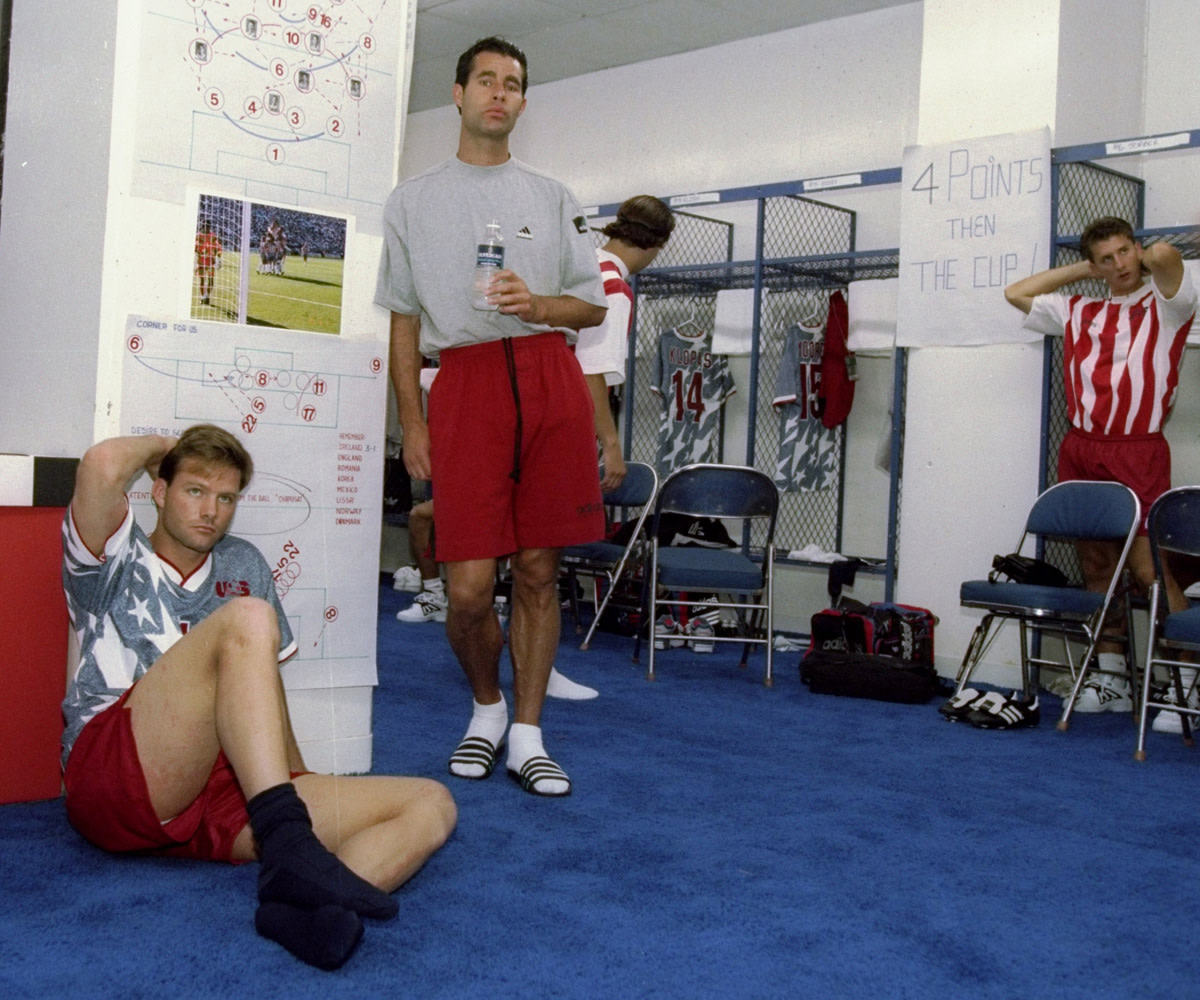
Eric Wynalda (sitting) and Roy Wegerle in the Silverdome locker room prior to taking on Switzerland in the 1994 World Cup.
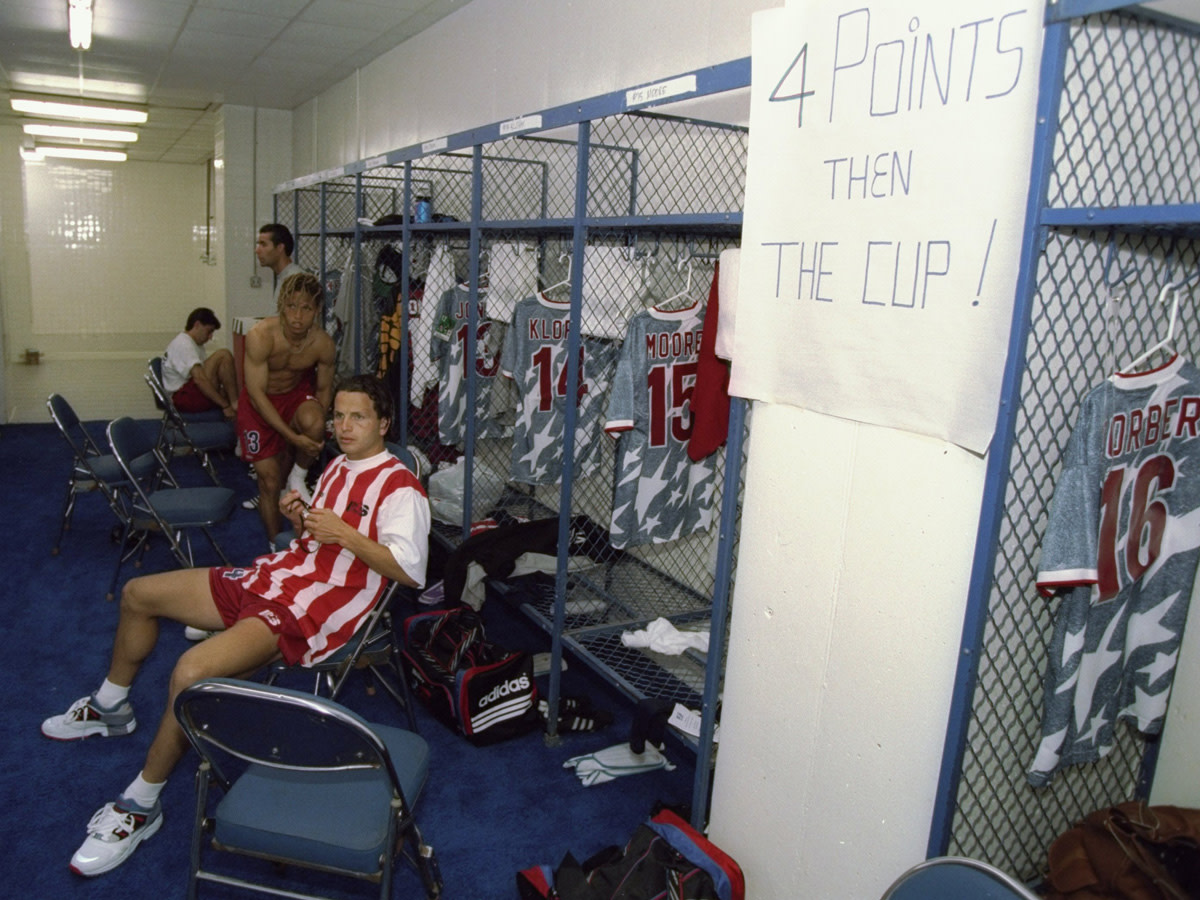
Frank Klopas sits at his locker room prior to the USA's 1994 World Cup match against Switzerland. On the wall, the message is clear.
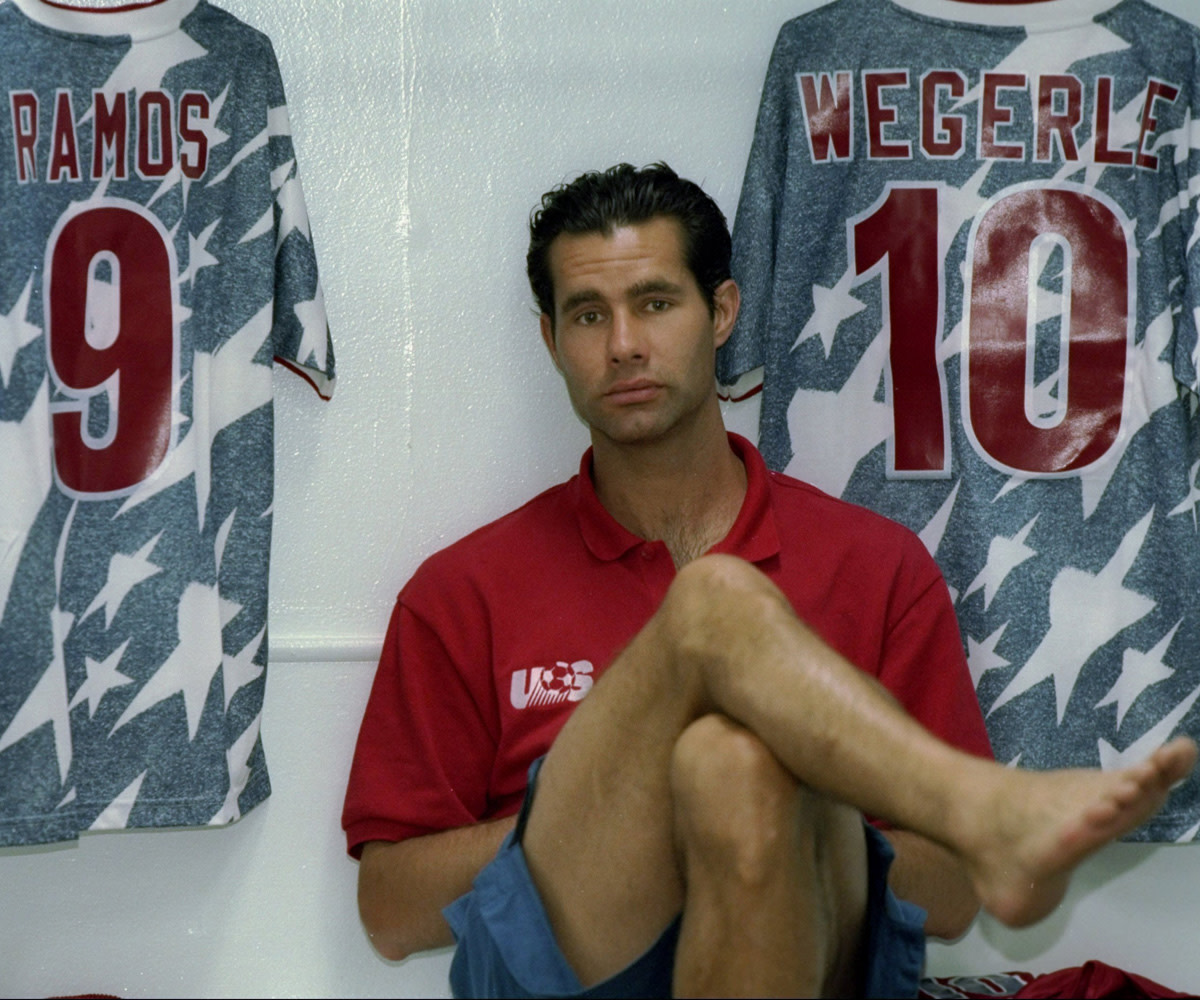
With Tab Ramos's and his own denim USA jersey draped above him, Roy Wegerle sits in the locker room prior to taking on Switzerland in the 1994 World Cup.
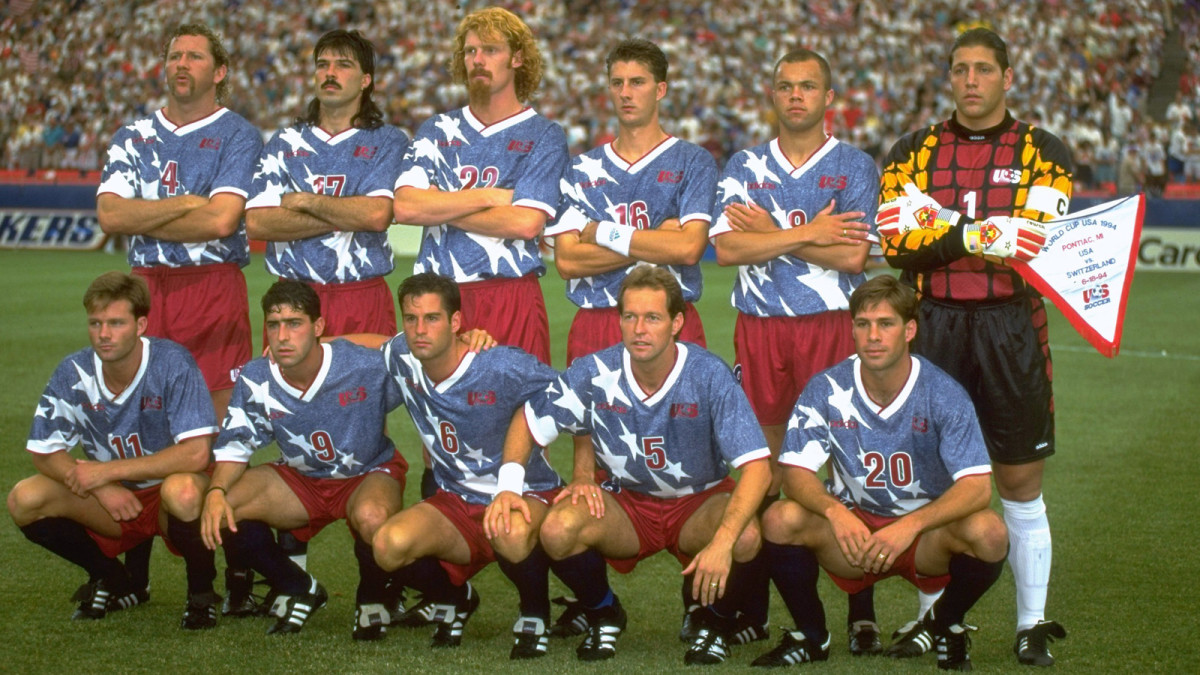
The USA starting lineup vs. Switzerland: (L-R Top) Cle Kooiman (4), Marcelo Balboa (17), Alexi Lalas (22), Mike Sorber (16), Earnie Stewart (8) and Tony Meola (1). (L-R Bottom) Eric Wynalda (11), Tab Ramos (9), John Harkes (6), Thomas Dooley (5) and Paul Caligiuri (20).

Alexi Lalas walks out of the tunnel and onto the Silverdome field, some 15 minutes from Birmingham, Michigan, where he was born.
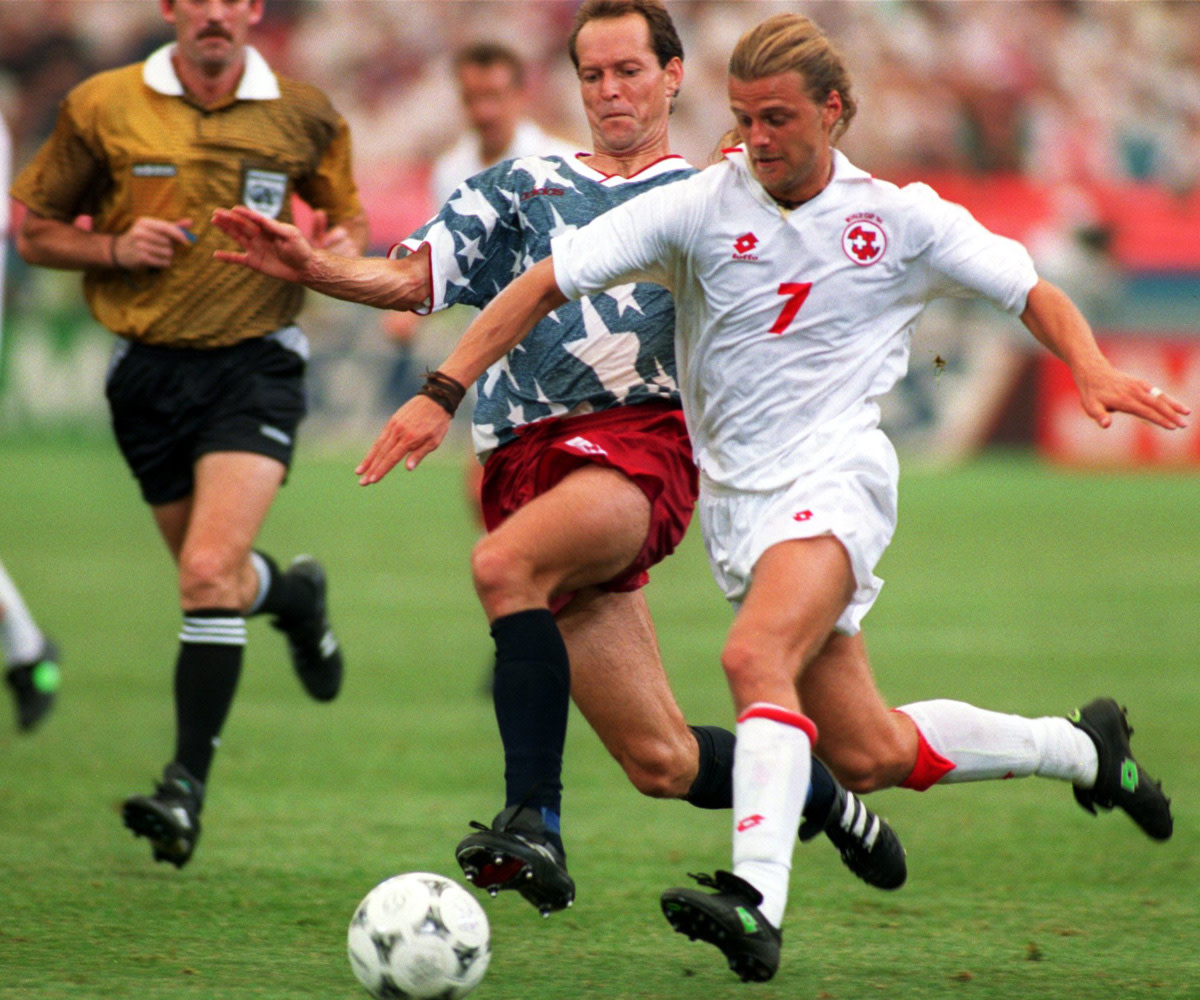
Thomas Dooley challenges Alain Sutter in the USA's 1994 World Cup match vs. Switzerland.
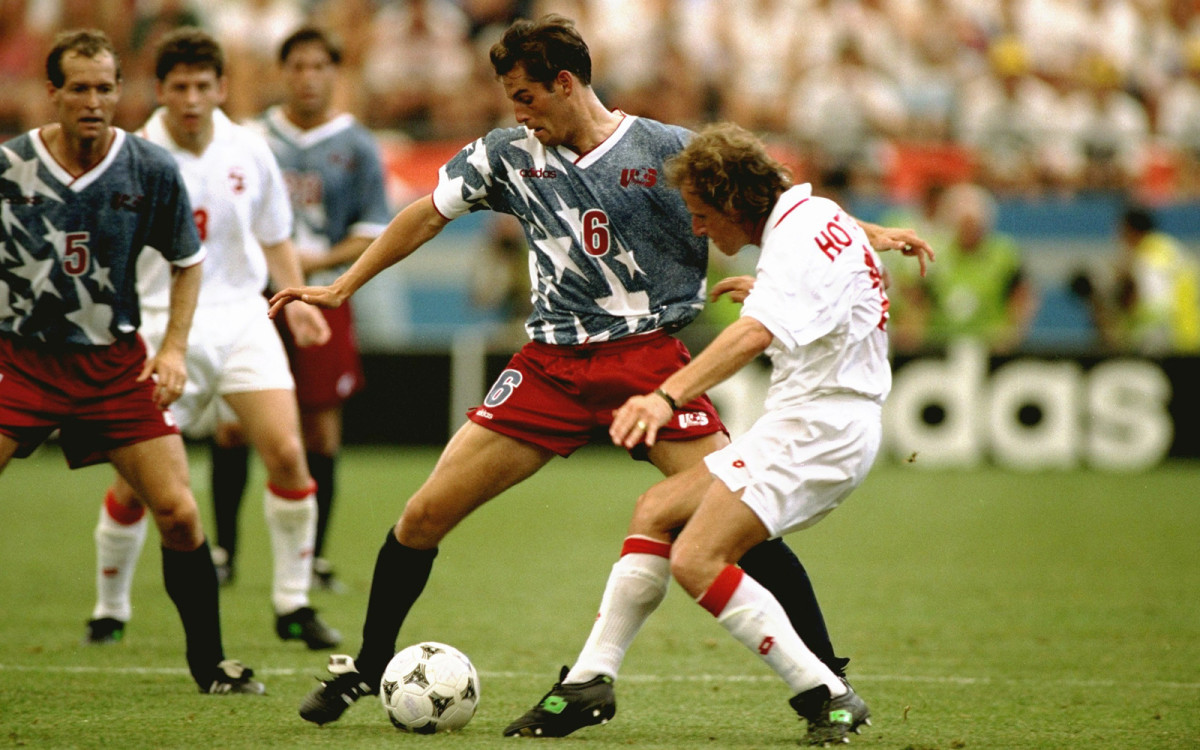
John Harkes fends off Switzerland's Marc Hottiger.
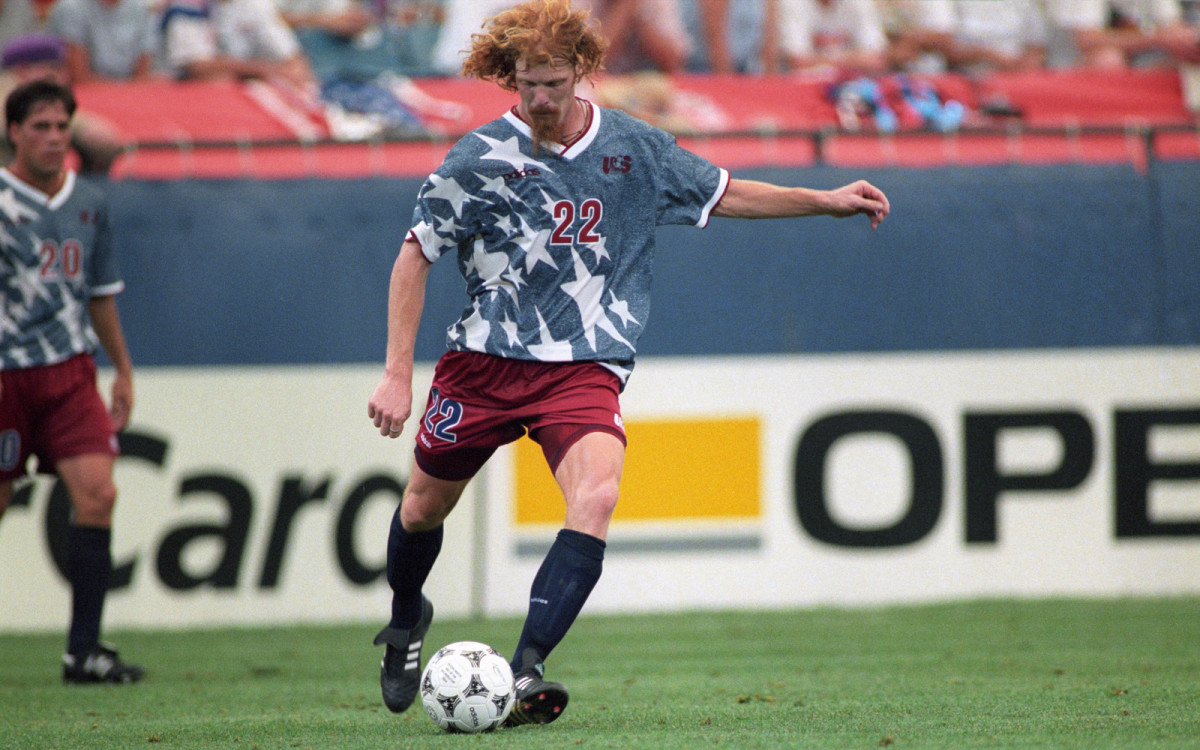
Alexi Lalas controls the ball vs. Switzerland.
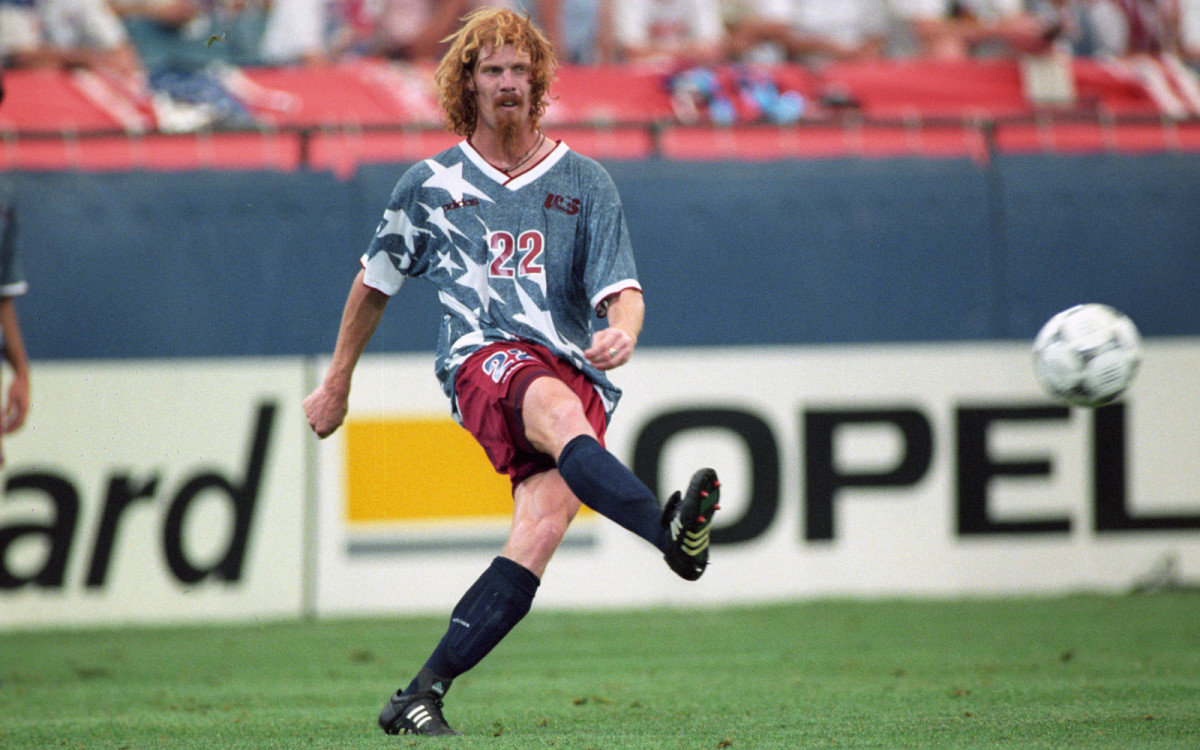
Alexi Lalas passes the ball upfield vs. Switzerland.
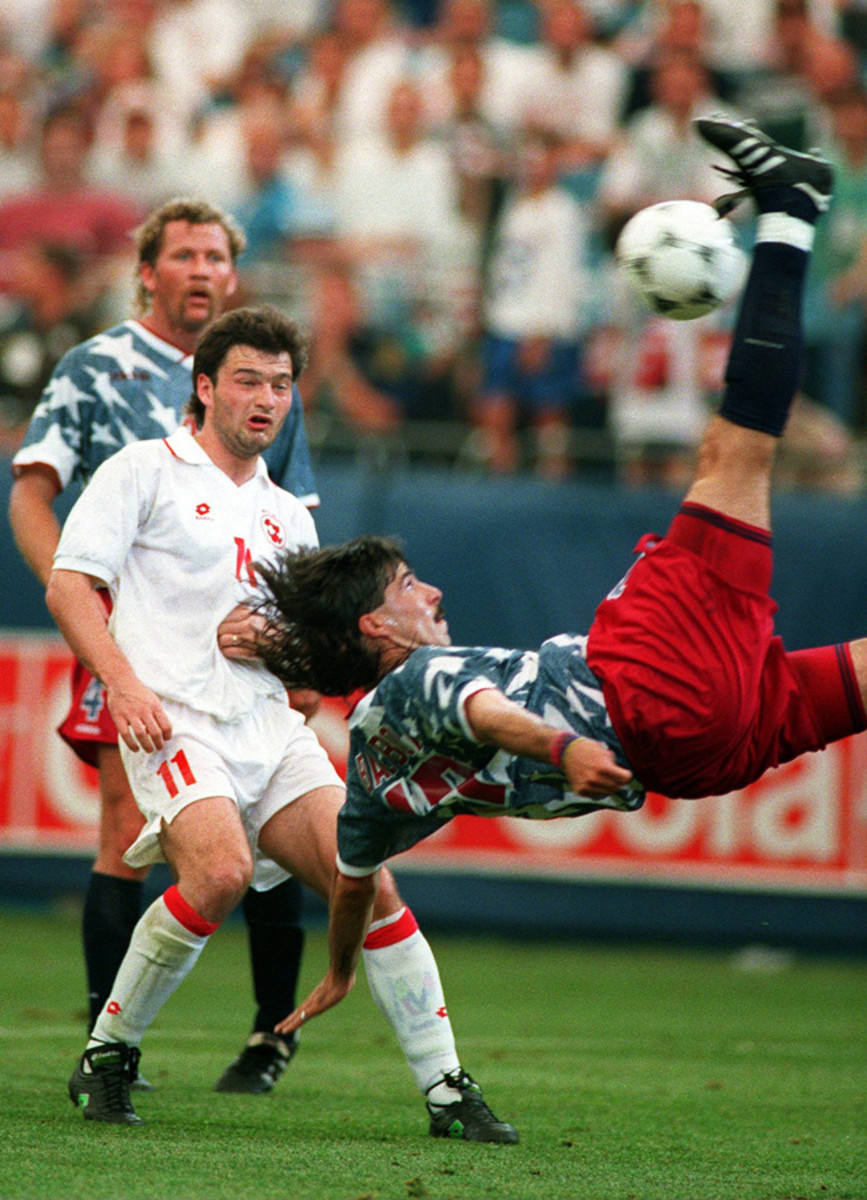
Marcelo Balboa tries a bicycle kick vs. Switzerland, foreshadowing his spectacular near make against Colombia in the next game that went just wide of the mark.
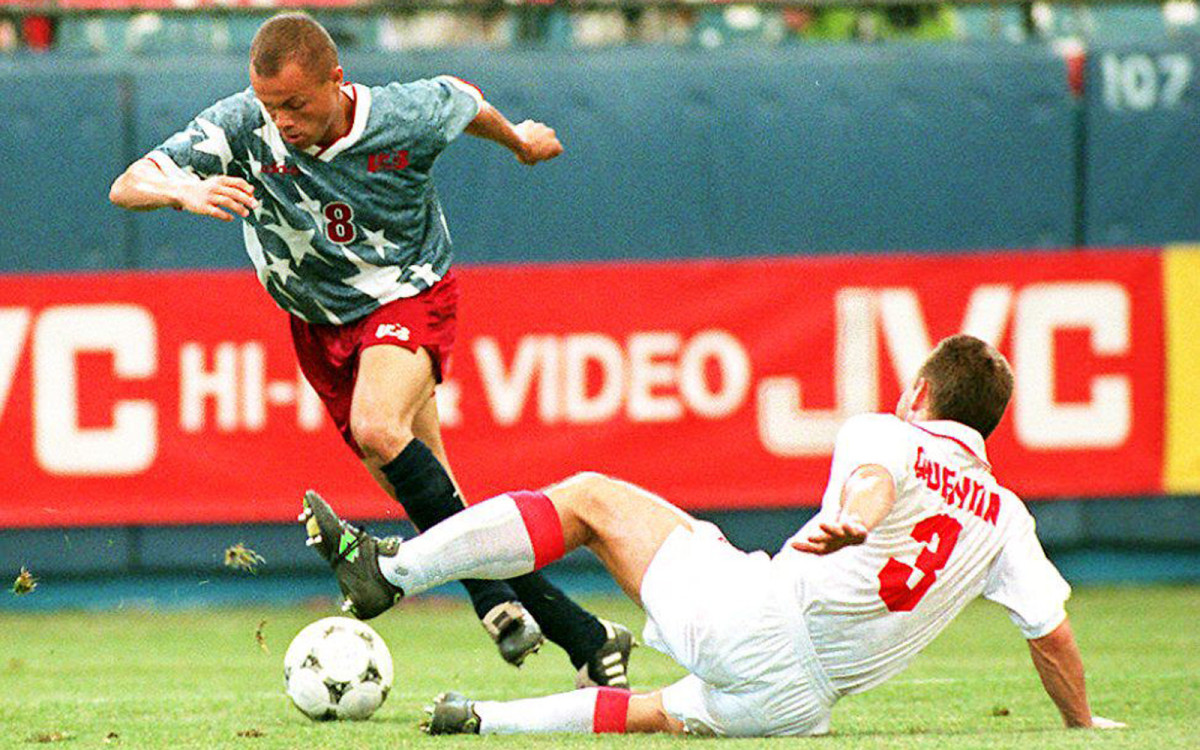
Earnie Stewart maneuvers by Yvan Quentin in the USA's 1-1 1994 World Cup draw vs. Switzerland.
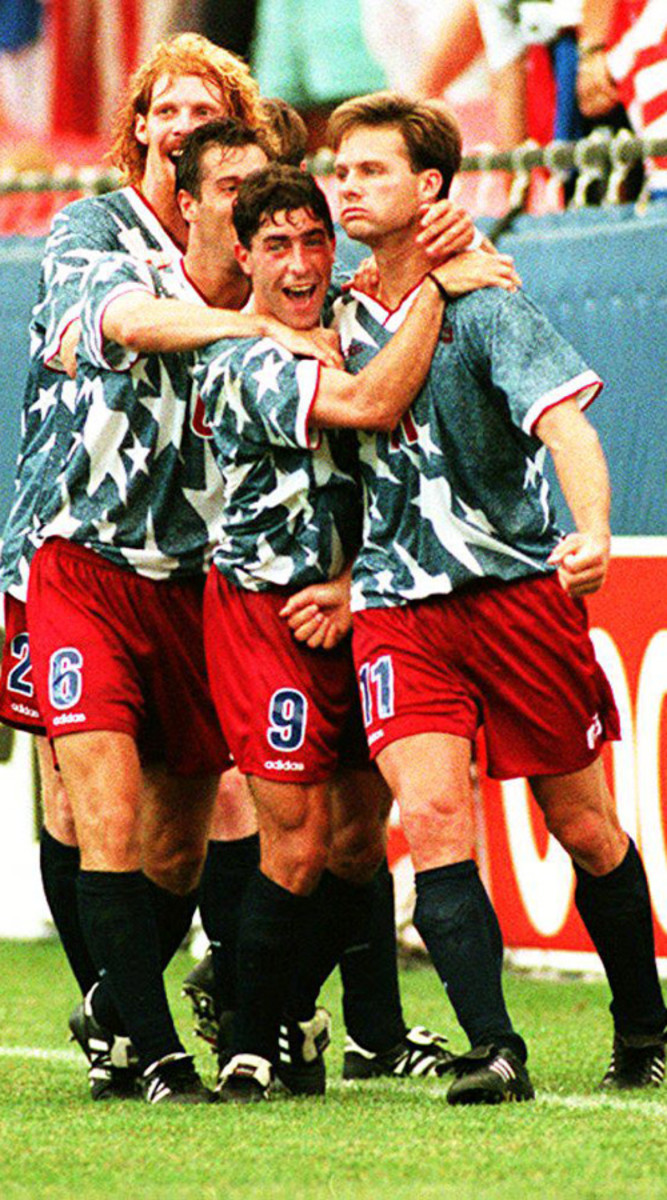
Eric Wynalda (right) is mobbed after scoring off a stellar free kick, which tied the game at the time and ultimately led to the USA's first World Cup point in 44 years.
It almost seems as if the team doesn’t know on which aspect to focus its energy, leading to breakdowns both ways. It’s a delicate balance that the U.S. hasn’t been able to strike recently.
As Pep Guardiola put it in Martí Perarnau’s Pep Confidential, “When we attack, it is important to defend as well, and when we defend, it is important to know how to attack. Football is attacking and defending. It is about attacking a lot and conceding very few opportunities.”
An organized defense gives a team better chances to win, regardless of how few opportunities it creates. If the U.S. can build on its defensive performance against Switzerland, with the addition of a solid final 10 minutes, it would provide a framework on which to build forward.
Before becoming a team that causes opposing defenses trouble, the U.S. must return to being a team that frustrates opposition attacks. At least then, the worst it could do is a scoreless draw.
GALLERY: USA vs. Mexico: The rivalry
USA vs. Mexico Soccer
November 11, 2016 – Mexico 2, USA 1
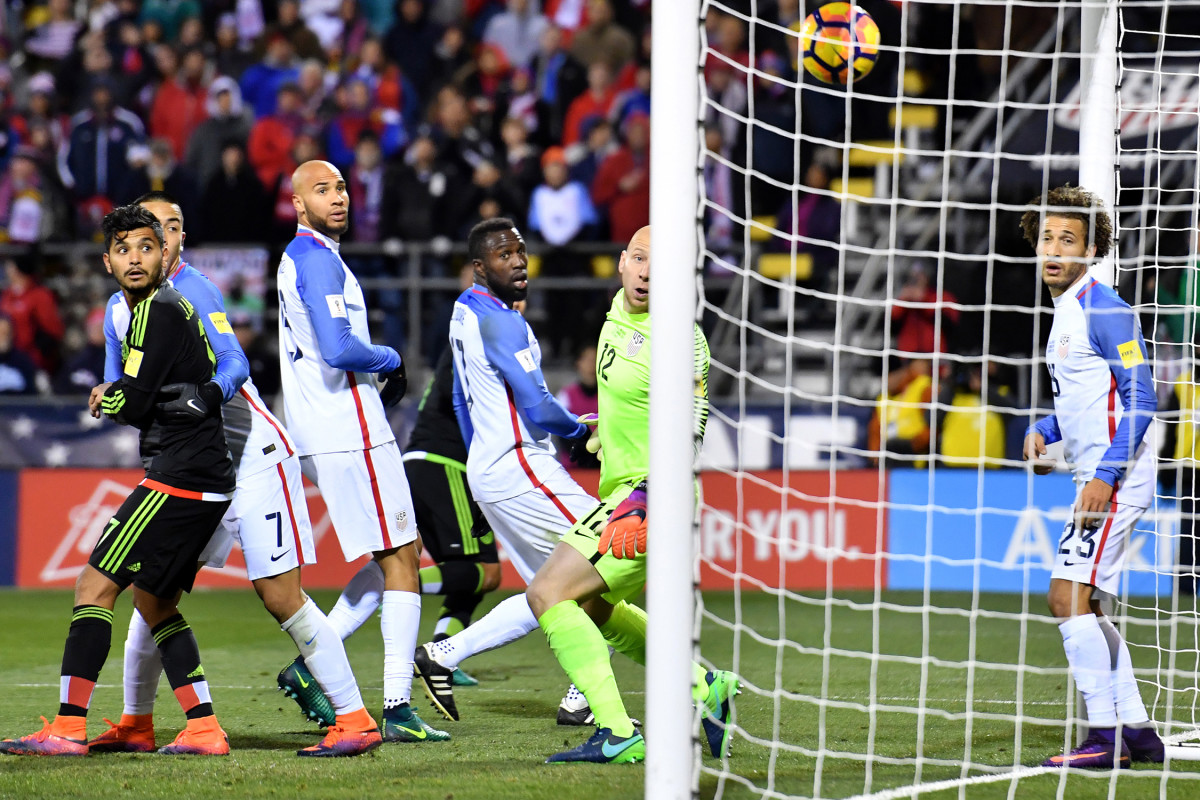
USA and Mexico players watch Rafa Marquez's 89th-minute header find the net in a famous World Cup qualifying win in Columbus for El Tri.
October 10, 2015 – Mexico 3, USA 2 (AET)
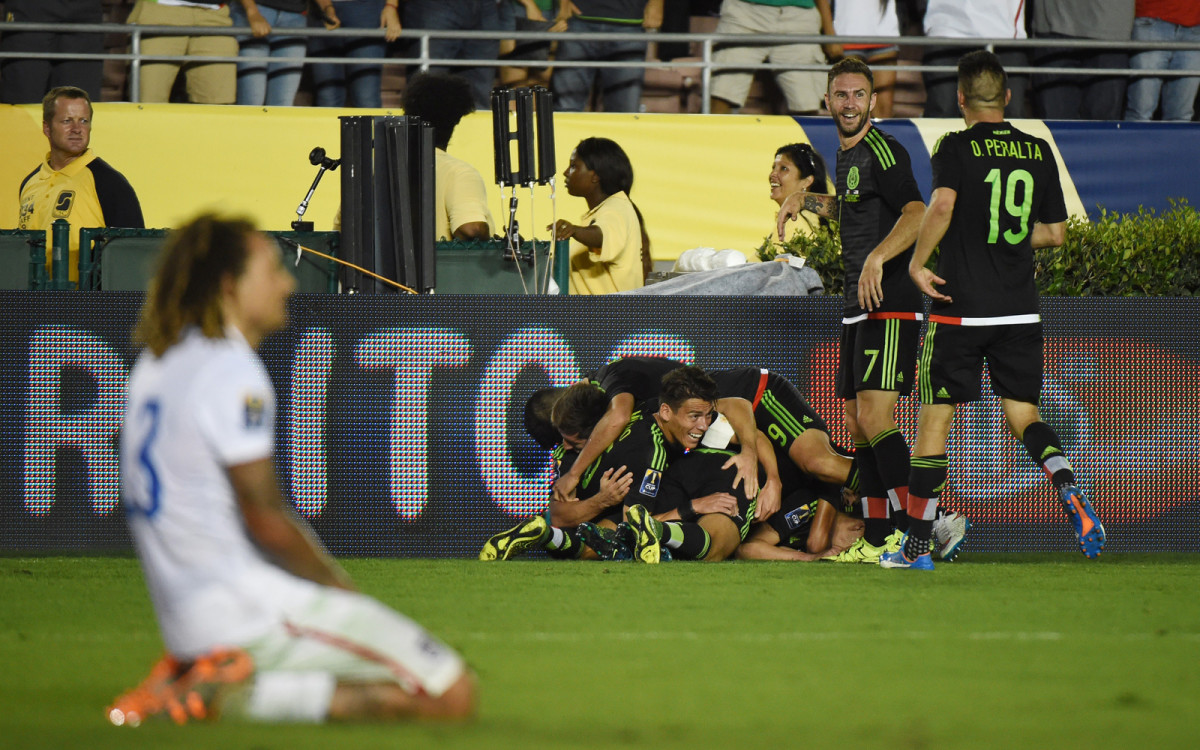
Jermaine Jones falls to his knees in disappointment as Mexico celebrates after Paul Aguilar's sensational volley in extra time captured the CONCACAF Cup for El Tri and sends the U.S. rival to the 2017 FIFA Confederations Cup.
April 15, 2015 — USA 2, Mexico 0
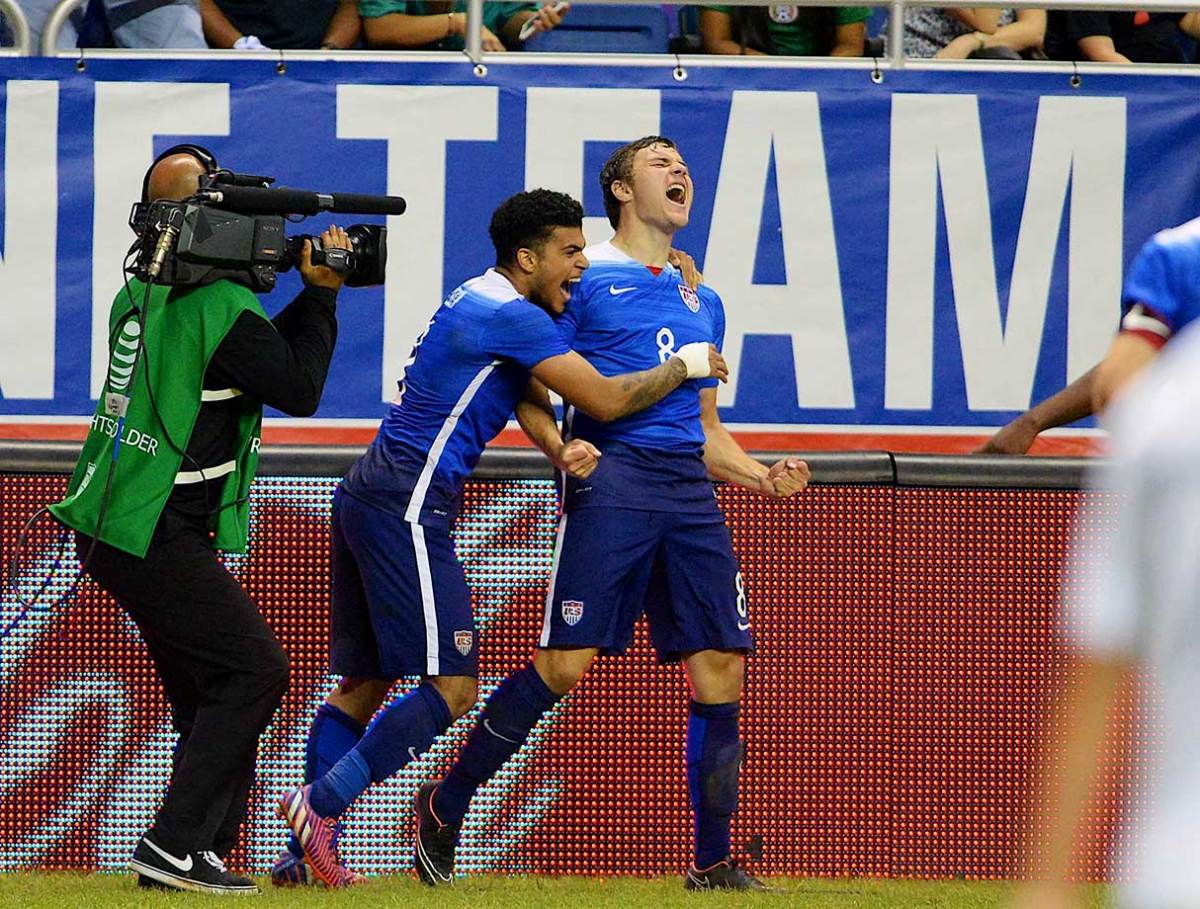
Stanford University's Jordan Morris marked his first senior national team start with his first international goal, sparking the USA in another 2-0 triumph over Mexico, this one at the Alamodome in San Antonio.
September 10, 2013 — USA 2, Mexico 0
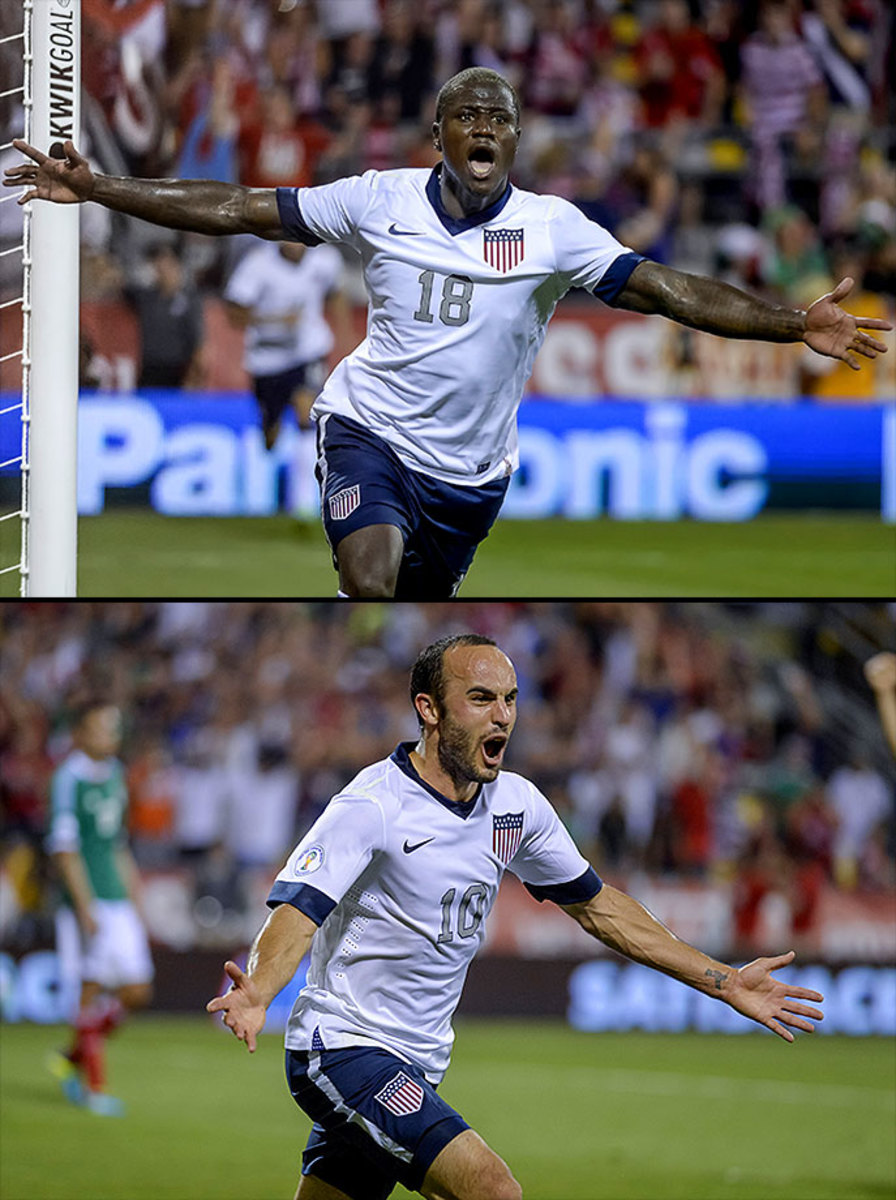
Eddie Johnson and Landon Donovan scored second-half goals to beat El Tri by the same score for the fourth consecutive qualifier in Columbus, Ohio.
March 26, 2013 — USA 0, Mexico 0
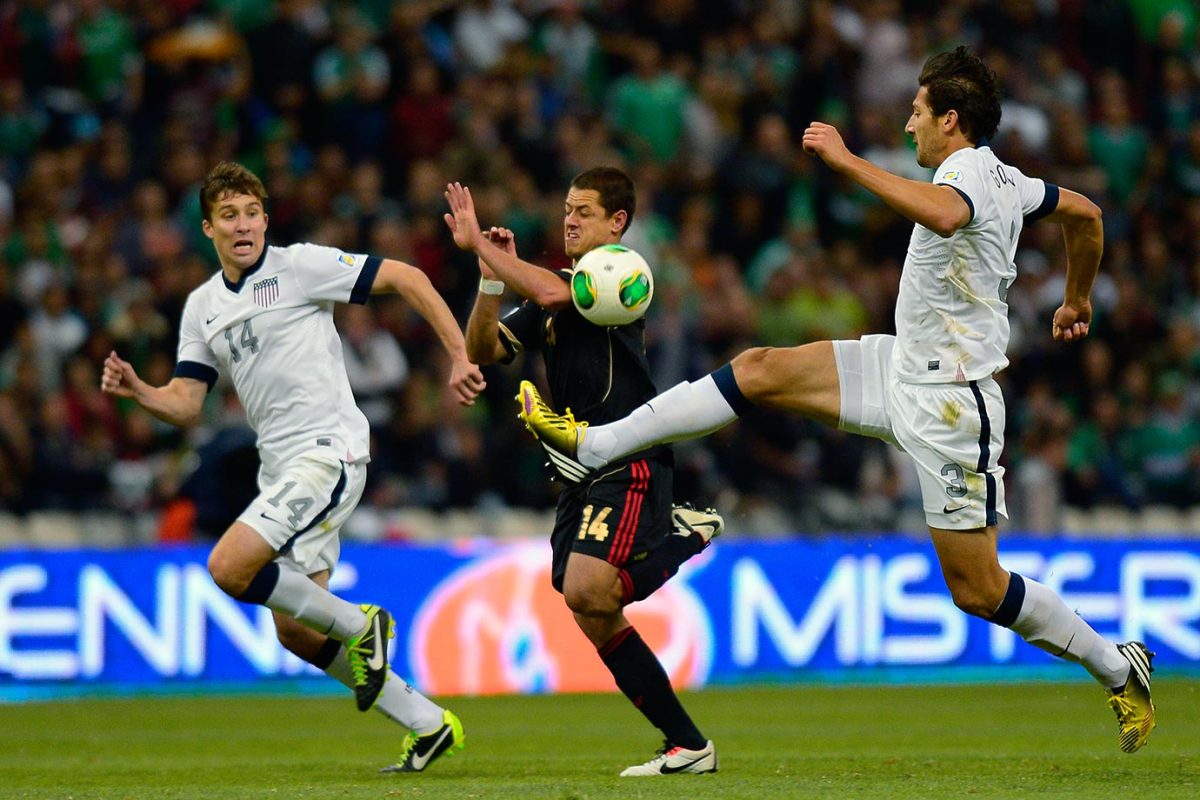
Clint Dempsey captained the U.S. to a 0-0 draw at Estadio Azteca, the second time ever the Americans registered a point in World Cup qualifying in Mexico (the other a 1997 tie). Defenders Omar Gonzalez and Matt Besler were the stars as Mexico couldn't cash in on several opportunities. The U.S. escaped to remain in second place in CONCACAF qualifying.
August 15, 2012 — USA 1, Mexico 0
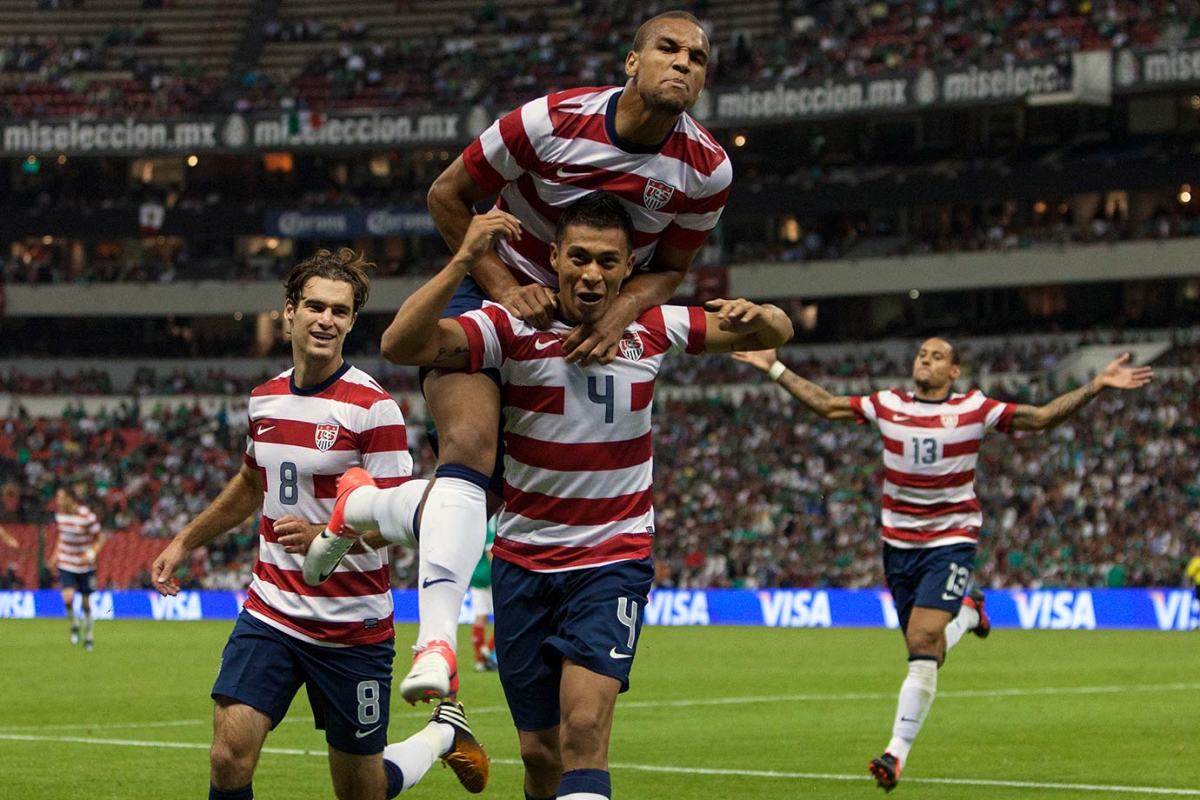
It took 25 attempts, but after this friendly, the United States could finally say that it had won at Mexico City's Azteca Stadium. Despite being outplayed for most of the match, the U.S. won thanks to an 80th-minute goal from Michael Orozco Fiscal — the first international goal of his career.
August 10, 2011 — USA 1, Mexico 1
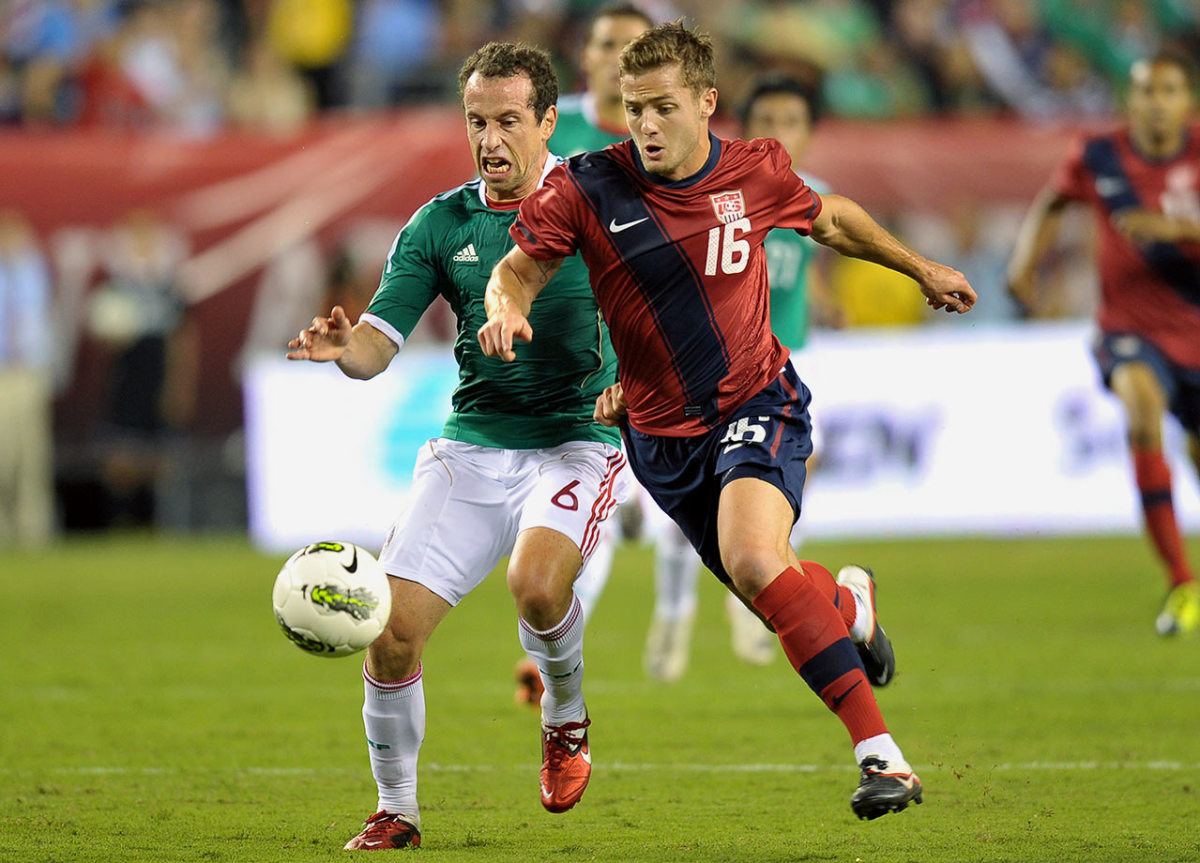
Head coach Jurgen Klinsmann's U.S. debut got off to a rough start, as the Americans trailed Mexico, 1-0 after an uninspired first half in Philadelphia. The U.S. showed more verve after halftime, though, and an impressive display from Brek Shea and a 73rd-minute goal from Robbie Rogers led to a 1-1 draw.
June 25, 2011 — Mexico 4, USA 2
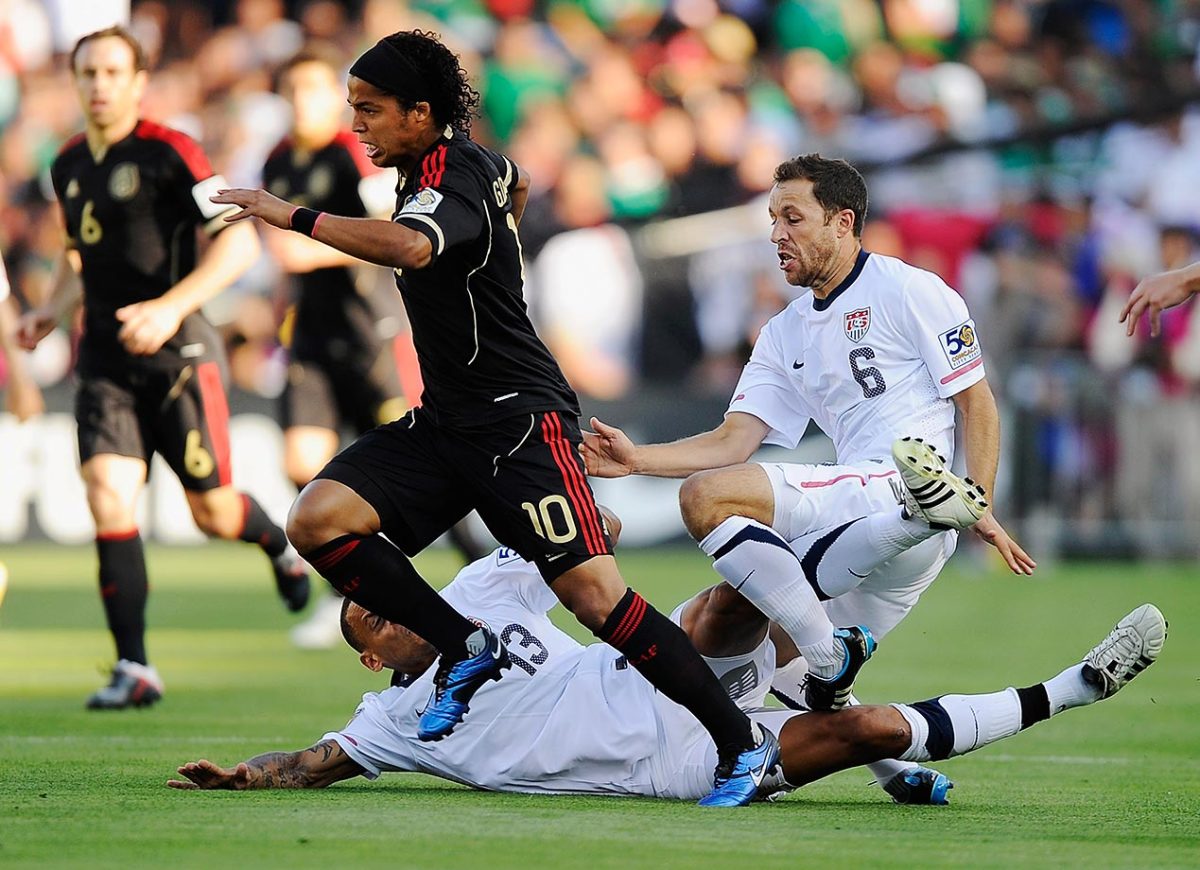
In the Gold Cup final, Mexico captured its second straight title in the battle for CONCACAF bragging rights and secured a berth in the 2013 Confederations Cup. Pablo Barrera scored twice; Giovani Dos Santos and Andres Guardado also had goals. The U.S. was up 2-0 early on Michael Bradley and Landon Donovan goals, but poor defending (partially due to the loss of Steve Cherundolo by injury) doomed the Americans.
August 12, 2009 — Mexico 2, USA 1
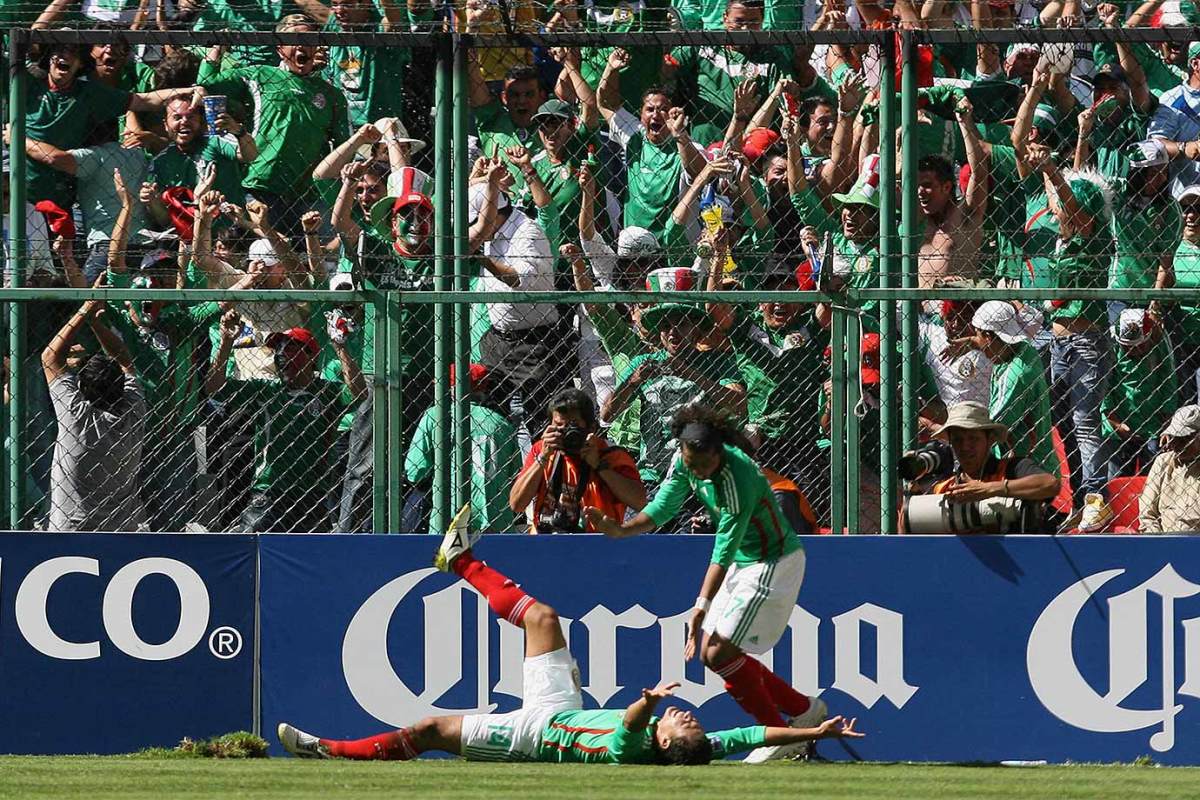
The U.S. took its first-ever lead at Azteca Stadium, but went on to lose 2-1 in what was a critical World Cup qualifier for Mexico. The win changed the tide for the then-struggling Mexican squad, as it went on to go 3-0-1 in its next four matches to earn a trip to South Africa. The U.S. still went on to finish first in CONCACAF qualification.
July 26, 2009 — Mexico 5, USA 0
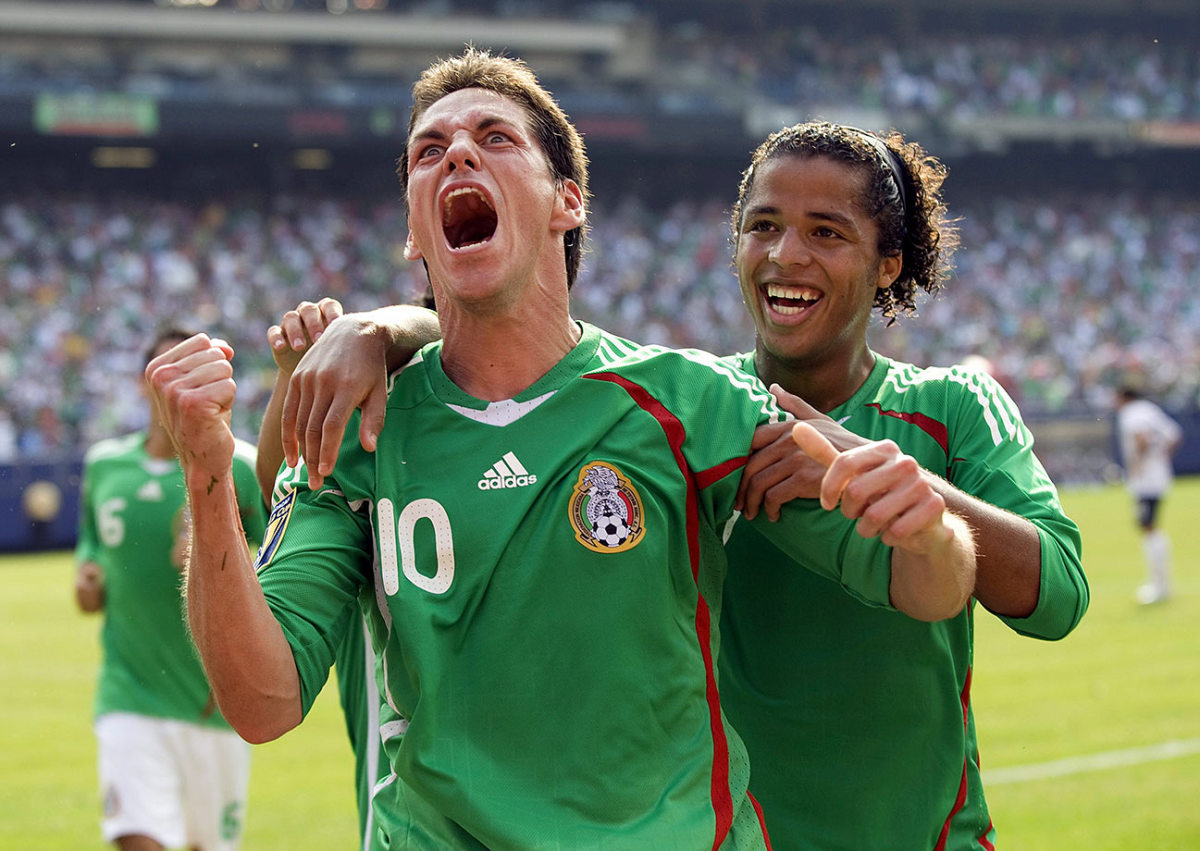
Mexico put an emphatic end to the Americans' 9-0-2 home streak against "El Tri." The Mexicans took the Gold Cup from the two-time defending champion, with five different players scoring goals in the second half at Giants Stadium.
February 11, 2009 — USA 2, Mexico 0
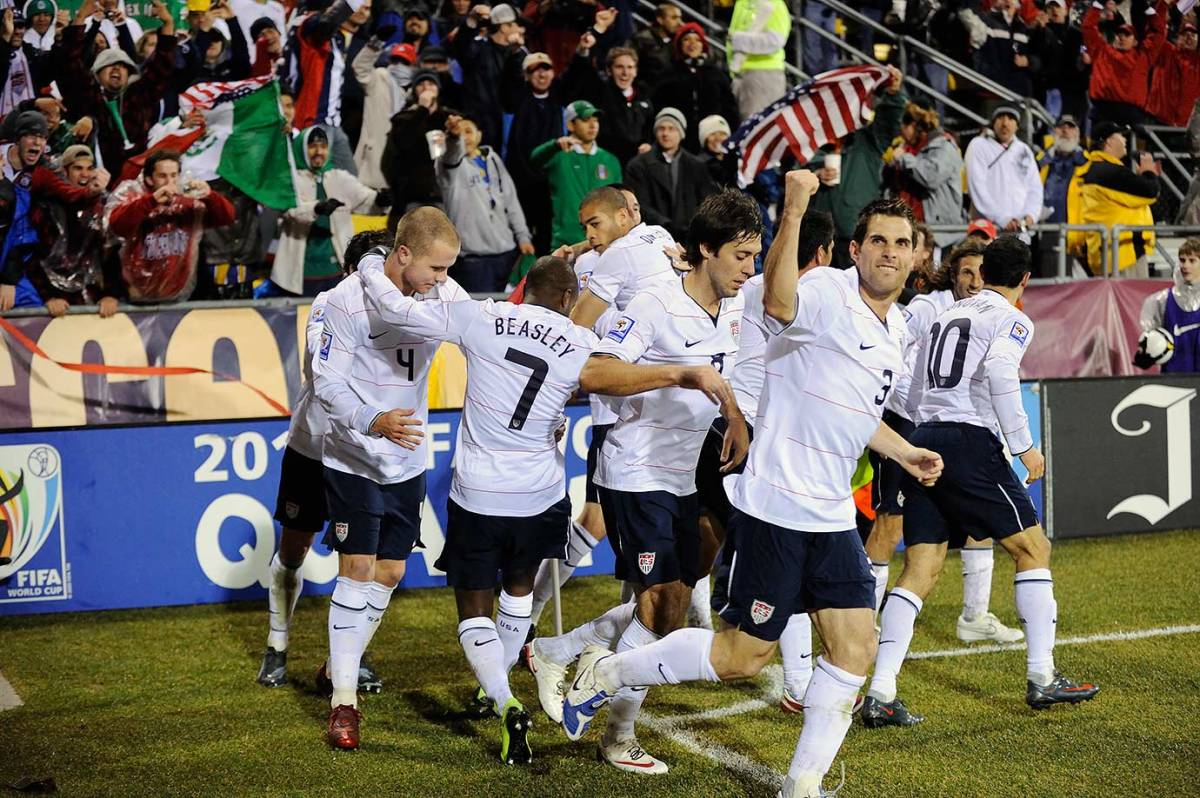
Two goals from Michael Bradley gave the U.S. another home victory over Mexico. It marked the eleventh consecutive time that the Americans had gone unbeaten against Mexico when playing on U.S. soil.
June 24, 2007 — USA 2, Mexico 1
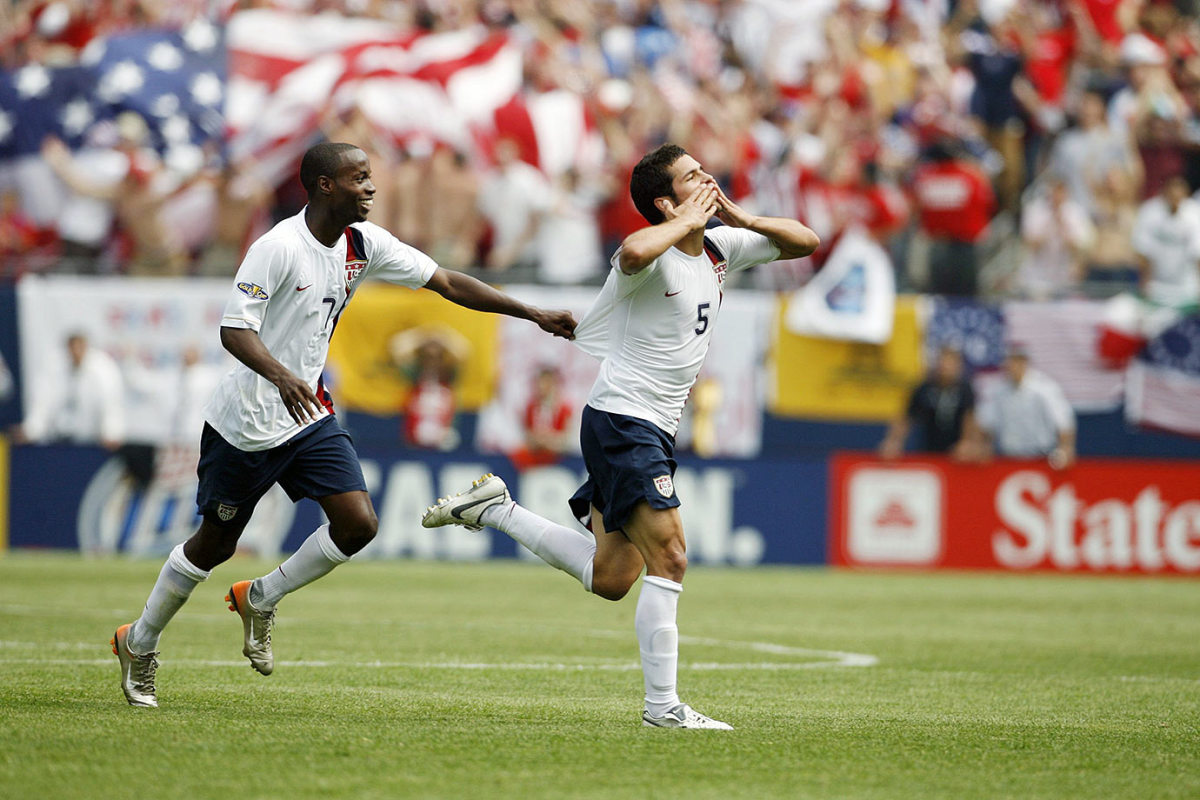
Down 1-0, second-half goals from Landon Donovan and Benny Feilhaber gave the U.S. the victory in the 2007 Gold Cup finals. The win earned the Americans a spot in the 2009 Confederations Cup, where they achieved their famous upset over Spain.
September 3, 2005 — USA 2, Mexico 0
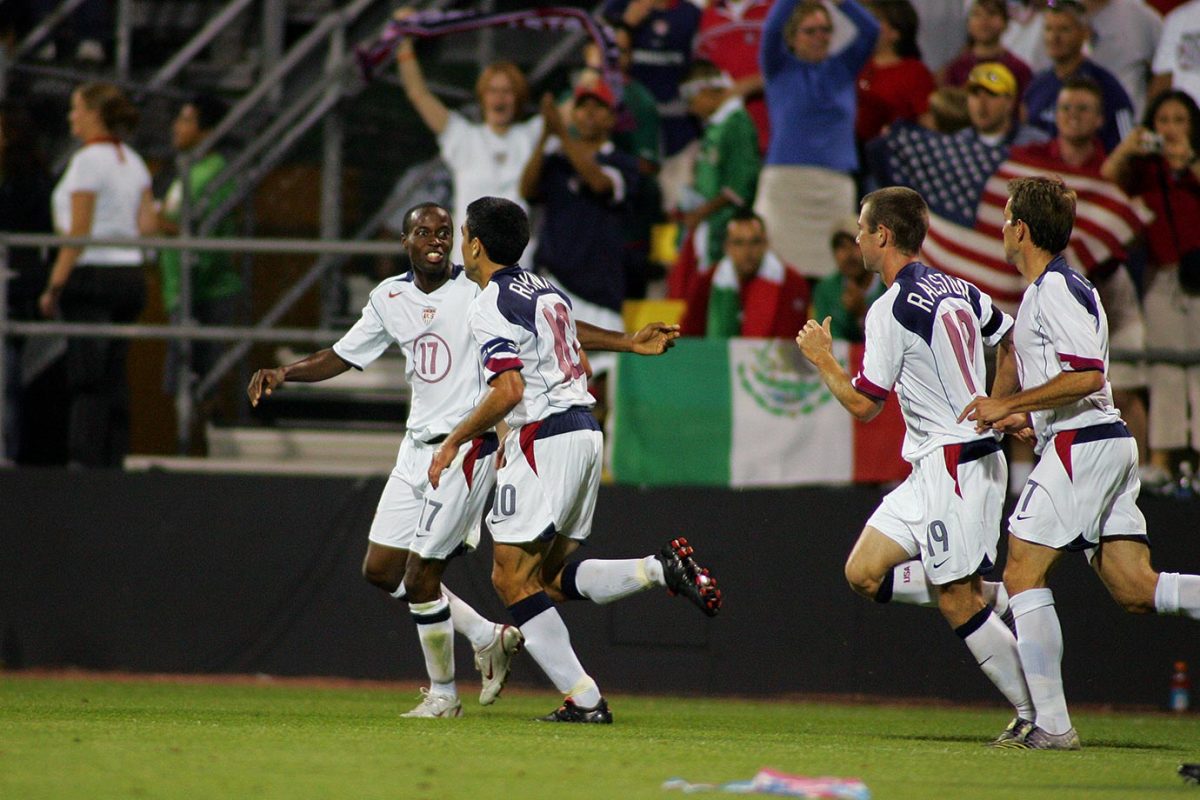
A 2-0 victory over "El Tri" clinched a spot in the 2006 World Cup, with goals coming from Steve Ralston and DaMarcus Beasley.
May 8, 2003 — USA 0, Mexico 0
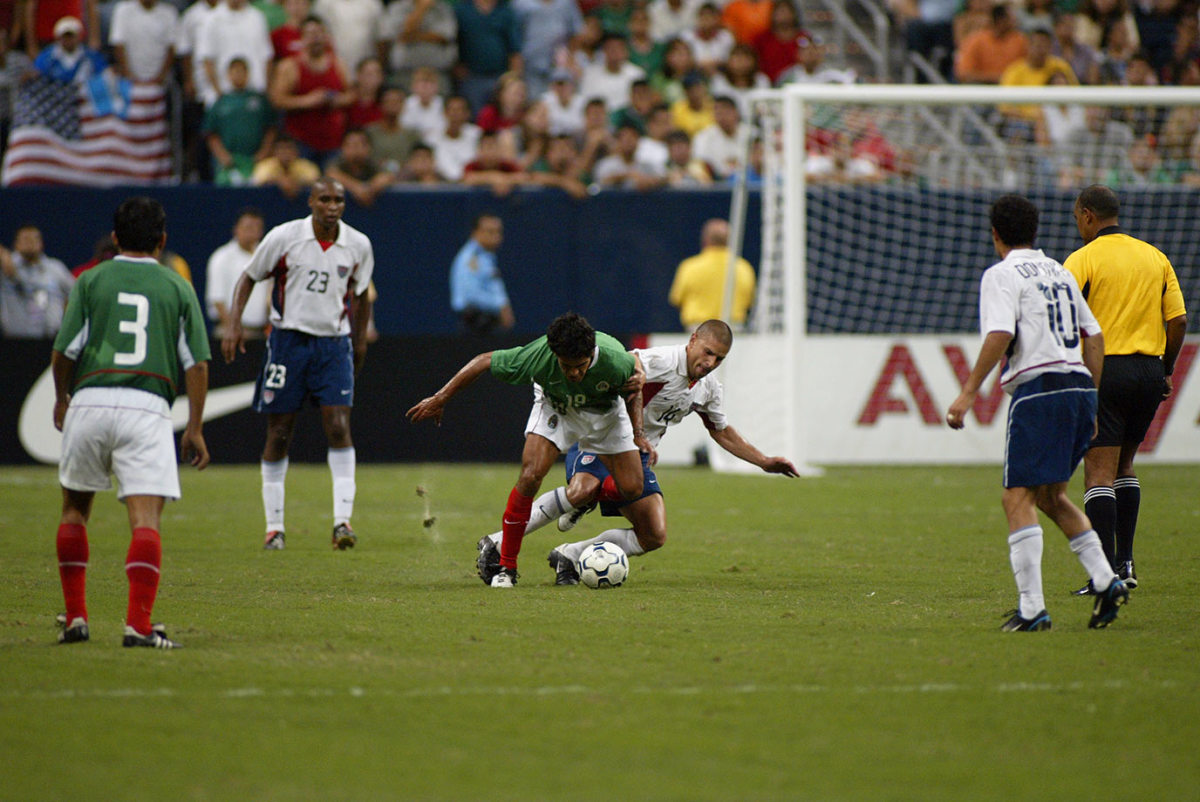
In their first meeting since the 2002 World Cup, an all-MLS squad of Americans played Mexico to a 0-0 draw in front of more than 69,000 people in Houston.
June 17, 2002 — USA 2, Mexico 0
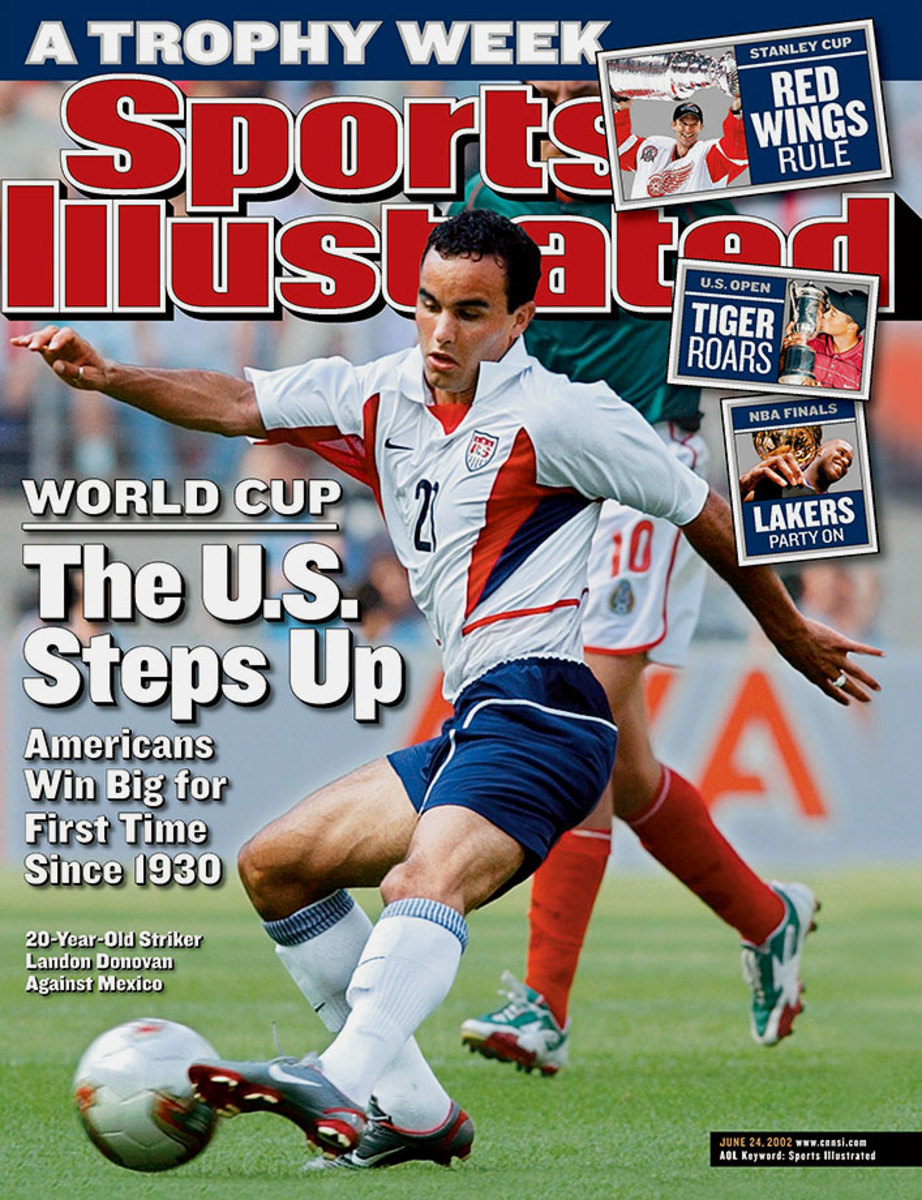
Arguably the biggest win in U.S. soccer team history came against its archrivals at the 2002 World Cup. Brian McBride and Landon Donovan gave the Americans a 2-0 victory in South Korea to send their team to the quarterfinals. It is the furthest stage the team has reached in the World Cup since 1930.
July 1, 2001 — Mexico 1, USA 0
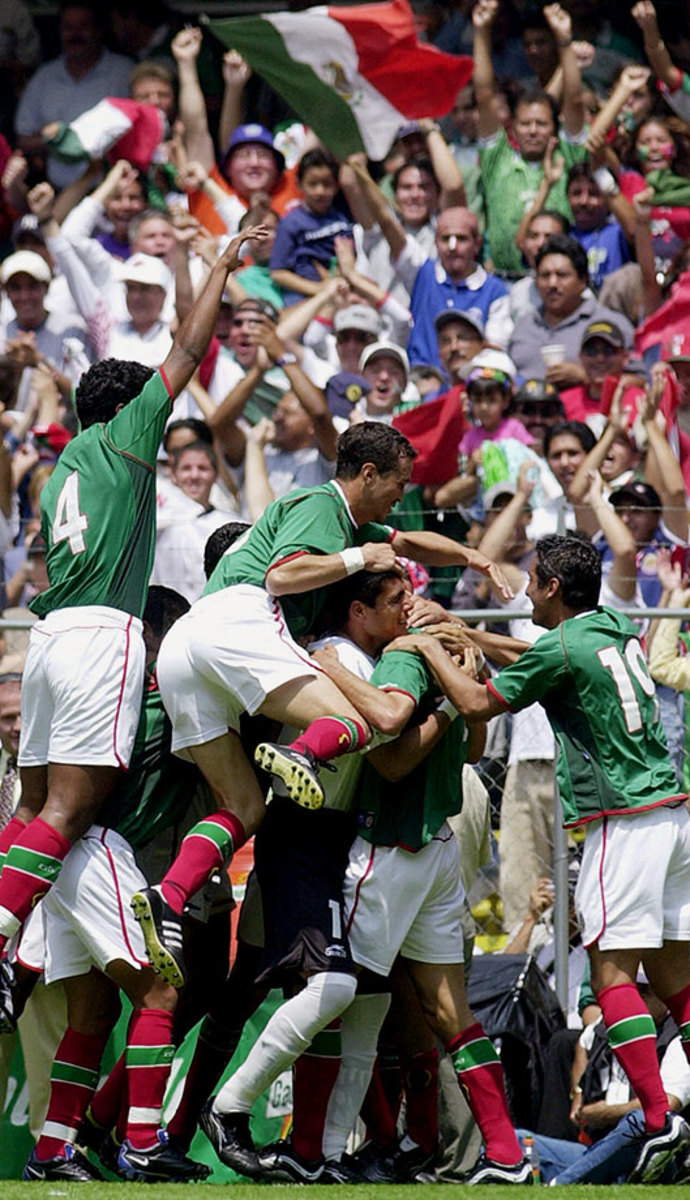
Needing a win to stay in contention for the 2002 World Cup, the Mexicans won 1-0 at Azteca Stadium, making their record 21-0-1 when hosting the Americans.
February 28, 2001 — USA 2, Mexico 0
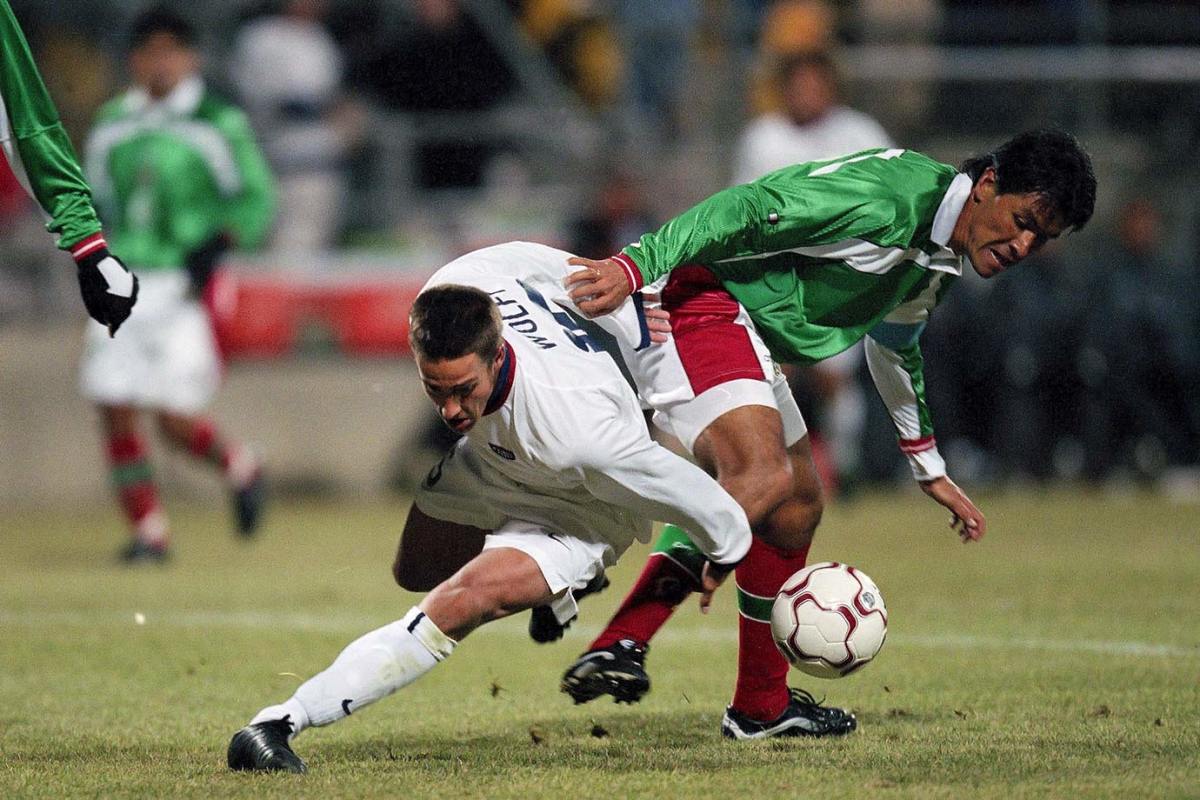
For the first time ever, the Americans won their third consecutive game against Mexico. The victory came in the World Cup qualifying finals and was held in Columbus, Ohio.
August 1, 1999 — Mexico 1, USA 0
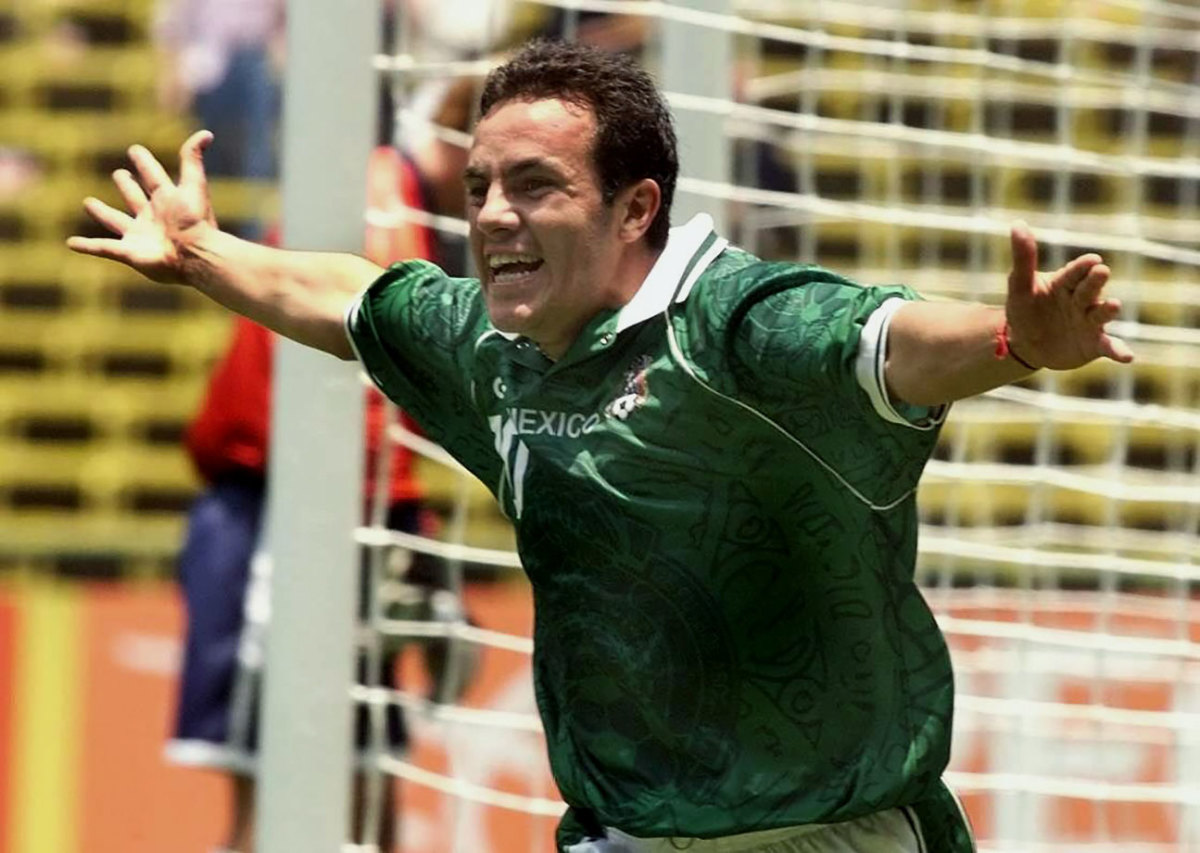
Cuauhtemoc Blanco's goal in extra time eliminated the U.S. in the semifinals of the 1999 Mexico City Confederations Cup. The win capped off a long tradition of Mexican dominance over the American side, a streak that shortly thereafter ended, as the Americans won the next three matches against their rivals.
July 17, 1995 — USA 0, Mexico 0
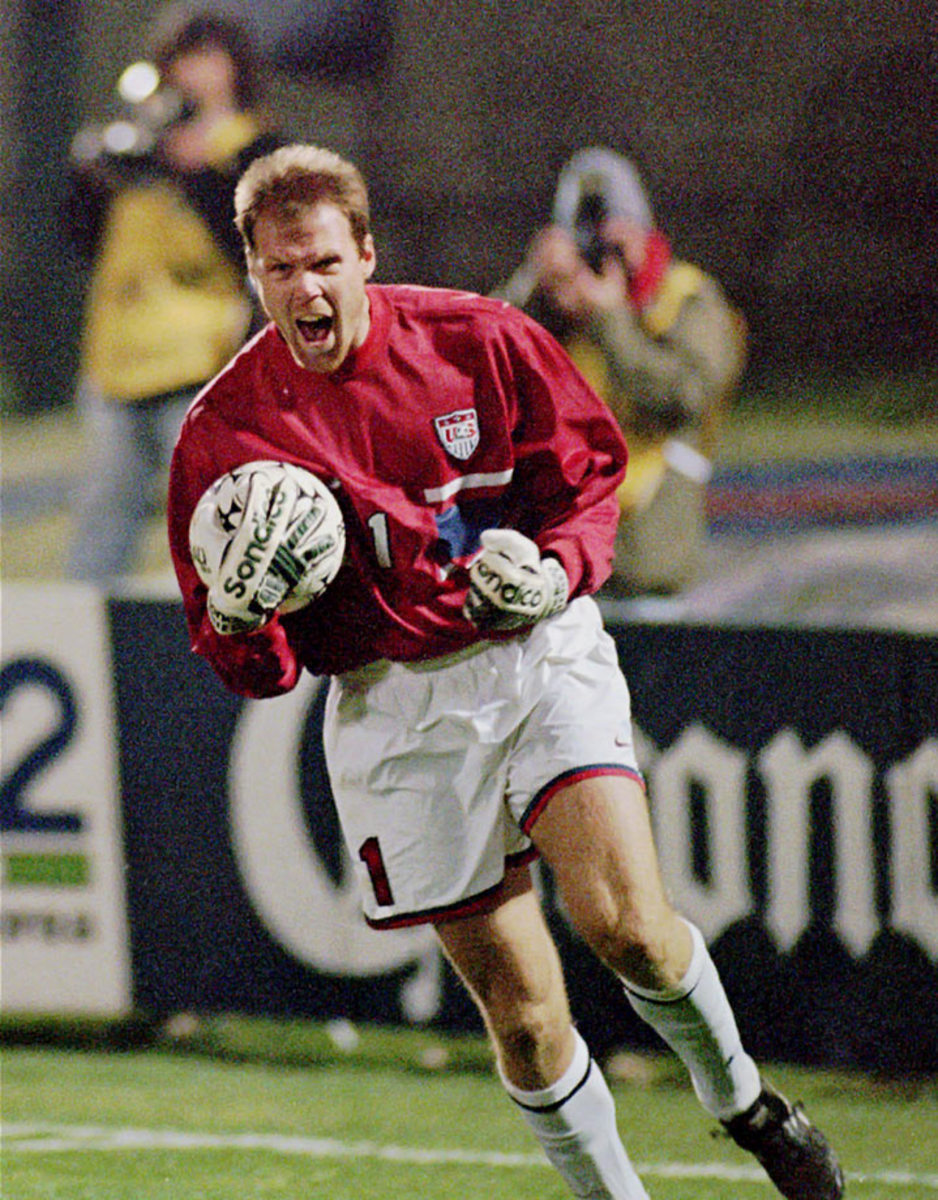
The USA outlasted Mexico in a penalty shootout to reach the semifinals of the 1995 Copa America. After a 0-0 draw, goalkeeper Brad Friedel was the hero in PKs, making two saves. The U.S. made all four of its attempts and advanced.
 Add us as a preferred source on Google
Liviu Bird is a soccer analyst with more than 20 years of experience in the game. He learned how to play in the streets of Romania before moving to the soccer wilderness of Fairbanks, Alaska, escaping to play collegiately as a goalkeeper at Highline Community College and Seattle Pacific University, where he also earned his B.A. in journalism. Bird played semiprofessionally and had tryouts at professional clubs but hung up his gloves in 2012 to focus on writing and coaching at the youth and collegiate levels. He joined Sports Illustrated in March 2013 as a freelance contributor and has also written for NBC Sports, Soccer Wire, The New York Times, American Soccer Now and the Telegraph (UK).