%20%20--%3E%0A%3Csvg%20version%3D%221.1%22%20id%3D%22Layer_1%22%20xmlns%3D%22http%3A%2F%2Fwww.w3.org%2F2000%2Fsvg%22%20xmlns%3Axlink%3D%22http%3A%2F%2Fwww.w3.org%2F1999%2Fxlink%22%20x%3D%220px%22%20y%3D%220px%22%0A%09%20width%3D%2239px%22%20height%3D%2240px%22%20viewBox%3D%220%200%2039%2040%22%20enable-background%3D%22new%200%200%2039%2040%22%20xml%3Aspace%3D%22preserve%22%3E%0A%3Cpath%20fill%3D%22%23FFFFFF%22%20d%3D%22M38.5%2C7H28.2v26h10.3V7z%22%2F%3E%0A%3Cpath%20fill-rule%3D%22evenodd%22%20clip-rule%3D%22evenodd%22%20fill%3D%22%23FFFFFF%22%20d%3D%22M26.1%2C25.5c0%2C5.8-4.1%2C7.5-12.9%2C7.5C3.9%2C33%2C0%2C31.2%2C0%2C25.2v-1.1h11.6%0A%09v2.4c0%2C0.7%2C0.1%2C1.4%2C1.2%2C1.4c1%2C0%2C1.2-0.4%2C1.2-1.3v-0.9c0-1.6-0.9-1.6-3.5-2.2C2.2%2C21.7%2C0%2C19.7%2C0%2C15.3v-0.9C0%2C9.3%2C5.5%2C7%2C12.9%2C7%0A%09c10.2%2C0%2C12.8%2C2.6%2C12.8%2C7.4v1.8h-11v-2.9c0-0.6-0.4-1.1-1.2-1.1c-0.6%2C0-1.2%2C0.4-1.2%2C1.1v0.9c0%2C1.5%2C0.9%2C2%2C3.3%2C2.5%0A%09c8%2C1.6%2C10.5%2C3.3%2C10.5%2C7.5V25.5z%22%2F%3E%0A%3C%2Fsvg%3E%0A)
Carmouche disposes notion of "The Ronda Rousey show"
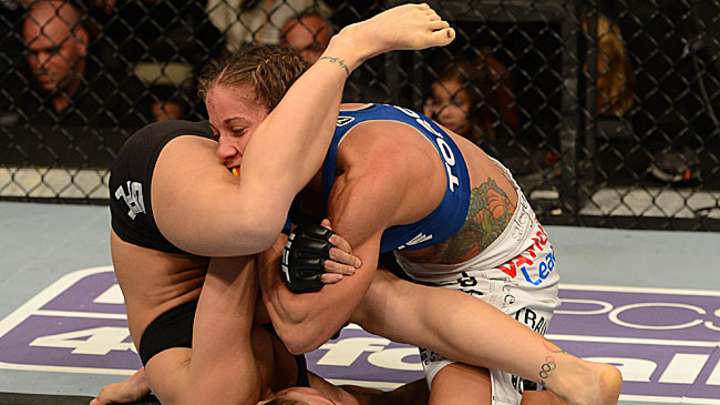
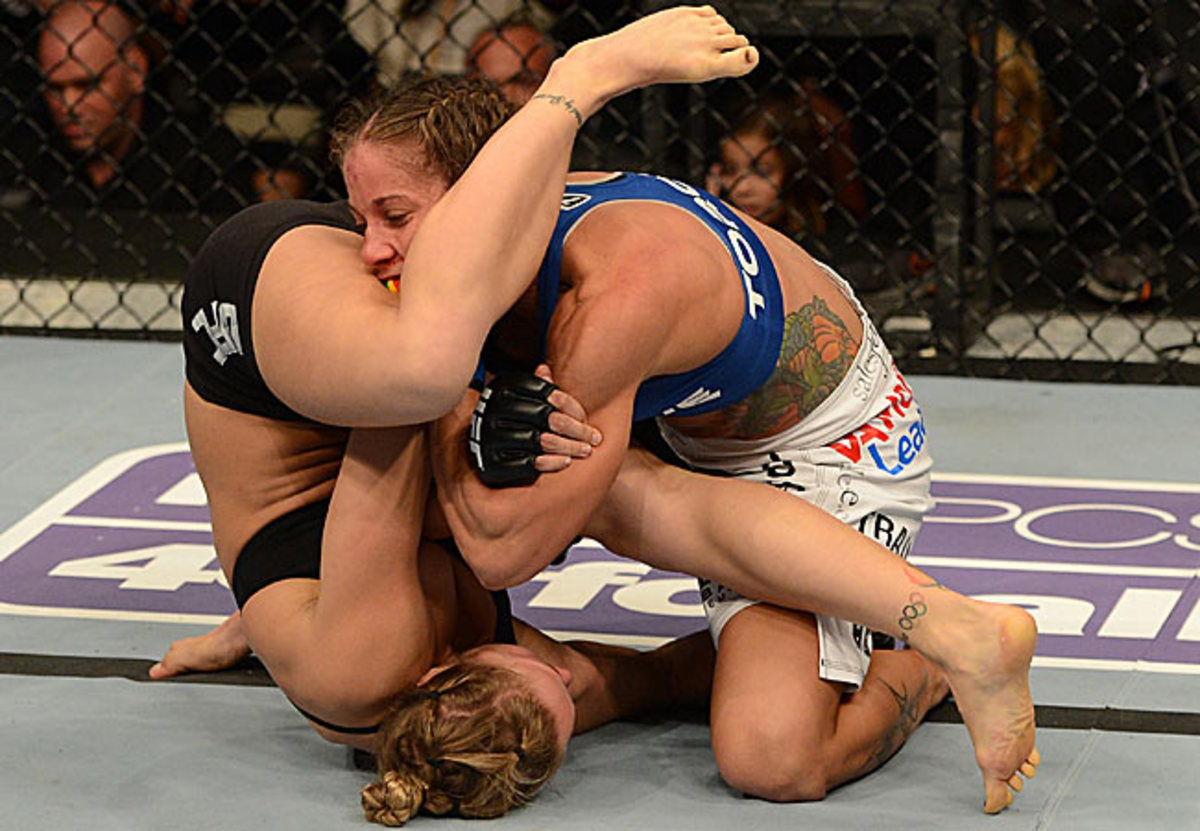
ANAHEIM --There was no way Liz Carmouche could lose. Of course, by now, we all know she lost -- via a Ronda Rousey armbar with 11 seconds left in the first round of the first UFC female fight in history. But even in losing she won -- more attention than another woman not named Rousey has ever achieved in women's MMA and more respectability for her sport at large by ably playing a noble, charming foil.
If Carmouche (7-3) would have lost immediately, she would have only reinforced the notion -- well-founded -- of Rousey's dominance and UFC president Dana White's assertions that his new women's bantamweight division is nothing more than "The Ronda Rousey show" meant to whet the appetites of a streak-hungry sports audience. But by engaging Rousey(7-0) -- even threating her with a neck crank that's the most vulnerable the inaugural women's champion has been in her seven professional fights -- Carmouche provided enough drama to bring a the crowd to its feet, gasping, with each maneuver that justified not just her's, but her gender's capabilities in the Octagon.
Carmouche offered the UFC the perfect counterpoint to Rousey. While Rousey's history as an Olympian offered a stroke of patriotism, Carmouche countered with her three tours through Iraq as a Marine. While Rousey's personal biography that includes the legacy of her mother and the ghost of her father, Carmouche offered her own story of embracing her lesbianism after emerging from a Don't-Ask-Don't-Tell career in the military. She also offered a reprieve for a league stained with past instances of homophobia.
In the end, thought, the UFC isn't a battle of narratives but of skill sets. Carmouche took an early advantage with the neck crank. "It was a tricky situation to be in," Rousey said of the hold. "I wasn't worried but I was very aware of the situation." But Rousey was able to shake off the shorter Carmouche and send her to the ground for what would be Rousey's seventh consecutive win via the armbar, a technique her world champion judoka mother, Dr. AnnMaria DeMars, taught her.
"She had a great technique," Carmouche says. "Just imagine bending your finger to the point where it's not meant to go. I didn't know how much time I had left otherwise I probably would have let it break just to go to the second round."
While Carmouche didn't make it to the second round, White assured his lovable loser that she would have a second shot in the UFC -- and a kitchen table. (A UFC documentary featuring Carmouche chronicled her working class status that's made a kitchen table an out-of-reach luxury for the fighter.)
"Liz Carmouche came in and proved she belonged in there," White said.
But she did much more than that. Carmouche proved any number of women belong in the Octagon. The pro-Rousey crowd cheered Carmouche at the end of her bout. And as she exited the cage, a Beyonce tune with the lyrics, "Who runs the world? Girls" piped through the arena. And for a few minutes at least in the MMA universe, it was true.
 Add us as a preferred source on Google
Staff Writer, Sports Illustrated Staff writer Melissa Segura made an immediate impression at Sports Illustrated. As an undergraduate intern in 2001, her reporting helped reveal that Danny Almonte, star of the Little League World Series, was 14, two years older than the maximum age allowed in Little League. Segura has since covered a range of sports for SI, from baseball to mixed martial arts, with a keen eye on how the games we play affect the lives we lead. In a Sept. 10, 2012, cover story titled, The Other Half of the Story, Segura chronicled the plight of NFL wives and girlfriends caring for brain-injured players. In 2009 she broke the story that MLB had discovered that Washington Nationals prospect Esmailyn Gonzalez, who had been signed to a team-record $1.4 million bonus in 2006, was really Carlos Alvarez and he was four years older than he had claimed to be. Segura graduated with honors from Santa Clara University in 2001 with a B.A. in Spanish studies and communications (with an emphasis in journalism). In 2011, she studied immigration issues as a New York Times fellow at UC-Berkeley's Graduate School of Journalism. Before joining SI full-time in 2002, she worked for The Santa Fe New Mexican and covered high school sports for The Record (Bergen County, N.J.). Segura says Gary Smith is the SI staffer she would most want to trade places with for a day. "While most noted for his writing style, having worked alongside Gary, I've come to realize he is an even more brilliant reporter than he is a writer."