%20%20--%3E%0A%3Csvg%20version%3D%221.1%22%20id%3D%22Layer_1%22%20xmlns%3D%22http%3A%2F%2Fwww.w3.org%2F2000%2Fsvg%22%20xmlns%3Axlink%3D%22http%3A%2F%2Fwww.w3.org%2F1999%2Fxlink%22%20x%3D%220px%22%20y%3D%220px%22%0A%09%20width%3D%2239px%22%20height%3D%2240px%22%20viewBox%3D%220%200%2039%2040%22%20enable-background%3D%22new%200%200%2039%2040%22%20xml%3Aspace%3D%22preserve%22%3E%0A%3Cpath%20fill%3D%22%23FFFFFF%22%20d%3D%22M38.5%2C7H28.2v26h10.3V7z%22%2F%3E%0A%3Cpath%20fill-rule%3D%22evenodd%22%20clip-rule%3D%22evenodd%22%20fill%3D%22%23FFFFFF%22%20d%3D%22M26.1%2C25.5c0%2C5.8-4.1%2C7.5-12.9%2C7.5C3.9%2C33%2C0%2C31.2%2C0%2C25.2v-1.1h11.6%0A%09v2.4c0%2C0.7%2C0.1%2C1.4%2C1.2%2C1.4c1%2C0%2C1.2-0.4%2C1.2-1.3v-0.9c0-1.6-0.9-1.6-3.5-2.2C2.2%2C21.7%2C0%2C19.7%2C0%2C15.3v-0.9C0%2C9.3%2C5.5%2C7%2C12.9%2C7%0A%09c10.2%2C0%2C12.8%2C2.6%2C12.8%2C7.4v1.8h-11v-2.9c0-0.6-0.4-1.1-1.2-1.1c-0.6%2C0-1.2%2C0.4-1.2%2C1.1v0.9c0%2C1.5%2C0.9%2C2%2C3.3%2C2.5%0A%09c8%2C1.6%2C10.5%2C3.3%2C10.5%2C7.5V25.5z%22%2F%3E%0A%3C%2Fsvg%3E%0A)
Sean O’Malley on Fatherhood, Merab Dvalishvili Rivalry and UFC 316
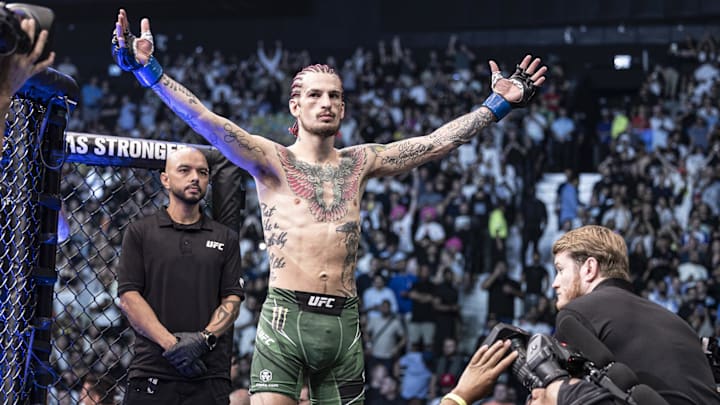
They sure grow up fast, these cage fighters. Could it really have been eight years ago already that Sean O’Malley was stealing the show on Dana White’s Contender Series? Here was a scrappy, mouthy bantamweight—and most of the weight came from his abundant body ink and his copious multi-colored hair—winning sensationally and talking more sensationally, still.
Deploying sneaky movement and a nuclear-grade right hand, O’Malley went a dozen pro fights without a defeat. While he finally lost to Marlon Vera at UFC 252, he avenged that defeat in a rematch last year.
Now O’Malley, the father of two (a son born in May) is, shockingly, 30 years old. And again finds himself in the role of avenger. Last September, he lost a five-round decision to the relentlessly entertaining Long Island resident (by way of Georgia) Merab Dvalishvili for the bantamweight belt. Dvalishvili then won his last fight in January at the Inuit Dome, stealing the show at UFC 311 and taking some of O’Malley’s celebrity wattage.
On Saturday, at the Prudential Center in Newark, O’Malley gets his rematch, hoping to channel the same beat-me-twice-shame-on-me energy that worked so well last time. The fight is the headline of UFC 316. A win would not only win back the belt, but would also help solidify O’Malley as perhaps the brightest star in the UFC hemisphere, a slick fighter who is all too happy to be a front facing figure in between fights.
A few days after the birth of his son, and a few days before beginning his weight cut, he spoke with Sports Illustrated. The following conversation is lightly edited for brevity and clarity.
Sports Illustrated: Where is your head these days? What’s occupying your thoughts these days?
Sean O’Malley: I have a five-day-old, so, you know, changing diapers, so that occupies quite a bit of the head space right now.
The work [for the fight] is pretty much done so. Just kind of getting by these next few days. This is where you start really, you know, cutting the calories and start really getting the weight down. So just being a dad hanging out still, you know, still training twice a day. But these days are good, good, good times.
SI: Yeah. The most important question is whether big sister knows what’s coming. Is she prepared?
SO: She asked for it! She wanted a baby brother; she got a baby brother. So far, so good.
SI: How does a rematch differ from a conventional fight where you’ve never fought together before?
SO: It’s definitely different fighting someone you fought before. This feels like my first real rematch. The [Vera] fight was just, it was so quick [a Round 1 TKO] I didn’t feel like the fight got to play out. So I didn’t really feel like that felt like much of a rematch. After spending 25 minutes in the cage with Merab, going in there for a second time, that’ll feel more familiar. We both felt each other in there.
SI: How do you characterize your relationship with him? What’s the beef factor?
SO: Merab, he’s a little goofball. I don’t mind the guy he is, he’s just Merab. He’s his own character. He’s just super smart. I don’t mind the guy.
SI: Do, do you prefer there to be some friction? How does the personal relationship impact the fighting for you?
SO: I mean, the [Vera] fight, there was like some animosity there. I really wanted to get that one back. I really want to put a whooping on him. The Merab [pre-fight hype] fight felt a little bit more forced. It’s just a sport. Athlete versus athlete. It's just competition.
SI: How are we feeling about the [upcoming weight] cut?
SO: I mean, mentally, I just prepare for a struggle. No one cutting weight is excited about it. You know, I’m not necessarily super excited to sit in a hot tub, but I look at cutting weight as part of the paycheck, so I gotta do that to get paid.
SI: When you’re in the cage, what’s the impulse you have to try hardest to fight or resist?
SO: Hmm. When you get in there, you gotta just go in there and let loose, let go and flow, ideally. Not think too much.
SI: At this stage—you have done this a while; you’re a father—what is fighting feeding inside of you these days?
SO: I just, I ask myself what else would I do? You gotta go out there, beat Merab, beat the next guy, win a bunch of fights. But I’m in a position to where I could be considered the greatest of all time at a certain thing on this earth, which is a cool thing for me. Where I’m at right now, it’s just like I want to reach my full potential. I’m 30. I'm healthy. And I want to just give it everything I got while I still can.
SI: How well or how much do you separate kind of personal happiness from results?
SO: I mean, for the most part, all I’ve done is win. The first Chito fight in my mind, mentally, I didn’t lose that fight. Like I got a lot of s--- from saying I was mentally undefeated. But I really was and never felt like I lost a fight until that last fight against Merab. And you know, it wasn’t ideal, but it wasn’t like life wasn’t still good, you know? I still had my family.
Everyone was still healthy. If you can find growth—and suffering—you can evolve more. It's all about perspective. I feel like happiness is a skill and if you know how to be happy, you can be happy with whatever happens.
SI: Go back to what you said before. What do you think you would be doing if you weren't fighting?
SO: I don't know. There was no plan B for me. It was plan A, get in UFC, make a lot of money.
SI: I’d say it's worked out pretty well.
Last question. The cliche is: What’s the best advice you’ve ever gotten? I wanna ask you what’s the advice you’re happiest that you didn’t follow?
SO: Probably early in my career when I would post about smoking weed, I got a lot of adults, a lot of people say, I'm just looking out for you. I don’t think you should be posting that. No one’s gonna wanna sponsor you. UFC’s not gonna wanna sign you. And I was like: Don’t care. I’m doing me. And uh, that was probably the greatest advice I never listened to was to, to not be myself.
 Add us as a preferred source on Google
Jon Wertheim is a senior writer for Sports Illustrated and has been part of the full-time SI writing staff since 1997, largely focusing on the tennis beat, sports business and social issues, and enterprise journalism. In addition to his work at SI, he is a correspondent for “60 Minutes” and a commentator for The Tennis Channel. He has authored 11 books and has been honored with two Emmys, numerous writing and investigative journalism awards, and the Eugene Scott Award from the International Tennis Hall of Fame. Wertheim is a longtime member of the New York Bar Association (retired), the International Tennis Writers Association and the Writers Guild of America. He has a bachelor’s in history from Yale University and received a law degree from the University of Pennsylvania. He resides in New York City and Paris with his wife, who is a divorce mediator and adjunct law professor. They have two children.
Follow jon_wertheim