%20%20--%3E%0A%3Csvg%20version%3D%221.1%22%20id%3D%22Layer_1%22%20xmlns%3D%22http%3A%2F%2Fwww.w3.org%2F2000%2Fsvg%22%20xmlns%3Axlink%3D%22http%3A%2F%2Fwww.w3.org%2F1999%2Fxlink%22%20x%3D%220px%22%20y%3D%220px%22%0A%09%20width%3D%2239px%22%20height%3D%2240px%22%20viewBox%3D%220%200%2039%2040%22%20enable-background%3D%22new%200%200%2039%2040%22%20xml%3Aspace%3D%22preserve%22%3E%0A%3Cpath%20fill%3D%22%23FFFFFF%22%20d%3D%22M38.5%2C7H28.2v26h10.3V7z%22%2F%3E%0A%3Cpath%20fill-rule%3D%22evenodd%22%20clip-rule%3D%22evenodd%22%20fill%3D%22%23FFFFFF%22%20d%3D%22M26.1%2C25.5c0%2C5.8-4.1%2C7.5-12.9%2C7.5C3.9%2C33%2C0%2C31.2%2C0%2C25.2v-1.1h11.6%0A%09v2.4c0%2C0.7%2C0.1%2C1.4%2C1.2%2C1.4c1%2C0%2C1.2-0.4%2C1.2-1.3v-0.9c0-1.6-0.9-1.6-3.5-2.2C2.2%2C21.7%2C0%2C19.7%2C0%2C15.3v-0.9C0%2C9.3%2C5.5%2C7%2C12.9%2C7%0A%09c10.2%2C0%2C12.8%2C2.6%2C12.8%2C7.4v1.8h-11v-2.9c0-0.6-0.4-1.1-1.2-1.1c-0.6%2C0-1.2%2C0.4-1.2%2C1.1v0.9c0%2C1.5%2C0.9%2C2%2C3.3%2C2.5%0A%09c8%2C1.6%2C10.5%2C3.3%2C10.5%2C7.5V25.5z%22%2F%3E%0A%3C%2Fsvg%3E%0A)
More instant replay under review

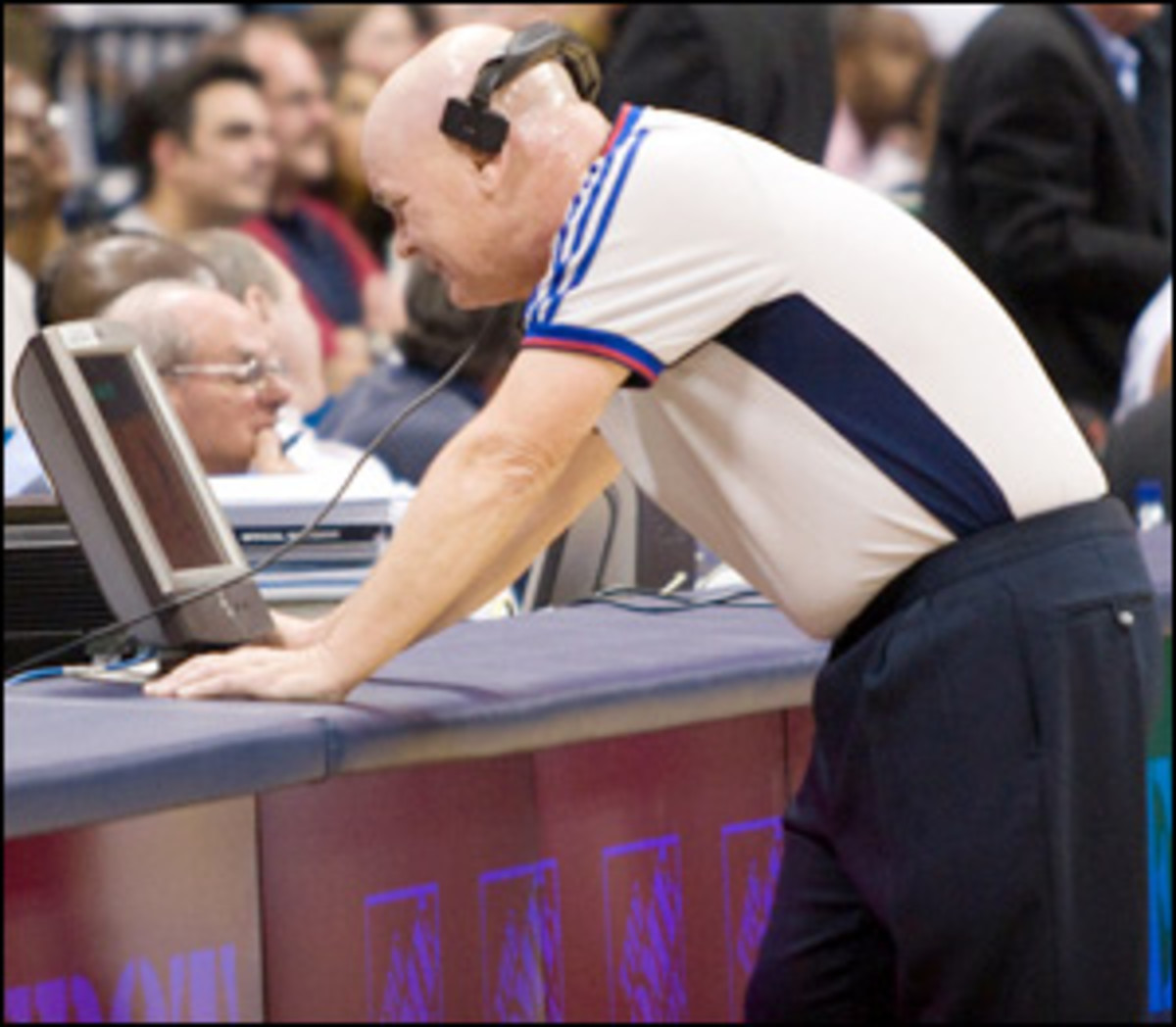
The NBA will consider an expansion of instant replay that could take effect as early as next season, SI.com has learned. The new application appears to have the blessing of coaches as well as the league office, which will present the concept to its competition committee in June.
Wary of creating regulations that could interrupt the flow of play, the league is examining a limited use of replay that would enable officials to instantly convert a three-point shot into a two-pointer, or vice versa.
"The one area that we're exploring is the three-vs.-two shot call near the end of a game,'' said Stu Jackson, the executive VP of basketball operations for the NBA.
The league currently permits video replay to be used after a game-ending play to help determine whether a shooter's foot was behind the three-point line.
"We're talking about expanding it for some period at the end of the game when there's a natural break in the action, vis-a-vis a timeout or something along those lines,'' Jackson said. "Where a coach could make a challenge, and/or a referee could conduct a review.''
The competition committee considered a similar three-vs.-two replay rule in 2005. "It didn't get a lot of support then,'' said Jackson, who added that the league is taking a second look at this use of replay at the urging of its coaches.
The coaches' rules committee has made a formal recommendation that each team receive one instant-replay challenge to be used in the last two minutes of regulation or overtime. If the challenge of the three-vs.-two call was successful, then the challenging team would retain the right to challenge another play. But if the original call was upheld, then the challenging team would lose either a full timeout or -- if all those timeouts had been spent -- a 20-second timeout. A team without timeouts could not issue a challenge.
Jackson said the league has yet to decide whether it will recommend a challenge system, or simply depend on the referees to decide whether a play should be reviewed.
"As to whether or not it may be possible [to install the rule next season], at this point I don't know,'' Jackson said. "But we are gathering some data and are starting to talk about it internally.''
After investing years of rules changes to speed up the tempo of play, the league doesn't want games to be slowed by complicated video reviews. Jackson believes challenges should be restricted to dead-ball situations, as would be the case on most three-vs.-two plays. He also acknowledges that a limited application of replay in the final seconds of a tight game might create suspense among fans as the officials attempt to make the proper call.
"As a whole, the coaches are very strong on the idea of some type of replay provision for late-game situations,'' said former Pacers coach Rick Carlisle, who is president of the NBA coaches' association. "If there's an opportunity to correct a potentially game-changing or series-changing call that may have been missed, that's something everyone would be in favor of.''
One issue will be the timing of the challenge. The league doesn't want to see a crucial fast break nullified by a challenge issued by the opposing coach. The rule would also cause delays if it forced officials to restore time to the game clock. More trouble would result if the challenge was issued after several possessions, which would muck up the strategy of the game if the scoreboard was changed long after the fact.
While this limited use of replay wouldn't resolve all of the potential mistakes on a three-vs.-two play, the league is interested in pursuing the change before a major error is made in the postseason.
"It really behooves us to be proactive on something like this,'' Jackson said. "If we do have the unfortunate event of having a key three-vs.-two question that's crucial in a playoff game, then we'll be right where we are today -- trying to find a way to account for a key shot at the end of a key game.''
For the most part, use of replay is currently restricted to the last play of each quarter, when referees can review video to determine if a player was out of bounds, or whether a shot was released or a foul was committed before the buzzer. They can also consult replays during the game to decide flagrant 2 fouls or potential ejections.
Jackson credited the coaches with forwarding other rules suggestions, though he said the NBA doesn't plan to act on them this season. The coaches proposed using replay to review a last-minutes call of goaltending or offensive basket interference, but Jackson points out that replays are often vague on deciding those plays. They also suggested that the the backboard be lit to signal 24-second violations, much as it is lit at the end of each quarter. Different colored lights would distinguish the 24-second violation from the final buzzer.
"Right now, we don't have the capability to do that,'' Jackson said. "Technically, the 24-second clock is not hooked up to the game clock. We've got different scoreboard systems in the arenas, and that needs further investigation. We wouldn't be able to look at it now.''
The coaches also suggested video reviews of out-of-bounds rulings at the end of the game, with the challenge to be applied on dead-ball situations only.
"Replay at the end of quarters has been effective because it enhances accuracy without disrupting the flow of the game,'' Carlisle said. "While in theory it might seem like you could use replay to review just about any kind of play, that would not be the case. An end-of-game replay provision would probably have to be limited to boundary-line situations, three-point line calls and possibly 24-second violation situations.''
Jackson sounded optimistic about enhancing replay to account for three-point shots next season. "It depends if we can come up with a system that we think works,'' he said. "If we can, I'm sure that would resonate with people.''
 Add us as a preferred source on Google
Senior Writer, Sports Illustrated Sports Illustrated Senior Writer Ian Thomsen, who joined the magazine in 1998, is one of SI's top basketball scribes. Along with writing columns and features for SI, Thomsen is a frequent contributor to SI.com. Before joining SI, Thomsen spent six years in Europe as the sports columnist for the International Herald Tribune, the world's largest international English-language daily. While at the paper Thomsen wrote about an array of sports for a global audience, including the major world and European soccer tournaments, the 1995 Rugby World Cup, Olympic Games, Ryder Cups, Grand Slam tennis events, Grand Prix auto races and, very rarely, cricket. Thomsen, who graduated from Northwestern with a journalism degree in 1983, was a feature writer for The National Sports Daily during its short, expensive run of 1990-91. His first job was with The Boston Globe, where he covered Doug Flutie's Boston College Eagles and all three of the Celtics-Lakers NBA Finals of the 1980s. Thomsen was a feature writer at SI before taking on the NBA beat fulltime in 2000. With Luis Fernando Llosa and Melissa Segura, Thomsen covered the 2001 scandal of overaged Little League pitcher Danny Almonte and wrote the first SI cover story on Kobe Bryant in 1998. Thomsen lives with his wife and two children near Boston.