%20%20--%3E%0A%3Csvg%20version%3D%221.1%22%20id%3D%22Layer_1%22%20xmlns%3D%22http%3A%2F%2Fwww.w3.org%2F2000%2Fsvg%22%20xmlns%3Axlink%3D%22http%3A%2F%2Fwww.w3.org%2F1999%2Fxlink%22%20x%3D%220px%22%20y%3D%220px%22%0A%09%20width%3D%2239px%22%20height%3D%2240px%22%20viewBox%3D%220%200%2039%2040%22%20enable-background%3D%22new%200%200%2039%2040%22%20xml%3Aspace%3D%22preserve%22%3E%0A%3Cpath%20fill%3D%22%23FFFFFF%22%20d%3D%22M38.5%2C7H28.2v26h10.3V7z%22%2F%3E%0A%3Cpath%20fill-rule%3D%22evenodd%22%20clip-rule%3D%22evenodd%22%20fill%3D%22%23FFFFFF%22%20d%3D%22M26.1%2C25.5c0%2C5.8-4.1%2C7.5-12.9%2C7.5C3.9%2C33%2C0%2C31.2%2C0%2C25.2v-1.1h11.6%0A%09v2.4c0%2C0.7%2C0.1%2C1.4%2C1.2%2C1.4c1%2C0%2C1.2-0.4%2C1.2-1.3v-0.9c0-1.6-0.9-1.6-3.5-2.2C2.2%2C21.7%2C0%2C19.7%2C0%2C15.3v-0.9C0%2C9.3%2C5.5%2C7%2C12.9%2C7%0A%09c10.2%2C0%2C12.8%2C2.6%2C12.8%2C7.4v1.8h-11v-2.9c0-0.6-0.4-1.1-1.2-1.1c-0.6%2C0-1.2%2C0.4-1.2%2C1.1v0.9c0%2C1.5%2C0.9%2C2%2C3.3%2C2.5%0A%09c8%2C1.6%2C10.5%2C3.3%2C10.5%2C7.5V25.5z%22%2F%3E%0A%3C%2Fsvg%3E%0A)
Dutchwoman dominates the U.S.
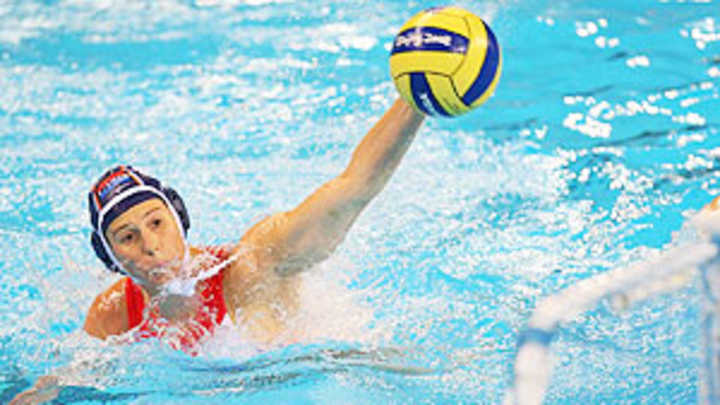

BEIJING -- The sport is the domain of the Stanford Cardinal and California Golden Bears and Southern California Trojans and UCLA Bruins, but there never has been a Bruin quite like her.
She actually is a de Bruijn. Her name is Danielle de Bruijn. She is a modest Dutchwoman who lives in the city of Gouda and has the well-scrubbed face that belongs on a billboard hawking yellow cheese. She is also the water polo player who almost single-handedly derailed the favored United States in the gold-medal game Thursday.
In her last international match, the 30-year-old de Bruijn continued the delightful pattern of virtuosity that has left as indelible mark on the Beijing Olympics as some of the iconic stadium architecture. She scored a remarkable seven goals, one fewer than the U.S., and received just enough help as the Netherlands edged the Americans 9-8 to win the third Olympic gold medal in the grand, albeit niche, sport of water polo. (If nothing else, water polo gets extra credit because none of the athletes have shoe contracts.) This might have been the greatest performance by a left-handed thrower since Sandy Koufax's final no-hitter.
Now the corollary to the story is that U.S. defenders allowed Bruijn to torch them for seven goals without actually drowning her first. (Seven goals, incidentally, might or might not be an Olympic record; it seems unlikely Elias Sports Bureau tracks this sort of thing). "I don't understand why America let her shoot like this," Ilse Sindorf, the Dutch assistant coach, said later. "We know she can shoot."
But rather than criticizing his players, or indirectly critiquing his own strategy against the crafty lefty, U.S. coach Guy Baker magnanimously praised her Phelpsian effort. Said Baker: "It's up there with the great performances. I've seen a lot of good players, but to play like that, especially in an Olympic final, it's definitely up there."
De Bruijn scored the winning goal on a power play with 26 seconds remaining -- "I think the team was playing for me so I could take the shot," she said -- but not all of her wizardry was six-on-five. The 2000 Female Water Polo Player of the Year (Water Polo World, in which every issue is the swimsuit edition, bestowed the honor) took advantage early as the Dutch counterattack caught the U.S. dawdling, scoring three goals in the first period. The Netherlands actually took a 4-0 lead in the first 3 minutes and 37 seconds, scoring on all four shots, at even strength, against goalie Betsey Armstrong.
Armstrong is the only player on the U.S. with no ties to California; she is an Ann Arbor, Mich., native who played at the University of Michigan and is conversant in Detroit sports lore. (After the dramatic semifinal win against Australia, she reacted to a question that had framed the physical Aussies in terms of the Pistons' Bad Boys teams.) Although treading water for 32 minutes and thrusting up to block shots is not especially conducive to contemplation, no one would have been shocked if she flashed back to Game 7 of the 2002 Western Conference finals -- Red Wings vs. the Avalanche -- when Colorado goalie Patrick Roy allowed goals on the first two shots and was chased from the game in the second period. Armstrong looked that helpless.
But she righted herself as the Americans tied the score by halftime and restored the natural order -- at least until de Bruijn scored twice in the first three-and-a-half minutes of the third period. Once again, the Americans were swimming uphill. Although the U.S. would tie the score twice, it would never lead.
"It's unbelievable for myself and I think for her, too," said coach Robin van Galen, who instructed his players after the first period to keep creating space and feeding the hot shooter. "She played a good tournament, but in the semis [a one-goal win over Hungary], she didn't perform very well. I was a little bit afraid before the match that her peak was over. But when I saw her score the first goal, I saw her face and I knew it was good. I know Danielle for a very long time. The first time I saw her she was 16. I already coached her for several years on the club team. So we have a special relationship. I know she can perform very well. I didn't know she [could] play so enormous as she did."
Although lachrymose after the loss, the American players might feel better about their silver medals in a few days when they realize someone has to come out on the wrong end of history. They were spectators early in the match, then fierce opponents and ultimately witnesses to unalloyed greatness. Their tears after the match were genuine, but the night belonged not to their emotion but to one big, bad de Bruijn.

Along with the pages of Sports Illustrated, you'll find senior writer Michael Farber in the Hockey Hall of Fame. Farber joined the staff of Sports Illustrated in January 1994 and now stands as one of the magazine's top journalists, covering primarily ice hockey and Olympic sports. He is also a regular contributor to SI.com. In 2003 Farber was honored with the Elmer Ferguson Award from the Hockey Hall of Fame for distinguished hockey writing. "Michael Farber represents the best in our business," said the New York Post's Larry Brooks, past president of the Professional Hockey Writers' Association. "He is a witty and stylish writer, who has the ability to tell a story with charm and intelligence." Farber says his Feb. 2, 1998 piece on the use and abuse of Sudafed among NHL players was his most memorable story for SI. He also cites a feature on the personal problems of Kevin Stevens, Life of the Party. His most memorable sports moment as a journalist came in 1988 when Canadian Ben Johnson set his controversial world record by running the 100 meters in 9.79 seconds at the Summer Olympic Games, in Seoul. Before coming to Sports Illustrated, Farber spent 15 years as an award-winning sports columnist and writer for the Montreal Gazette, three years at the Bergen Record, and one year at the Sun Bulletin in Binghamton, NY. He has won many honors for his writing, including the "outstanding sports writing award" in 2007 from Sports Media Canada, and the Prix Jacques-Beauchamp (Quebec sportswriter of the year) in 1993. While at the Gazette, he won a National Newspaper award in 1982 and 1990. Sometimes Life Gets in the Way, a compendium of his best Gazette columns, was published during his time in newspapers. Farber says hockey is his favorite sport to cover. "The most down-to-earth athletes play the most demanding game," he says. Away from Sports Illustrated, Farber is a commentator for CJAD-AM in Montreal and a panelist on TSN's The Reporters (the Canadian equivalent of ESPN's The Sports Reporters in the United States, except more dignified). Farber is also one of the 18 members on the Hockey Hall of Fame selection committee. Born and raised in New Jersey, Farber is a 1973 graduate of Rutgers University where he was Phi Beta Kappa. He now resides in Montreal with his wife, Danielle Tétrault, son Jérémy and daughter Gabrielle.