%20%20--%3E%0A%3Csvg%20version%3D%221.1%22%20id%3D%22Layer_1%22%20xmlns%3D%22http%3A%2F%2Fwww.w3.org%2F2000%2Fsvg%22%20xmlns%3Axlink%3D%22http%3A%2F%2Fwww.w3.org%2F1999%2Fxlink%22%20x%3D%220px%22%20y%3D%220px%22%0A%09%20width%3D%2239px%22%20height%3D%2240px%22%20viewBox%3D%220%200%2039%2040%22%20enable-background%3D%22new%200%200%2039%2040%22%20xml%3Aspace%3D%22preserve%22%3E%0A%3Cpath%20fill%3D%22%23FFFFFF%22%20d%3D%22M38.5%2C7H28.2v26h10.3V7z%22%2F%3E%0A%3Cpath%20fill-rule%3D%22evenodd%22%20clip-rule%3D%22evenodd%22%20fill%3D%22%23FFFFFF%22%20d%3D%22M26.1%2C25.5c0%2C5.8-4.1%2C7.5-12.9%2C7.5C3.9%2C33%2C0%2C31.2%2C0%2C25.2v-1.1h11.6%0A%09v2.4c0%2C0.7%2C0.1%2C1.4%2C1.2%2C1.4c1%2C0%2C1.2-0.4%2C1.2-1.3v-0.9c0-1.6-0.9-1.6-3.5-2.2C2.2%2C21.7%2C0%2C19.7%2C0%2C15.3v-0.9C0%2C9.3%2C5.5%2C7%2C12.9%2C7%0A%09c10.2%2C0%2C12.8%2C2.6%2C12.8%2C7.4v1.8h-11v-2.9c0-0.6-0.4-1.1-1.2-1.1c-0.6%2C0-1.2%2C0.4-1.2%2C1.1v0.9c0%2C1.5%2C0.9%2C2%2C3.3%2C2.5%0A%09c8%2C1.6%2C10.5%2C3.3%2C10.5%2C7.5V25.5z%22%2F%3E%0A%3C%2Fsvg%3E%0A)
Moment of the Year: NHL
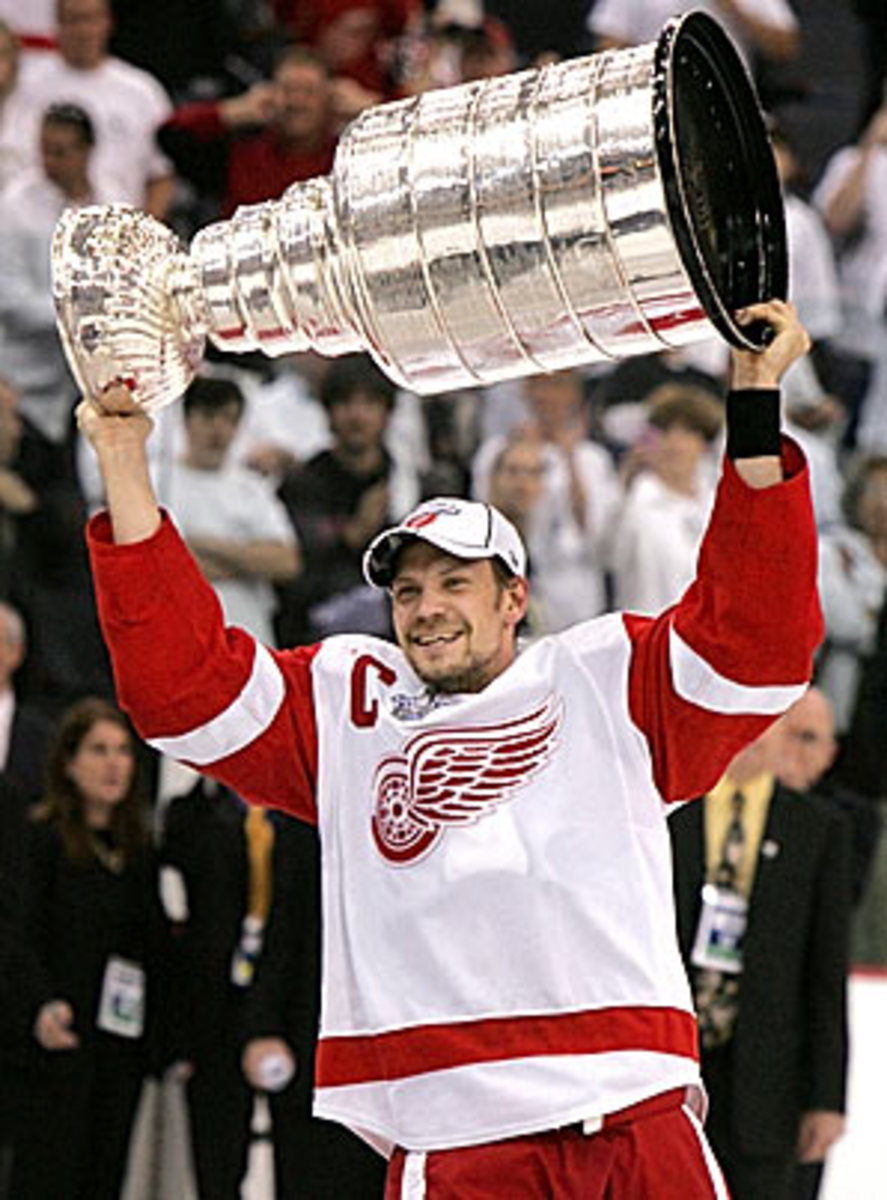
When Nicklas Lidstrom raised the Stanley Cup over his head on an early June night, a million shards from hockey's glass ceiling rained down on the ice at the Igloo in Pittsburgh.
Lidstrom was accustomed to breaking barriers. He'd been the first European defenseman to win the Norris Trophy (2001) and the first European player to win the Conn Smythe as MVP of the playoffs (2002). But as he took the Cup from Commissioner Gary Bettman after Game 6 of the final, Lidstrom, the beaming captain of the Detroit Red Wings, had become the first European to formally lead his team to a championship.
In 35 years, the NHL had gone from "chicken Swedes" -- the estimable Borje Salming and Inge Hammarstrom, who had joined Toronto at a time when the league was composed almost exclusively of Canadians -- to championship Swedes.
There were a gaggle of Swedes in Detroit, which is now basically Stockholm except for a better choice of Greek restaurants. The 2007-08 Red Wings featured the thunderous checks of defenseman Niklas Kronwall, the goal-scoring touch of Johan (The Mule) Franzen, the timely offensive contributions of Mikael Samuelsson and the net-front staying power of the indestructible Tomas Holmstrom. But in a dressing room with a decidedly European bent, Lidstrom was always the lead Swede.
Lidstrom plays defense differently than almost anyone ever has, using his mind as much as the body. He is always in position. He rarely takes a penalty. Instead of stripping the puck with a crunching hit, he can pickpocket an attacking player with his quick stick. Lidstrom almost never panics, throwing a puck away recklessly under pressure or taking himself out of the play in search of a hit. And he is rarely hit himself. When Colorado's Ian Lapèrriere nailed him into the boards last February -- Lidstrom sustained an MCL injury on the play -- it was shocking because Lidstrom, like Wayne Gretzky in decades past, almost never puts himself in a vulnerable position. He is the template for thinking man's hockey, as efficient as it is bland. Of course, it is also that kind of playing style that has allowed Lidstrom to win the Norris six times in the past seven seasons.
If he occasionally has been unable to raise his level of play in the playoffs, maybe that's because he's had no higher place to take it. But after assuming the captaincy from Steve Yzerman in 2006, Lidstrom felt a heightened need to carry the Red Wings a little further, especially after the keen playoff disappointments of his first two seasons as captain.
Lidstrom has had better playoffs than 2008, including his Conn Smythe year, but never has he had a more personally meaningful one. While Kronwall made the eye-catching hits, Lidstrom methodically kept a lid on Evgeni Malkin and the explosive Penguins. His play was understated in its eloquence -- two months of sustained professionalism that culminated with his accepting the most beautiful trophy in sports.
At that precise moment, the NHL's favorite libel -- Europeans don't care about the Cup -- was forever banished. Like Lidstrom's game, it had no place to go.
You're not sure? Well, when Detroit general manager Ken Holland signed free-agent Marian Hossa to a one-year free agent contract, you didn't hear anyone say that the Red Wings were too European.
 Add us as a preferred source on Google
Along with the pages of Sports Illustrated, you'll find senior writer Michael Farber in the Hockey Hall of Fame. Farber joined the staff of Sports Illustrated in January 1994 and now stands as one of the magazine's top journalists, covering primarily ice hockey and Olympic sports. He is also a regular contributor to SI.com. In 2003 Farber was honored with the Elmer Ferguson Award from the Hockey Hall of Fame for distinguished hockey writing. "Michael Farber represents the best in our business," said the New York Post's Larry Brooks, past president of the Professional Hockey Writers' Association. "He is a witty and stylish writer, who has the ability to tell a story with charm and intelligence." Farber says his Feb. 2, 1998 piece on the use and abuse of Sudafed among NHL players was his most memorable story for SI. He also cites a feature on the personal problems of Kevin Stevens, Life of the Party. His most memorable sports moment as a journalist came in 1988 when Canadian Ben Johnson set his controversial world record by running the 100 meters in 9.79 seconds at the Summer Olympic Games, in Seoul. Before coming to Sports Illustrated, Farber spent 15 years as an award-winning sports columnist and writer for the Montreal Gazette, three years at the Bergen Record, and one year at the Sun Bulletin in Binghamton, NY. He has won many honors for his writing, including the "outstanding sports writing award" in 2007 from Sports Media Canada, and the Prix Jacques-Beauchamp (Quebec sportswriter of the year) in 1993. While at the Gazette, he won a National Newspaper award in 1982 and 1990. Sometimes Life Gets in the Way, a compendium of his best Gazette columns, was published during his time in newspapers. Farber says hockey is his favorite sport to cover. "The most down-to-earth athletes play the most demanding game," he says. Away from Sports Illustrated, Farber is a commentator for CJAD-AM in Montreal and a panelist on TSN's The Reporters (the Canadian equivalent of ESPN's The Sports Reporters in the United States, except more dignified). Farber is also one of the 18 members on the Hockey Hall of Fame selection committee. Born and raised in New Jersey, Farber is a 1973 graduate of Rutgers University where he was Phi Beta Kappa. He now resides in Montreal with his wife, Danielle Tétrault, son Jérémy and daughter Gabrielle.