%20%20--%3E%0A%3Csvg%20version%3D%221.1%22%20id%3D%22Layer_1%22%20xmlns%3D%22http%3A%2F%2Fwww.w3.org%2F2000%2Fsvg%22%20xmlns%3Axlink%3D%22http%3A%2F%2Fwww.w3.org%2F1999%2Fxlink%22%20x%3D%220px%22%20y%3D%220px%22%0A%09%20width%3D%2239px%22%20height%3D%2240px%22%20viewBox%3D%220%200%2039%2040%22%20enable-background%3D%22new%200%200%2039%2040%22%20xml%3Aspace%3D%22preserve%22%3E%0A%3Cpath%20fill%3D%22%23FFFFFF%22%20d%3D%22M38.5%2C7H28.2v26h10.3V7z%22%2F%3E%0A%3Cpath%20fill-rule%3D%22evenodd%22%20clip-rule%3D%22evenodd%22%20fill%3D%22%23FFFFFF%22%20d%3D%22M26.1%2C25.5c0%2C5.8-4.1%2C7.5-12.9%2C7.5C3.9%2C33%2C0%2C31.2%2C0%2C25.2v-1.1h11.6%0A%09v2.4c0%2C0.7%2C0.1%2C1.4%2C1.2%2C1.4c1%2C0%2C1.2-0.4%2C1.2-1.3v-0.9c0-1.6-0.9-1.6-3.5-2.2C2.2%2C21.7%2C0%2C19.7%2C0%2C15.3v-0.9C0%2C9.3%2C5.5%2C7%2C12.9%2C7%0A%09c10.2%2C0%2C12.8%2C2.6%2C12.8%2C7.4v1.8h-11v-2.9c0-0.6-0.4-1.1-1.2-1.1c-0.6%2C0-1.2%2C0.4-1.2%2C1.1v0.9c0%2C1.5%2C0.9%2C2%2C3.3%2C2.5%0A%09c8%2C1.6%2C10.5%2C3.3%2C10.5%2C7.5V25.5z%22%2F%3E%0A%3C%2Fsvg%3E%0A)
Carl Edwards' wreck should be a wake-up call to NASCAR
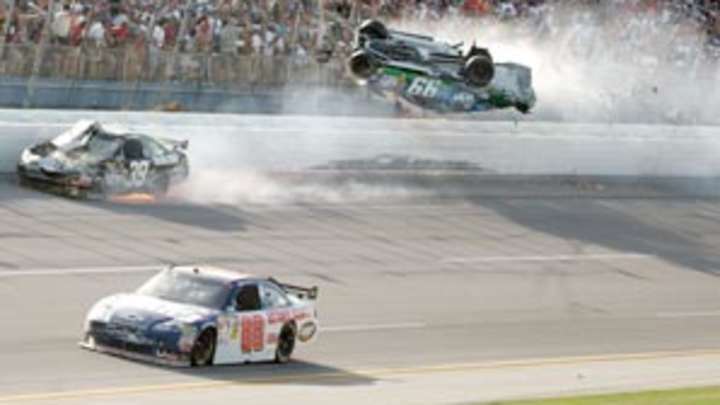
By now every motor sports enthusiast has seen the video clip of Carl Edwards flying into the catch fence along the frontstretch on the final lap of Sunday's race. Make no mistake: This could have turned out to be the worst tragedy in the history of NASCAR. If the fence doesn't hold and Edwards' 3,400-pound car goes into the grandstands, dozens of people, if not more, would have been killed.
Here's how it transpired: Edwards was in the lead as he roared toward the finish line at 190 miles per hour. Rookie Brad Keselowski had a run on Edwards, and first juked high. Edwards went up to block, then Keselowski dove low. Edwards again went to block, but got there a nanosecond too late. Keselowski held his ground, not wanting to go beneath the yellow line on the inside of the track that signifies out of bounds. Keselowski then nudged the left rear of Edwards No. 99 Ford, sending him spinning. Edwards was then hit by Ryan Newman, which launched Edwards into the air and into the fence.
I was with Edwards when he walked out of the infield care center. While he may have appeared calm on television -- like many NASCAR drivers, he seems to possess an actor's ease when the cameras start rolling -- it was clear that once he started walking to his motor coach that the crash had left him seriously shaken. I think it was just starting to dawn on him how lucky he was.
"I'm glad the car didn't go up in the grandstands and hurt somebody," Edwards said. "I saw some fencing at one point and that made me a little bit nervous. I don't know if I could live with myself if I ended up in the grandstands."
Clearly, NASCAR needs to do something to change the way the races are run at Talladega. I think the yellow-line rule needs to be abolished on the final lap. Check out my story in the magazine this week to read more about this important safety issue.
Keselowski probably won't win another race this season, but on Sunday he showed that he has one thing that can't be taught: guts. He knew that he and Edwards were going to crash, but he held his ground because he had made up his mind that he wasn't going to let Edwards intimidate him.
"It's a give and take sport and as races go on, it's a challenge of who is going to lift and who is not," Keselowski said. "It's testing each other every moment. That was a test on Carl's side ... I'm sure he felt like I would let him in even if I was there, and I was not gonna. It's a test of character."
Even though seven people in the grandstands sustained injuries as a result of the debris coming off of Edwards' car -- the most severe was a broken jaw -- Keselowski passed this test. The 25-year-old is one of Dale Earnhardt Jr.'s closest friends. And who knows? If Mark Martin retires at the end of the season, it's not beyond reason to think that Keselowski could slide into that ride at Hendrick Motorsports, and be housed under the same garage as Little E. And remember: This was only the fifth start of his Cup career. To win a race this early in his career is very, very impressive.
Right from the drop of the green flag, there was an abundance of aggressive driving on the track. Drivers were charging through the corners three- and four-wide, which is a recipe for a wreck at a restrictor-plate track. And sure enough, about five minutes into the race -- on Lap 7 of 188 -- the Big One erupted when Jeff Gordon and Matt Kenseth made contact.
In an eye-blink, 14 drivers had damage to their cars. Robbie Gordon viciously smashed into the wall and several legitimate contenders -- Jeff Gordon, Mark Martin, Kasey Kahne, Kevin Harvick, Jamie McMurray and Clint Bowyer -- all had their day ruined.
"We were three- and four-wide too early, that's for sure," said Scott Riggs, who also got caught up in the accident. "When you're that close together, things like that are going to happen, for sure. It's just the nature of the beast here."
For the first time in more than four years, Busch has driven to the top of the standings. Sunday was a typical Busch day in 2009: His car sustained damage in the Big One on Lap 7; his crew chief, Pat Tryson, did a masterful job of making on-the-fly repairs; Busch avoided wrecks for the rest of the afternoon as the field thinned out; and he then finished sixth. It was his sixth top-10 of the season and he now holds a five-point lead over Gordon in the standings.
If there's one track on the Sprint Cup circuit that Martin positively despises, it's Talladega. Like many drivers, he doesn't believe that 'Dega fosters "true" racing, because of the luck it takes to avoid the Big One. Well, on Sunday Martin had his worst finish of the season (43rd) after he hit the wall hard during the Lap 7 melee. Said Martin, who fell from 13th to 18th in the standings, "Here, having a great car doesn't do you any good because you can't separate yourself from the other cars."
Sound frustrated? Well, on Sunday at 'Dega, that was how most of the top drivers felt.
Here's a sampling of what drivers were saying afterward.
Ryan Newman: "Talladega is short for, 'We're going to crash, we just don't know when.' We need to look at things to keep the cars on the ground."
Marcos Ambrose: "It's insanity on four wheels."
Jimmie Johnson: "Man, it sucks racing here."
No doubt there are seven fans today that feel the same way.
 Add us as a preferred source on Google
Senior Writer, Sports Illustrated Senior writer Lars Anderson is Sports Illustrated's main motor sports writer. He has profiled many of the sport's iconic figures, including cover stories on Dale Earnhardt Jr, Jimmie Johnson and Danica Patrick. Anderson has covered multiple Daytona 500s and Indianapolis 500s and writes a twice-weekly racing column for SI.com. He also covers college football. Anderson penned a regional cover story on Alabama's defense in 2011 and has written features on Cam Newton at Auburn, coach Frank Solich at Ohio and the history of spring practice. The most important piece of his SI career, according to Anderson, was his 2011 cover story on the tornado that struck Tuscaloosa, Ala., and how sports was going to play a role in rebuilding that sports-obsessed city. Anderson is the author of five books: The First Star: Red Grange and the Barnstorming Tour that Launched the NFL (published by Random House in December 2009), Carlisle vs. Army (Random House, 2007), The All Americans (St. Martins, 2005), The Proving Ground: A Season on the Fringe in NFL Europe (St. Martins, 2001) and Pickup Artists (Verso, 1998). Both Carlisle Vs. Army and The All Americans have been optioned for movies. Of Carlisle, Booklist, in a starred review, called the work "a great sports story, told with propulsive narrative drive and offering a fascinating look at multiple layers of American pop culture." Anderson is currently working on a sixth book, The Storm and The Tide, about the 2011 Tuscaloosa tornado and Alabama's national championship that season. It will be published by Time Home Entertainment Inc., a division of Time Inc., in August 2014. A native of Lincoln, Neb., Anderson joined SI in 1994 following a short stint as a general assignment reporter at the Lincoln (Neb.) Journal Star. He received a B.A. from St. Olaf College in Northfield, Minn., and an M.S., from the Graduate School of Journalism at Columbia University. Anderson resides in Birmingham, Ala.