%20%20--%3E%0A%3Csvg%20version%3D%221.1%22%20id%3D%22Layer_1%22%20xmlns%3D%22http%3A%2F%2Fwww.w3.org%2F2000%2Fsvg%22%20xmlns%3Axlink%3D%22http%3A%2F%2Fwww.w3.org%2F1999%2Fxlink%22%20x%3D%220px%22%20y%3D%220px%22%0A%09%20width%3D%2239px%22%20height%3D%2240px%22%20viewBox%3D%220%200%2039%2040%22%20enable-background%3D%22new%200%200%2039%2040%22%20xml%3Aspace%3D%22preserve%22%3E%0A%3Cpath%20fill%3D%22%23FFFFFF%22%20d%3D%22M38.5%2C7H28.2v26h10.3V7z%22%2F%3E%0A%3Cpath%20fill-rule%3D%22evenodd%22%20clip-rule%3D%22evenodd%22%20fill%3D%22%23FFFFFF%22%20d%3D%22M26.1%2C25.5c0%2C5.8-4.1%2C7.5-12.9%2C7.5C3.9%2C33%2C0%2C31.2%2C0%2C25.2v-1.1h11.6%0A%09v2.4c0%2C0.7%2C0.1%2C1.4%2C1.2%2C1.4c1%2C0%2C1.2-0.4%2C1.2-1.3v-0.9c0-1.6-0.9-1.6-3.5-2.2C2.2%2C21.7%2C0%2C19.7%2C0%2C15.3v-0.9C0%2C9.3%2C5.5%2C7%2C12.9%2C7%0A%09c10.2%2C0%2C12.8%2C2.6%2C12.8%2C7.4v1.8h-11v-2.9c0-0.6-0.4-1.1-1.2-1.1c-0.6%2C0-1.2%2C0.4-1.2%2C1.1v0.9c0%2C1.5%2C0.9%2C2%2C3.3%2C2.5%0A%09c8%2C1.6%2C10.5%2C3.3%2C10.5%2C7.5V25.5z%22%2F%3E%0A%3C%2Fsvg%3E%0A)
LeBron looms over NBA Finals

Yes, rarely has a man been so conspicuous by his absence as the King was before, during and after Game 1 at the Staples Center. In the days leading up to the championship series, James had been torched for walking off the court without shaking hands after his Cavs had been eliminated by the Magic in Game 6 of the Eastern Conference finals, and compounding it by blowing off the mandatory media session.
Then, before Game 1 of the Finals on Thursday, commissioner David Stern announced that he had reversed his initial position and decided to fine James $25,000. Stern indicated that the walkoff and the media blowoff were both factors in the fine, but I don't buy that. James was fined for skipping the interview session, which is in keeping with precedent.
Finally, Kobe Bryant's incendiary 40-point, eight-rebound, eight-assist performance predictably revived the perhaps-Kobe-should-have-been-MVP-instead-of-LeBron talk.
If the Magic aren't able to recover in Game 2 and make this a series, chances are those storylines will continue. So with all this in mind, let's try to straighten out l'affaire James.
First, and most obviously, James was wrong to walk off the floor after the 103-90 loss to the Magic, and the press was absolutely justified in criticizing him for it. James' action was compared, predictably, to the Pistons' famed pre-buzzer walkoff after their four-game elimination against the Bulls in the 1991 East finals. But it was nothing like it. What the Pistons did was a petulant, pre-planned pout, one, incidentally, that their coach, the late Chuck Daly, tried to talk them out of, and something that continued to bother him long after his retirement.
James, by contrast, had a bad moment. It shouldn't pass without notice, especially in a culture where sportsmanship is rapidly disappearing. And James compounded his error when he explained away his actions a day after the loss. "It's hard for me to congratulate somebody after you just lose to them," James said. "I'm a winner. It's not being a poor sport or anything like that." Well, yes it is. Being a poor sport is exactly what it is, and someone needs to talk to him about it, a responsibility that Stern, I suspect, has already assumed.
As for the fine, here's where I break ranks with the NBA, and probably many of my colleagues: I don't think athletes should be required to talk to the media and should not be fined for failing to do so, not in circumstances such as those surrounding the Game 6 loss. Missing scheduled interview sessions during All-Star weekend, which is what Michael Jordan famously used to do so he could play golf, is one thing; missing one after a painful playoff loss is something else entirely.
Now, if a player continually obviates his responsibilities to deal with the media, particularly a star like LeBron, it becomes a problem for the franchise and perhaps for the NBA. Maybe some kind of scale should be in place, where a fine kicks in after, say, three such incidents.
But my dirty little secret is that if a guy doesn't want to talk to me, I don't want to talk to him. I don't want a guy dragged kicking and screaming to the postgame podium so he can spout a few disheartened nothings. They just outplayed us. We'll be back next year. We still had a great season. The journalistic world would be better off without such clichés ... as long as players remember that, if they don't speak, they accept the consequences of someone speaking for them.
Now, onto the court. Bryant's performance should have absolutely no bearing on LeBron's MVP award. We run into this often: Player A wins the MVP over Player B, but Player B makes the Finals and plays well while Player A is home on the sofa, and critics say that Player B got screwed. No, he didn't. The MVP award is for the regular season, and in this season James deserved it.
However, I was surprised at how many times I heard during the season that LeBron, not Kobe, has become the league's best player. I don't buy that. I still think it's Bryant.
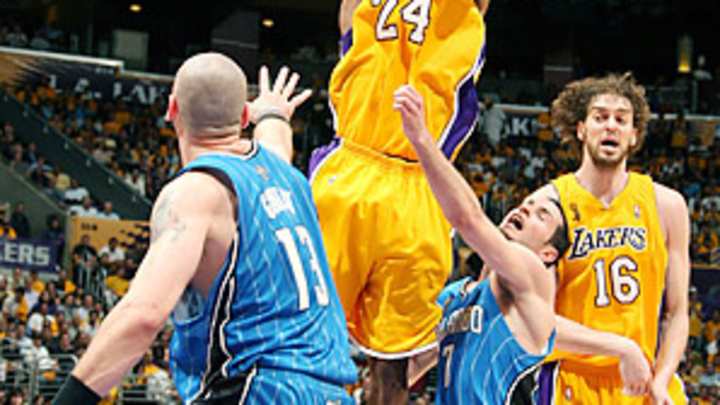
One third-quarter play capsulated Bryant's deadly big-game ability. Derek Fisher retrieved a loose ball near midcourt with about nine seconds left on the shot clock. It took him a couple of seconds to find Bryant, the designated one-on-one clock-beater. Bryant started toward the basket with about six seconds left. Everyone in Staples Center knew that the shot was his to take. The Magic collapsed on him. Bryant got that hellfire look in his eyes and got off a twisting shot between 20½ feet of humanity (Dwight Howard, Mickael Pietrus and Rashard Lewis). In it went.
We often talk about great players needing to win the MVP to validate their career. But really great players also want that Finals MVP. Shaquille O'Neal, not Bryant, won all three of those during the Lakers' championship trifecta from 2000 to '02, a fact of which Bryant is starkly aware.
But as Kobe goes after that goal, let's cut James, a great player and a credit to the game who had a bad moment, some slack. Remember how badly you felt after a trip to the dentist?

Special Contributor, Sports Illustrated As a member of the Basketball Hall of Fame, it seems obvious what Jack McCallum would choose as his favorite sport to cover. "You would think it would be pro basketball," says McCallum, a Sports Illustrated special contributor, "but it would be anything where I'm the only reporter there because all the stuff you gather is your own." For three decades McCallum's rollicking prose has entertained SI readers. He joined Sports Illustrated in 1981 and famously chronicled the Celtics-Lakers battles of 1980s. McCallum returned to the NBA beat for the 2001-02 season, having covered the league for eight years in the Bird-Magic heydays. He has edited the weekly Scorecard section of the magazine, written frequently for the Swimsuit Issue and commemorative division and is currently a contributor to SI.com. McCallum cited a series of pieces about a 1989 summer vacation he took with his family as his most memorable SI assignment. "A paid summer va-kay? Of course it's my favorite," says McCallum. In 2008, McCallum profiled Special Olympics founder Eunice Shriver, winner of SI's first Sportsman of the Year Legacy Award. McCallum has written 10 books, including Dream Team, which spent six seeks on the New York Times best-seller list in 2012, and his 2007 novel, Foul Lines, about pro basketball (with SI colleague Jon Wertheim). His book about his experience with cancer, The Prostate Monologues, came out in September 2013, and his 2007 book, Seven Seconds or Less: My Season on the Bench with the Runnin' and Gunnin' Phoenix Suns, was a best-selling behind-the-scenes account of the Suns' 2005-06 season. He has also written scripts for various SI Sportsman of the Year shows, "pontificated on so many TV shows about pro hoops that I have my own IMDB entry," and teaches college journalism. In September 2005, McCallum was presented with the Curt Gowdy Award, given annually by the Naismith Memorial Basketball Hall of Fame for outstanding basketball writing. McCallum was previously awarded the National Women Sports Foundation Media Award. Before Sports Illustrated, McCallum worked at four newspapers, including the Baltimore News-American, where he covered the Baltimore Colts in 1980. He received a B.A. in English from Muhlenberg College in Allentown, Pa. and holds an M.A. in English Literature from Lehigh University. He and his wife, Donna, reside in Bethlehem, Pa., and have two adult sons, Jamie and Chris.