%20%20--%3E%0A%3Csvg%20version%3D%221.1%22%20id%3D%22Layer_1%22%20xmlns%3D%22http%3A%2F%2Fwww.w3.org%2F2000%2Fsvg%22%20xmlns%3Axlink%3D%22http%3A%2F%2Fwww.w3.org%2F1999%2Fxlink%22%20x%3D%220px%22%20y%3D%220px%22%0A%09%20width%3D%2239px%22%20height%3D%2240px%22%20viewBox%3D%220%200%2039%2040%22%20enable-background%3D%22new%200%200%2039%2040%22%20xml%3Aspace%3D%22preserve%22%3E%0A%3Cpath%20fill%3D%22%23FFFFFF%22%20d%3D%22M38.5%2C7H28.2v26h10.3V7z%22%2F%3E%0A%3Cpath%20fill-rule%3D%22evenodd%22%20clip-rule%3D%22evenodd%22%20fill%3D%22%23FFFFFF%22%20d%3D%22M26.1%2C25.5c0%2C5.8-4.1%2C7.5-12.9%2C7.5C3.9%2C33%2C0%2C31.2%2C0%2C25.2v-1.1h11.6%0A%09v2.4c0%2C0.7%2C0.1%2C1.4%2C1.2%2C1.4c1%2C0%2C1.2-0.4%2C1.2-1.3v-0.9c0-1.6-0.9-1.6-3.5-2.2C2.2%2C21.7%2C0%2C19.7%2C0%2C15.3v-0.9C0%2C9.3%2C5.5%2C7%2C12.9%2C7%0A%09c10.2%2C0%2C12.8%2C2.6%2C12.8%2C7.4v1.8h-11v-2.9c0-0.6-0.4-1.1-1.2-1.1c-0.6%2C0-1.2%2C0.4-1.2%2C1.1v0.9c0%2C1.5%2C0.9%2C2%2C3.3%2C2.5%0A%09c8%2C1.6%2C10.5%2C3.3%2C10.5%2C7.5V25.5z%22%2F%3E%0A%3C%2Fsvg%3E%0A)
Tailgating as traditional as sports

I can't remember the last picnic I went on. I mean one of those classic old-fashioned picnics where you take a blanket and a hamper, a cooler, maybe, or a thermos, and drive out to the countryside and sit down peacefully in a lovely field of wild flowers, alone with nature, and ... have a picnic.
Really, does anybody do that anymore?
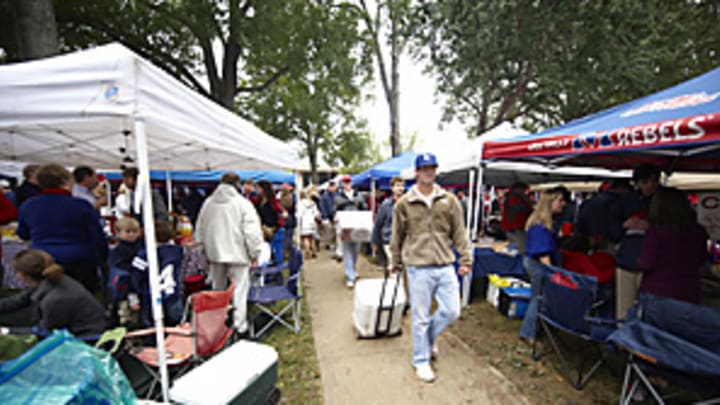
But, of course, what Americans do now is tailgate, that grand old football tradition. Jammed together, on asphalt, 'midst exhaust fumes and exhausting vulgarities. Tailgating seems pretty much an American institution confined pretty much, in sports, to football. Even on soft Summer days, most baseball fans, arriving at the park early, will eschew the charms of the parking lot and rush inside to watch batting practice. But even late in the season, football fans will tailgate, foregathering on the cold, hard tarmac for hours, dining al fresco Americano, when it's cold and raw and very un-picnicy.
There is nothing selective about tail gaiting. It crosses all ethnic, racial and religious lines. You just have to like football, and, likewise, alcoholic beverages. You don't even have to have a vehicle with a tailgate in order to tailgate.
I suppose the reason tailgating originated with football is because football games only come once a week and are events. In fact, traditionally -- especially at college games -- we refer to football "weekends," not merely football games. They don't sell corsages at hockey games, do they? There was once an episode on The Simpsons, the essence of which was that tailgating was more important than the game. This is not, I do not believe, an opinion held only by Homer Simpson.
And while tailgating has never fully migrated to other sports, there is one other entertainment where it has caught on: rock concerts. We used to think that the most popular item consumed by concert-goers was weed, and while that sort of thing has hardly gone out now, I am assured by my crack concert spies that nowadays the primary smell wafting around parking lots before concerts is more likely just to be that of good old all-American football-style hamburgers on the grill.
Concert tailgating appears to be limited, however. It is more likely to be the case where aging entertainers, like Bruce Springsteen or U2, are performing. They attract a more mature, boomer audience. Teenyboppers don't tailgate. Tailgating is a sign of growing up. People tailgate before the Santa Fe Opera. Honestly.
And, of course, another reason why tailgating has superceded picnics is because at least there ain't no ants in stadium parking lots.

Frank Deford is among the most versatile of American writers. His work has appeared in virtually every medium, including print, where he has written eloquently for Sports Illustrated since 1962. Deford is currently the magazine's Senior Contributing Writer and contributes a weekly column to SI.com. Deford can be heard as a commentator each week on Morning Edition. On television he is a regular correspondent on the HBO show Real Sports With Bryant Gumbel. He is the author of 15 books, and his latest,The Enitled, a novel about celebrity, sex and baseball, was published in 2007 to exceptional reviews. He and Red Smith are the only writers with multiple features in The Best American Sports Writing of the Century. Editor David Halberstam selected Deford's 1981 Sports Illustrated profile on Bobby Knight (The Rabbit Hunter) and his 1985 SI profile of boxer Billy Conn (The Boxer and the Blonde) for that prestigious anthology. For Deford the comparison is meaningful. "Red Smith was the finest columnist, and I mean not just sports columnist," Deford told Powell's Books in 2007. "I've always said that Red is like Vermeer, with those tiny, priceless pieces. Five hundred words, perfectly chosen, crafted. Best literary columnist, in any newspaper, that I've ever seen." Deford was elected to the National Association of Sportscasters and Sportswriters Hall of Fame. Six times at Sports Illustrated Deford was voted by his peers as U.S. Sportswriter of The Year. The American Journalism Review has likewise cited him as the nation's finest sportswriter, and twice he was voted Magazine Writer of The Year by the Washington Journalism Review. Deford has also been presented with the National Magazine Award for profiles; a Christopher Award; and journalism honor awards from the University of Missouri and Northeastern University; and he has received many honorary degrees. The Sporting News has described Deford as "the most influential sports voice among members of the print media," and the magazine GQ has called him, simply, "The world's greatest sportswriter." In broadcast, Deford has won a Cable Ace award, an Emmy and a George Foster Peabody Award for his television work. In 2005 ESPN presented a television biography of Deford's life and work, You Write Better Than You Play. Deford has spoken at well over a hundred colleges, as well as at forums, conventions and on cruise ships around the world. He served as the editor-in-chief of The National Sports Daily in its brief but celebrated existence. Deford also wrote Sports Illustrated's first Point After column, in 1986. Two of Deford's books, the novel, Everybody's All-American, and Alex: The Life Of A Child, his memoir about his daughter who died of cystic fibrosis, have been made into movies. Two of his original screenplays have also been filmed. For 16 years Deford served as national chairman of the Cystic Fibrosis Foundation, and he remains chairman emeritus. He resides in Westport, CT, with his wife, Carol. They have two grown children – a son, Christian, and a daughter, Scarlet. A native of Baltimore, Deford is a graduate of Princeton University, where he has taught American Studies.