%20%20--%3E%0A%3Csvg%20version%3D%221.1%22%20id%3D%22Layer_1%22%20xmlns%3D%22http%3A%2F%2Fwww.w3.org%2F2000%2Fsvg%22%20xmlns%3Axlink%3D%22http%3A%2F%2Fwww.w3.org%2F1999%2Fxlink%22%20x%3D%220px%22%20y%3D%220px%22%0A%09%20width%3D%2239px%22%20height%3D%2240px%22%20viewBox%3D%220%200%2039%2040%22%20enable-background%3D%22new%200%200%2039%2040%22%20xml%3Aspace%3D%22preserve%22%3E%0A%3Cpath%20fill%3D%22%23FFFFFF%22%20d%3D%22M38.5%2C7H28.2v26h10.3V7z%22%2F%3E%0A%3Cpath%20fill-rule%3D%22evenodd%22%20clip-rule%3D%22evenodd%22%20fill%3D%22%23FFFFFF%22%20d%3D%22M26.1%2C25.5c0%2C5.8-4.1%2C7.5-12.9%2C7.5C3.9%2C33%2C0%2C31.2%2C0%2C25.2v-1.1h11.6%0A%09v2.4c0%2C0.7%2C0.1%2C1.4%2C1.2%2C1.4c1%2C0%2C1.2-0.4%2C1.2-1.3v-0.9c0-1.6-0.9-1.6-3.5-2.2C2.2%2C21.7%2C0%2C19.7%2C0%2C15.3v-0.9C0%2C9.3%2C5.5%2C7%2C12.9%2C7%0A%09c10.2%2C0%2C12.8%2C2.6%2C12.8%2C7.4v1.8h-11v-2.9c0-0.6-0.4-1.1-1.2-1.1c-0.6%2C0-1.2%2C0.4-1.2%2C1.1v0.9c0%2C1.5%2C0.9%2C2%2C3.3%2C2.5%0A%09c8%2C1.6%2C10.5%2C3.3%2C10.5%2C7.5V25.5z%22%2F%3E%0A%3C%2Fsvg%3E%0A)
Time to lose the loser point, but keep traditional award names

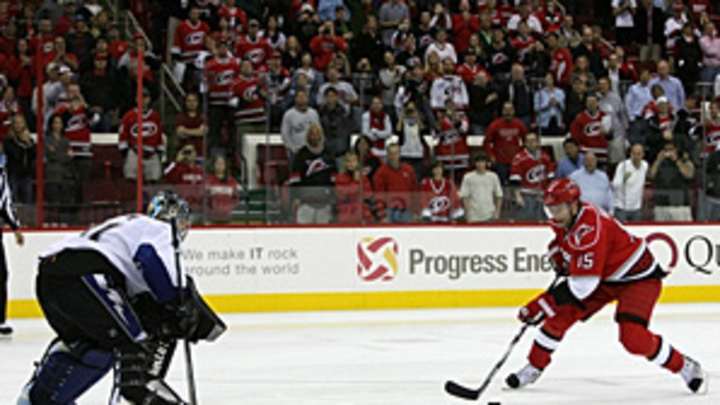
Almost three-and-a-half years since its post-lockout introduction into the NHL, the shootout is in a state of suspended animation, floating somewhere between gimmick and game-decider, ornament and integral part of the league.
Like it or loathe it, the subject continues to be a source of conversation among coaches, according to Buffalo's Lindy Ruff.
The problem for many hockey watchers is the thrill is gone. The shootout, after four-on-four, somehow seems perfunctory: a wham-bam, too-quick coda that might delight the team that walks away with the spare point but not unduly distress the one that already has been compensated at the end of regulation. The prospect of a consolation prize certainly sucks the life out of some third periods when teams turn as risk-aversive as cash under the mattress.
"I think there are some cases where teams will just hang in there for loser points," Ruff says. "Sometimes you think, let's just get a point. The schedule makes it tough. If you're playing four (games) in six (nights) and you're on that fourth game with a back-to-back and the other team is a fresh team and you're hanging around the last five minutes, a loser point is pretty damn good. I know coaches talk about it."
(By the way, the NHL hates when any of its employees uses the term "loser point." It also hates "lockout," which accurately puts the onus on the owners, and prefers the generic "work stoppage" with the implication that then-NHLPA executive director Bob Goodenow yelled "down tools!")
"I don't know what the answer is," Ruff says. "Some people are throwing good ideas around: three points for a regulation win, stuff like that. This is stuff that has to be looked at. I don't think we should just be happy with where we're at. Why shouldn't we look for more ways to make the game better?"
So maybe the NHL should try this answer: go big or go home.
To make the four-on-four and shootout be anything more than a nice parting gift to fans, the league has to raise the stakes considerably. Expunge "loser point" from the hockey vocabulary permanently. If the winner now must be clearly identified, then so, too, should the loser. If a team loses in overtime or the shootout, there should be no consolation prize. To borrow from Gertrude Stein -- no relation to Gil -- a loss is a loss is a loss.
Of course, while making the post-60 minutes truly meaningful, the NHL should have to expand the shootout to five from three skaters per side. Although traditionalists never will embrace it -- the home-run-derby-settling-a-baseball-game argument is not only for flat-earthers -- an increase in the number of shooters at least would expand the "team" dimension of the exercise, a sticking point for even fervent admirers of the shootout.
The trickle-down benefits would be obvious. The intensity of tie games would be amped in the third period, and four-on-four and shootouts would be inherently more dramatic with everything at stake. (NHL teams might actually bother spending a fair bit of time practicing both, rather than treating them as a bother.)
And the standings wouldn't look like the DaVinci Code. Instead of the current hieroglyphics of wins, losses, overtime losses, shootout losses and points, there would be wins and losses and games behind. While the traditional two points for a win would become an anachronism, this is one slice of NHL patrimony that could be sacrificed on the altar of clarity.
As On The Fly routinely mentions, the reason the NHL clings to the gray area of three-point games is that they artificially create playoff races that a black-and-white approach would squelch. Consider Tampa Bay, which woke up Tuesday a mere two points out of a playoff spot in a tie for 10th even though the Lightning should be in 14th place based on 11 wins in 32 games. A team that, at first glance, would appear to be one game under .500 has won barely a third of its games but is hanging around because three of its losses came in overtime and six more occurred in shootouts.
If the oft-pilloried Philadelphia Flyers were judged on wins and losses, they -- and not the Montreal Canadiens, who have scavenged eight points in overtime and shootouts -- would be in a playoff spot.
Anyway, instead of soccer-style three points for a win or the timid status quo, the NHL should rip away the security of a point for effort and let teams stand or fall on actual results in what is supposed to be a bottom-line industry.
On the subject of ideas, Bill Daly, the NHL senior vice-president, recently resurrected an old one that calls for renaming trophies in honor of Gordie Howe, Wayne Gretzky, Bobby Orr and Mario Lemieux.
Like that Colorado family, you know how those trial balloons can work out.
Now, if the NHL wants to invent new awards in the names of four of the best players in history, have at it. This is a marvelously inclusive sport -- see three-point games -- and there is so much hockey love to share, like the two-year-old Mark Messier NHL Leadership Award. To jog your memory, the Messier joins a roster of congratulations that includes the Hart, Art Ross, Calder, Norris, Vezina, Lady Byng, Selke, Jack Adams, Jennings, Conn Smythe, Masterton, King Clancy, Rocket Richard, Pearson, NHL Foundation Award, and the Scotiabank/NHL Fan Fav Award as hardware dedicated to the players. If the smart folks in New York can stay in the giving mode and develop, say, a Howe Trophy for a combination of skill and toughness -- Jarome Iginla is the first winner -- by all means.
But in thinking aloud about turning the Hart into the Howe, the Art Ross into the Gretzky, the Norris into the Orr, and the Calder into the Lemieux, the NHL would be cannibalizing its heritage.
The Hart Trophy was named for its donor, Dr. David Hart, whose son, Cecil, was a Canadiens coach and general manager. Ross, a coach and GM of the Bruins, was a Hall of Fame player. Frank Calder was the original president of the NHL, serving from 1917 until 1943. James Norris was the Red Wings owner whose family, for a spell in the Original Six years, also controlled the Blackhawks and had a tremendous influence on the Rangers. While essentially running half the league was creepy, it wasn't criminal. Not even Norris deserves to have his name ripped off the award.
The NHL already downgraded the Prince of Wales and the late NHL President Clarence Campbell by taking their names off the respective conferences to make the standings into the more accessible Eastern and Western. (The future king of England, Edward VIII, donated a trophy that still is awarded.) But simply stripping off layers of the past to add a fresher and splashier coat of paint does a disservice to the league.
The Los Angeles Kings entered the week as the No. 1 team in the Western Conference. Even after a loss to Vancouver on Monday, their 45 points equaled San Jose's total as the most in the conference.
Want a sign why Los Angeles probably won't finish the season atop the conference?
Through 35 games, the Kings had a goal differential of plus three, having scored 107 and allowed 104.
There is no more reliable reflection of success than goal differential. Since 1989, the worst/plus minus for a regular-season conference winner was plus-35, by the Bruins in 1990 and 2002. The '89 Red Wings, with an 80-point season, managed to win the Norris Division (like the Adams, Patrick and Smythe, those traditional names, too, were sacrificed to geography) despite allowing three more goals than they scored, but no other division winner has ventured into negative territory.
Other division winners with close shaves include Carolina, which scored and allowed 217 goals in '02, Atlanta (plus-one in '07), and Minnesota (plus-five in '08.)
Coach Terry Murray has helped give the structure, and Jonathan Quick has provided A-minus goaltending for the upstart Kings, who are winners of 10 of 15 one-goal games. But other than the 1993 Canadiens, who won 10 straight OT games in the playoffs with the nonpareil Patrick Roy in goal, virtually no team -- especially a young one like Los Angeles -- truly is comfortable walking a tightrope every game.

Along with the pages of Sports Illustrated, you'll find senior writer Michael Farber in the Hockey Hall of Fame. Farber joined the staff of Sports Illustrated in January 1994 and now stands as one of the magazine's top journalists, covering primarily ice hockey and Olympic sports. He is also a regular contributor to SI.com. In 2003 Farber was honored with the Elmer Ferguson Award from the Hockey Hall of Fame for distinguished hockey writing. "Michael Farber represents the best in our business," said the New York Post's Larry Brooks, past president of the Professional Hockey Writers' Association. "He is a witty and stylish writer, who has the ability to tell a story with charm and intelligence." Farber says his Feb. 2, 1998 piece on the use and abuse of Sudafed among NHL players was his most memorable story for SI. He also cites a feature on the personal problems of Kevin Stevens, Life of the Party. His most memorable sports moment as a journalist came in 1988 when Canadian Ben Johnson set his controversial world record by running the 100 meters in 9.79 seconds at the Summer Olympic Games, in Seoul. Before coming to Sports Illustrated, Farber spent 15 years as an award-winning sports columnist and writer for the Montreal Gazette, three years at the Bergen Record, and one year at the Sun Bulletin in Binghamton, NY. He has won many honors for his writing, including the "outstanding sports writing award" in 2007 from Sports Media Canada, and the Prix Jacques-Beauchamp (Quebec sportswriter of the year) in 1993. While at the Gazette, he won a National Newspaper award in 1982 and 1990. Sometimes Life Gets in the Way, a compendium of his best Gazette columns, was published during his time in newspapers. Farber says hockey is his favorite sport to cover. "The most down-to-earth athletes play the most demanding game," he says. Away from Sports Illustrated, Farber is a commentator for CJAD-AM in Montreal and a panelist on TSN's The Reporters (the Canadian equivalent of ESPN's The Sports Reporters in the United States, except more dignified). Farber is also one of the 18 members on the Hockey Hall of Fame selection committee. Born and raised in New Jersey, Farber is a 1973 graduate of Rutgers University where he was Phi Beta Kappa. He now resides in Montreal with his wife, Danielle Tétrault, son Jérémy and daughter Gabrielle.