%20%20--%3E%0A%3Csvg%20version%3D%221.1%22%20id%3D%22Layer_1%22%20xmlns%3D%22http%3A%2F%2Fwww.w3.org%2F2000%2Fsvg%22%20xmlns%3Axlink%3D%22http%3A%2F%2Fwww.w3.org%2F1999%2Fxlink%22%20x%3D%220px%22%20y%3D%220px%22%0A%09%20width%3D%2239px%22%20height%3D%2240px%22%20viewBox%3D%220%200%2039%2040%22%20enable-background%3D%22new%200%200%2039%2040%22%20xml%3Aspace%3D%22preserve%22%3E%0A%3Cpath%20fill%3D%22%23FFFFFF%22%20d%3D%22M38.5%2C7H28.2v26h10.3V7z%22%2F%3E%0A%3Cpath%20fill-rule%3D%22evenodd%22%20clip-rule%3D%22evenodd%22%20fill%3D%22%23FFFFFF%22%20d%3D%22M26.1%2C25.5c0%2C5.8-4.1%2C7.5-12.9%2C7.5C3.9%2C33%2C0%2C31.2%2C0%2C25.2v-1.1h11.6%0A%09v2.4c0%2C0.7%2C0.1%2C1.4%2C1.2%2C1.4c1%2C0%2C1.2-0.4%2C1.2-1.3v-0.9c0-1.6-0.9-1.6-3.5-2.2C2.2%2C21.7%2C0%2C19.7%2C0%2C15.3v-0.9C0%2C9.3%2C5.5%2C7%2C12.9%2C7%0A%09c10.2%2C0%2C12.8%2C2.6%2C12.8%2C7.4v1.8h-11v-2.9c0-0.6-0.4-1.1-1.2-1.1c-0.6%2C0-1.2%2C0.4-1.2%2C1.1v0.9c0%2C1.5%2C0.9%2C2%2C3.3%2C2.5%0A%09c8%2C1.6%2C10.5%2C3.3%2C10.5%2C7.5V25.5z%22%2F%3E%0A%3C%2Fsvg%3E%0A)
Red Wings, Coyotes break out the fireworks -- for one night only
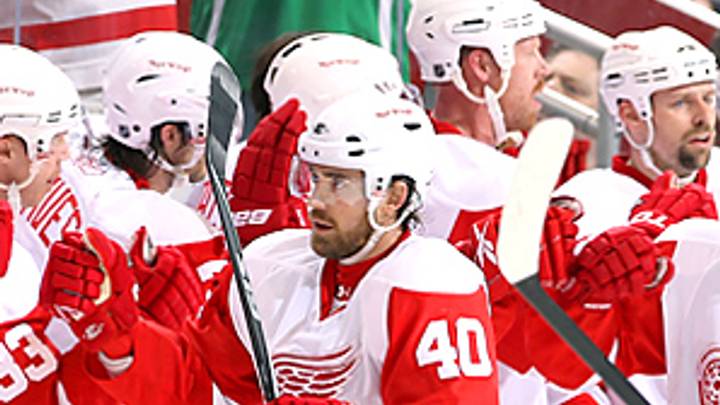
The score: Detroit 7, Phoenix 4. In the annals of Coyotes playoff hockey -- we know, this no as voluminous as War and Peace -- this game will be remembered as the Shootout at the "I'm OK, You're OK" Corral.
The Red Wings certainly are OK, having won this marvelous and no doubt maddening game -- for the Coyotes coaches, anyway -- to even the first-round series after two games. The Red Wings reminded the hockey world of their bona fides, utilizing their superior skill and showing a considerable will. Henrik Zetterberg had three goals -- the empty-netter concluded a hat trick -- and Valtteri Filppula had another two in this brazen display of firewagon hockey that had some Coyotes heads spinning Friday more than Linda Blair in The Exorcist. "Wide open, a lot of fun," said rookie Detroit goalie Jimmy Howard, who won his first playoff game in an unconventional manner. "We have some skilled guys, but they also have some guys who can skate and just go. My guess is you'll see a lot more of a defensive style (in Game 3) Sunday."
But the Coyotes, well, they sort of were OK, too. They got caught up in the second-period merriment, but then showed -- for a time, at least -- they could be more than a buttoned-down, cautious team that was eternally obliged to eke out one-goal victories. Now, they certainly don't want to keep getting into shootouts with a team that has way more bullets; but in defeat, they showed a side that had largely kept hidden.
"We opened up a lot," said Phoenix center Matthew Lombardi, one of the NHL's premier skaters, "but that's because we kept making so many mistakes. That's not how we usually do things around here. We know that our success has mostly come in those 2-1 or 3-2 games. Having that much open ice, guys flying up and down, that might be great to watch, but that's not how we got here. It was sort of fun while it lasted, but you don't want to try that too much against them. Look at their roster. They have world-class guys who can make you pay if you keep making mistakes."
"We're not going to win many hockey games doing that," coach Dave Tippett said. "...That's certainly not our M.O. for the season." Anyway, once Tippett hides the lampshades the fun and foolish Coyotes wore for the last 40 minutes, this series could be an honest-to-goodness thing. Sure, the Coyotes have been a cute bedtime story, the little engine that could, if, say, the railroad line were in receivership and about to be nationalized. But the split at home only reinforced that Phoenix, when it sticks to the script, is capable of playing -- and beating -- a veteran team that's been to the past two finals. The Red Wings fell into a 1-0 first-period hole, the result of Coyotes persistence and puck support mingled with some of their own sloth. Petr Prucha carried the puck along the right wing, cut off at the half board by defenseman Brad Stuart. But Radim Vrbata jumped in and grabbed the puck and seconds later Martin Hanzal was circling the net and bouncing a shot off Howard's shoulder. This time Keith Yandle, the dynamic blueliner who is on the cusp of joining the group of elite young attacking defenseman, broke in unmarked from the blue line -- Todd Bertuzzi did not exactly overextend himself backchecking on the play -- and buried a rebound.
"He's such a mobile defenseman," Coyotes veteran defenseman Ed Jovanovski said of Yandle. "He's got quick feet, and he's able to get into holes."
And in the second period, there were nothing but holes. In the most entertaining period of these still young playoffs, the party hats and noisemakers were broken out. Staring with Zetterberg's power play goal at 6:27 and ending with Filppula's nifty finish at 10:25, the teams scored five times in two ticks under four minutes, alternating goals. They were like two schoolyard welterweights at recess who simply forgot about self-preservation and took turns whaling away at each other, inflicting a fair amount of punishment.
From a Phoenix perspective, the quick answers to the first two Detroit goals were most impressive. When Howard and defenseman Niklas Kronwall ran into communication problems and left a puck free for a second a few feet from the crease, Wojtek Wolski pounced to give the Coyotes a lead just 38 seconds after they had lost one. And following Pavel Datsyuk's goal -- the Jobing.com scoreboard had just thoughtfully mentioned that he hadn't scored in 15 playoff games -- Lombardi used his otherworldly speed to take a chip pass from Shane Doan, outrace Drew Miller and beat Howard with a backhand on the modified breakaway. Only after Filppula used his speed to beat Zbynek Michalek and then goalie Ilya Bryzgalov with a backhander -- Jovanovski had taken himself out of the play to hit Bertuzzi in the neutral zone -- did the game lose its wonderful, frenetic quality. But Phoenix had misplaced the formula. Three late goals and it was over, even if the series is only getting revved up. The only epitaph that likely will be written is: Firewagon hockey, RIP.
 Add us as a preferred source on Google
Along with the pages of Sports Illustrated, you'll find senior writer Michael Farber in the Hockey Hall of Fame. Farber joined the staff of Sports Illustrated in January 1994 and now stands as one of the magazine's top journalists, covering primarily ice hockey and Olympic sports. He is also a regular contributor to SI.com. In 2003 Farber was honored with the Elmer Ferguson Award from the Hockey Hall of Fame for distinguished hockey writing. "Michael Farber represents the best in our business," said the New York Post's Larry Brooks, past president of the Professional Hockey Writers' Association. "He is a witty and stylish writer, who has the ability to tell a story with charm and intelligence." Farber says his Feb. 2, 1998 piece on the use and abuse of Sudafed among NHL players was his most memorable story for SI. He also cites a feature on the personal problems of Kevin Stevens, Life of the Party. His most memorable sports moment as a journalist came in 1988 when Canadian Ben Johnson set his controversial world record by running the 100 meters in 9.79 seconds at the Summer Olympic Games, in Seoul. Before coming to Sports Illustrated, Farber spent 15 years as an award-winning sports columnist and writer for the Montreal Gazette, three years at the Bergen Record, and one year at the Sun Bulletin in Binghamton, NY. He has won many honors for his writing, including the "outstanding sports writing award" in 2007 from Sports Media Canada, and the Prix Jacques-Beauchamp (Quebec sportswriter of the year) in 1993. While at the Gazette, he won a National Newspaper award in 1982 and 1990. Sometimes Life Gets in the Way, a compendium of his best Gazette columns, was published during his time in newspapers. Farber says hockey is his favorite sport to cover. "The most down-to-earth athletes play the most demanding game," he says. Away from Sports Illustrated, Farber is a commentator for CJAD-AM in Montreal and a panelist on TSN's The Reporters (the Canadian equivalent of ESPN's The Sports Reporters in the United States, except more dignified). Farber is also one of the 18 members on the Hockey Hall of Fame selection committee. Born and raised in New Jersey, Farber is a 1973 graduate of Rutgers University where he was Phi Beta Kappa. He now resides in Montreal with his wife, Danielle Tétrault, son Jérémy and daughter Gabrielle.