%20%20--%3E%0A%3Csvg%20version%3D%221.1%22%20id%3D%22Layer_1%22%20xmlns%3D%22http%3A%2F%2Fwww.w3.org%2F2000%2Fsvg%22%20xmlns%3Axlink%3D%22http%3A%2F%2Fwww.w3.org%2F1999%2Fxlink%22%20x%3D%220px%22%20y%3D%220px%22%0A%09%20width%3D%2239px%22%20height%3D%2240px%22%20viewBox%3D%220%200%2039%2040%22%20enable-background%3D%22new%200%200%2039%2040%22%20xml%3Aspace%3D%22preserve%22%3E%0A%3Cpath%20fill%3D%22%23FFFFFF%22%20d%3D%22M38.5%2C7H28.2v26h10.3V7z%22%2F%3E%0A%3Cpath%20fill-rule%3D%22evenodd%22%20clip-rule%3D%22evenodd%22%20fill%3D%22%23FFFFFF%22%20d%3D%22M26.1%2C25.5c0%2C5.8-4.1%2C7.5-12.9%2C7.5C3.9%2C33%2C0%2C31.2%2C0%2C25.2v-1.1h11.6%0A%09v2.4c0%2C0.7%2C0.1%2C1.4%2C1.2%2C1.4c1%2C0%2C1.2-0.4%2C1.2-1.3v-0.9c0-1.6-0.9-1.6-3.5-2.2C2.2%2C21.7%2C0%2C19.7%2C0%2C15.3v-0.9C0%2C9.3%2C5.5%2C7%2C12.9%2C7%0A%09c10.2%2C0%2C12.8%2C2.6%2C12.8%2C7.4v1.8h-11v-2.9c0-0.6-0.4-1.1-1.2-1.1c-0.6%2C0-1.2%2C0.4-1.2%2C1.1v0.9c0%2C1.5%2C0.9%2C2%2C3.3%2C2.5%0A%09c8%2C1.6%2C10.5%2C3.3%2C10.5%2C7.5V25.5z%22%2F%3E%0A%3C%2Fsvg%3E%0A)
Refereeing at World Cup is a joke, and it's hurting image of the game

But ...
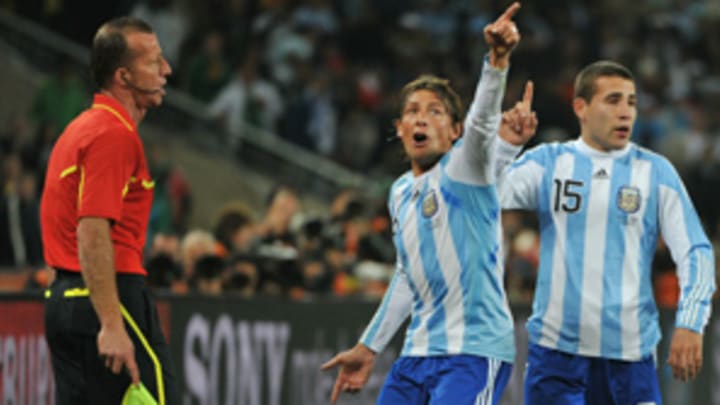
The World Cup refereeing has been an absolute joke, so atrocious that it has come close to ruining the entire tournament for me.
Who cares, right? I'm not the soccer demographic, the guy who picks his cable system based on the best selection of Premier League games. And I wasn't the journalist traipsing from one end of South Africa to the other, chronicling the hundreds of incredible stories that demanded to be told but will never see the light of day because we're not a soccer country.
But I am the armchair fan who desperately wants to love this game, and, like untold thousands (millions?), had no choice but to curse it out, turned off by incompetent refereeing, a situation exacerbated by a governing body so intransigent and arrogant it makes British Petroleum look like a warm and cuddly quilting circle. "I am very, very satisfied," Jose-Maria Garcia-Aranda, the head of FIFA's referees, said of the quality of officiating in the World Cup matches.
If he truly believes that, Mr. Garcia-Aranda is very, very, very out of it.
Let's cut right to the chase:
In a sport where a score of, say, 5-2 is considered an offensive onslaught of massive proportions, a legitimate goal must be counted. If the ball bounces over the line, it's a goal. End of story, no debate, case closed. True, other sports are not perfect when it comes to scoring. A mistaken non-call on goaltending might take away a legitimate field goal in an NBA game, for example, but that's two points out of 200. And replays are now allowed to determine if a shot counts for two points or three. In major league baseball, a sport that takes to change the way a sea lion takes to the Sahara, umpires are now allowed to consult replay cameras to determine whether a home run is fair or foul or whether a ball did in fact go over the barrier into the seats. And it goes without saying that the NFL replay system all but guarantees that a touchdown will be counted as a touchdown.
But even if there were no replay in other sports, disallowing a legit goal in soccer, a sport in which offenses work so hard for even a great opportunity to take a crack at the goal, is indefensible. Even the most tradition-bound purists must agree that a goal should be a goal. So when referee Mauricio Espinosa mistakenly disallowed Frank Lampard's goal on Sunday, a score that would've enabled England to tie Germany 2-2, it was a very big deal. And when FIFA general secretary Jerome Valcke all but ruled out the use of video replay that would correct such situations, it exposed a sport crying out not just for visionary leadership but for leadership with some grasp of reality. Not counting a goal for fear of dehumanizing a sport with replay is not in the tradition of anything besides the tradition of ignorance.
The fact that Germany was the superior team and probably would've won the game anyway is irrelevant.
Lampard put it across the goal line.
Give the man a goal!
Cutting to the chase, part two:
In a sport whose doling out of punishment seems capricious at best -- a player can earn a yellow card for practically cutting someone's legs off at the knees and the same penalty for making an entirely legitimate defensive tackle -- the idea that a referee can make a game-changing call and not even explain what it was is right out of Kafka. As we all know, that's what happened when the manifestly incompetent Koman Coulibaly called something that took away what could have been the winning U.S. goal in its 2-2 opening-round tie with Slovenia. Most observers assumed that it was an offsides call on midfielder Michael Bradley, which would've been ridiculous given how a Slovenian defender was physically restraining him as Landon Donavan's free kick headed toward the net. But SI's Grant Wahl reported that the play-by-play sheet listed a foul on Maurice Edu, the midfielder who scored the goal, a call that was equally ridiculous. Wahl is fairly certain that the scorekeeper was just guessing anyway because he was not in communication with Coulibaly. The replay seems to reveal that Coulibaly isn't sure what he called himself.
At any rate, the situation screamed out for clarification because the least we can expect of referees is that we know what infraction they called. But Coulibaly's concept of justice that is not only blind but also mute was, needless to say, backed up by FIFA, whose officials repeatedly said that Coulibaly did not have to explain himself. "Some of them [referee calls] are not good decisions on the field of play and this for human beings, is natural," said Garcia-Aranda.
Mistakes are natural but not correcting the most egregious of them -- when they are correctable -- is just plain stupid. Disallowing a legitimate goal and making an unexplained phantom call on a goal are beyond human error. They are negations of the game itself, impossible to justify, impossible to explain away and impossible not to negatively affect the casual fan's belief in the sport.

Special Contributor, Sports Illustrated As a member of the Basketball Hall of Fame, it seems obvious what Jack McCallum would choose as his favorite sport to cover. "You would think it would be pro basketball," says McCallum, a Sports Illustrated special contributor, "but it would be anything where I'm the only reporter there because all the stuff you gather is your own." For three decades McCallum's rollicking prose has entertained SI readers. He joined Sports Illustrated in 1981 and famously chronicled the Celtics-Lakers battles of 1980s. McCallum returned to the NBA beat for the 2001-02 season, having covered the league for eight years in the Bird-Magic heydays. He has edited the weekly Scorecard section of the magazine, written frequently for the Swimsuit Issue and commemorative division and is currently a contributor to SI.com. McCallum cited a series of pieces about a 1989 summer vacation he took with his family as his most memorable SI assignment. "A paid summer va-kay? Of course it's my favorite," says McCallum. In 2008, McCallum profiled Special Olympics founder Eunice Shriver, winner of SI's first Sportsman of the Year Legacy Award. McCallum has written 10 books, including Dream Team, which spent six seeks on the New York Times best-seller list in 2012, and his 2007 novel, Foul Lines, about pro basketball (with SI colleague Jon Wertheim). His book about his experience with cancer, The Prostate Monologues, came out in September 2013, and his 2007 book, Seven Seconds or Less: My Season on the Bench with the Runnin' and Gunnin' Phoenix Suns, was a best-selling behind-the-scenes account of the Suns' 2005-06 season. He has also written scripts for various SI Sportsman of the Year shows, "pontificated on so many TV shows about pro hoops that I have my own IMDB entry," and teaches college journalism. In September 2005, McCallum was presented with the Curt Gowdy Award, given annually by the Naismith Memorial Basketball Hall of Fame for outstanding basketball writing. McCallum was previously awarded the National Women Sports Foundation Media Award. Before Sports Illustrated, McCallum worked at four newspapers, including the Baltimore News-American, where he covered the Baltimore Colts in 1980. He received a B.A. in English from Muhlenberg College in Allentown, Pa. and holds an M.A. in English Literature from Lehigh University. He and his wife, Donna, reside in Bethlehem, Pa., and have two adult sons, Jamie and Chris.