%20%20--%3E%0A%3Csvg%20version%3D%221.1%22%20id%3D%22Layer_1%22%20xmlns%3D%22http%3A%2F%2Fwww.w3.org%2F2000%2Fsvg%22%20xmlns%3Axlink%3D%22http%3A%2F%2Fwww.w3.org%2F1999%2Fxlink%22%20x%3D%220px%22%20y%3D%220px%22%0A%09%20width%3D%2239px%22%20height%3D%2240px%22%20viewBox%3D%220%200%2039%2040%22%20enable-background%3D%22new%200%200%2039%2040%22%20xml%3Aspace%3D%22preserve%22%3E%0A%3Cpath%20fill%3D%22%23FFFFFF%22%20d%3D%22M38.5%2C7H28.2v26h10.3V7z%22%2F%3E%0A%3Cpath%20fill-rule%3D%22evenodd%22%20clip-rule%3D%22evenodd%22%20fill%3D%22%23FFFFFF%22%20d%3D%22M26.1%2C25.5c0%2C5.8-4.1%2C7.5-12.9%2C7.5C3.9%2C33%2C0%2C31.2%2C0%2C25.2v-1.1h11.6%0A%09v2.4c0%2C0.7%2C0.1%2C1.4%2C1.2%2C1.4c1%2C0%2C1.2-0.4%2C1.2-1.3v-0.9c0-1.6-0.9-1.6-3.5-2.2C2.2%2C21.7%2C0%2C19.7%2C0%2C15.3v-0.9C0%2C9.3%2C5.5%2C7%2C12.9%2C7%0A%09c10.2%2C0%2C12.8%2C2.6%2C12.8%2C7.4v1.8h-11v-2.9c0-0.6-0.4-1.1-1.2-1.1c-0.6%2C0-1.2%2C0.4-1.2%2C1.1v0.9c0%2C1.5%2C0.9%2C2%2C3.3%2C2.5%0A%09c8%2C1.6%2C10.5%2C3.3%2C10.5%2C7.5V25.5z%22%2F%3E%0A%3C%2Fsvg%3E%0A)
Disaster in the making: NBA to penalize players' reactions to refs
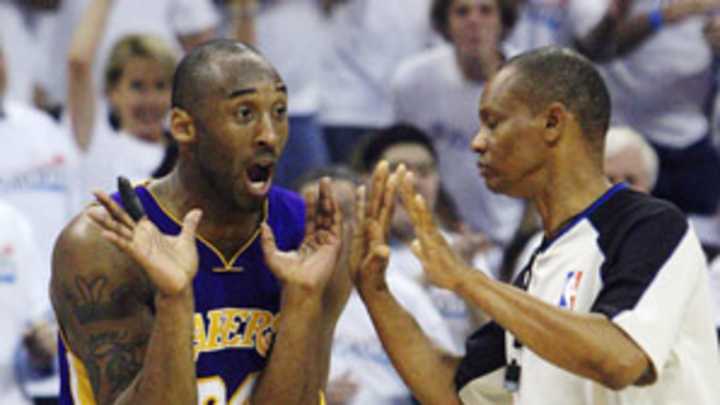

"We're going to expand the universe of unsportsmanlike actions that will be penalized,'' NBA vice president of basketball operations Stu Jackson said Friday. "They will include air-punching at an official. Waving him off as a sign of disrespect. Running up to an official from across the court to voice a complaint. Flailing arms in disbelief. Jumping up and down and pirouetting in disbelief or clapping sarcastically at an official. Those are some of the types of actions that really have no place in our game."
The NBA has been trying to outlaw excessive complaining by players since 2006-07, but fans maintain that "NBA players complain too much and do so much more than players in other leagues," Jackson said. "We have a great game with great players and we have a great product. Let's focus on executing offense and defense and being highly competitive, because complaining doesn't have a part in our game and has never changed a noncall to a call, or a call to a noncall. So focus on playing the game."
It is true that players complain far too often -- especially in the playoffs, when poorly played games are rendered altogether unwatchable by badly behaved players who consistently take out their frustrations on the referees. But I believe these new restrictions will backfire for two reasons. One reason is that the players will view these hard-line rules as a manifestation of the collective bargaining negotiations -- another example of the owners trying to make them subservient employees in every way imaginable.
The second reason is that this new understanding comes so completely out of left field as to appear arbitrary. During a meeting Thursday night in Jersey City, N.J., with reporters and team broadcasters, NBA director of officials Bernie Fryer showed a series of player reactions that will now be deemed worthy of technical fouls. Many of them were mild forms of protest in which the player wasn't looking at the referee or was approaching the official emotionally in a nonthreatening, pleading way with his arms extended.
I spoke to a head coach who attended the coaches meeting and watched a similar array of videos earlier this week.
"The coaches thought only one or two of those reactions was a technical foul," said the coach, speaking on behalf of his colleagues. "It's a bad idea."
It is one thing to alter a rule that can be reviewed on video in black-and-white terms. But this new edict will force officials to judge players in emotional terms that will be very difficult to define.
The league's best players are among the biggest complainers, so they will receive more penalties than ever. Will a young referee be willing to hit KobeBryant or Tim Duncan with a technical and cast him out of the game? And what happens when a referee makes a mistake -- knows he made a bad call -- and then has to punish the player for questioning that call? The TV broadcasters will have a lot of fun replaying those sequences. In a lot of these situations, the referee is going to be portrayed as the villain.
Of course the players need to stop grousing. They look like whiners and they set a bad example for young players around the world. Ultimately, there is no easy way to change this behavior.
But wouldn't it be better to enforce this new standard after the anticipated lockout next season? The owners are talking about using the next collective bargaining agreement to seize back control of the league in all kinds of ways, and a harder line on player complaining could be folded into the new era to come. Throughout the ongoing negotiations the players would be warned that it is in their best interests and the interests of the league to abolish the griping. After the lockout there will be much talk of winning back the fans, and an almost-zero-tolerance approach to complaining about the referees could be seen in that light and therefore embraced by all sides.
But right now the players are going to view the new policy as an extension of their bargaining conflict with management. Some fans are going to like the crackdowns, but a lot of people are going to question why some player complaints are being penalized and others are being ignored. Altogether it will be difficult to understand and practically impossible to enforce.

Senior Writer, Sports Illustrated Sports Illustrated Senior Writer Ian Thomsen, who joined the magazine in 1998, is one of SI's top basketball scribes. Along with writing columns and features for SI, Thomsen is a frequent contributor to SI.com. Before joining SI, Thomsen spent six years in Europe as the sports columnist for the International Herald Tribune, the world's largest international English-language daily. While at the paper Thomsen wrote about an array of sports for a global audience, including the major world and European soccer tournaments, the 1995 Rugby World Cup, Olympic Games, Ryder Cups, Grand Slam tennis events, Grand Prix auto races and, very rarely, cricket. Thomsen, who graduated from Northwestern with a journalism degree in 1983, was a feature writer for The National Sports Daily during its short, expensive run of 1990-91. His first job was with The Boston Globe, where he covered Doug Flutie's Boston College Eagles and all three of the Celtics-Lakers NBA Finals of the 1980s. Thomsen was a feature writer at SI before taking on the NBA beat fulltime in 2000. With Luis Fernando Llosa and Melissa Segura, Thomsen covered the 2001 scandal of overaged Little League pitcher Danny Almonte and wrote the first SI cover story on Kobe Bryant in 1998. Thomsen lives with his wife and two children near Boston.