%20%20--%3E%0A%3Csvg%20version%3D%221.1%22%20id%3D%22Layer_1%22%20xmlns%3D%22http%3A%2F%2Fwww.w3.org%2F2000%2Fsvg%22%20xmlns%3Axlink%3D%22http%3A%2F%2Fwww.w3.org%2F1999%2Fxlink%22%20x%3D%220px%22%20y%3D%220px%22%0A%09%20width%3D%2239px%22%20height%3D%2240px%22%20viewBox%3D%220%200%2039%2040%22%20enable-background%3D%22new%200%200%2039%2040%22%20xml%3Aspace%3D%22preserve%22%3E%0A%3Cpath%20fill%3D%22%23FFFFFF%22%20d%3D%22M38.5%2C7H28.2v26h10.3V7z%22%2F%3E%0A%3Cpath%20fill-rule%3D%22evenodd%22%20clip-rule%3D%22evenodd%22%20fill%3D%22%23FFFFFF%22%20d%3D%22M26.1%2C25.5c0%2C5.8-4.1%2C7.5-12.9%2C7.5C3.9%2C33%2C0%2C31.2%2C0%2C25.2v-1.1h11.6%0A%09v2.4c0%2C0.7%2C0.1%2C1.4%2C1.2%2C1.4c1%2C0%2C1.2-0.4%2C1.2-1.3v-0.9c0-1.6-0.9-1.6-3.5-2.2C2.2%2C21.7%2C0%2C19.7%2C0%2C15.3v-0.9C0%2C9.3%2C5.5%2C7%2C12.9%2C7%0A%09c10.2%2C0%2C12.8%2C2.6%2C12.8%2C7.4v1.8h-11v-2.9c0-0.6-0.4-1.1-1.2-1.1c-0.6%2C0-1.2%2C0.4-1.2%2C1.1v0.9c0%2C1.5%2C0.9%2C2%2C3.3%2C2.5%0A%09c8%2C1.6%2C10.5%2C3.3%2C10.5%2C7.5V25.5z%22%2F%3E%0A%3C%2Fsvg%3E%0A)
In memory of the Metrodome

If you're not from there, you think the Midwest is composed of interchangeable parts. A CNN graphic last weekend showed heavy snow in "Minneapolis, Wisconsin." An ABC studio host told a freezing correspondent in Minnesota: "Sorry about that, Chicago!" When people ask if Marquette University is in Michigan, and I tell them my alma mater is in Milwaukee, they sometimes say: "What's the difference?"
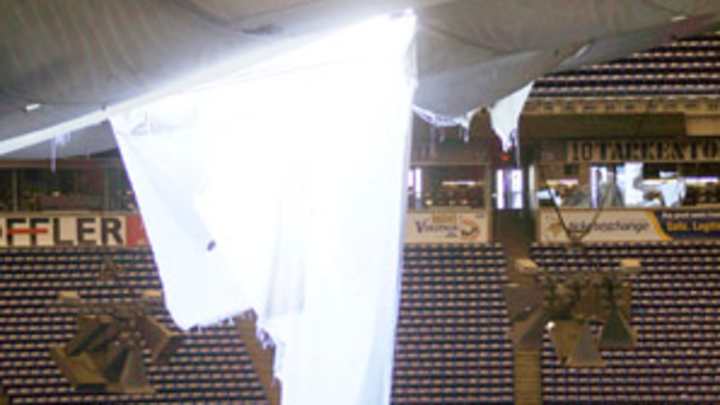
So when the Metrodome roof collapsed on Sunday, I got a little defensive, as I always do when the national spotlight is on Minneapolis -- which I've heard called, on more than one occasion, "Minndianapolis."
The nationwide descriptions of the Dome -- as dump and dinosaur, an inverted dog-dish of decrepitude -- are all true. But they still sting, and raise the natural defenses of most Minnesotans. When the Metrodome opened in 1982, an official wall sign down the rightfield line -- designed to be visible on all televised games -- read: THE METRODOME -- MINNEAPOLIS -- WE LIKE IT HERE.
The implication was clear: "Sure this place is an un-air-conditioned anachronism, built on the cheap and hideous to behold, but it's ours, and it's probably all that we deserve, and anyway, what we build is none of your beeswax: We like it here."
The truth is, we've never liked the Metrodome all that much, but we see it as we do many aging adversaries: Our anger toward them dims over time, we begin to see their good side, and when they fall apart -- when they get snow on the roof and begin to buckle -- we call on the better angels of our nature and prepare a nice eulogy.
And so I've come to praise the Metrodome, not to bury it. (That will be done soon enough, when the Vikings' lease expires at the end of next season.) I have witnessed more games beneath that Teflon roof than in any other existing stadium. I spent a year slaving over a hot rollergrill in a Metrodome concession stand and watched the World Series there, and a Super Bowl, and a Final Four. I can honestly say -- regardless of outcome -- that I left every game floating on air. Literally: When the doors were opened after games, fans were aggressively blown onto the street by an escaping gale of wind that made the Metrodome the world's largest whoopee cushion.
Which is perfect. The Dome's greatest asset has always been its sense of humor, its line of cheap slapstick. In 1984, Dave Kingman hit a fly ball that entered an interior hole in a roof panel and never fell to Earth: A ground-rule double devoid of ground. On his second run from scrimmage as a Viking, Herschel Walker gained 47 yards, the last several in just one shoe, the Metrodome uncannily robbing a dramatic moment of dignity or self-importance. Thurman Thomas sat out the Bills' first series of Super Bowl XXVI because he couldn't find his helmet. These things were always happening at the Metrodome, whose tent-like architecture invited unflattering circus metaphors.
"Domes should be used for roller rinks," Mike Ditka said before his Bears visited in 1987. "That's all they're good for: Rollerskating." And so the Vikings sent him Rollerblades, and the cheerleaders wore roller skates, and Ditka did an interview in the dome while wearing one of those Vikings' horned Helga Hats, explaining: "There's got to be some levity in life."
The irony is that what the unleavened Metrodome needs now is what it has always had in abundance: Levity. Which is to say, buoyancy or uplift. Contrary to its dreary image, the Metrodome has, for the past 20 winters, been a haven for cabin-fevered Minnesotans, who enjoy Rollerblading on its concourses from November to March. In that guise, the stadium is not known as the Metrodome but the Rollerdome, an homage to the great Ditka.
The Twins, of course, won two World Series in the Metrodome, but the bulk of their games there were played in obscurity. Though not without fanfare: P.A. announcer Bob Casey's nightly exhortations against smoking in the Metrodome gave the joint atmosphere. In lineup introductions, Casey spat out syllables like machine-gun fire: "The second baseman! Steve! Lom-bar-DOZZ-i!" That phrase still reverberates off the walls, if vinyl walls are capable of reverberation.
The Metrodome was built for football. Fans seated down the third-base line at a baseball game faced centerfield, so that they had to turn and look over their right shoulders to see home plate. Minnesotans, for the most part, bore this burden with silence and black humor, much the way they will deal with the current hole in the roof.
Before the Twins moved to Target Field last spring, vinyl banners bearing the likenesses of team stars -- Hrbek, Puckett, Oliva, et. al. -- hung in the Metrodome. I suggested on Twitter that the torn ceiling panel be patched with another such vinyl likeness: The former Twin Phil Roof to fill the Twins' former roof. It's a serious piece of free advice, the kind of self-deprecating whimsy -- what Ditka would call levity -- that Minnesota is known for. We do care what you think of us, just not all that much. WE LIKE IT HERE.
As video of the roof collapse continues to air nationally, I keep thinking of the Beatles' song "Fixing a Hole." It's a perfect anthem for the Metrodome and its sudden defenders like me -- especially the part that goes: "And it really doesn't matter if I'm wrong/I'm right where I belong."

Special Contributor, Sports Illustrated Steve Rushin was born in Elmhurst, Ill. on September 22, 1966 and raised in Bloomington, Minn. After graduating from Bloomington Kennedy High School in 1984 and Marquette University in 1988, Rushin joined the staff of Sports Illustrated. He is a Special Contributor to the magazine, for which he writes columns and features. In 25 years at SI, he has filed stories from Greenland, India, Indonesia, Antarctica, the Arctic Circle and other farflung locales, as well as the usual locales to which sportswriters are routinely posted. His first novel, The Pint Man, was published by Doubleday in 2010. The Los Angeles Times called the book "Engaging, clever and often wipe-your-eyes funny." His next book, a work of nonfiction, The 34-Ton Bat, will be published by Little, Brown in 2013. Rushin gave the commencement address at Marquette in 2007 and was awarded an honorary Doctor of Letters for "his unique gift of documenting the human condition through his writing." In 2006 he was named the National Sportswriter of the Year by the National Sportswriters and Sportscasters Association. A collection of his sports and travel writing—The Caddie Was a Reindeer—was published by Grove Atlantic in 2005 and was a semifinalist for the Thurber Prize for American Humor. The Denver Post suggested, "If you don't end up dropping The Caddie Was a Reindeerduring fits of uncontrollable merriment, it is likely you need immediate medical attention." A four-time finalist for the National Magazine Award, Rushin has had his work anthologized in The Best American Sports Writing, The Best American Travel Writing and The Best American Magazine Writing collections. His essays have appeared in Time magazine andThe New York Times. He also writes a weekly column for SI.com. His first book, Road Swing, published in 1998, was named one of the "Best Books of the Year" by Publishers Weekly and one of the "Top 100 Sports Books of All Time" by SI. He and his wife, Rebecca Lobo, have four children and live in Connecticut.