%20%20--%3E%0A%3Csvg%20version%3D%221.1%22%20id%3D%22Layer_1%22%20xmlns%3D%22http%3A%2F%2Fwww.w3.org%2F2000%2Fsvg%22%20xmlns%3Axlink%3D%22http%3A%2F%2Fwww.w3.org%2F1999%2Fxlink%22%20x%3D%220px%22%20y%3D%220px%22%0A%09%20width%3D%2239px%22%20height%3D%2240px%22%20viewBox%3D%220%200%2039%2040%22%20enable-background%3D%22new%200%200%2039%2040%22%20xml%3Aspace%3D%22preserve%22%3E%0A%3Cpath%20fill%3D%22%23FFFFFF%22%20d%3D%22M38.5%2C7H28.2v26h10.3V7z%22%2F%3E%0A%3Cpath%20fill-rule%3D%22evenodd%22%20clip-rule%3D%22evenodd%22%20fill%3D%22%23FFFFFF%22%20d%3D%22M26.1%2C25.5c0%2C5.8-4.1%2C7.5-12.9%2C7.5C3.9%2C33%2C0%2C31.2%2C0%2C25.2v-1.1h11.6%0A%09v2.4c0%2C0.7%2C0.1%2C1.4%2C1.2%2C1.4c1%2C0%2C1.2-0.4%2C1.2-1.3v-0.9c0-1.6-0.9-1.6-3.5-2.2C2.2%2C21.7%2C0%2C19.7%2C0%2C15.3v-0.9C0%2C9.3%2C5.5%2C7%2C12.9%2C7%0A%09c10.2%2C0%2C12.8%2C2.6%2C12.8%2C7.4v1.8h-11v-2.9c0-0.6-0.4-1.1-1.2-1.1c-0.6%2C0-1.2%2C0.4-1.2%2C1.1v0.9c0%2C1.5%2C0.9%2C2%2C3.3%2C2.5%0A%09c8%2C1.6%2C10.5%2C3.3%2C10.5%2C7.5V25.5z%22%2F%3E%0A%3C%2Fsvg%3E%0A)
Athletes, phones not a good mix

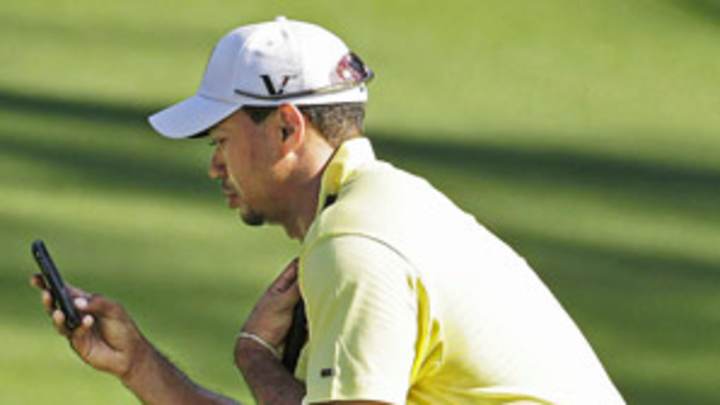
Before long, every major athlete of our time will have been undone by his telephone. Brett Favre and Tiger Woods are the two most prominent athletes accused of texts outside of marriage, both men imprisoned in a cell -- and by a cell -- of their own making.
But they're hardly the first athletes for whom the telephone and its various accessories have been a malevolent force. The journeyman knuckleballer Steve Sparks, then with the Brewers, separated his shoulder in 1994 while trying, in a motivational seminar, to tear a telephone book in half. Many blamed Sparks. I blame the telephone.
I don't like telephones, can't bear to call a plumber or a pizza joint, even dread retrieving messages from the void of voice mail. The default ringtone of an old Nokia -- still heard in movies that were made at the turn of this century -- induces panic in me, a reminder of unpleasant calls from uncountable editors.
It's not that I'm old -- though I agree with Ogden Nash, who described middle age as sitting at home on Saturday night, hoping the phone's not for you. No, even as a kid, the wall-mounted phone in our kitchen looked like a weapon, its banana-yellow handset trailing fifty feet of coiled cord that resembled concertina wire on a prison wall.
Camera-equipped cell phones have long looked that way to most celebrities, caught in public with their pants down. Some industrious stars catch themselves with their pants down, to save time, which is why Blazers center Greg Oden apologized last year for a nude cell-phone self-portrait that found its way onto the interwebs. (These things always "find their way" onto the net, of course, the way some sleepwalkers find themselves in front of the fridge, at 2 in the morning, above an empty pint of Haagen-Dazs, oblivious to how they arrived there.)
Surely we shouldn't blame the medium for the message. (Or the massage, in Favre's case.) And I don't. But I still can't get past my telephone hangup.
The night last November when the San Francisco Giants won the World Series, the franchise's biggest star, Barry Bonds, was ticketed for talking on his cell phone while driving in West Hollywood. The $125 fine levied against Bonds -- a man obsessively pursued by law enforcement for years -- felt like the Steroid Era's equivalent of Al Capone being brought down for tax evasion.
Having said that, I'm for prosecuting people who use cell phones almost anywhere, at any time. In church not long ago, a cell phone went off two pews up. The guy answered it, evidently answering a higher call.
When a cell phone goes off in a press conference, reporters feel like first-graders caught chewing gum. In 2005, a cell rang in Mike Sherman's press conference. When nobody would own up to the ringtone, the Packers' coach, a former high school teacher, walked out. God forbid a cell went off in one of Sherman's meetings. "You'd get punched in the face," his offensive coordinator at the time, Tom Rossley, told the AP. "Everybody in the room gets to punch you in the face ... It just doesn't happen. It's not something that happens in this building."
The truth is, cell phones ring in every building, on every tarmacked airplane, beneath every blue sky. Last summer, when that guy sitting down the rightfield line at Yankee Stadium was hit in the face by a ground-rule double while his cell phone was pressed to his ear, a nation cheered in catharsis. Moral: Unless your name is Mariano Rivera, don't answer the phone at Yankee Stadium.
Everyone claims to loathe the people who talk on their cell phones at games: Aptly named Saints wide receiver Joe Horn was vilified in 2003 when he celebrated a touchdown by whipping his cell phone out of the goal-post padding and pretending to make a call. Yet everyone talks on their cell phones at games.
And so fans taunting Jets coach Rex Ryan at an MMA event before the last Super Bowl easily caught him, on cell phone camera, flipping them the bird. This photo, too, self-navigated its way to the Internet, forcing Ryan to apologize instead of beating the photographer with a phone book, which is said to leave no marks. Though former Brewers knuckleballer Steve Sparks would probably disagree.
There was a time, incidentally, when phone books were used for good instead of evil: Knicks forward Jerry Lucas had memorized the Manhattan telephone directory, wowing fans of the early '70s by reciting entire pages. (In fairness to those fans, there were fewer entertainment options then.) Now, of course, phone books are a nuisance, still washing up at our mailboxes on a quarterly basis for no apparent reason.
I save mine, and use them against people who talk on their cell phones on the golf course.

Special Contributor, Sports Illustrated Steve Rushin was born in Elmhurst, Ill. on September 22, 1966 and raised in Bloomington, Minn. After graduating from Bloomington Kennedy High School in 1984 and Marquette University in 1988, Rushin joined the staff of Sports Illustrated. He is a Special Contributor to the magazine, for which he writes columns and features. In 25 years at SI, he has filed stories from Greenland, India, Indonesia, Antarctica, the Arctic Circle and other farflung locales, as well as the usual locales to which sportswriters are routinely posted. His first novel, The Pint Man, was published by Doubleday in 2010. The Los Angeles Times called the book "Engaging, clever and often wipe-your-eyes funny." His next book, a work of nonfiction, The 34-Ton Bat, will be published by Little, Brown in 2013. Rushin gave the commencement address at Marquette in 2007 and was awarded an honorary Doctor of Letters for "his unique gift of documenting the human condition through his writing." In 2006 he was named the National Sportswriter of the Year by the National Sportswriters and Sportscasters Association. A collection of his sports and travel writing—The Caddie Was a Reindeer—was published by Grove Atlantic in 2005 and was a semifinalist for the Thurber Prize for American Humor. The Denver Post suggested, "If you don't end up dropping The Caddie Was a Reindeerduring fits of uncontrollable merriment, it is likely you need immediate medical attention." A four-time finalist for the National Magazine Award, Rushin has had his work anthologized in The Best American Sports Writing, The Best American Travel Writing and The Best American Magazine Writing collections. His essays have appeared in Time magazine andThe New York Times. He also writes a weekly column for SI.com. His first book, Road Swing, published in 1998, was named one of the "Best Books of the Year" by Publishers Weekly and one of the "Top 100 Sports Books of All Time" by SI. He and his wife, Rebecca Lobo, have four children and live in Connecticut.