%20%20--%3E%0A%3Csvg%20version%3D%221.1%22%20id%3D%22Layer_1%22%20xmlns%3D%22http%3A%2F%2Fwww.w3.org%2F2000%2Fsvg%22%20xmlns%3Axlink%3D%22http%3A%2F%2Fwww.w3.org%2F1999%2Fxlink%22%20x%3D%220px%22%20y%3D%220px%22%0A%09%20width%3D%2239px%22%20height%3D%2240px%22%20viewBox%3D%220%200%2039%2040%22%20enable-background%3D%22new%200%200%2039%2040%22%20xml%3Aspace%3D%22preserve%22%3E%0A%3Cpath%20fill%3D%22%23FFFFFF%22%20d%3D%22M38.5%2C7H28.2v26h10.3V7z%22%2F%3E%0A%3Cpath%20fill-rule%3D%22evenodd%22%20clip-rule%3D%22evenodd%22%20fill%3D%22%23FFFFFF%22%20d%3D%22M26.1%2C25.5c0%2C5.8-4.1%2C7.5-12.9%2C7.5C3.9%2C33%2C0%2C31.2%2C0%2C25.2v-1.1h11.6%0A%09v2.4c0%2C0.7%2C0.1%2C1.4%2C1.2%2C1.4c1%2C0%2C1.2-0.4%2C1.2-1.3v-0.9c0-1.6-0.9-1.6-3.5-2.2C2.2%2C21.7%2C0%2C19.7%2C0%2C15.3v-0.9C0%2C9.3%2C5.5%2C7%2C12.9%2C7%0A%09c10.2%2C0%2C12.8%2C2.6%2C12.8%2C7.4v1.8h-11v-2.9c0-0.6-0.4-1.1-1.2-1.1c-0.6%2C0-1.2%2C0.4-1.2%2C1.1v0.9c0%2C1.5%2C0.9%2C2%2C3.3%2C2.5%0A%09c8%2C1.6%2C10.5%2C3.3%2C10.5%2C7.5V25.5z%22%2F%3E%0A%3C%2Fsvg%3E%0A)
Sports through lens of a poster
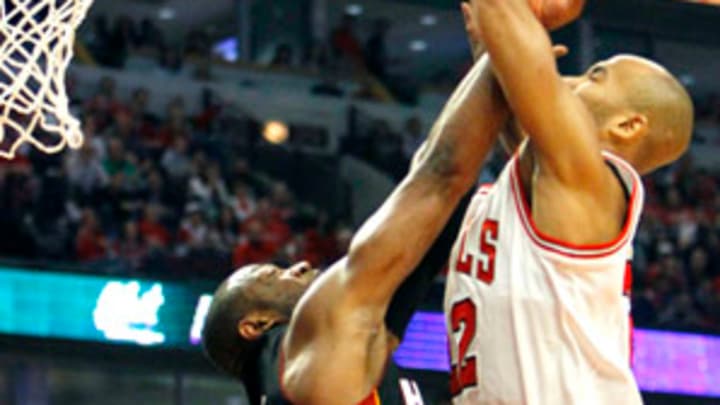
When Heat star Dwyane Wade got dunked on by Taj Gibson of the Bulls in Game 1 of the NBA Eastern Conference finals on Sunday, I instantly thought of Bobby Gross of the Blazers, feebly waving as Julius Erving dunked on him in the poster Scotch-taped to my bedroom door as a kid.
What do they say about chocolate? A moment on the lips, a lifetime on the hips? Getting posterized was like that for Gross: A moment on the floor, a lifetime on my door.
I had a three-poster bed. Which is to say, a bed with a view of three posters. Doc was on the door's exterior, so that I saw him at night, when the door was open, guarding my dreams. This is more than can be said of Gross, who wasn't guarding anybody.
Alan Page was on the door's interior, so that I only ever saw him when the door was shut -- and it was only ever shut when it was slammed shut, which explains why I long associated the Vikings' defensive tackle with brooding. His was the image I saw when banished to my room while dinner went cold.
That poster was a perfect vessel for unfocused adolescent anger, as Page was about to hammer a hapless -- and soon-to-be capless -- Browns quarterback, probably Dave Mays. It's impossible to say for certain, because the QB's number isn't entirely visible. Whoever he is, he's going to get sacked -- posterized and posterior-ized in one instant made eternal on the B-side of the bedroom door.
Finally, next to the dresser, the third poster -- but the first one to go up: Reds second baseman Joe Morgan, whose left arm made a flapping motion at the plate. When replicated in the backyard, with your right hand inserted under your left armpit, the arm-flapping produced the satisfying sound of flatulence, which partly explains why Morgan was my first baseball hero, and first poster of any kind.
Considering that we spend a third of our lives in bed, and I spent a third of my life aged 14 or under, then I spent one-third of one-third of my life in my three-poster bed -- my Sealy Poster-pedic -- about to get dunked on by Dr. J, concussed by Alan Page or drilled by a Joe Morgan line drive.
Was this healthy? Suffice to say that I flinched a lot growing up, and still do: When Gibson dunked on Wade the other night, my first instinct was to duck and then step out of the photographer's frame, even though I was on my couch.
It's probably for the best that the Golden Age of Sports Posters -- the late '70s and early '80s -- is long past, though you can still find, fairly easily, those classic staples of Reagan-era bedroom décor.
Who thought it was a good idea to photograph Moses Malone parting an Orange Sea of basketballs while holding a staff shaped like a swoosh? Why Nike did, of course, though that doesn't explain the burlap bathrobe Moses wore over the kind of generic basketball uniform -- numberless, logoless, replete with piped jogging shorts -- that Shaq still wears in Icy Hot commercials.
And yet half my friends had that poster, or the Nike poster of Darrell Griffith, Dr. Dunkenstein, carrying half a steaming basketball in either hand, while wearing a white coat, so that he appears less to be conducting a science experiment than serving soup at the Carnegie Deli. Twenty-five years ago that poster screamed basketball. Today it screams, "Who ordered the Matzoh Ball?"
The one Nike poster that looks as good today as it did three decades ago is The Iceman's: George Gervin -- on a throne of ice, on what appears to be Krypton -- crossing his legs in a silver sweatsuit, worn as a precaution against perspiring too profusely on a frozen throne on a frozen planet.
Like Nora Desmond in Sunset Boulevard, The Iceman's still big -- it's the posters that got small. Like Joe Morgan, the posters got nibbled at the corners -- the corners where we taped or tacked them up (and then re-taped and re-tacked them, each time the corners eroding a little more).
Finally, at 14 or so, I moved into a room with my brother Tom, who already had his own posters up, most prominently the famous Farrah Fawcett. The best-selling poster of all-time, it came with most houses in the 1970s, along with the wall-to-wall shag and the avocado fridge. As a sign of my newfound sophistication, I put up a poster of my own, adorning a wall with Earth, Wind & Fire, a dozen men in dashikis. It's at least possible that it was the only EWF poster on our block of Amundsens, Caspersons and Petersens.
As for Dr. J, Alan Page and Joe Morgan: My mom would have rolled them up while I was at school and kicked them to the curb, consigning them to the garbage man and what Trotsky called "the ash heap of history."
Still, every once in a while, when some poor schlub like Wade gets posterized on TV, I picture my old bedroom and think: If those walls could talk.
But of course they did, and still do.
 Add us as a preferred source on Google
Special Contributor, Sports Illustrated Steve Rushin was born in Elmhurst, Ill. on September 22, 1966 and raised in Bloomington, Minn. After graduating from Bloomington Kennedy High School in 1984 and Marquette University in 1988, Rushin joined the staff of Sports Illustrated. He is a Special Contributor to the magazine, for which he writes columns and features. In 25 years at SI, he has filed stories from Greenland, India, Indonesia, Antarctica, the Arctic Circle and other farflung locales, as well as the usual locales to which sportswriters are routinely posted. His first novel, The Pint Man, was published by Doubleday in 2010. The Los Angeles Times called the book "Engaging, clever and often wipe-your-eyes funny." His next book, a work of nonfiction, The 34-Ton Bat, will be published by Little, Brown in 2013. Rushin gave the commencement address at Marquette in 2007 and was awarded an honorary Doctor of Letters for "his unique gift of documenting the human condition through his writing." In 2006 he was named the National Sportswriter of the Year by the National Sportswriters and Sportscasters Association. A collection of his sports and travel writing—The Caddie Was a Reindeer—was published by Grove Atlantic in 2005 and was a semifinalist for the Thurber Prize for American Humor. The Denver Post suggested, "If you don't end up dropping The Caddie Was a Reindeerduring fits of uncontrollable merriment, it is likely you need immediate medical attention." A four-time finalist for the National Magazine Award, Rushin has had his work anthologized in The Best American Sports Writing, The Best American Travel Writing and The Best American Magazine Writing collections. His essays have appeared in Time magazine andThe New York Times. He also writes a weekly column for SI.com. His first book, Road Swing, published in 1998, was named one of the "Best Books of the Year" by Publishers Weekly and one of the "Top 100 Sports Books of All Time" by SI. He and his wife, Rebecca Lobo, have four children and live in Connecticut.