%20%20--%3E%0A%3Csvg%20version%3D%221.1%22%20id%3D%22Layer_1%22%20xmlns%3D%22http%3A%2F%2Fwww.w3.org%2F2000%2Fsvg%22%20xmlns%3Axlink%3D%22http%3A%2F%2Fwww.w3.org%2F1999%2Fxlink%22%20x%3D%220px%22%20y%3D%220px%22%0A%09%20width%3D%2239px%22%20height%3D%2240px%22%20viewBox%3D%220%200%2039%2040%22%20enable-background%3D%22new%200%200%2039%2040%22%20xml%3Aspace%3D%22preserve%22%3E%0A%3Cpath%20fill%3D%22%23FFFFFF%22%20d%3D%22M38.5%2C7H28.2v26h10.3V7z%22%2F%3E%0A%3Cpath%20fill-rule%3D%22evenodd%22%20clip-rule%3D%22evenodd%22%20fill%3D%22%23FFFFFF%22%20d%3D%22M26.1%2C25.5c0%2C5.8-4.1%2C7.5-12.9%2C7.5C3.9%2C33%2C0%2C31.2%2C0%2C25.2v-1.1h11.6%0A%09v2.4c0%2C0.7%2C0.1%2C1.4%2C1.2%2C1.4c1%2C0%2C1.2-0.4%2C1.2-1.3v-0.9c0-1.6-0.9-1.6-3.5-2.2C2.2%2C21.7%2C0%2C19.7%2C0%2C15.3v-0.9C0%2C9.3%2C5.5%2C7%2C12.9%2C7%0A%09c10.2%2C0%2C12.8%2C2.6%2C12.8%2C7.4v1.8h-11v-2.9c0-0.6-0.4-1.1-1.2-1.1c-0.6%2C0-1.2%2C0.4-1.2%2C1.1v0.9c0%2C1.5%2C0.9%2C2%2C3.3%2C2.5%0A%09c8%2C1.6%2C10.5%2C3.3%2C10.5%2C7.5V25.5z%22%2F%3E%0A%3C%2Fsvg%3E%0A)
The age of too much information

Thanks to the unlikely trio of British Petroleum, Brett Favre and Anthony Weiner, we have -- in one year -- endured three scandals employing two different definitions of the phrase "junk shot," a concept I'd very much like to unlearn and consign to a body of un-knowledge consisting of everything I want to un-know.
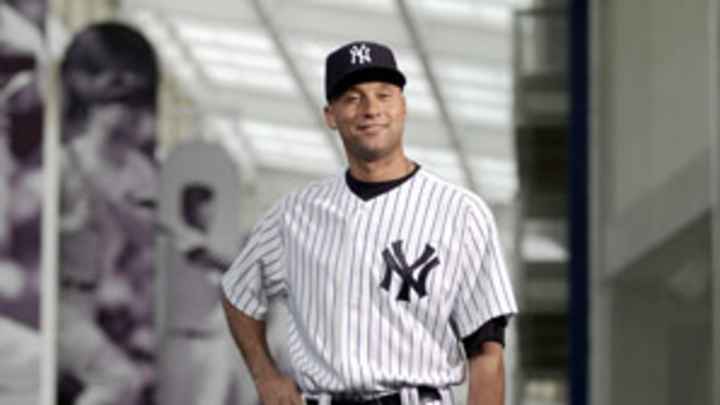
I'm not a pathologist, urologist or housekeeper, but I've had cause to contemplate -- in a professional capacity in those same 12 months -- Lance Armstrong's urine, Tiger Woods' spit and the lavatorial bounty of Derek Jeter's mansion, which has nine bathrooms. Because of this last bit of information, I now see Jeter in perpetual bathrobe -- The Captain in Chenille -- which is no fault of the Yankee shortstop's.
I'd prefer not to know that Jeter owns the world's largest concentration of porcelain this side of Limoges, and the ever-discreet Jeter would understandably prefer this as well. The trouble is, I happen to be alive in 2011, and reasonably interested in sports, which makes me -- which makes all of us -- Jimmy Stewart in The Man Who Knew Too Much. Even an athlete such as Jeter, admirably revealing nothing of his private life, is unavoidably subject to a news bulletin every time he tweaks his groin. That I am also privy to his privy -- to all nine privies -- is not his doing, and something I'd be happy to unlearn.
But then the bucket list of things I want to un-see and un-hear is practically unending. I'm sure yours is too. Among the images in permanent residence in my brain is the Abraham Lincoln portrait tattooed to the Adam's apple of DeShawn Stevenson. Every time the Mavericks guard wears a turtleneck, our greatest president becomes Mort from Bazooka Joe's Gang, or Wilson, the neighbor peering over the fence in Home Improvement. The tattoo hasn't diminished Stevenson in my eyes. On the contrary: It has diminished Lincoln.
Which is why I wish I'd never seen it. I'd likewise love to un-see Joe Theismann, Barbaro and my daughter break their legs, to un-hear Roseanne Barr and Carl Lewis sing the national anthem, to un-smell the Pittsburgh Penguins postgame equipment pile that I once stumbled onto accidentally, an olfactory souvenir still singed into my nose hairs.
What I would have given to un-taste the Red Man tobacco I tried while working Twins games when I was 13, or to un-feel the two-day hangover that befell me when they won the 1987 World Series, or to un-wear the enormous glasses that made me look, for most of the 1990s, like Tootsie. But what I mostly want in this age of wanton confession -- the kind perpetrated in the preceding sentence -- is to un-know.
Because Derek Jeter has never invited me and eight full-bladdered friends into his house to simultaneously avail ourselves of his copious facilities, I have no reason to know how many bathrooms he has. But I do, and I'm not sure how that happened, except that aerial shots of his Tampa pile -- inevitably known as St. Jetersburg -- appeared unbidden on my TV this spring, and in my newspaper, and on my computer, and always seemed to enumerate the number of bathrooms therein. Thanks to a New York Times interview with Jeter's garbage collectors, I also know that the Yankee shortstop has three trash bins. What he doesn't have is a yard. To put this in New York terms, his 31,000-square-foot house is all Flushing and no Meadow.
But I feel strangely uncomfortable knowing all that, and even worse sharing it, as oversharing is already an international epidemic. You know all about me and I know all about you. Even though I don't know you and you don't know me. The world is a pair of airplane seats and every one of us a chatty passenger.
All of which makes me grateful to Dallas Mavericks owner Mark Cuban for saying exactly what needed to be said during this year's NBA playoffs: Nothing.
Nothing, by definition, is always in short supply, but especially scarce now, when many of us would give anything for a little nothing. Nothing has that certain something -- call it dignity -- that everything lacks. But everything is what we're stuck with: We know everything about everyone. You no longer have to go to the gym to see a naked stranger. The gym comes to you, without warning, at the top of the nightly news, and all the pixelating in the world can't make you un-see it.
To his credit, Cuban recognized that nothing is the new something. When he all but vanished during the finals, a funny thing happened: Cuban's invisibility became high profile. His silence took on a kind of eloquence. The lack of attention drew favorable attention. In a world of white noise, closing one's mouth was the best pep talk of all. Or as Cuban put it: "The quieter I got, the more we won. I didn't want to break the karma."
And he didn't. As Cuban spoke, he was seated next to the Larry O'Brien trophy. Like silence, it was golden.

Special Contributor, Sports Illustrated Steve Rushin was born in Elmhurst, Ill. on September 22, 1966 and raised in Bloomington, Minn. After graduating from Bloomington Kennedy High School in 1984 and Marquette University in 1988, Rushin joined the staff of Sports Illustrated. He is a Special Contributor to the magazine, for which he writes columns and features. In 25 years at SI, he has filed stories from Greenland, India, Indonesia, Antarctica, the Arctic Circle and other farflung locales, as well as the usual locales to which sportswriters are routinely posted. His first novel, The Pint Man, was published by Doubleday in 2010. The Los Angeles Times called the book "Engaging, clever and often wipe-your-eyes funny." His next book, a work of nonfiction, The 34-Ton Bat, will be published by Little, Brown in 2013. Rushin gave the commencement address at Marquette in 2007 and was awarded an honorary Doctor of Letters for "his unique gift of documenting the human condition through his writing." In 2006 he was named the National Sportswriter of the Year by the National Sportswriters and Sportscasters Association. A collection of his sports and travel writing—The Caddie Was a Reindeer—was published by Grove Atlantic in 2005 and was a semifinalist for the Thurber Prize for American Humor. The Denver Post suggested, "If you don't end up dropping The Caddie Was a Reindeerduring fits of uncontrollable merriment, it is likely you need immediate medical attention." A four-time finalist for the National Magazine Award, Rushin has had his work anthologized in The Best American Sports Writing, The Best American Travel Writing and The Best American Magazine Writing collections. His essays have appeared in Time magazine andThe New York Times. He also writes a weekly column for SI.com. His first book, Road Swing, published in 1998, was named one of the "Best Books of the Year" by Publishers Weekly and one of the "Top 100 Sports Books of All Time" by SI. He and his wife, Rebecca Lobo, have four children and live in Connecticut.