%20%20--%3E%0A%3Csvg%20version%3D%221.1%22%20id%3D%22Layer_1%22%20xmlns%3D%22http%3A%2F%2Fwww.w3.org%2F2000%2Fsvg%22%20xmlns%3Axlink%3D%22http%3A%2F%2Fwww.w3.org%2F1999%2Fxlink%22%20x%3D%220px%22%20y%3D%220px%22%0A%09%20width%3D%2239px%22%20height%3D%2240px%22%20viewBox%3D%220%200%2039%2040%22%20enable-background%3D%22new%200%200%2039%2040%22%20xml%3Aspace%3D%22preserve%22%3E%0A%3Cpath%20fill%3D%22%23FFFFFF%22%20d%3D%22M38.5%2C7H28.2v26h10.3V7z%22%2F%3E%0A%3Cpath%20fill-rule%3D%22evenodd%22%20clip-rule%3D%22evenodd%22%20fill%3D%22%23FFFFFF%22%20d%3D%22M26.1%2C25.5c0%2C5.8-4.1%2C7.5-12.9%2C7.5C3.9%2C33%2C0%2C31.2%2C0%2C25.2v-1.1h11.6%0A%09v2.4c0%2C0.7%2C0.1%2C1.4%2C1.2%2C1.4c1%2C0%2C1.2-0.4%2C1.2-1.3v-0.9c0-1.6-0.9-1.6-3.5-2.2C2.2%2C21.7%2C0%2C19.7%2C0%2C15.3v-0.9C0%2C9.3%2C5.5%2C7%2C12.9%2C7%0A%09c10.2%2C0%2C12.8%2C2.6%2C12.8%2C7.4v1.8h-11v-2.9c0-0.6-0.4-1.1-1.2-1.1c-0.6%2C0-1.2%2C0.4-1.2%2C1.1v0.9c0%2C1.5%2C0.9%2C2%2C3.3%2C2.5%0A%09c8%2C1.6%2C10.5%2C3.3%2C10.5%2C7.5V25.5z%22%2F%3E%0A%3C%2Fsvg%3E%0A)
The 50 Greatest Footballers Who Never Won the World Cup
Lifting the FIFA World Cup is the pinnacle of any footballer’s career—the dream that fuels countless hours on pitches, playgrounds and training grounds around the world.
Yet some of the greatest players the sport has ever seen never got to hold the trophy aloft. Some were born into nations that simply weren’t competitive enough, others came agonisingly close only to fall short and a few missed out through injury, omission or sheer misfortune.
Here’s a look at the 50 greatest footballers who never won the World Cup.
50. Hidetoshi Nakata

Widely considered the greatest Asian footballer of all time, Nakata featured at two World Cups, the second of which was partly held in his native Japan.
He never advanced beyond the round of 16, but he’ll always have his goal against Tunisia in 2002 to treasure—a deft header slipped through the goalkeeper’s legs in front of a jubilant home crowd.
49. Andriy Shevchenko

Up until his ill-fated move to Chelsea, Andriy Shevchenko was one of the most feared strikers in world football. Prolific for both Dynamo Kyiv and AC Milan—joining the Rossoneri for a then-record fee—his international trophy cabinet remained empty, largely due to representing Ukraine.
Still, he captained his nation at Germany 2006, netting twice during an impressive run to the quarterfinals.
48. David Beckham

Flashy and stylish, Beckham’s ability and impact on matches is often overstated. Nevertheless, he was a solid weapon for England, with “Golden Balls” spending most of his time at World Cups battling Argentina.
The winger’s decisive red card against the South Americans in 1998 played a major role in the Three Lions’ penalty shootout exit, before he scored the only goal—fittingly from the spot—in their group stage clash four years later, sending Hernán Crespo and co. packing.
47. Michael Ballack

Ballack must have seriously angered the footballing gods.
In 2002 his Bayer Leverkusen team finished runners-up in the Bundesliga, lost the Champions League final and were beaten in the DFB-Pokal. But his misery that year wasn’t done.
Pulling the strings for Germany at the World Cup, he was central to their march to the final in Yokohama—only to be suspended for the showpiece itself and forced to watch from the sidelines as Ronaldo struck twice in the second half, sealing a 2-0 win for Brazil and their fifth world title.
Somehow—if you can believe it—things got worse.
Germany hosted the 2006 edition and met Italy in the semifinals, only to come undone in the dying moments of extra time and leave a nation, and Ballack, in despair in what would be the midfielder’s final World Cup appearance.
46. Salif Keïta

Salif Keïta is arguably Africa’s most influential and one of its greatest-ever players—even if his name isn’t widely known today. A star for Saint-Étienne in the 1960s and ’70s, he was the first African player to truly make an impact in Europe, helping the club win four league titles.
Unfortunately, he represented Mali, so there was never any realistic chance of him lifting a World Cup.
45. Billy Bremner

If you’re laughing at the idea of a Scot making this list, just remember that the Auld Enemy qualified for more World Cups in the 1970s and 1980s than England.
Billy Bremner featured in just one of the five consecutive World Cups his nation reached in the late 20th century, the midfield enforcer bringing steel and grit to the centre of the park while also proving an exceptional leader for both Scotland and the once-great Leeds United.
44. Gheorghe Hagi

Having represented both Barcelona and Real Madrid in his stellar career, Hagi was clearly a talented winger. However, his Romanian teammates were evidently a class below and never likely to threaten those at the top of the sport.
Nevertheless, he was in splendid form at all three World Cup tournaments in the 1990s, acting as the driving force in '94 as the Tricolorii reached their only quarterfinal to date.
43. Michael Laudrup

More like a dancer than a footballer, Michael Laudrup was mesmerising to watch. The Dane’s World Cup appearances came 12 years apart, in 1986 and 1998, captaining his country in the latter.
Never likely to mount a serious challenge for the trophy, Denmark’s most memorable moment in any tournament remains Laudrup’s awe-inspiring dribble through the entirety of Uruguay’s team—including the goalkeeper —culminating in a simple tap-in.
42. Samuel Eto’o

Samuel Eto’o enjoyed a stellar career for club and country, collecting league and Champions League titles in both Spain and Italy with Barcelona and Inter Milan, alongside a couple of African Cup of Nations triumphs.
Finishing fifth in the 2009 Ballon d’Or highlighted just what a lethal finisher he was, but at the World Cup, it sadly wasn’t enough to carry Cameroon far. They failed to get out of the group stage in all four tournaments he played in.
Imagine what might have been if he had Roger Milla alongside him up front ...
41. Luka Modrić

Luka Modrić won the Golden Ball and Ballon d’Or in 2018 after a brilliant World Cup in Russia, but it did little to soften the sting of France’s 4-2 victory in the final.
In 2022, he once again starred as Croatia claimed third place, dictating games with his trademark elegance and control.
Even in his forties, Modrić still has one last shot at World Cup glory in 2026. Stranger things have happened.
40. Hristo Stoichkov

Regularly lauded as the greatest Bulgarian footballer of all time, Stoichkov was a phenomenal forward, racking up 37 goals in 83 appearances for a decidedly underpowered nation.
It was the striker who fired Bulgaria to the semifinals of USA '94, earning himself the Golden Boot award and bagging the leveller in the 2-1 defeat of reigning champions Germany in the quarters.
That still stands as their best performance at a World Cup, an achievement that would have been impossible without the talismanic Stoichkov.
39. Raúl

Raúl was simply born a few years too early. Amassing 100 caps and 44 goals, the Real Madrid legend last played for Spain in 2006, just as the Iberians were on the cusp of greatness.
In the six years that followed, his countrymen would lift one World Cup and two European Championships—ouch.
38. Didier Drogba

If Raúl was an intelligent poacher up front, Didier Drogba was a bulldozing force of nature.
Like many on this list, he was far superior to his international teammates, who rarely provided the platform for the Chelsea stalwart to showcase his full capabilities.
He enjoyed a handful of top-quality colleagues with Ivory Coast, but that wasn’t enough to overcome a squad lacking a killer instinct—a flaw that saw them eliminated in the group stage three times during Drogba’s era.
37. Kenny Dalglish

Like Bremner, Scotland frontman Dalglish was a standout for a side that achieved far more than their successors. But, he was also unable to take them into the latter stages of a World Cup.
In all the three he took part in, the Tartan Terriers fell in the first round, though the Liverpool legend did net in a famous 3-2 victory over eventual runners-up the Netherlands in 1978.
36. Gareth Bale

Gareth Bale is undoubtedly the greatest Welsh player of all time. He is the only Welshman to have played for Real Madrid, where he played a crucial role in winning five Champions League titles, and he was instrumental in helping the Dragons qualify for the 2022 World Cup—their first World Cup since 1958.
At the tournament, however, Bale’s world-class talent wasn’t enough to carry Wales out of their group, with his teammates unable to match his quality.
35. Yaya Touré

A powerhouse in Manchester City’s engine room for much of a decade and a Champions League winner with Barcelona, Yaya Touré is no stranger to glory.
Yet he was never able to achieve it on the world’s biggest stage, falling victim to the same limitations that hampered Didier Drogba at international level.
34. Claude Makélélé

If you hadn’t guessed already, the “Makélélé Role” is named after this industrious French midfielder, who effectively paved the way for N’Golo Kanté.
It was easy to underestimate Makélélé’s work—on the surface it looked simple—but in reality, his style demanded a deep understanding of the game and an uncanny ability to read it.
Yet Aimé Jacquet overlooked him when France assembled their squad for the 1998 home World Cup. The team went on to lift the trophy, but having the Marseille midfielder in the mix would undoubtedly have been invaluable.
33. Just Fontaine

French favourite Just Fontaine delivered a remarkable performance at Sweden '58, scoring four against West Germany, a hat-trick versus Paraguay, and six more goals to finish with a total of 13.
To put that in perspective, record-holder Miroslav Klose managed 16 across 12 years.
Had Fontaine played in another tournament, perhaps France would have celebrated their first major trophy sooner.
32. Steven Gerrard

Steven Gerrard was the complete midfielder and one of the standout stars of England’s so-called “Golden Generation”—a team that too often flattered to deceive. The less said about that, the better.
There were two truly brilliant moments for the Reds skipper at major tournaments: A breathtaking strike against Trinidad & Tobago in 2006 and a composed finish for England’s opening goal in 2010 versus the USA.
Just try to forget that ITV HD aired a car advert instead of Gerrard’s goal against the Americans—the only moment of joy for England in an otherwise miserable campaign.
31. Eric Cantona

A falling out with the French coaching setup in 1995 brought a premature end to Cantona’s international career, an incident he claims prevented him from extending his playing days.
In an interview years on from that dispute, the eccentric forward revealed that he would have stuck around for the 1998 World Cup had he still been involved with France.
They hosted it that time and went on to win, making Cantona’s exile all the more annoying from his point of view.
30. Clarence Seedorf

The only player to win the Champions League with three different clubs during his career, Clarence Seedorf—known for his seed-of-a-tree trunk thighs—was a formidable presence in midfield.
Yet, like so many great Dutch players before (and after) him, he was unable to deliver on football’s biggest stage.
Seedorf appeared in just one World Cup, in 1998, when the Oranje reached the semifinals.
29. George Weah

Which carries more weight: A World Cup triumph or the Ballon d’Or? It’s a close call. But how about being the only footballer from your continent to win the latter—is that more impressive than lifting the famous old trophy?
George Weah would probably say yes.
The Liberian remains the only African ever named the world’s best player. It’s a bitter shame he never played at a World Cup finals, coming closest in 2002 when a single point denied him and his compatriots.
28. Paul Gascoigne

Paul Gascoigne had his demons, but they couldn’t stop an extraordinary talent from reaching the very heights of the game. At his best, he was unstoppable, making the spectacular look effortless.
Off-field struggles limited the midfielder to just one World Cup, yet it was one of England’s most memorable. Italia ’90—Gascoigne’s tears, the semifinal heartbreak—a summer that will never be forgotten.
27. Karim Benzema

Why Karim Benzema, the 2022 Ballon d’Or winner, never lifted a World Cup can be explained twofold.
Part of it was his own doing. In 2010, he was omitted from the squad, reportedly in part due to a controversial case involving a prostitution ring. Then, when France won the World Cup in 2018, Benzema was again excluded, this time over his alleged involvement in the blackmail of fellow France international Mathieu Valbuena concerning a sex tape.
In 2022, when France finished runners-up, Benzema was then sidelined by injury, though reports also suggested a falling out with manager Didier Deschamps.
Ultimately, one of the finest forwards of his generation saw his World Cup dreams slip away, a mix of personal missteps and unfortunate circumstances preventing him from claiming football’s ultimate prize.
26. László Kubala

If you’re voted Barcelona’s greatest player of the 20th century, you’re probably pretty good at kicking a ball. László Kubala certainly was, earning that splendid accolade in 1999.
His direct dribbling, unerring finishing and masterful dead-ball technique helped three different national teams compete at the highest level.
Sadly, none of Czechoslovakia, Hungary or Spain were able to fully capitalise on having this footballing traveller in their lineups.
25. Luis Suárez

Love him or hate him, Luis Suárez at his pomp was a terrifying prospect for any defence. He’s also a frighteningly good shot-stopper, as he proved against Ghana in 2010.
The former Liverpool maverick batted away a goal-bound effort from Dominic Adiyiah in the last minute of Uruguay’s quarterfinal clash with the Africans and was shown a red card for his actions, yet he was jumping for joy moments later when Asamoah Gyan blazed the resulting penalty over the bar.
Justice of sorts arrived when the Dutch dumped La Celeste out in the semifinals. Still, we hadn’t seen the last of Suárez-related controversy—the forward was handed a four-month ban for biting Giorgio Chiellini at the 2014 tournament.
24. Zlatan Ibrahimović

No player has ever been so adept at producing the miraculous. No one was so unwavering in their self-belief. Zlatan Ibrahimović was truly in a league of his own.
The Swedish striker could do almost anything, scoring some genuinely astonishing goals—most famously his 40-yard overhead kick in a 4-2 victory over England.
Sadly for Zlatan, none of his incredible strikes came on the World Cup stage.
23. Lev Yashin

In many corners of the footballing world, Lev Yashin is revered as the greatest goalkeeper of all time. Athletic, sharp and intimidating, he guided the USSR to the last four of the 1966 World Cup.
Yet his reputation took a small hit following an uncharacteristically poor showing in Chile four years earlier, with French newspaper L’Equipe prematurely predicting the end of Yashin’s career after a shaky performance against Colombia in a 4-4 draw.
22. Sergio Agüero

Sergio Agüero, one of the Premier League’s and Argentina’s greatest-ever strikers, can count himself unlucky to never have officially lifted a World Cup … at least as a player.
He represented La Albiceleste in 2010, 2014 and 2018, coming heartbreakingly close in 2014 when Argentina lost to Germany in the final. Tragically, he was forced into retirement just months before the 2022 tournament—which Argentina ultimately won.
He did, however, get his hands on a medal.
Seen parading around the celebrations with it around his neck, it was reported that Argentina had officially registered Agüero as an assistant coach before the final so he could receive it.
21. Luís Figo

It takes serious guts to agree to a transfer from Barcelona to Real Madrid—and that’s exactly what Luís Figo did.
Yet the cunning and intelligence that defined the Portuguese’s play were never enough to deliver a major international triumph.
20. Dani Alves

Aside from Lionel Messi, Dani Alves is the most decorated footballer in history, with a trophy cabinet so full it’s practically a museum.
One prize has always eluded him, however: the World Cup.
Arguably the greatest right-back of his generation, Alves combined pace, power, skill, and a footballing intelligence more typical of a seasoned midfielder. Yet in his three World Cup appearances for Brazil—in 2010, 2014, and 2022—he never made it past the quarterfinals.
19. Dennis Bergkamp

Bergkamp's superlative skills are well-documented.
Just watch his majestic score against Argentina in 1998. This man was worthy of lifting the trophy.
18. Stanley Matthews

Twenty-three years. That’s how long it spanned between Stanley Matthews’ first cap for England and his final one.
Unfortunately, the Stoke City and Blackpool legend—the first-ever recipient of the Ballon d’Or—was surrounded by a squad of less distinguished players, and the Three Lions failed to progress beyond the second round in both 1950 and 1954.
17. Sócrates

If you looked up the word “cool” in the dictionary, you’d likely see a picture of Sócrates. Beyond his iconic beard-and-headband combo, the Brazilian was as wise and thoughtful on the pitch as his philosophical namesake.
Beloved by fans for his delicate distribution and effortless style on the ball, he captained the Seleção in 1982, only to be knocked out by Italy in the second round.
He returned in 1986, but France again ended his World Cup dreams in the quarterfinals, progressing after a penalty shootout.
16. Kevin Keegan

Back-to-back Ballon d'Or victories represent the crowning achievement of Keegan’s career, though leading England in 1982 would appear to come as a close second.
However, he managed just one appearance in Spain that year due to a chronic back problem, playing the last 26 minutes in a match needed to win.
Facing the hosts, Keegan missed a header from point-blank range that would have broken the deadlock, his poorly-timed attempt condemning Ron Greenwood’s recruits to a second-round exit.
With England failing to qualify for the two previous tournaments and the forward knowing he wouldn’t make it to Mexico '86, he chose to gamble when not fully fit, a risk that didn’t pay off.
15. Ruud Gullit

Another Ballon d’Or winner, another who fell short when it mattered most.
Ruud Gullit was a key figure in a trailblazing Dutch team, yet struggled in his only World Cup in 1990 as the Netherlands crashed out in the round of 16.
Burdened by expectation, the Dutch had missed the previous two tournaments, while their dazzling frontman Gullit walked out of training weeks before the 1994 World Cup—never to return.
14. Zico

If Sócrates was the brain of Brazil’s famed 1980s side, Zico was its heartbeat. Calling him “flair” barely scratches the surface of the playmaker’s on-field magic.
Boasting a strike rate of roughly two goals every three matches for the Seleção, he was as clinical in front of goal as he was creative with the ball. Beyond scoring, Zico mesmerised with his vision, passing and ability to orchestrate play.
13. Karl-Heinz Rummenigge

Two-time European Footballer of the Year Karl-Heinz Rummenigge was a ruthless goalscorer, netting over 200 times for Bayern Munich during a decade in Bavaria. He was equally prolific for West Germany, scoring 45 goals in 95 appearances.
Some of those caps came in World Cup finals, though both campaigns ended in defeat. After losing to Italy four years earlier, Rummenigge and his teammates faced Argentina at the Estadio Azteca in 1986. The striker sparked a stirring fightback with an instinctive 74th-minute effort.
Germany briefly equalised, but Diego Maradona delivered the decisive blow, threading a perfect through ball to an unmarked Jorge Burruchaga, who calmly slotted it past the goalkeeper to seal Argentina’s victory.
12. Duncan Edwards

Had his life not been claimed by the Munich Air Disaster in 1958, Edwards would have been at the peak of his career and a shoo-in for England’s 1966 squad.
Many of the wideman’s contemporaries claim that it would have been him, not Bobby Moore, captaining Sir Alf Ramsey’s triumphant side, but Bobby Charlton’s comments stand out among a sea of tributes.
“He was the only player that made me feel inferior,” Charlton said. “His death was the biggest single tragedy ever to happen to Manchester United and English football.”
11. Roberto Baggio

What does everyone remember the mercurial Baggio for? That penalty in the 1994 final shootout with Brazil. Some say the ball is yet to land, still flying high somewhere over California.
It’s an unjust fate to befall the Italian, who was handed the Ballon d'Or mere months before the showdown in the USA.
10. Oliver Kahn

The only goalkeeper to be awarded the Golden Ball was also the villain in Germany’s 2002 loss to Brazil in Yokohama. It was Kahn who gifted Ronaldo the opener in the second-half, but his status amongst the game’s greats is not remotely harmed by that error.
If you never watched the Bayern shot-stopper play, just imagine how incredible Manuel Neuer was until 2017 and combine it with the brilliance of prime Iker Casillas.
9. Paolo Maldini

Paolo Maldini is widely regarded as the greatest defender to ever grace the game.
Yet all four of his World Cup campaigns ended in disappointment—made perhaps even more bitter by Italy’s triumph in the tournament immediately after his international retirement.
Still, he could take pride in his extraordinary club career: Seven Serie A titles, five European Cups and countless other domestic honours during a lifelong devotion to Milan.
8. George Best

Best by name, best by nature—in his prime, the Northern Irishman was devastating on the wing and a deserved winner of the 1968 Ballon d'Or after fending off the likes of Franz Beckenbauer and Bobby Charlton.
Tragically, he lost his way and found alcohol as a solace, his addiction to the drink and sharp decline leading manager Billy Bingham to overlook the washed-up 35-year-old when Northern Ireland eventually qualified for a World Cup in 1982.
7. Eusébio

Few footballers have been as lethal in front of goal as Eusébio, who scored nine times in his only World Cup finals appearance.
Four of those came in a stunning display against North Korea as Portugal reached the semifinals in England, where they fell 2-1 to the hosts. Unsurprisingly, it was their star striker who netted the consolation, saluting goalkeeper Gordon Banks in a memorable gesture of respect.
6. Marco van Basten

Marco van Basten had no weaknesses, no flaws for opponents to exploit. He glided across the pitch with effortless composure, never appearing fazed regardless of the situation.
Tall, elegant, and blessed with mesmerising feet, the Dutchman was lethal in the air and deadly on the ground, always seeming to be in the right place at the right time.
But of course, we all know how this brilliant Dutch side’s story ended.
5. Ferenc Puskás

With 514 goals in 530 club games, Puskás clearly knew how to find the back of the net. Remarkably, he was even more prolific on the international stage for Hungary, scoring 84 times in 85 appearances.
His astonishing strike-rate powered Hungary’s run to the 1954 World Cup final in Switzerland, where they faced West Germany. Although the Hungarians fell 3-2, Puskás opened the scoring and left his mark on the match—and on football history.
Three years after his passing, FIFA honoured him with the Puskás Award for the most beautiful goal, a fitting tribute to a true legend.
4. Johan Cruyff

Cruyff transformed the game, pioneering “Total Football” at Barcelona, Ajax and with the Netherlands national team. The system allowed any player to take on the role of another, yet no one could match the sheer brilliance of the revolutionary Dutchman.
Words barely capture his extraordinary skill. Watching Cruyff in his prime is essential—unearth some clips, and you won’t be disappointed.
3. Michel Platini

His reputation may have taken a hit over the years, but Michel Platini was once a joy to watch in full flow.
The French maestro won the Ballon d’Or three times, though he arrived at the only World Cup he played under that accolade slightly short of match fitness. Still, he scored two crucial goals as Les Bleus powered their way to the semifinals in 1986.
Having been largely anonymous in 1978, Platini truly shone four years later, helping France reach the last four before falling in a dramatic penalty shootout after a thrilling 3-3 draw.
2. Alfredo Di Stéfano

The Real Madrid of the 1950s and 1960s belonged to Alfredo Di Stéfano.
The Argentina-born Spaniard was the driving force behind five consecutive European Cup triumphs, yet he could never replicate that success on the international stage.
Both Spain and Argentina were still developing as footballing nations, while a four-cap spell with Colombia was never going to deliver World Cup immortality—not that he needed it, given his legendary status in Madrid.
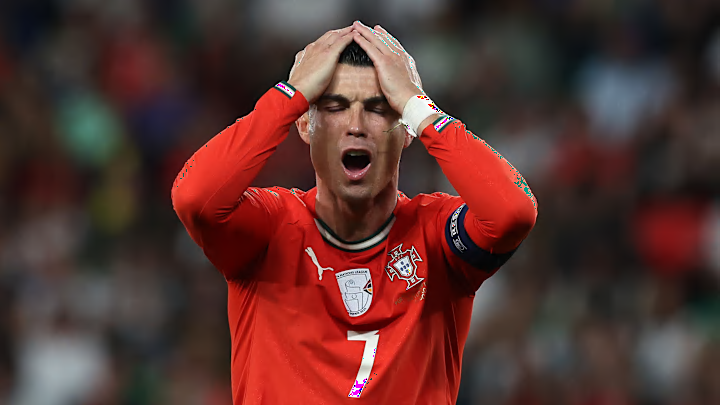
1. Cristiano Ronaldo

What’s left to say about Cristiano Ronaldo that hasn’t already been said? Opinions vary on his all-round ability, but no one questions the ruthlessness of his finishing.
Even those who call him overrated tense up the moment he takes possession, dreading an unstoppable strike or a dazzling bit of skill.
He’s won almost everything in his illustrious career—including the 2016 Euros and the 2019 Nations League with Portugal—but one prize still eludes him.
The 2026 World Cup is do or die.
READ THE LATEST WORLD CUP NEWS, PREVIEWS & ANALYSIS HERE
 Add us as a preferred source on Google