%20%20--%3E%0A%3Csvg%20version%3D%221.1%22%20id%3D%22Layer_1%22%20xmlns%3D%22http%3A%2F%2Fwww.w3.org%2F2000%2Fsvg%22%20xmlns%3Axlink%3D%22http%3A%2F%2Fwww.w3.org%2F1999%2Fxlink%22%20x%3D%220px%22%20y%3D%220px%22%0A%09%20width%3D%2239px%22%20height%3D%2240px%22%20viewBox%3D%220%200%2039%2040%22%20enable-background%3D%22new%200%200%2039%2040%22%20xml%3Aspace%3D%22preserve%22%3E%0A%3Cpath%20fill%3D%22%23FFFFFF%22%20d%3D%22M38.5%2C7H28.2v26h10.3V7z%22%2F%3E%0A%3Cpath%20fill-rule%3D%22evenodd%22%20clip-rule%3D%22evenodd%22%20fill%3D%22%23FFFFFF%22%20d%3D%22M26.1%2C25.5c0%2C5.8-4.1%2C7.5-12.9%2C7.5C3.9%2C33%2C0%2C31.2%2C0%2C25.2v-1.1h11.6%0A%09v2.4c0%2C0.7%2C0.1%2C1.4%2C1.2%2C1.4c1%2C0%2C1.2-0.4%2C1.2-1.3v-0.9c0-1.6-0.9-1.6-3.5-2.2C2.2%2C21.7%2C0%2C19.7%2C0%2C15.3v-0.9C0%2C9.3%2C5.5%2C7%2C12.9%2C7%0A%09c10.2%2C0%2C12.8%2C2.6%2C12.8%2C7.4v1.8h-11v-2.9c0-0.6-0.4-1.1-1.2-1.1c-0.6%2C0-1.2%2C0.4-1.2%2C1.1v0.9c0%2C1.5%2C0.9%2C2%2C3.3%2C2.5%0A%09c8%2C1.6%2C10.5%2C3.3%2C10.5%2C7.5V25.5z%22%2F%3E%0A%3C%2Fsvg%3E%0A)
Forde-Yard Dash: James Franklin’s Firing Reveals College Football’s New, Mercurial Ecosystem
In this story:
Forty names, games, teams and minutiae making news in college football, where losing to Tim Skipper and David Braun is a 1–2 knockout punch.
First Quarter: The Swift, Sudden, Stunning Fall of James Franklin
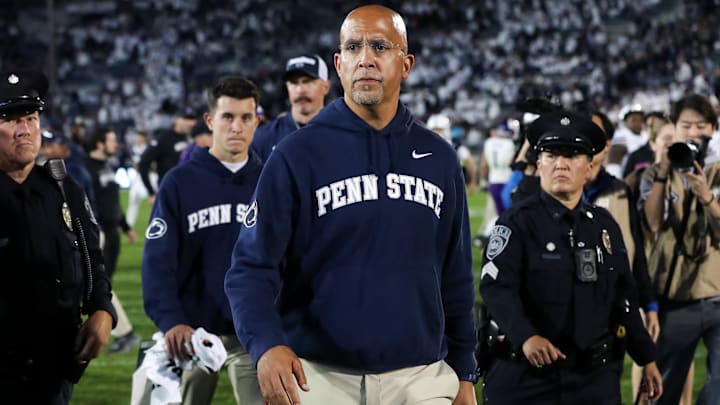
Penn State (1) lined up just about everything James Franklin (2) could have desired for this season of big dreams. It bankrolled a $3 million defensive coordinator hire, swiping Jim Knowles from nemesis Ohio State and making him the highest-paid assistant coach in the country. Donors shelled out NIL money to bring in a few key transfers and keep many veteran players on both sides of the ball for one more run, from quarterback Drew Allar to running backs Nicholas Singleton and Kaytron Allen to defensive stars Dani Dennis-Sutton, Zane Durant and Zakee Wheatley. The infrastructure and support staff were all there, as was a nonconference slate of easy home games.
If ever the Nittany Lions were going to win a national title under Franklin, this was the year. The fans bought in, and so did the media—including Sports Illustrated, which picked Penn State No. 1 before the season. The preseason ranking in the AP and coaches polls was No. 2.
Six games in, the season has gone to hell and Franklin has been fired. It has been a shocking and costly collapse. Franklin’s buyout is $49 million, second-biggest on record, trailing only the $76 million Jimbo Fisher got from Texas A&M a couple of years ago. That millstone of a contract from 2021 was former athletic director Sandy Barbour’s gift to the school.
The revenue-sharing era, when top programs are paying well in excess of $20.5 million to their players, that’s an even more expensive hit. The new economics of the sport should make contracts of the length and security afforded to Franklin a thing of the past—if presidents and athletic directors have the spine to stand up for fiscal sanity.
But whether it came now or in November, the Franklin buyout price tag was going to be the same. As outrageous as it is, this parting had to happen.
Last January, Penn State was locked in a tie game with Notre Dame and appeared headed to overtime in the College Football Playoff national semifinals. Then Allar threw an interception that set up the Irish for the win. To go from a 13–3 season—and 34-8 over the previous three seasons—to fired six games later is the merciless way of the modern world.
Between the buyout and the body of work—six seasons of double-digit victories, seven New Year’s Day bowls, one Big Ten title—Franklin would have been one of the most secure coaches in the profession in another era. Times have changed.
A double-overtime home loss to Oregon (3) on Sept. 27 seems to have broken Penn State. It poured jet fuel on the criticism of Franklin. The derisive “Big Game James” label has only gotten heavier as his record against top 10 opponents got worse and worse (4–21).
What followed was much worse, as Big Game James lost a pair of medium games. The Nittany Lions were stunned by winless, 24.5-point underdog UCLA on Oct. 4, then followed that up with an equally disastrous home loss to three-touchdown underdog Northwestern on Saturday. That was believed to be the first time a team lost consecutive games when favored by 20 or more points.

That was it. Penn State reached its saturation point on program toxicity. There is no more salvaging anything in a championship-or-bust season. When the bust happened, the school acted.
If you look around college football, it seems harder than ever to keep a team from spiraling when things go bad. Mike Gundy is the best coach in Oklahoma State history by a wide margin, but he lost the plot last year and was fired four games into this year. Virginia Tech and UCLA went into unmanageable tailspins with upset losses to non-power-conference opponents, necessitating firings at both schools after 0–3 starts. Arkansas lost three in a row, and Sam Pittman was gone. Oregon State fired Trent Bray on Sunday after an 0-7 start.
Is this a factor of the more transactional nature of college football (4) today? Maybe. If teams are built on a year-to-year basis with the objective of winning (and getting paid) now, is there enough commitment between coaches and players to dig in and fix problems?
Now a failure to course-correct has cost Franklin, too. If someone with 14 previous seasons of head coaching experience and 104 career wins can lose a team, anyone can lose a team.
What’s next? Franklin will get another job if he wants one—a good job. He’s 53 years old and has a career winning percentage of .680, which is better than Lou Holtz, Mack Brown, Frank Beamer, Kirk Ferentz and Bill Snyder, among others. Producing back-to-back 9–4 seasons at Vanderbilt should make him attractive in the SEC, where there is one opening and more to come.
As for Penn State? The first call has to go to Curt Cignetti (5), whose 17–2 record at Indiana is on the short list of the greatest coaching jobs The Dash has ever seen. Cignetti and Indiana have been a great fit and are good for each other, but he has roots in the state of Pennsylvania and it would be hard not to listen when (not if) the Nittany Lions call.
But Cig might also feel some loyalty to the program that finally gave him his power-conference shot at age 62. This much is sure: Phones are ringing among Indiana administrators and donors right now to circle the wagons around their savior.

Matt Rhule (6) is a Penn State alum who appears to have turned the battleship at Nebraska in his third season. He’s gone from 5–7 to 7–6 to 5–1 this year with star quarterback Dylan Raiola. Rhule, age 50, has a friendship with AD Pat Kraft.
If Kraft’s search goes past those two candidates, does he knock on the door of Mike Elko (7)? Kraft made a run at him at Temple when he was the AD there and Elko was a coordinator. Elko’s record as a head coach is a sterling 30–14 in two seasons at Duke and one and a half at Texas A&M, including a 6–0 start this year. He might not leave the Aggies for the Nittany Lions, but it’s still easier to win in the Big Ten than the SEC.
Other coaches who have done well in jobs that are harder than Penn State: Eli Drinkwitz (8) at Missouri, Brent Key (9) at Georgia Tech and Matt Campbell (10) at Iowa State.
Penn State clearly sees itself among the handful of schools that should always compete for playoff bids and national championships (even if it hasn’t won one of those since 1986). There are maybe a dozen places where that is a semi-realistic expectation.
But this is also reality: An Indiana can rise up. A Texas Tech. An SMU. Maybe a Georgia Tech. The right mix of donor dollars, portal success and coaching acumen can change the rigid contender-pretender equation more than ever.
Penn State is well within its rights to shoot for national titles. But when a program wobbles, it can all break down very quickly. James Franklin found that out, when more than a decade of success was wiped out in three disastrous weeks.
More College Football on Sports Illustrated
Listen to SI’s new college sports podcast, Others Receiving Votes, below or on Apple and Spotify. Watch the show on SI’s YouTube channel.
 Add us as a preferred source on Google
Pat Forde is a senior writer for Sports Illustrated who covers college football and college basketball as well as the Olympics and horse racing. He cohosts the Others Receiving Votes podcast for SI and is a regular contributor to the Tony Kornheiser Show podcast. He previously worked for Yahoo Sports, ESPN and The (Louisville) Courier-Journal. Forde has won 28 Associated Press Sports Editors writing contest awards, has been published three times in the Best American Sports Writing book series, and was nominated for the 1990 Pulitzer Prize. A past president of the U.S. Basketball Writers Association and member of the Football Writers Association of America, he lives in Louisville with his wife. They have three children, all of whom were collegiate swimmers.
Follow ByPatForde