
Will MLB's New 2020 Schedule Favor the A's?
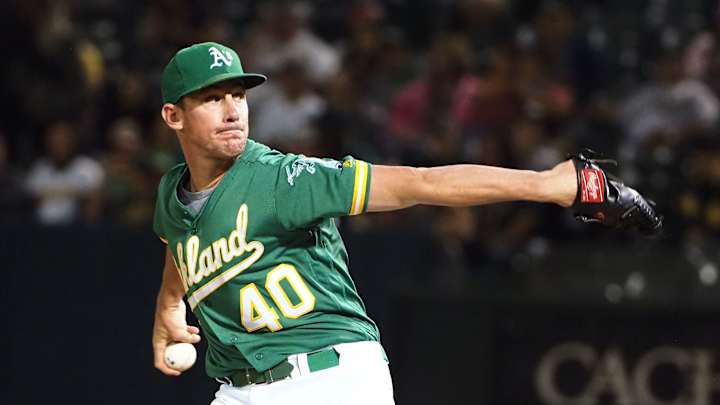
Just what will happen when the A’s and the rest of Major League baseball get back together and put together a 2020 season?
The teams are going to want to play as many games as possible, it seems as if a 162-game schedule is going to be off the table, and even the old 154-game season would be a struggle.
It might be that Major League Baseball finds itself limited to a 140-game season, or less, given that the first eight weeks of the season have been scrapped.
To make up for some of those games lost, MLB is likely to go to the players’ association and ask for a waiver of the 20-day rule. The rules under the current Basic Agreement between owners and players say that teams cannot play more than 20 days without a scheduled day off. Scrapping that rule for the course of this one pandemic-impacted season would make a larger number of games possible.
Doubleheaders used to a staple of the baseball schedule. There were popular, often drawing some of the biggest crowds of the year. Taking one year at random, 1973, the A’s played eight doubleheaders. A look at the 1973 Giants schedule shows that San Francisco also played eight, including in one arm-sapping stretch, two doubleheaders in three days, April 15 and April 17. April 16, thankfully was a day off.
What might be different this time around is having day-night doubleheaders rather than the way it was in 1973, with 30 minutes or so between games.
There’s no telling now – and may not be for a month or more – how much spring training players, particularly pitchers, would be allowed. But as A’s Hall of Fame closer Dennis Eckersley told SI.com earlier this week, 17 days to three weeks would be an ideal minimum. That would about half the time of a regular spring, so players aren’t likely to be fully ready if that kind of abbreviated spring is imposed.
The 2020 season was going to be the debut of the 26-man roster. That’s another rule that is going to have to be looked at. If the clubs are going to load up on doubleheaders while dropping days off and going with a shortened spring, the logical move would be to expand the roster, say to 28, which would have the impact of adding one more pitcher and one more position player, in many cases likely to be a third catcher, to the roster.
Another thing about those potential doubleheaders. Teams aren’t going to want to strain the arms of their pitchers, so it might be necessary to carry six starting pitchers. And if that’s the case, as the San Francisco Chronicle suggested this morning, the A’s might be able to lay claim to the best sixth starter in baseball in Chris Bassitt.
Even without doubleheaders, the A’s were going to have to consider plenty of starts for Bassitt, because even when healthy, rookies A.J. Puk and Jesus Luzardo were likely to have innings limits. Puk has great promise, but he missed all of 2018 due to Tommy John surgery and has never thrown more than 125 innings in any pro season. Luzardo’s arm has the same kind of high expectations, and the lefty has never missed a full season, but he’s had a Tommy John surgery, too, and he’s never thrown more than 109.1 innings in a given year.
And while veteran Sean Manaea wasn’t going to have much of a pitch limit, he did miss the first five months of the 2019 season after shoulder surgery and only threw 66 innings between majors and minors last year, so it seemed likely A’s manager Bob Melvin and pitching coach Scott Emerson would occasionally skip Manaea as he builds his arm back to full strength.
 Add us as a preferred source on Google