%20%20--%3E%0A%3Csvg%20version%3D%221.1%22%20id%3D%22Layer_1%22%20xmlns%3D%22http%3A%2F%2Fwww.w3.org%2F2000%2Fsvg%22%20xmlns%3Axlink%3D%22http%3A%2F%2Fwww.w3.org%2F1999%2Fxlink%22%20x%3D%220px%22%20y%3D%220px%22%0A%09%20width%3D%2239px%22%20height%3D%2240px%22%20viewBox%3D%220%200%2039%2040%22%20enable-background%3D%22new%200%200%2039%2040%22%20xml%3Aspace%3D%22preserve%22%3E%0A%3Cpath%20fill%3D%22%23FFFFFF%22%20d%3D%22M38.5%2C7H28.2v26h10.3V7z%22%2F%3E%0A%3Cpath%20fill-rule%3D%22evenodd%22%20clip-rule%3D%22evenodd%22%20fill%3D%22%23FFFFFF%22%20d%3D%22M26.1%2C25.5c0%2C5.8-4.1%2C7.5-12.9%2C7.5C3.9%2C33%2C0%2C31.2%2C0%2C25.2v-1.1h11.6%0A%09v2.4c0%2C0.7%2C0.1%2C1.4%2C1.2%2C1.4c1%2C0%2C1.2-0.4%2C1.2-1.3v-0.9c0-1.6-0.9-1.6-3.5-2.2C2.2%2C21.7%2C0%2C19.7%2C0%2C15.3v-0.9C0%2C9.3%2C5.5%2C7%2C12.9%2C7%0A%09c10.2%2C0%2C12.8%2C2.6%2C12.8%2C7.4v1.8h-11v-2.9c0-0.6-0.4-1.1-1.2-1.1c-0.6%2C0-1.2%2C0.4-1.2%2C1.1v0.9c0%2C1.5%2C0.9%2C2%2C3.3%2C2.5%0A%09c8%2C1.6%2C10.5%2C3.3%2C10.5%2C7.5V25.5z%22%2F%3E%0A%3C%2Fsvg%3E%0A)
Reds Adding Scary Good Power Arm to Talented Young Pitching Arsenal
In this story:
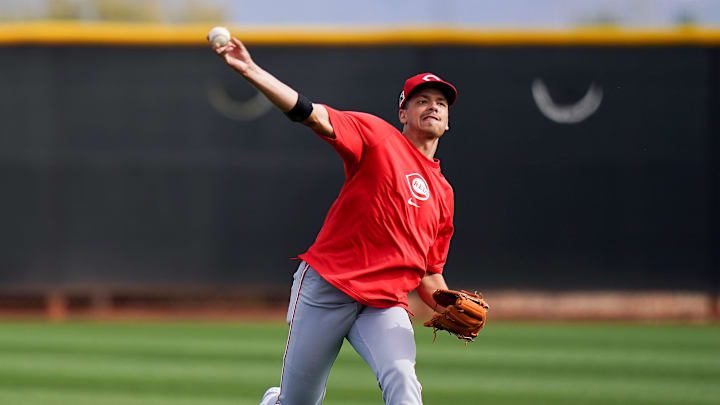
Chase Burns is fast. Just 11 months after the Cincinnati Reds selected him with the second pick of the draft and just three months after he made his pro debut in Class A ball in front of 4,532 fans in Comstock Park, Mich., the righthander will make his major league debut Tuesday against the New York Yankees.
His rapid ascent of just 66 innings of pro ball is a testament to how he has dominated (13 walks, 89 strikeouts and just 38 hits) with his high-spin, high-velocity fastball. At 22 years and 159 days old, he is the youngest starter to debut against the Yankees since Ian Anderson of the Braves beat New York in 2020.
If you’re looking for comps for Burns, you must look beyond this year. There is no starting pitcher in MLB who throws this hard and with such a high release point as Burns does. Here is how he ranks if you consider his minor league metrics:
Highest release point, MLB starters with 95+ mph fastball
MPH | Vertical Release | |
|---|---|---|
1. Chase Burns (minors) | 97.8 | 6.61 |
2. Hayden Birdsong, Giants | 95.6 | 6.52 |
3. Ben Brown, Cubs | 95.7 | 6.40 |
4. Ben Casparius, Dodgers | 96.2 | 6.26 |
To find the best comp, you need to go back a decade to a prime Justin Verlander:
Four-seam comparison
MPH | Vertical release | Extension | Spin rate | |
|---|---|---|---|---|
Justin Verlander 2015 | 96 | 6.62 | 6.3 | 2,576 |
Chase Burns 2025 (minors) | 97.8 | 6.61 | 6.3 | 2,531 |
That is a close match on paper. But when we look at the mechanics, we see Verlander had a smoother delivery. Burns has the same release height, but a higher arm angle. He needs to tilt his torso to move his head to allow his arm to work at that angle, a move that can tax the shoulder more—a move that caught up to Anderson and prompted Michael Wacha, after injury concerns, to lower his arm slot.

But like Anderson and Wacha, Burns has the stuff to dominate right out of the box, especially at higher velocity. Sixty-six innings don’t sound like much of a runup to the big leagues. But pitching labs and advances in college coaching (Burns pitched at Tennessee and Wake Forest) have shortened the learning curve for pitchers—as have pitcher injuries. A door opened for Burns because of injuries to Hunter Greene and Wade Miley. The game today makes it easier to push pitchers faster than hitters.
The universe of successful first-year pitchers this season is robust, including Jacob Misiorowski, Braxton Ashcraft, Braydon Fisher, Logan Henderson, Noah Cameron, Shane Smith, Jack Dreyer, Mick Abel and Chad Patrick. The same can’t be said for hitters trying to break in. Cam Smith and Kristian Campbell, who has been sent back to the minors, are the only qualified first-year hitters. Eleven of the 16 first-year players with 100 plate appearances have a below-average OPS+.
Burns also features a wipeout slider. He has the powerful combination of elite stuff and an unusual arm slot. It’s the kind of arsenal, as we have seen from Misiorowski, that can produce immediate success. For the longer haul, Cincinnati is positioned well with an impressive core of young pitchers, with Burns joining Chase Petty, 22; Rhett Lowder, 23; Greene, 25; Andrew Abbott, 26; and Nick Lodolo, 27. These are exciting times in Cincinnati, especially with those arms in the hands of manager Terry Francona and pitching coach Derek Johnson.

Ace on the trading block
It took a while, but the command is back for the post-op version of Miami Marlins ace Sandy Alcántara. He has re-established himself as the best arm available on the trade market next month. Looking for a red-hot pitcher? Look what Alcántara has done this month:
Alcántara splits
Games started | W–L | ERA | Strike Rate | |
|---|---|---|---|---|
March-May | 11 | 2–7 | 8.47 | 61.6% |
June | 4 | 2–1 | 2.74 | 67.4% |
What’s behind the turnaround? Like many pitchers coming back from Tommy John surgery, Alcántara quickly found his top-gear velocity, but what was missing was command and touch on his breaking pitches. It took 11 starts, but those qualities are back. And Alcántara is leaning on his elite spin much more:
Alcántara breaking pitch use
Percentage | Avg. | SLG | |
|---|---|---|---|
March-May | 26.2% | .237 | .474 |
June | 39.1% | .148 | .296 |
MLB’s surprise power hitter
Seattle Mariners catcher Cal Raleigh is the breakout star of the first half. He has gone next level with pull-side power by moving closer to the plate, as you can see here. Check out the position of his hands and front foot in relation to the plate:

By getting on the plate, Raleigh is turning the outside half the plate into the middle lane. There is no safe zone. Pitch him away? He still pulls it for power. He did it again Monday night, pulling an outer-half changeup from Joey Wentz for home run No. 32.
Here are his home runs by splitting the plate in half:
Raleigh home runs by pitch location
Inside | Outside | |
|---|---|---|
Lefthanded | 9 | 12 |
Righthanded | 4 | 7 |
Totals | 13 | 19* (*13 HRs to pull side) |
Most home runs on outer half pitches, 2025
HRs | |
|---|---|
1. Cal Raleigh, Mariners | 19 |
t-2. Corbin Carroll, Diamondbacks | 16 |
t-2. Aaron Judge | 16 |
4. Eugenio Suarez, Diamondbacks | 15 |
5. Kyle Schwarber, Phillies | 14 |
Where have we seen this kind of adjustment before? Curtis Granderson, Daniel Murphy, José Ramírez, Matt Carpenter and, of course, Barry Bonds, also moved right on top of the plate. They not only dared pitchers to pitch inside but also turned the outside lane into the middle lane. It’s a bold move if, like Raleigh, you are quick enough to get to velocity in.

Hidden pitching gem
Looking for the next Luke Weaver, a multiple-inning reliever with wipeout stuff? Teams should be looking at Washington Nationals starter Mike Soroka as a bullpen weapon. He struck out a career-high 10 batters against the Dodgers in his last start. In his previous start, he touched 97.3 mph, a career high.
And he throws what just might be the most unhittable pitch in baseball: a wicked spinning slurve (2,920 rpm) with 50 inches of drop and 12 inches of run. It’s a pitch he had thrown only 68 times in his previous five big league seasons and now it’s as baffling and Wiffle-like a pitch as the Blake Treinen sweeper.
This month, Soroka has thrown 134 slurves and given up one hit on the pitch (1-for-30 for a .033 batting average). He has leaned on it 37% this month.
Soroka’s overall numbers may look pedestrian: 5.06 ERA and 10 homers allowed in 10 starts. But look closer and—just like the Yankees discovered with Weaver—you’ll see a dominant bullpen arm buried in there.
Soroka dominates righthanded hitters (.169), making him perfect against the right pocket of hitters late in a game. He dominates hitters in initial bursts but doesn’t hold his stuff. He holds hitters to a .155 batting average first time through the lineup, then it goes up to .259. He holds them to a .165 average through 50 pitches, then it’s .282 thereafter.
The Nationals signed Soroka to a one-year, $9 million deal. That looks like a bargain compared to what value Soroka can bring on the trade market.
More MLB on Sports Illustrated
 Add us as a preferred source on Google
Tom Verducci is a senior writer for Sports Illustrated who has covered Major League Baseball since 1981. He also serves as an analyst for FOX Sports and the MLB Network; is a New York Times best-selling author; and cohosts The Book of Joe podcast with Joe Maddon. A five-time Emmy Award winner across three categories (studio analyst, reporter, short form writing) and nominated in a fourth (game analyst), he is a three-time National Sportswriter of the Year winner, two-time National Magazine Award finalist, and a Penn State Distinguished Alumnus Award recipient. Verducci is a member of the National Sports Media Hall of Fame, Baseball Writers Association of America (including past New York chapter chairman) and a Baseball Hall of Fame voter since 1993. He also is the only writer to be a game analyst for World Series telecasts. He lives in New Jersey with his wife, with whom he has two children.