
Where Were They Then? Part One
The White Sox finished the 1958 season in good shape as far as we might think of a minor league "system," with a specialty in developing catchers and outfielders. The Sox had been drawing from the farm to fill starting and key bench positions for a few years, by then. In 1957, Jim Landis and Earl Battey passed their rookie eligibility. And in 1958 Bob Shaw, Barry Latman, a couple of durable arms through the 60's, would surpass the rookie minimums in the Sox bullpen.
As 1959 loomed, the White Sox had their share of young(er) fungible arms to shuffle in and out of the bullpen and rotation. Don Rudolph and Tom Flanigan were at Triple-A. They had a young group of catchers ready to spell Sherm Lollar behind the plate. Rookie bats were ready to start getting playing time in the outfield.
In considering how to present the South Side's Top 10 prospects of 1959 offseason, I decided to rank them based on lifetime WAR as computed by Baseball-Reference.com. I leaned heavily on their stats pages, and cribbed their SABR and Wikipedia bios for background. Our own Mark Liptak is referenced abundantly in one of the SABR bios.
We'll be presenting these in reverse order over the next five days. Let's start with a few interesting players who filled roles for a season or two, looked good enough for another team to pluck out of our system, or seemed to make other players above them on the depth chart somewhat expendable.
Honorable mentions (Presented in no particular order) There were a cadre of players with glowing prospects at the end of 1958. For whatever reasons (injury, not seeing a way onto a major league roster, just not adjusting to the highest level), here are four players who bore watching:
Jim McAnany Five-tool right fielder. In his third pro season (1957), his bat started to come alive in Class-B Davenport of the Triple-I League. He hit .303/.412/.486 with 17 HRs in 524 PAs. That earned him a September callup, when he went hitless. In 1959, McAnany picked it up a notch in Class-A Colorado Springs, where the higher elevation probably helped him hit .400 with 26 HRs. That earned him a tune-up in Triple-A Indianapolis, and a promotion to the White Sox in July when right field and left field played like pitcher spots in the batting order. McAnany took over as the RF starter on the White Sox, and hit a torrid .322/.392/.425 in July. He cooled down in August, and was relegated to the short end of a straight platoon with Jim Rivera by September. An offseason shoulder injury while serving in the Army Reserve put a dent in McAnany's offensive game that he never really recovered from. The White Sox exposed him in the 1960 expansion draft, and he was drafted by the Angels, then traded to the Cubs. His bat recovered a bit in Triple-A that season. He retired in 1963 with 61 major league hits, and a 0.2 bWAR.
J.C. Martin progressed through the minors as a bat-first corner infielder. By the 1961 season, he rose to the major leagues, but his bat never really showed up. The Sox transitioned him to catcher, and he quickly developed a reputation as a good game-caller. Due to injuries on the roster, Martin was given the opportunity to start in 1964, but by the 1966 season, he was relegated to reserve catcher, and after the 1967 season, sent to Mets to complete a deadline deal for Ken Boyer. Traditional fielding stats don't really capture all that a catcher does during the game, however, Martin had accumulated negative WAR by the time the Cubs released him during spring training, 1973.
As the 1958 season drew to a close, Stan Johnson was seen as a rising star in the Sox system as a contact hitter with just a little pop. His 1958 stint in Colorado Springs did high-elevation things to his offensive numbers. The 1959 season saw his numbers come back to Earth, at least some (.281/.334/.368) in Triple-A Indianapolis, but he responded to repeating the level 1960 in San Diego (.333/.365/.482). A Minnie Miñoso/Jim Landis/Floyd Robinson outfield didn't offer any playing time, and Mike Hershberger was the prospect with an arrow eating up any spare innings at the time. Johnson was sent to the Athletics in a 1961 midseason deal that would bring back Ray Herbert, a run-of-the-mill chucker who the Sox would turn into an All-Star the next season. Johnson was dealt to the Dodgers that offseason, then to Boston the next, where he was another reserve outfielder at Triple-A for six seasons. His six plate appearances for the White Sox in September of 1960 would be his only major league experience. His one hit was a home run in Cleveland off of reliever Frank Funk, pinch-hitting for Miñoso.
Robert Sagers was a bat-first infielder who came back from a two-year stint in the service as a power-hitting 3B. He quickly ascended the Sox system ladder until strong numbers at Triple-A in 1959 made him enticing enough to head the package going back to the Pirates for Ted Kluszewski. He promptly forgot how to hit for two seasons until he hung 'em up.
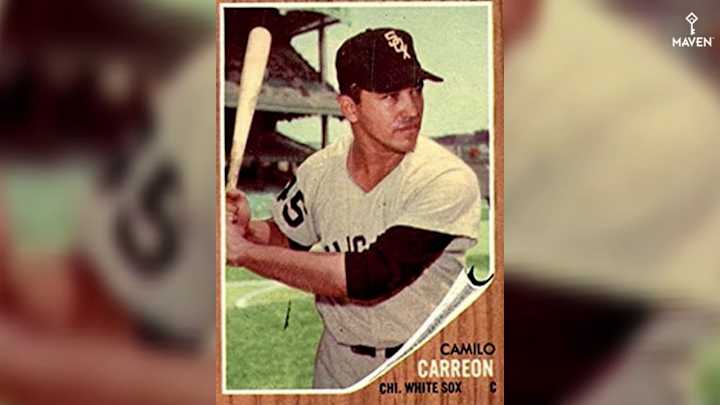
10. Cam Carreon In 1956, the White Sox scouted Carreon out of semipro ball in Colton, Calif., where he starred as a multi-sport athlete in high school. As he progressed, he was thought to have the highest ceiling in the Sox system, as a power hitter. Possessing mostly gap power, Carreon's bat and steady glove seemingly made John Romano and Earl Battey expendable after the 1960 season. Carreon displaced Sherm Lollar, and became the main catcher for the 1962 and 1963 seasons. Carreon's power hitting never materialized, however. After a shoulder injury, J.C. Martin ate into his playing time, even though Carreon was still the better hitter. Before the 1965 season, Carreon was sent to Cleveland in the three-team deal that returned John Romano to the White Sox. Carreon never really recovered from his shoulder injury, and ended his career after the 1966 season with 2.8 bWAR.
Tomorrow: a solid southpaw, and a Seattle Pilot, as the WAR of lost Sox in the 1960s begins to climb ...
 Add us as a preferred source on Google
John Gorlewski has been a White Sox fan for close to 50 years. In the mid-90's, he managed the White Sox community for Real Fans Sports Network, and later CBS sports on AOL. A 16-year foray into market research had limited his written takes on South Side Sox and South Side Hit Pen to lengthy comments, and the rare article. John dabbles in song-writing and recording, and may foist the odd song upon you when you are least suspecting.
Follow @JohnGorlewski