%22%3E%0A%3Cpath%20d%3D%22M0%209H6.73992C13.734%209%2017.2358%2012.4453%2017.2358%2017.6508V17.6979C17.2358%2022.9034%2013.6681%2026.6029%206.54224%2026.6029H0V9ZM5.89273%2014.1302V21.4726H6.87171C9.56391%2021.4726%2011.296%2020.3619%2011.296%2017.8203V17.7732C11.296%2015.2316%209.56391%2014.1208%206.87171%2014.1208H5.89273V14.1302Z%22%20fill%3D%22white%22%2F%3E%0A%3Cpath%20d%3D%22M18.375%2019.8159V19.7688C18.375%2015.6646%2021.3214%2012.5488%2025.4444%2012.5488C30.3299%2012.5488%2032.5891%2015.947%2032.5891%2020.1171C32.5891%2020.4183%2032.5891%2020.7761%2032.5608%2021.0679H23.7312C24.1359%2022.2728%2025.0867%2022.9035%2026.3198%2022.9035C27.3553%2022.9035%2028.2025%2022.4234%2029.1156%2021.4915L32.1843%2023.9295C30.8288%2025.6898%2028.8897%2026.9229%2025.9245%2026.9229C21.4249%2026.9229%2018.375%2024.0801%2018.375%2019.8065V19.8159ZM27.3741%2018.5545C27.2517%2017.2461%2026.4704%2016.493%2025.4632%2016.493C24.456%2016.493%2023.8253%2017.3025%2023.6559%2018.5545H27.3835H27.3741Z%22%20fill%3D%22white%22%2F%3E%0A%3Cpath%20d%3D%22M33.944%2012.869H39.6579V14.7799C40.5427%2013.6503%2041.9265%2012.5396%2043.8562%2012.5396C46.7461%2012.5396%2048.5628%2014.4505%2048.5628%2017.5474V26.603H42.849V19.383C42.849%2018.1969%2042.143%2017.5192%2041.2864%2017.5192C40.4297%2017.5192%2039.6484%2018.1969%2039.6484%2019.383V26.603H33.9346V12.869H33.944Z%22%20fill%3D%22white%22%2F%3E%0A%3Cpath%20d%3D%22M48.9205%2012.8691H54.9074L57.1195%2019.7597L59.3599%2012.8691H65.2715L59.7082%2026.7067H54.4744L48.9111%2012.8691H48.9205Z%22%20fill%3D%22white%22%2F%3E%0A%3Cpath%20d%3D%22M64.9238%2019.8159V19.7688C64.9238%2015.6646%2067.8702%2012.5488%2071.9932%2012.5488C76.8787%2012.5488%2079.1379%2015.947%2079.1379%2020.1171C79.1379%2020.4183%2079.1379%2020.7761%2079.1097%2021.0679H70.28C70.6848%2022.2728%2071.6355%2022.9035%2072.8687%2022.9035C73.9041%2022.9035%2074.7513%2022.4234%2075.6644%2021.4915L78.7331%2023.9295C77.3776%2025.6898%2075.4385%2026.9229%2072.4733%2026.9229C67.9737%2026.9229%2064.9238%2024.0801%2064.9238%2019.8065V19.8159ZM73.9229%2018.5545C73.8006%2017.2461%2073.0193%2016.493%2072.012%2016.493C71.0048%2016.493%2070.3741%2017.3025%2070.2047%2018.5545H73.9324H73.9229Z%22%20fill%3D%22white%22%2F%3E%0A%3Cpath%20d%3D%22M80.4932%2012.8689H86.207V15.6364C86.9883%2013.7726%2088.2497%2012.5677%2090.5089%2012.6712V18.7334H89.9065C87.4872%2018.7334%2086.207%2020.0701%2086.207%2023.1106V26.6123H80.4932V12.8783V12.8689Z%22%20fill%3D%22white%22%2F%3E%0A%3Cpath%20d%3D%22M98.2373%209H108.102C110.54%209%20112.075%209.55538%20113.11%2010.5814C113.741%2011.2121%20114.193%2012.1158%20114.193%2013.3207V13.3678C114.193%2015.4575%20112.931%2016.7377%20111.049%2017.3967C113.317%2018.0556%20114.776%2019.2605%20114.776%2021.6703V21.7174C114.776%2024.5319%20112.461%2026.6029%20108.008%2026.6029H98.2467V9H98.2373ZM108.394%2014.6574C108.394%2013.8761%20107.764%2013.4525%20106.502%2013.4525H103.961V15.9188H106.53C107.792%2015.9188%20108.394%2015.4952%20108.394%2014.7139V14.6668V14.6574ZM106.935%2019.5429H103.97V22.1598H106.916C108.197%2022.1598%20108.856%2021.6326%20108.856%2020.8796V20.8325C108.856%2020.0795%20108.225%2019.5523%20106.945%2019.5523L106.935%2019.5429Z%22%20fill%3D%22white%22%2F%3E%0A%3Cpath%20d%3D%22M115.99%2012.8689H121.704V15.6364C122.485%2013.7726%20123.747%2012.5677%20126.006%2012.6712V18.7334H125.404C122.984%2018.7334%20121.704%2020.0701%20121.704%2023.1106V26.6123H115.99V12.8783V12.8689Z%22%20fill%3D%22white%22%2F%3E%0A%3Cpath%20d%3D%22M126.533%2019.7877V19.7406C126.533%2015.8623%20129.753%2012.5488%20134.28%2012.5488C138.808%2012.5488%20141.98%2015.8152%20141.98%2019.6935V19.7406C141.98%2023.6189%20138.761%2026.9324%20134.233%2026.9324C129.705%2026.9324%20126.533%2023.6659%20126.533%2019.7877ZM136.502%2019.7877V19.7406C136.502%2018.3851%20135.495%2017.3025%20134.233%2017.3025C132.972%2017.3025%20132.021%2018.3851%20132.021%2019.6935V19.7406C132.021%2021.0961%20133.028%2022.1786%20134.29%2022.1786C135.551%2022.1786%20136.502%2021.0961%20136.502%2019.7877Z%22%20fill%3D%22white%22%2F%3E%0A%3Cpath%20d%3D%22M143.374%2012.869H149.088V14.7799C149.972%2013.6503%20151.356%2012.5396%20153.286%2012.5396C156.176%2012.5396%20157.993%2014.4505%20157.993%2017.5474V26.603H152.279V19.383C152.279%2018.1969%20151.573%2017.5192%20150.716%2017.5192C149.859%2017.5192%20149.078%2018.1969%20149.078%2019.383V26.603H143.364V12.869H143.374Z%22%20fill%3D%22white%22%2F%3E%0A%3Cpath%20d%3D%22M159.273%2019.816V19.7689C159.273%2015.9189%20162.295%2012.5771%20166.766%2012.5771C169.788%2012.5771%20171.925%2014.1398%20172.979%2016.3801L168.875%2018.6958C168.395%2017.8109%20167.792%2017.312%20166.861%2017.312C165.656%2017.312%20164.752%2018.3663%20164.752%2019.7313V19.7783C164.752%2021.2091%20165.656%2022.2446%20166.795%2022.2446C167.802%2022.2446%20168.376%2021.7457%20168.931%2020.8609L173.083%2023.2236C171.85%2025.511%20169.76%2026.9701%20166.493%2026.9701C162.314%2026.9701%20159.273%2023.6754%20159.273%2019.8254V19.816Z%22%20fill%3D%22white%22%2F%3E%0A%3Cpath%20d%3D%22M173.261%2019.7877V19.7406C173.261%2015.8623%20176.48%2012.5488%20181.008%2012.5488C185.536%2012.5488%20188.708%2015.8152%20188.708%2019.6935V19.7406C188.708%2023.6189%20185.489%2026.9324%20180.961%2026.9324C176.433%2026.9324%20173.261%2023.6659%20173.261%2019.7877ZM183.22%2019.7877V19.7406C183.22%2018.3851%20182.213%2017.3025%20180.961%2017.3025C179.709%2017.3025%20178.749%2018.3851%20178.749%2019.6935V19.7406C178.749%2021.0961%20179.756%2022.1786%20181.017%2022.1786C182.279%2022.1786%20183.229%2021.0961%20183.229%2019.7877H183.22Z%22%20fill%3D%22white%22%2F%3E%0A%3Cpath%20d%3D%22M188.991%2024.9463L190.93%2021.6987C192.587%2022.7247%20194.451%2023.2331%20196.014%2023.2331C196.569%2023.2331%20196.842%2023.1107%20196.842%2022.7812V22.7342C196.842%2022.4612%20196.588%2022.2823%20195.204%2021.9246C191.73%2021.068%20189.594%2020.1361%20189.594%2017.2933V17.2462C189.594%2014.2245%20192.013%2012.5396%20195.581%2012.5396C197.849%2012.5396%20200.08%2013.1138%20201.746%2014.121L199.939%2017.5192C198.48%2016.7096%20196.72%2016.239%20195.562%2016.239C195.006%2016.239%20194.752%2016.3896%20194.752%2016.6626V16.7096C194.752%2016.9826%20195.053%2017.1615%20196.437%2017.5192C199.911%2018.3758%20202%2019.3265%20202%2022.1505V22.1976C202%2025.191%20199.76%2026.9231%20196.042%2026.9231C193.378%2026.9231%20190.959%2026.2453%20189.001%2024.9369L188.991%2024.9463Z%22%20fill%3D%22white%22%2F%3E%0A%3Cpath%20fill-rule%3D%22evenodd%22%20clip-rule%3D%22evenodd%22%20d%3D%22M211.368%204.36764C217.191%20-1.45588%20226.632%20-1.45588%20232.456%204.36764C238.279%2010.1912%20238.279%2019.6324%20232.456%2025.4559L221.912%2036L211.368%2025.4559C205.544%2019.6324%20205.544%2010.1912%20211.368%204.36764ZM214.009%207.55761C213.948%207.86849%20213.916%208.39718%20213.916%209.14566V10.4189C213.916%2011.1832%20213.948%2011.7198%20214.013%2012.0267C214.078%2012.3317%20214.278%2012.6168%20214.617%2012.8762C214.956%2013.1376%20215.403%2013.3316%20215.958%2013.4623C216.512%2013.593%20217.1%2013.6584%20217.837%2013.6584C218.573%2013.6584%20219.217%2013.591%20219.769%2013.4524C220.322%2013.3158%20220.761%2013.1178%20221.086%2012.8604C221.411%2012.6029%20221.605%2012.3178%20221.666%2012.0069C221.728%2011.6961%20221.759%2011.1674%20221.759%2010.4189V9.14566C221.759%208.38134%20221.728%207.84473%20221.662%207.53781C221.597%207.23287%20221.397%206.94971%20221.058%206.68834C220.72%206.42696%20220.272%206.23291%20219.718%206.10223C219.163%205.97154%20218.536%205.90619%20217.839%205.90619C217.102%205.90619%20216.459%205.97352%20215.906%206.11213C215.352%206.24875%20214.914%206.44677%20214.589%206.70418C214.265%206.9616%20214.071%207.24673%20214.009%207.55761ZM219.276%2024.8638C222.876%2024.8638%20224.557%2024.2064%20224.557%2021.862V21.858V21.3155C224.557%2019.6581%20223.516%2018.971%20220.252%2018.3136C219.278%2018.1136%20218.908%2017.9136%20218.908%2017.3136V16.9414C218.908%2016.6543%20219.177%2016.5117%20219.413%2016.5117C219.749%2016.5117%20219.918%2016.7137%20219.918%2016.9414V18.1136H224.391V17.3988C224.391%2015.4563%20223.347%2014.4266%20219.177%2014.4266C216.15%2014.4266%20213.896%2015.3414%20213.896%2017.3711V17.7433C213.896%2019.5155%20214.805%2020.3155%20218.201%2021.0303C218.28%2021.0472%20218.355%2021.063%20218.427%2021.0781C219.329%2021.2674%20219.647%2021.3341%20219.647%2021.9174V22.2897C219.647%2022.6619%20219.546%2022.8045%20219.142%2022.8045C218.67%2022.8045%20218.637%2022.5471%20218.637%2022.262V21.2897H213.894V21.7471C213.894%2024.149%20215.476%2024.8638%20219.276%2024.8638ZM225.424%2024.5569H229.925V14.7355H225.424V24.5569ZM226.955%2013.5019H229.925V6.06064H227.092V9.411L225.193%206.06064H222.359V13.5019H225.193V10.1199L226.955%2013.5019ZM218.269%2012.152C218.204%2012.2688%20218.055%2012.3262%20217.825%2012.3262L217.827%2012.3282C217.604%2012.3282%20217.459%2012.2767%20217.398%2012.1758C217.336%2012.0748%20217.305%2011.8074%20217.305%2011.3758V7.90068C217.305%207.51852%20217.352%207.28684%20217.445%207.20962C217.538%207.13239%20217.675%207.09279%20217.851%207.09279C218.059%207.09279%20218.198%207.14031%20218.265%207.23734C218.332%207.33239%20218.366%207.55416%20218.366%207.90068V11.3203C218.366%2011.7579%20218.334%2012.0352%20218.269%2012.152Z%22%20fill%3D%22white%22%2F%3E%0A%3C%2Fg%3E%0A%3Cdefs%3E%0A%3CclipPath%20id%3D%22clip0_15232_3035%22%3E%0A%3Crect%20width%3D%22237%22%20height%3D%2236%22%20fill%3D%22white%22%2F%3E%0A%3C%2FclipPath%3E%0A%3C%2Fdefs%3E%0A%3C%2Fsvg%3E%0A)
2003 Bengals' 0-3 start & comparable QB situation could provide map for listless Broncos
An 0-3 start is never fun, especially when the team you root for is used to having strong starts to the season.
The Denver Broncos are a team with some talent but they have made way too many mistakes this season — more than they can afford to make, especially against good teams. We saw that in Sunday's loss to Green Bay, in which two turnovers set up two Packers' touchdowns and an interception ended a promising drive.
It hasn't helped that the Broncos have been unable to generate turnovers and sacks on defense. That gives Broncos fans plenty of reason to be worried.
However, while I don't believe the team is a playoff contender, there is still a chance for the Broncos to turn it around and finish with a respectable record.
One team that did it before was the 2003 Cincinnati Bengals. That's a team I've compared the Broncos' current quarterback situation to, in which the Bengals had a veteran who started and remained there while a highly-touted rookie sat on the bench.
Then I looked up information from Pro Football Reference about the Bengals' 2003 season to see if there were other similarities between them and the current Broncos team. While there were some key differences, they were similar in other ways, and in a few instances, the Broncos actually have more talent at particular positions.
So let's take a closer look at the 2003 Bengals, how they compare to the 2019 Broncos, and whether Denver have a chance to finish as the 2003 Bengals did at 8-8 overall. I'll break down as much as I can, but one thing you will realize; the Bengals had a QB situation in which back then — as I'm sure it would be now — there would be cries for a change after an 0-3 start.
But let's start with the head coaching position before we get to players.
Head coach: Marvin Lewis entered his first year as the Cincinnati Bengals head coach. Like Vic Fangio, he was considered one of the best defensive minds in the game. Lewis spent six seasons with the Baltimore Ravens, then a year in Washington, before the Bengals hired him to be head coach.
Of course, we know about Lewis' overall track record — he was 131-122 as head coach. He wasn't a great coach, by any means, but gets more grief from fans than is deserved.
How Fangio measures up overall remains to be seen, but like Lewis, he started his coaching career with three straight losses. We'll get to the games in more detail later on, but let's look at personnel.
Quarterback: Jon Kitna had been with the Bengals the two seasons prior to Lewis' arrival. In those two seasons, he had thrown 28 touchdowns to 38 interceptions — numbers that would make any Broncos fan today call for that quarterback to be cut.
In other words, if you think Kitna was better than Joe Flacco, think again. Kitna had a grand total of two seasons as a starting quarterback in which he threw more touchdowns than interceptions. (He did throw 16 touchdowns to 12 interceptions with the Cowboys in 2010, but that was as the backup who took over after Tony Romo was lost for the season because of injuries.)
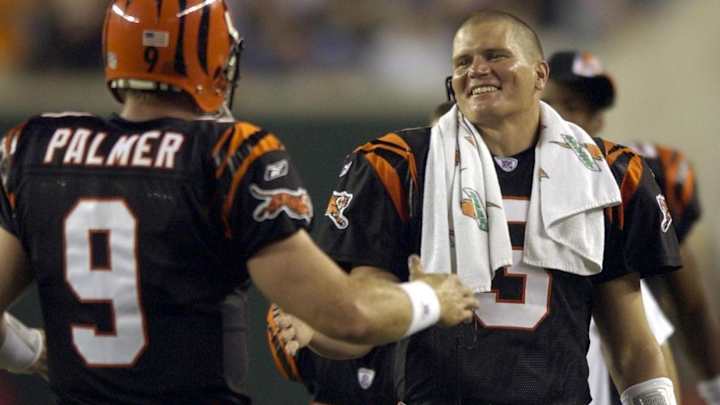
Meanwhile, Carson Palmer sat on the bench behind Kitna. Unlike Drew Lock, Palmer was taken in the first round — and more importantly, he was the No. 1 overall pick in the 2003 draft.
If the Broncos had that QB situation back then, how many would have demanded Palmer take over for Kitna? Thought so.
But let's remember there's more to consider about the roster.
Running backs: The Bengals entered the season with Corey Dillon as their starting running back. He battled injuries, though, and backup Rudi Johnson took over as starter, finishing the year with 957 yards rushing and nine touchdowns, averaging 4.5 yards per carry.
So this isn't like the Broncos, who have Phillip Lindsay and Royce Freeman in a tandem, and an effective one, too.
Wide receiver: The Bengals used high draft picks on wide receivers in 2000 and 2001. The former was Peter Warrick, who never lived up to expectations as the No. 4 overall pick in the draft.
The other player was Chad Johnson, a second-round pick who was far more productive. After a quiet rookie campaign, Johnson broke out in 2002, then was even better in 2003.
Interestingly, the Broncos used a second-round pick on Courtland Sutton, who enters his second year and looks better than he did as a rookie. The other top receiver, Emmanuel Sanders, is certainly a better player than Warrick ever was.
Tight end: The Bengals didn't have much to write home about here. Their most productive tight end was Matt Schobel, who was in his second season in the NFL and caught 24 passes for 332 yards and two touchdowns.
The Broncos are relying on rookie tight end Noah Fant and middling veteran Jeff Heuerman, the latter of whom may as well be comparable to the Bengals' most experienced tight end in 2003, Reggie Kelly. A second-round pick in 1999, Kelly spent 12 years in the NFL but never caught more than 31 passes in a single season.
No question that Broncos fans would have been demanding a better tight end if they had what the Bengals had in 2003.
Offensive line: This is one area in which the Bengals in 2003 are better than what the Broncos are now. They had stability at right tackle with veteran Willie Anderson, who was 28 years old and had one of his best seasons as a pro in 2003.
Cincy had a better left tackle than what the Broncos have now, though he wasn't an impact player. The Bengals drafted Levi Jones 10th overall in 2002 and, while he was solid, he wasn't great by any means.
The Bengals used a second-round pick in 2003 on offensive guard Eric Steinbach, much like the Broncos did with Dalton Risner this year. Steinbach had a fine NFL career.
The other offensive linemen were center Rich Braham, who spent his entire 12-year career with the Bengals, and right guard Mike Goff, who played his sixth and final season with the Bengals in 2003, then signed with the Chargers. I don't think you can compare either to Connor McGovern or Ronald Leary, though it's likely Leary will be gone after this season, similar to Goff.
While it's tough to make direct comparisons here, I would give the Bengals the edge, particularly because they were in better shape at offensive tackle.
Defensive line: This is where it's tough to make a comparison because the Bengals ran a 4-3 scheme while the Broncos are running a 3-4. But let's look at the Bengals and see how they were upfront.
DE Duane Clemons joined the Bengals as a free agent in 2003 and was 29 years old at the time. He finished the season with six sacks. Teammate Justin Smith, the No. 4 overall pick of the 2001 draft, had his best seasons as a pro later in his career with San Francisco, but he was productive for the Bengals, too, with five sacks in 2003 — though he had better numbers in his first two seasons, with 8.5 sacks as a rookie in 2001 and 6.5 in 2002.
The DTs were John Thornton, who played four years with the Titans, then joined Cincy in 2003 and had six sacks, and Tony Williams, who had two sacks in his seventh season in the league.
Clemons is roughly comparable to Derek Wolfe and the two would be about even. Smith, then, would be comparable to Adam Gotsis and Smith was the better player in 2003. There are some comparisons to be drawn between Thornton and Shelby Harris, perhaps.
Cincy would have the edge here because of the presence of Justin Smith.
Linebackers: Again, it's tough to compare directly because of the difference in the defensive scheme. Here, though, the Broncos have the more talented pass rushers in Von Miller and Bradley Chubb, even if the numbers aren't showing up in the first three games.
But the Bengals weren't going to threaten anybody in the pass rush with Adrian Ross and Brian Simmons, though the latter was solid in coverage.
The other linebacker was veteran Kevin Hardy, who played with Jacksonville from 1996 to 2001, then had a good season with the Cowboys in 2002 with 11 pass breakups. He signed with the Bengals, but wasn't as good in coverage that year with just four pass breakups.
I'd give the advantage to the Broncos, even if it's not showing up in the stat box. Having Todd Davis and Josey Jewell in tandem on the field more often should help the Broncos improve here.
Defensive backs: A former Broncos draft pick, Tory James, was one of the starting cornerbacks. He never found his niche in Denver, but got better later in his career and had 18 pass breakups in 2003. It's worth noting he was named to the Pro Bowl in 2004.
The other starting cornerback, Jeff Burris, had played for the Bills and Colts before joining the Bengals in 2002. He wasn't particularly good in 2003, with just six pass breakups, and it was his last season in the NFL.
Strong safety Rogers Beckett joined the Bengals after spending three seasons with the Chargers and was solid but not great. Free safety Mark Roman wasn't bad, but the 2000 second-round pick left for the Packers after the 2003 season.
I give the Broncos the advantage here because they have Chris Harris, Jr. and Kareem Jackson, who are better than any player the Bengals had in 2003.
The first three games: The Bengals lost their season opener to none other than the Broncos, a 30-10 loss. The Broncos didn't play that well, with Jake Plummer throwing three interceptions. But the Bengals' mistakes were more costly.
The Bengals trailed 10-3, then gave up a 34-yard kickoff return by Chris Cole. A couple of plays later, Clinton Portis rushed for 23 yards, setting up his 8-yard touchdown run. The Bengals then fumbled the ensuing kickoff and that led to a Jason Elam field goal. In the third quarter, the Bengals were deep in their own territory and Kitna threw a pick-six to Ian Gold.
The following week, the Bengals lost 23-20 to the Oakland Raiders. The game was tied 13-13 going into the fourth quarter and the Bengals were driving, when Phillip Buchanon intercepted a Kitna pass and returned it 83 yards for a touchdown. Though the Bengals responded and got a touchdown to tie it, the Raiders benefited from a defensive pass interference penalty that set up the game-winning field goal by Sebastian Janikowski.
In Week 3, the Bengals lost to the Pittsburgh Steelers 17-10. The Bengals drove to the Pittsburgh 17-yard line on their first offensive drive, but Kitna threw an interception.
Still, the game was scoreless until late in the second quarter when the Steelers scored a touchdown with 1:55 left. And early in the third quarter, Rogers Beckett intercepted a Tommy Maddox pass that set up a Shayne Graham 44-yard field goal.
But the Bengals couldn't finish drives and the Steelers took a 17-3 lead. The Bengals cut the lead to 17-10 after a Kitna TD pass to Peter Warrick with 5:59 left. But the Bengals D couldn't get a stop and the Steelers ran out the clock.
Like the Broncos first three games this year, there were some positive but plenty of costly mistakes that took the 2003 Bengals out of the games. The 2003 Bengals-Broncos game may as well be compared to the Broncos-Packers game this year and you could say the Bengals-Raiders game in 2003 was as much of a heartbreaker as the Broncos-Bears game this year.
What it means
Take the performance of the 2003 Bengals and put it on a Broncos team today and fans would still be frustrated. The Bengals had plenty of opportunities to win games but the mistakes were enough to keep them out.
Of course, the Bengals did force turnovers during these games, whereas the Broncos haven't done that. But I don't think that's a sign that the Broncos are destined to be worse. The defense is doing what it can to generate pressure, but teams are taking advantage of the important flaws the Broncos have on defense.
Furthermore, the Bengals didn't rebound right away after the 0-3 start — in fact, they were 1-4 to open the season, with their only win coming against the Cleveland Browns in Week 4, a game in which the offense didn't turn the ball over, but trailed 14-7 before tying it toward the end of the second quarter.
From there, the Bengals lost in overtime to the Buffalo Bills before entering a bye week. The Broncos, of course, have a bye week that comes later in the season — but they could easily be 1-4 after the first five games of the season.
Still, I see enough from examing Pro Football Reference to believe that this was a Bengals team that showed fight, but was held back because of costly mistakes. However, let's not kid ourselves into thinking that nobody was calling for Kitna to be benched and for Palmer to start, or how the Bengals were destined to be 'the Bungles' once again.
But Cincy came off the bye week and won several close games, improving to 7-5 by Week 13. They closed out the season 1-3, though, and missed the playoffs.
I still think the Broncos can be like the Bengals, however, and find a way to get toward an 8-8 record, even if I don't think it comes with them making a playoff push late in the season. But they do have the talent to win games and they are showing more swagger.
In several areas, the Broncos have better talent (WR, TE, LB, DB) even if the Bengals were better in a couple of areas (OL, DL), so I don't believe the talent level is an issue.
The real question is whether the Broncos can cut down their costly mistakes and instead find ways to force opponents to make more mistakes. Doing that is going to give the Broncos a better chance to win games.
But while it's understandable that the Broncos need to play better, let's remember that the bigger question is how well they play as the season progresses. It's possible to overcome an 0-3 start, or a 1-4 start, to finish .500. What matters is getting better in all aspects of the game and doing a better job of minimizing mistakes.
It's not fun to lose games, but remember that it's not how you start a season, but how you finish a season, that really matters.
Follow Bob on Twitter @BobMorrisSports and @MileHighHuddle.
 Add us as a preferred source on Google
Bob Morris has served as Denver Broncos On SI's resident cap analyst covering the Denver Broncos and NFL since 2017. His works have been featured on Scout.com, 247Sports.com, CBSSports.com, and BleacherReport.com.
Follow BobMorrisSports