%20%20--%3E%0A%3Csvg%20version%3D%221.1%22%20id%3D%22Layer_1%22%20xmlns%3D%22http%3A%2F%2Fwww.w3.org%2F2000%2Fsvg%22%20xmlns%3Axlink%3D%22http%3A%2F%2Fwww.w3.org%2F1999%2Fxlink%22%20x%3D%220px%22%20y%3D%220px%22%0A%09%20width%3D%2239px%22%20height%3D%2240px%22%20viewBox%3D%220%200%2039%2040%22%20enable-background%3D%22new%200%200%2039%2040%22%20xml%3Aspace%3D%22preserve%22%3E%0A%3Cpath%20fill%3D%22%23FFFFFF%22%20d%3D%22M38.5%2C7H28.2v26h10.3V7z%22%2F%3E%0A%3Cpath%20fill-rule%3D%22evenodd%22%20clip-rule%3D%22evenodd%22%20fill%3D%22%23FFFFFF%22%20d%3D%22M26.1%2C25.5c0%2C5.8-4.1%2C7.5-12.9%2C7.5C3.9%2C33%2C0%2C31.2%2C0%2C25.2v-1.1h11.6%0A%09v2.4c0%2C0.7%2C0.1%2C1.4%2C1.2%2C1.4c1%2C0%2C1.2-0.4%2C1.2-1.3v-0.9c0-1.6-0.9-1.6-3.5-2.2C2.2%2C21.7%2C0%2C19.7%2C0%2C15.3v-0.9C0%2C9.3%2C5.5%2C7%2C12.9%2C7%0A%09c10.2%2C0%2C12.8%2C2.6%2C12.8%2C7.4v1.8h-11v-2.9c0-0.6-0.4-1.1-1.2-1.1c-0.6%2C0-1.2%2C0.4-1.2%2C1.1v0.9c0%2C1.5%2C0.9%2C2%2C3.3%2C2.5%0A%09c8%2C1.6%2C10.5%2C3.3%2C10.5%2C7.5V25.5z%22%2F%3E%0A%3C%2Fsvg%3E%0A)
2026 World Cup: Canada’s Draw Provides Plenty of Possibility and Concern
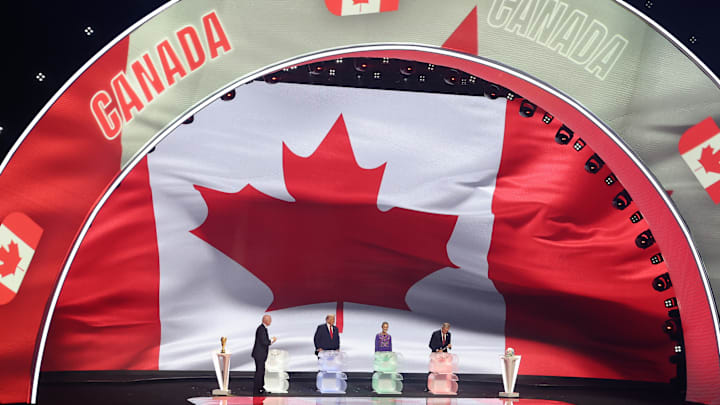
The Canadian men’s national team learned its 2026 FIFA World Cup group-stage opponents on Friday, as well as the path it could take to a deep run in the tournament.
As a tournament co-host alongside the United States and Mexico, Canada was placed in Pot 1 and avoided the best teams in the current FIFA World Ranking. Prime Minister Mark Carney and NHL legend Wayne Gretzky made selections.
However, Group B won’t be straightforward, with manager Jesse Marsch’s No. 27-ranked side joined by No. 17 Switzerland and No. 51 Qatar, as well as the winner of UEFA Playoff Path A, one of Italy, Wales, Northern Ireland or Bosnia and Herzegovina.
With their opponent for the June 12 opening match in Toronto yet to be determined, here are Sports Illustrated’s key takeaways from Canada’s World Cup Draw results.
A Challenging, Winnable Group

In a perfect world, Canada would have a group with at least two teams it is confident in beating. Instead, they will face a formidable opponent, Switzerland, in their final match, after playing a must-win clash against Qatar in the second game.
Group B shapes up with every team favored over Qatar, making the battle with the Swiss likely the most critical and decisive, especially given its status as the group stage finale, which could determine both teams’ paths.
It was also clear that things could have gone much worse. Marsch admitted he did not want to face Erling Haaland’s Norway and avoided them as well as challenging Pot 2 sides, such as Morocco and Croatia, among others.
“It's not the toughest, it's not the easiest,” Marsch said of the draw. “We're excited about the opportunity to play against these opponents ... we were confident in our team. Whoever we were going to draw, we were going to be ready for those games and know that we can beat anyone.”
Alphonso Davies is loving watching the World Cup draw... including seeing #CanMNT head coach Jesse Marsch on screen
— OneSoccer (@onesoccer) December 5, 2025
📹Twitch/Alphonso Davies pic.twitter.com/zQSa2AtSLu
So far, Canada's preparations have included matches against several sides ranked between 10th and 30th on the FIFA Ranking, similar to Switzerland. In six games against similarly ranked opposition in 2025, they have two wins, two draws and two losses.
“It’s not the best, it’s not the worst,” added Celtic and Canada right back Alistair Johnston. “When you’re a Pot 1 team in this expanded format, we were never going to get a group as we had in 2022, but at the same time, there’s some difficult teams here—it’s the World Cup.”
Will Jesse Marsch’s Canada Adapt to Low Blocks?

While Marsch would have preferred to have had every team in Group B determined, his analysts were already at work breaking down the two confirmed teams for the second and third matches of the tournament.
He confirmed that Canada had at least one friendly booked for March and despite not unveiling the nation, was confident it would provide an ample stylistic challenge to that of the World Cup opponents.
The official groups for the 2026 World Cup. Which is the best group? pic.twitter.com/ny09VUzK4h
— Sports Illustrated FC (@SI_FootballClub) December 5, 2025
Regardless of opposition, Canada will have to overcome their scoring woes, having scored just three in the final five games of 2025. Many of those issues come down to Canada’s reliance on counterpressing, and the fact that the approach to neutralize Canada is to sit in a low defensive block.
Marsch hasn’t been one to adjust heavily and has been adamant that he won’t. Still, the friendlies must show growth in their approach to defense, as the blueprint for making Canada uncomfortable is clear.
“In theory, these opponents like the ball," added Marsch. “So with us being very intense against the ball, it could be a good matchup for us. But there is still a lot of quality in the teams. We’ll have to do all of our preparation.”
Opening Game Strategy—Italy?

Canada won’t know its opening match opponent until the end of the March international window, but Italy remains the favorite to qualify out of UEFA Playoff Path A. As such, it raises the question: Is it better to get a strong team early in the group stage, or later?
At the 2022 World Cup in Qatar, Canada faced off against the No. 2-ranked Belgium in the first game and had plenty of scoring opportunities, largely outplaying the UEFA giants, before Alphonso Davies’s missed penalty and Belgium’s late breakthrough saw them lose 1–0.
While Italy has not been to a World Cup since Brazil 2014, they remain a world-class team and a side brimming with elite talent, even though they have struggled to reach their peak at the international level.
Which team will progress to face Canada in their opening #FIFAWorldCup 2026 match? 🇨🇦
— FIFA World Cup (@FIFAWorldCup) December 5, 2025
Canada v ___________? 💭 pic.twitter.com/1KxG8vJTXu
By playing a team like Italy, or other strong UEFA opposition such as Italy, Wales, Northern Ireland or Bosnia and Herzegovina to kick off the tournament, Canada could look to bank on their cohesive approach and tactical commitments, and potentially take advantage of a strong side that has yet to hit its peak.
“I think playing Italy would be outstanding,” said Marsch. “Especially the first game at home. I know that there would be a lot of Italian-Canadians at the match and they better root for Canada, that’s all I’m gonna say.”
READ THE LATEST WORLD CUP NEWS, PREVIEWS & ANALYSIS HERE
 Add us as a preferred source on Google
Ben Steiner is an American-Canadian journalist who brings in-depth experience, having covered the North American national teams, MLS, CPL, NWSL, NSL and Liga MX for prominent outlets, including MLSsoccer.com, CBC Sports, and OneSoccer.
Follow BenSteiner00