%20%20--%3E%0A%3Csvg%20version%3D%221.1%22%20id%3D%22Layer_1%22%20xmlns%3D%22http%3A%2F%2Fwww.w3.org%2F2000%2Fsvg%22%20xmlns%3Axlink%3D%22http%3A%2F%2Fwww.w3.org%2F1999%2Fxlink%22%20x%3D%220px%22%20y%3D%220px%22%0A%09%20width%3D%2239px%22%20height%3D%2240px%22%20viewBox%3D%220%200%2039%2040%22%20enable-background%3D%22new%200%200%2039%2040%22%20xml%3Aspace%3D%22preserve%22%3E%0A%3Cpath%20fill%3D%22%23FFFFFF%22%20d%3D%22M38.5%2C7H28.2v26h10.3V7z%22%2F%3E%0A%3Cpath%20fill-rule%3D%22evenodd%22%20clip-rule%3D%22evenodd%22%20fill%3D%22%23FFFFFF%22%20d%3D%22M26.1%2C25.5c0%2C5.8-4.1%2C7.5-12.9%2C7.5C3.9%2C33%2C0%2C31.2%2C0%2C25.2v-1.1h11.6%0A%09v2.4c0%2C0.7%2C0.1%2C1.4%2C1.2%2C1.4c1%2C0%2C1.2-0.4%2C1.2-1.3v-0.9c0-1.6-0.9-1.6-3.5-2.2C2.2%2C21.7%2C0%2C19.7%2C0%2C15.3v-0.9C0%2C9.3%2C5.5%2C7%2C12.9%2C7%0A%09c10.2%2C0%2C12.8%2C2.6%2C12.8%2C7.4v1.8h-11v-2.9c0-0.6-0.4-1.1-1.2-1.1c-0.6%2C0-1.2%2C0.4-1.2%2C1.1v0.9c0%2C1.5%2C0.9%2C2%2C3.3%2C2.5%0A%09c8%2C1.6%2C10.5%2C3.3%2C10.5%2C7.5V25.5z%22%2F%3E%0A%3C%2Fsvg%3E%0A)
Mikayla Blakes, Shea Ralph Have Turned Vanderbilt From an Afterthought Into a Contender
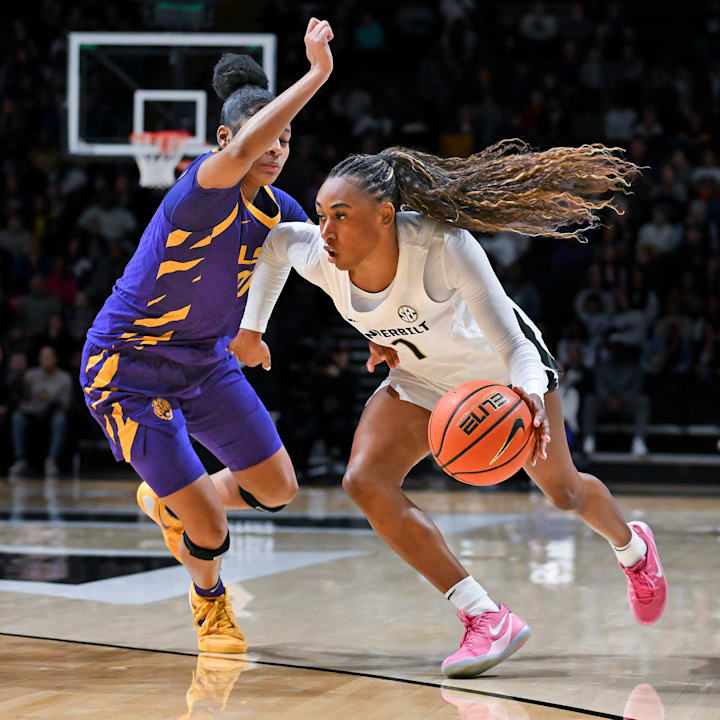
Early in January, grinning at the podium after the biggest win of her college basketball career, Mikayla Blakes said everything that was expected of her.
Describing how then-No. 12 Vanderbilt knocked off then-No. 5 LSU, the sophomore guard talked about getting stops, diving for loose balls, all the most reliable phrases in the basketball hustle dictionary. And then Blakes was asked if this was the reason she had come to Nashville, if she had wanted to be part of a win like this when she committed to Vanderbilt in 2024, and she pulled out something different.
“It’s a lot easier to go to, I think, top programs and just win,” she said. “I wanted to do the uncommon thing.”

Her language felt instructive. It was confident without being cocky and curiously precise. Blakes did not need to describe what she wanted as unthinkable or unprecedented: It was simply uncommon. Which applies, certainly, to a top prospect committing to a program that had gone nine seasons without qualifying for the NCAA tournament. It similarly applies to much of what she has done since.
Last year Blakes averaged 23.2 points per game en route to being named National Freshman of the Year. Over the summer at the Women’s AmeriCup, she led USA Basketball to victory over Brazil in the final and was named tournament MVP. And now, Blakes has pushed Vanderbilt to the best start in the history of the program, with sights on playing deep into March. The No. 5 Commodores have more than held their own in an increasingly tough SEC and remain a threat for a No. 1 seed.
Seated next to her at that January press conference was someone else with a taste for the unconventional. Commodores coach Shea Ralph had spent the majority of her adult life on staff at the most storied program in the sport, UConn, before deciding to leave for a tricky reclamation project. Five seasons later, Ralph has now made Vanderbilt, previously a perennial afterthought, into a legitimate title contender.
That’s a credit to Blakes, of course, who is on the short list as one of the best scorers in the country and currently leads Division I with 26.6 PPG. It’s just as much a credit to Ralph, the person who was able to sell the star player on a plan to overhaul the program culture and deliver a winning record.
“We have a vision and standards and values. I think, a lot of times, people read that and roll their eyes,” Ralph says. “But look at what it’s doing.”
Ralph did much of her growing as a player, coach and person at UConn. As one of the most lauded guards in the country, she captained the team to a national title in 2000, and as one of the most valued assistants to Huskies coach Geno Auriemma from ’08 to ’21, she won six more. That success is why people come to UConn. It’s also why many people feel they must stay at UConn.
“It’s a hard place to leave if you don’t want your own thing, your own program, your own imprint,” says Ralph’s husband, former NBA player Tom Garrick.

Eventually, however, Ralph realized that she did want all of that. But the idea that she would willingly go somewhere else was hard to fathom. During a practice in 2013, she turned to the Huskies’ hard-hustling, ever-prepared student manager, a senior named Kevin DeMille, and said that she would love to hire him when she became a head coach.
“I just thought, That’s the nicest thing in the whole world,” DeMille says. “But she’s not leaving.”
He could look up and see her name on the wall behind them. Ralph had been one of the most beloved players in school history and had become one of the most trusted members of the staff. But by the spring of 2021, she was frequently named among the most valuable assistants in the country, and it was no longer surprising that she would leave UConn. Yet it was certainly surprising that she would leave for … Vanderbilt. The program had not played in the NCAA tournament in seven years and hadn’t seen the Sweet 16 since 2009. Ralph was accustomed to annual Final Four trips with UConn. Vanderbilt had been just once—back in 1993 when Ralph was still in high school. But the decision felt clear to her. It had been shaped by a piece of advice she received from her boss.
Auriemma had told Ralph not to consider a job unless the athletic director shared her values and vision. Ralph had clicked immediately with new Vanderbilt AD Candice Storey Lee, a former basketball player for the Commodores, who made no secret of her desire to rebuild the program. There were a thousand ways in which this would be different from anything she had experienced at UConn. Ralph believed it was a difference worth exploring.
Just as she had said years ago, Ralph hired DeMille, and she decided to hire Garrick, too. (Her husband had previously been the women’s head coach at Rhode Island and at UMass Lowell, and was on staff at Vanderbilt from 2009 to ’15; Ralph had logged plenty of visits to Nashville back when their relationship was long-distance.) And then Ralph set about doing something that would be very unfamiliar to anyone coming from UConn: She had to lose.
Ralph had a long view of success. She pitched Lee on completely overhauling Vanderbilt women’s basketball over six years. The plan showed the attention to detail that made her a promising hire. It also showed that some degree of patience would be needed.

The process started with re-recruiting the players already on the roster. Ralph’s position as a longtime assistant meant her name held clout for coaches and for administrators but less so for young players. One of Vanderbilt’s top recruits, Sacha Washington, went to her high school coach with questions. “I was like, They hired this lady named Shea Ralph,” the forward remembers. “And he was like, Oh, then you’ll be perfectly fine.” The new coach wanted to be perfectly up-front about how much she would be asking from her players.
“She maintained the standard of, ‘This is the pace, this is how far we’re going to go, this is the level of physicality we’re going to do it with, this is the level of versatility we’re going to demand,’ ” DeMille says. “Knowing that the group of players we had maybe was not the group of players we were going to have five years from now. But we were preparing to coach the team we were going to have in five years.”
That first season began with grueling workouts in an unairconditioned gym (the practice facility was closed for summer renovations), a stifling heat that no one can forget even five years later. (“Almost like one of those storybook things,” DeMille says. “Just impossibly hot.”) It ended with a 16–19 record. That kind of losing was something that Ralph had not seen in high school or college or in the vast majority of her time as a coach: She had experienced it only briefly, in her first staff gig, which she held at Pittsburgh before moving back to UConn.
“I was so used to winning that I forgot what it felt like to handle a lot of losing,” she says. But those 16 wins were the most Vanderbilt had seen in six seasons. The coach finished out her rookie campaign with fresh confidence in her plans. And then everything changed.
The dawn of NIL made Ralph’s six-year timeline suddenly look quaint in the new context of Division I. But she wanted to stick with it.
“The landscape was changing, but that didn’t mean that we had to change who we are or how we operate,” Ralph says. “I still believed that we could win and be developmental, and I still was really committed to helping these kids grow. Because at the end of the day, yes, NIL is a thing, the transfer portal is a thing, college sports is still this huge business, but these are still kids.”

Ralph had never wanted to be anything other than a professional basketball player. And then she tore her ACL, and tore it again, and then tore the other. (She was drafted by the Utah Starzz in the third round of the 2001 WNBA draft but never appeared in a game.) Ralph did not want to build a program where a player like her might end up feeling totally lost as a person upon graduating.
There is not any naivete here about modern college hoops. Vanderbilt has a major NIL collective like any other Power 4 school. The university spent $300 million on a new basketball facility that opened last year with equal space for men and women. (“Down to the square inch,” Ralph proudly notes.) But in terms of money spent on its roster, Vanderbilt is not in the top third of the SEC, their coach has said. Ralph has not ignored the opportunities and resources. But she did not want them as the driving force of their program, either. She wanted to build a culture that could stand on its own.
So Vanderbilt kept cultivating that until the program finally positioned itself to recruit a player who might single-handedly change things. And Ralph & Co. knew that could be Blakes.
DeMille led the initial recruiting charge on Blakes and quickly picked up on two qualities in the five-star teen from Somerset, N.J. One was how clear she was on exactly what she wanted. The other was how similar that made her to Ralph.
“When you ask 15-year-olds questions about their basketball aspirations, you get a lot of the same kinds of answers,” DeMille says. “Mikayla blew me away from the jump.”
The guard was sure of herself in a way that still feels difficult for him to describe. She wasn’t given to bravado or sweeping declarations. But Blakes knew she needed to be at a strong academic school. She liked the idea of a program where she could help build something, and she loved the idea of that being a revival at a place with some history, rather than a completely blank slate.

“She just believes in herself in the way that Shea believes in herself,” DeMille says. “They’re really, really, really similar. They can get on my nerves in the same way. But with their confidence, they’re so similar in their belief and determination.”
In January 2024, Vanderbilt crumbled in the final minutes of a loss to Tennessee. Down the stretch, lost possessions and fateful errors piled up, and the Commodores were left with a game that no one player could take over. On the quiet bus ride afterward, Ralph’s phone buzzed with a FaceTime from Blakes. The staff wondered if she would share that she had committed somewhere else. She did not. Blakes had been watching the game and hoped it was one that she could help them win next year.
So almost exactly a year later, the unranked Commodores beat No. 15 Tennessee, 71–70, with 23 points and a buzzer-beating tip-in from Blakes.
Blakes changed just about everything for Vanderbilt. Her presence on campus immediately shifted expectations. But there was still plenty of work ahead.
The group did not always play like a cohesive unit last season. “There was a stretch where, if you found the right buttons to push, we’d need Mikayla to score 50 to win,” DeMille says. (She did indeed score more than 50 twice—breaking the D-I freshman scoring record for a single game with 55 points in a win over Auburn.) The chemistry could be remarkably uneven.
So could the results. Vanderbilt hit a rough stretch of conference play last February in which it dropped five out of seven. Ralph found herself unable to figure out what was wrong. “It wasn’t the winning and losing,” she says. “It was that I was struggling with our culture.”
The same attention to detail behind all of her planning can also lead to obsessive internalizing.

“She’s very introspective,” Garrick says. Which meant that when Ralph saw a chemistry issue among her players, Garrick says, “She didn’t look at them, she looked at herself. Like, ‘The example that I’m setting must be a little askew, and so how do I fix that?’ ”
Ralph ultimately settled on a few things. One was trusting herself more, even as the program drew notice and gained access to bigger recruits and, essentially, had opportunities to deviate from her original standards. Another was letting herself take more joy in the small victories that give a season texture. (Her approach came in part from a conversation with Vanderbilt football coach Clark Lea—who stopped by her office when he learned she was struggling and then stayed for more than two hours after she burst into tears when asked how she was doing.) The following month, Vanderbilt landed its highest NCAA tournament seed in more than a decade, at No. 7. It still lost in the first round. Then several players entered the transfer portal, including Khamil Pierre and Iyana Moore, the second- and third-leading scorers last season behind Blakes.
Still, Ralph liked the group she had going into the 2025–26 campaign. Sharpshooting recruit Aubrey Galvan was entering the program. Senior wing Justine Pissott was ready to step into a starting role. Washington was returning for her final season after missing last year with blood clots, and Blakes would be even more lethal as a sophomore. The squad’s energy immediately felt higher during summer workouts in Nashville.
“We’ve done a lot of things where I’ve been like, Oh, this is a different group,” Washington says. “We’re really locked in. We’re committed to what we want to do.”
The Commodores ranked in the bottom half of D-I programs for assist rate last year at 54%: That number has now shot up to 63%. Blakes’s skill development in areas other than scoring has unlocked more possibilities for the group. “Her commitment to being a better defender and rebounder has made our team better,” Ralph says. And the addition of Galvan as a ballhandler has allowed Blakes to be more creative off the ball. Opposing teams cannot simply clamp down on Blakes and no one else: There’s no longer much juice to the idea that Vanderbilt only wins if Blakes drops 50. “I just don’t think that we’re in a position anymore where that has to be the case,” DeMille says. Against then-No. 7 Michigan in January, Blakes was stifled for a season low of 14 points. It did not matter, because Galvan had 20 and the rest of the roster similarly stepped up for a 72–69 win.
That balance is critical. Blakes is scoring more (26.6 PPG) and assisting more (4.6 APG), while turning over the ball less, and racking up more boards (3.8 RPG) and steals (2.9 SPG) than she did as a freshman. And yet her load feels lighter. “A big part of Mikayla’s growth is remembering this is supposed to be really fun,” DeMille says. Ralph decided last year that she had to find more joy in the game. She made sure that spread to her best player.
Another victory in January was less impressive at a glance but just as meaningful. Vanderbilt handily beat unranked Missouri. With all five starters dropping at least 15 points in a conference win, the Commodores did something that had been accomplished just once in the last 25 years in the SEC, a kind of harmony that would have been unthinkable the year before.
There were just two undefeated teams left standing in D-I by late January. One was UConn, of course, as it has so often been over the last three decades. And the other was Vanderbilt. Ralph and Blakes knew that what they were after had never been impossible or singular or unthinkable. It was simply uncommon.
More College Basketball on Sports Illustrated
 Add us as a preferred source on Google
Emma Baccellieri was a staff writer focused on women’s basketball for Sports Illustrated. She previously covered MLB. She has also written for Baseball Prospectus and has been honored with multiple awards from the Society of American Baseball Research. A graduate of Duke University, she lives in Washington, D.C.
Follow emmabaccellieri