
This Week in High School Sports History: Future Pro Baseball Players Were Once Linked as Football Kicking Standouts
High school sports history is filled with remarkable moments that have mostly disappeared from the larger story of American sports. This Week in High School History looks back at significant, unusual, and sometimes forgotten events in high school athletics.
For the Week of Oct. 19-25:
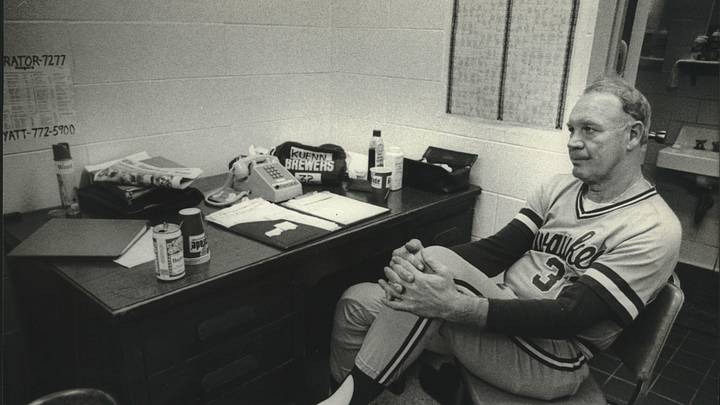
Long before Harvey Kuenn embarked on a Major League Baseball playing career that lasted 15 seasons, he was a three-sport standout at Milwaukee Lutheran (Wis.). He also appeared to set a state football record – until someone took a closer look.
On Oct. 23, 1948, Kuenn booted a 52-yard dropkick field goal as Lutheran defeated University High (Wis.), 24-14. Kuenn, also the team’s star quarterback, earned co-player of the week by the Wisconsin Associated Press for his performance.
News of Kuenn’s performance quickly spread. On Oct. 27, The Associated Press circulated a brief declaring his effort the longest in Wisconsin football that year at any level — professional, college or high school. Newspapers in Memphis, Tenn., Indianapolis, Philadelphia, Tampa, Fla., and as far away as Bangor, Maine, published the article.
There was one problem. Three weeks earlier, about 210 miles northwest of Milwaukee, Leonard VanDeHey had connected on a 58-yard dropkick in the final minute to give his Loyal (Wis.) team a 9-6 victory over Abbotsford (Wis.).
VanDeHey’s performance only came to light after Kuenn’s record-setting effort made headlines.
The oversight is understandable. VanDeHey played at a small school that received little media attention. Loyal, a town of about 1,000 residents, had a high school with fewer than 200 students. VanDeHey was one of just 46 students in his senior class.
The Associated Press released an article on Nov. 4 acknowledging VanDeHey’s kick and setting the record straight.
While both players gained attention for their football kicking exploits, baseball would shape their futures.
At first, it appeared that Kuenn and VanDeHey might even become college teammates. The multi-sport Kuenn chose to attend the University of Wisconsin, later focusing on baseball. VanDeHey, according to his 2019 obituary, turned down a football scholarship from Wisconsin to sign a professional baseball contract out of high school.
VanDeHey began his pro baseball career in 1950 as an 18-year-old with Class D Carthage. Kuenn, following his playing days at Wisconsin, turned pro in 1952 as a 21-year-old with Class B Davenport. The 1952 season was the only time the two played in the minor leagues simultaneously.
By the end of 1952, Kuenn had reached the majors with the Detroit Tigers. VanDeHey appeared poised to climb the professional ranks in 1956, batting .357 for Class A Albuquerque in the Western League. But he never advanced closer to the majors. After playing sparingly in 1957, he ended his professional career.
VanDeHey then returned to college where he starred for Wisconsin-Eau Claire’s basketball team and established several school records. VanDeHey ultimately became a high school teacher and coach, and even spent a few years at his alma mater.
Meanwhile, Kuenn turned to coaching following his Major League Baseball playing days, and ultimately guided his hometown Milwaukee Brewers to the 1982 World Series, the team’s only trip to the Fall Classic until this year.
Also This Week in History
Oct. 20
1945 – West Nottingham Academy found itself playing football on back-to-back days because of an administrative oversight — but all worked out as the Rams won both outings. The story goes like this: WNA’s 1944 coach Charles Remaley scheduled Baltimore Friends for Oct. 19, 1945. Remaley left WNA after the 1944-45 school year, and Paul R. Davis inherited the varsity program. Not realizing Remaley had scheduled an Oct. 19 contest, Davis locked down an Oct. 20 date with Massanutten Military Academy (Va.). West Nottingham Academy had little option when it realized the error. The school decided to honor both contracts and played on consecutive days. WNA defeated Baltimore Friends 24-6 and the next afternoon edged Massanutten 13-6 on its way to a 6-2 season.
1894 – Carl Squire of Hunting Valley University School (Ohio) delivered a performance that, albeit with an asterisk, could still be regarded as a national football record. He scored 28 extra points in University School's 100-0 season-opening win over Cleveland South (Ohio). Under the scoring rules of the day, touchdowns were worth four points and the ensuing conversion, if successful, was worth two. Squire scored nine touchdowns (36 points) and made 14 conversions (28 PATs) for 64 total points under 1894 rules. University played only four more contests that season, finishing 4-1. Over the last four games, Squire totaled five touchdowns and six goals, giving him 96 points.
Oct. 22
1921 – Cozad (Neb.) made high school football history, becoming the first documented team to appear on both sides of a 100-point game in the same season. North Platte overwhelmed Cozad 176-0 on Sept. 30, but Cozad turned the tables on Farnam with a 174-0 victory on Oct. 22. Cozad was not finished, however. On Nov. 5, it routed Overton 201-7.
Oct. 23
1926 – Gilford Skenadore of West DePere (Wis.) establishes a Wisconsin state record by converting 18 extra points in the team's 126-0 win over Kewaunee (Wis.). Skenadore also scored eight touchdowns, giving him 66 points in the contest.
1920 – In the early days of high school sports, matchups between high schools and college teams — often freshman or reserve squads — were not uncommon. The older, more experienced college players usually held the advantage, but not on this day in Bakersfield, Calif. Bakersfield High School routed San Luis Obispo’s freshman team 133-0 in a football game. George Williamson kicked 18 extra points, a mark that remains a California high school record, despite being set against a college opponent.
This Week in High School History is compiled by Sheldon Shealer, a sports historian and lecturer at Mount St. Mary’s University, whose research focuses on the history and development of American high school football. Shealer compiles entries from newspaper accounts, state and school records, historical publications, archival collections, and other documented sources. Special thanks to the National Federation of State High School Associations (NFHS), whose records help preserve high school sports history.
 Add us as a preferred source on Google

Sheldon Shealer is an award-winning sports journalist with more than 30 years of state and national high school sports coverage, which includes creating the Maryland high school football media state rankings and state records. His previous stops include editor positions with ESPN, Student Sports, The Frederick News-Post, and Hagerstown Herald-Mail, and time as a reporter with The Washington Post. He is also a professor of sports journalism at Mount St. Mary's University and a PhD candidate at Penn State University. He began contributing to High School On SI in 2025.