%20%20--%3E%0A%3Csvg%20version%3D%221.1%22%20id%3D%22Layer_1%22%20xmlns%3D%22http%3A%2F%2Fwww.w3.org%2F2000%2Fsvg%22%20xmlns%3Axlink%3D%22http%3A%2F%2Fwww.w3.org%2F1999%2Fxlink%22%20x%3D%220px%22%20y%3D%220px%22%0A%09%20width%3D%2239px%22%20height%3D%2240px%22%20viewBox%3D%220%200%2039%2040%22%20enable-background%3D%22new%200%200%2039%2040%22%20xml%3Aspace%3D%22preserve%22%3E%0A%3Cpath%20fill%3D%22%23FFFFFF%22%20d%3D%22M38.5%2C7H28.2v26h10.3V7z%22%2F%3E%0A%3Cpath%20fill-rule%3D%22evenodd%22%20clip-rule%3D%22evenodd%22%20fill%3D%22%23FFFFFF%22%20d%3D%22M26.1%2C25.5c0%2C5.8-4.1%2C7.5-12.9%2C7.5C3.9%2C33%2C0%2C31.2%2C0%2C25.2v-1.1h11.6%0A%09v2.4c0%2C0.7%2C0.1%2C1.4%2C1.2%2C1.4c1%2C0%2C1.2-0.4%2C1.2-1.3v-0.9c0-1.6-0.9-1.6-3.5-2.2C2.2%2C21.7%2C0%2C19.7%2C0%2C15.3v-0.9C0%2C9.3%2C5.5%2C7%2C12.9%2C7%0A%09c10.2%2C0%2C12.8%2C2.6%2C12.8%2C7.4v1.8h-11v-2.9c0-0.6-0.4-1.1-1.2-1.1c-0.6%2C0-1.2%2C0.4-1.2%2C1.1v0.9c0%2C1.5%2C0.9%2C2%2C3.3%2C2.5%0A%09c8%2C1.6%2C10.5%2C3.3%2C10.5%2C7.5V25.5z%22%2F%3E%0A%3C%2Fsvg%3E%0A)
For Sydney Sweeney, Playing Christy Martin Was More Than Just a Movie Role. It Was a Responsibility.
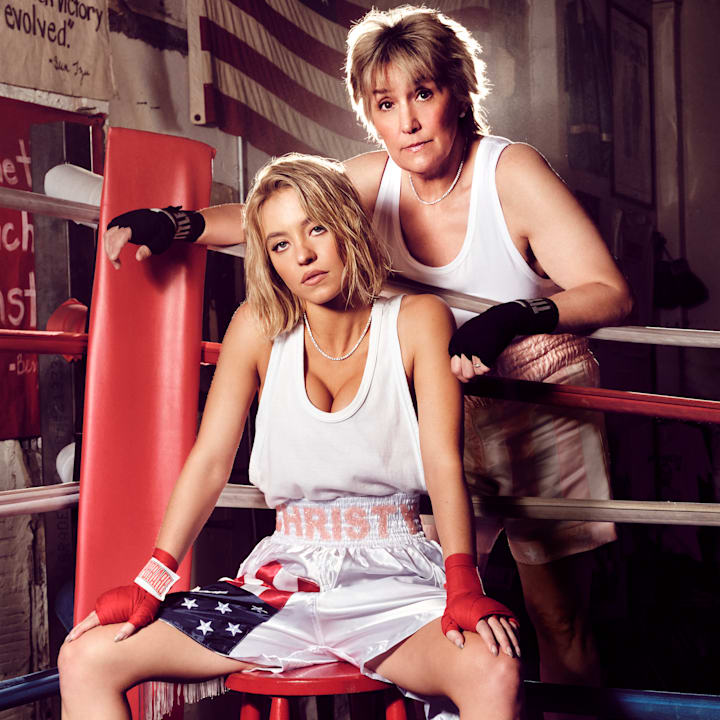
Christy Salters Martin is not enjoying this press tour.
There are moments of joy, of course: She likes seeing the country, although she did a lot of that as the most famous female boxer of her generation. She chuckles as her Pomeranian, Champ, earns his executive platinum status on American Airlines and appreciates it not at all. She loves watching rooms react to Sydney Sweeney, in part because after so long in the spotlight, Salters Martin, 57, now gets to observe from the shadows. But honestly, after something like two weeks in half a dozen cities—she’s lost count—what she wants to do more than anything is go home. Not to Apopka, Fla., where she and her wife, fellow former boxer Lisa Holewyne, live a five-minute drive from where Salters Martin’s then husband tried to kill her. She wants to go back to rural West Virginia, where she grew up, and where all this started.
“They’re like, ‘You want to do The Drew Barrymore Show with Sydney?’ ” she says. “I’m like, ‘No. I’m going home. I’m going to my people. It’s important to me.’ ”
She has only seen Christy—the biopic of her life that stars Sweeney (now available on demand, wherever you buy or rent movies)—three times at this point: once with Holewyne alone in the home theater of the head of the production company, once at the Toronto Film Festival and once with “my people in Orlando.” At the special premiere at Marquee Cinemas in Beckley, W.Va., 40 minutes from her hometown of Itmann, Salters Martin asked that there not be a Q&A after the screening; she says she doesn’t trust any of her high school classmates with a microphone. “They knew me when I was doing crazy s--- as a kid,” she says with a laugh.

Her relationships with people from her early days are complicated. Her mother, Joyce, and brother, Randy, have both died, and she is not sure her father, Johnny, will see the movie. Tears flick in her eyes and she falls silent as she thinks about the possibility of giving him a hug. Not everyone from home understood her or accepted her. But at least they knew her back when she was Christy Salters, before she became Christy Martin and eventually Christy Salters Martin.
She thinks the next viewing might be the last time she watches the movie. She is anxious to see which new details will reveal themselves.
“When I watched it in Toronto, I said to Lisa, ‘But these scenes weren’t in there when we watched it at [the last screening]!’ ” Salters Martin says. “She was like, ‘Yes, they were.’ So I think my brain just shut down and protected me a little bit.”

That’s probably for the best. In addition to her rise to boxing glory, Christy depicts the domestic violence she survived, sometimes lingering on moments of graphic brutality. Salters Martin signed off on it because, she says, as she was lying in the hospital bed after Jim Martin’s final and most savage attack, she made a deal with God: If you let me live, I’ll help one person before I leave this earth.
“And then, arrogant ass, I said, ‘I’ll help one person every day,’ ” she says wryly. “So I’m trying my best.”
So she wakes up every day, stands in front of a crowd of people who think they know her and relives the worst moments of her life.
The first thing that caught Sweeney’s attention about Salters Martin’s story was that she hadn’t already heard it. Director David Michôd sent her the script in March 2024 and she read it while on a flight to Barcelona.
“I was very surprised I didn’t know who she was,” says the 28-year-old Sweeney.
And indeed, as popular as women’s sports and true crime are, it seems impossible that Salters Martin’s life hasn’t broken through into the public consciousness. After picking up the sport on a dare, she spent a decade as the best and most famous female boxer on the planet. She had everything fans wanted: the nickname (the Coal Miner’s Daughter), the look (she fought in pink) and the attitude (she was cute but talked trash). She walked into trainer Jim Martin’s gym in 1990 with her mother and her Pomeranian, Casey. He considered having her ribs broken to get her out of there but eventually saw a money-making opportunity—and a work ethic that compared favorably to most of the men he’d trained. He persuaded her to marry him a year later, when she was 22 and he was 47. In 1993, she became the first woman to sign with legendary promoter Don King.

Her 1996 hard-fought battle against Ireland’s Deirdre Gogarty—on the undercard of a championship bout between Mike Tyson and Frank Bruno on Showtime—got more attention than the main event. Her face shining with blood from a shot to the nose, Salters Martin won in a six-round unanimous decision; a month later, having already toured The Tonight Show and Today, she was on the cover of Sports Illustrated, mean-mugging in her pink shorts, THE LADY IS THE CHAMP headline introducing her to anyone who hadn’t taken note yet.
But like everyone else, we got the story wrong. The public believed her marriage, while its age gap was unorthodox, was a charming detail in the tale of her rise. SI ran a photo of her vacuuming the carpet at their home and quoted Jim insisting they were smitten with one another: “I’m old-fashioned, I admit it,” he said. “But some things you just can’t stop.” Time lamented that she was “a disappointment to feminists” because “she doesn’t believe strongly in women’s rights.” The New York Times called Jim “her Béla Károlyi”—and meant it as a compliment.
Sports fans loved it all. After seven decades of all men, the amateur New York Golden Gloves tournament added a women’s category in 1995. Boxing gyms began holding coed classes. A USA Network poll of boxing fans around the time of the Gogarty fight found that 80% wanted to see more women’s boxing.

Meanwhile, Jim was monitoring Christy’s phone calls. She would go to Walmart, turn and find him standing beside her in the aisle. She would get her hair cut, and he’d be in the chair next to hers. He got her hooked on cocaine and videotaped the sexual acts he demanded she perform while on it. He beat her up at home and knocked her out sparring at the gym. He drowned her pup Casey. He had told her he’d make her the best female boxer in the world, and she’d believed him. Now he told her that he’d kill her if she left him, and she started to believe that, too. After one of his beatings, she left a few drops of blood in the bathroom and told a friend to send the police there for evidence when he eventually murdered her.
She had never loved him. She was gay, and he knew it. In fact, he’d been the one to out her to her beloved father as a tactic to pressure her into marrying him. (It worked: The next day they were at city hall.) Jim encouraged her to cut prefight promos calling her opponents homophobic slurs and to decry what he called “manly type women.” In 2010, she reconnected with her high school girlfriend, Sherry Lusk. As she opened up to Lusk, Christy felt strong enough to tell Jim she wanted a divorce. Jim seemed receptive to the idea; they agreed to live together until her next fight. But after she met Lusk for lunch, Jim threatened to send explicit videos of her to everyone she knew. When the two women met at a hotel a few days later, he called and told Christy he had followed her and was in the parking lot.
The next afternoon, she returned to their home in Apopka. She was midway through putting on her sneakers when Jim, fresh off calling everyone he could think of to tell them she was a lesbian and a junkie, sauntered into their bedroom and stabbed her four times with a nine-inch Buck knife. The blade was so sharp she didn’t feel it at first. He sliced at her leg, tearing eight inches of her left calf muscle almost off the bone. When she tried to fight back, he smashed her head into the side of the dresser, then left to treat the gash he’d torn into his own hand. He came back to check on her a few times, and, annoyed that she was still alive, produced a gun—her gun.
“You can’t f------ kill me!” she roared.
He pointed the pink barrel of the 9mm handgun at her chest and shot her three inches from her heart.

As she bled out, she begged him to call 911. He smirked, removed the battery from her cellphone and made her watch as he disconnected the landline. No one was coming to save her.
She thinks she must have passed out then, which convinced him that she was dead, so he left to take a shower. When she heard the water running, she realized this was her only chance. As the blood gurgled from her collapsed left lung and that calf muscle swayed, she dragged herself out of the house and into the street, wearing only her left Nike, where a passing motorist picked her up. As they raced to the hospital, she apologized for bleeding on his seat.
She spent seven days in the hospital, during which time the police found and arrested Jim. On the eighth, she returned to the gym. A little over six months later, with a bullet still lodged in her back, she climbed into the ring for a fight. She was 50 seconds from her 50th win when the ringside doctor saw her wincing every time she used her right hand and stopped the fight. She was rushed into surgery to repair the nine bones she had broken, and she had a stroke on the table.
Naturally, 14 months later, she was back in the ring. She never did win another bout, but she stood there and took every punch. And once she retired, she decided to fulfill her end of the bargain she’d made with God in that hospital bed. She put her Concord College education degree to use as a substitute teacher, and she took on a second job helping veterans and disabled adults find work. She began speaking to anyone who would listen about domestic violence. She started her own boxing outfit, Christy Martin Promotions. Whenever she could, she started going by both her maiden and married names—Christy Salters Martin. She wanted to erase Jim, but she didn’t want to erase the person she’d become when she was with him. (For his part, in 2012, Jim was convicted of attempted second-degree murder with a firearm and aggravated battery, and he was sentenced to 25 years in prison. Up until he died in November 2024, he continued to insist he hadn’t committed the crime.)

After Sweeney was cast, she devoured Salters Martin’s history—reading her autobiography, watching old videos and so closely mimicking her mannerisms that eventually even Salters Martin would do a double take. Sweeney wondered what kind of person could have survived all this. Surely a life of such pain would produce a bitter, closed-off woman, slow to engage with the world around her.
“When I actually got to meet her and get to know her, it’s so inspiring to see how caring and delightful and full of happiness and joy that she is, even though she’s overcome so much,” Sweeney says. “The person she is now—it reminds me that no matter what happens, if you always lead with kindness, then you’re on the right path.”
This no longer felt like just a film project. It felt like a responsibility.
“I definitely felt the weight of the importance of Christy’s story,” she says.
After years of smaller roles, Sweeney burst onto the scene in 2019 as a lead character in the HBO drama Euphoria, then picked up more fans with her performance in the network’s The White Lotus, earning Emmy nominations for both. In 2020, she founded her own production company, Fifty-Fifty Films, and continued to cement her star status by hosting Saturday Night Live in March 2024. She’s also been the subject of multiple online controversies; they seem to follow her. Recently, Sweeney's American Eagle jeans ad was accused of being tone deaf, sparking a debate on politics, race and beauty standards. (Her standard response during the Christy press tour to questions about that issue was that she was excited to talk about Salters Martin. Later, in a December interview with People, she said, "I’m against hate and divisiveness.") Sweeney knew that her status as a person who draws social media posts from the president and weeks of discourse on cable news could offer a level of publicity to Salters Martin that another actor could not. “I knew that even if I couldn’t be in it, I wanted to produce it,” she says. “I wanted to use my platform to [draw attention to her].”
Salters Martin wants that too, of course. It’s why she said yes as producers bandied about telling her story. But after a decade or so of this, she doubted anything would come of it—until, early in 2024, she got a call from Black Bear Pictures: They were interested. And six weeks later, another call: Sydney Sweeney was attached. Suddenly everything sped up.
Salters Martin barely had a chance to reflect on what this would all really mean for her. She had spent so long as a person people thought they knew, and she’d just reclaimed her story, participating in a 2021 Netflix documentary, Untold: Deal with the Devil, and writing her ’22 autobiography, Fighting for Survival: My Journey through Boxing Fame, Abuse, Murder, and Resurrection. Now she would have to cede control of the narrative to writers, directors, actors and countless others—and, of course, the journalists who would write about all of it.
“It’s hard to trust people,” she says. “You have to really listen.”
She liked Michôd and writer Mirrah Foulkes right away, she says, and she felt safe with the actors, including Ben Foster, who plays Jim, although he was so convincing that she couldn’t spend time around him on set. Once she ran into him unexpectedly and cussed him out. “I told myself, That’s not Jim Martin. But he was Jim Martin,” she says. And, perhaps most important, she believed in Sweeney. “I trusted Sydney,” she says. “This is a very challenging role for an actor, but I think she also sees it’s important to the world.”

It was easy for Salters Martin to see what she would gain. She is still coming to terms with what she is losing.
As a boxer, she cloaked herself in bravado every time she pulled on her gloves. She once knocked out an opponent and then spat on her. In 1995, promoting the undercard for a Tyson–Buster Mathis Jr. fight, she announced from the dais, “I’ll open the show, and Mike will close it.” In 2001, at the weigh-in before their fight, Holewyne said, “Good luck, Martin,” and Salters Martin sneered back, “Good luck getting knocked the f--- out.” Even today, some of that swagger still leaks out when she’s on comfortable turf. As she conducts a video interview with SI at the center of a boxing ring, she is asked about UFC. “Ronda Rousey is not a very good fighter at all,” she scoffs. “She uses a lot of hype and media behind her.”
That’s Christy Martin. Christy Salters Martin is a woman who, in the car on the way to the photo shoot, insists to her cousin, Kelley Dunbar, “This isn’t about me. This is about Sydney.” (She is unmoved by the point that the movie is not called Sydney.) A stylist has brought in a dozen outfits and asks her to choose her favorite; Salters Martin says she’ll wear whatever looks best with Sweeney’s choice. During the shoot, Salters Martin can’t figure out which direction to tilt her head. The stroke has affected her balance, and she is afraid she will topple over in the high heels. She is visibly relieved when it’s over.
“Christy Martin was definitely a persona that I’d like to be!” she says. “But who I really am is different.”
Sweeney was attracted to the challenge of playing a character who is herself, at times, playing a character. And she saw a kinship there.
“The perception is that the media version of who you are is who you actually are,” Sweeney says. What do people get wrong about her? “A lot of things,” she says. She declines to elaborate.
Well, perhaps one is how her body features in her work: She is often cast as more of a ring girl than a boxer. Last year, amid worldwide commentary on her figure, she told Variety that the discussion was “this weird relationship that people have with me that I have no control or say over.”

Christy offered her a chance to look like a very different person. Sweeney says she loved adding 30 pounds for the role. She built a boxing gym in her grandmother’s shed, near where she grew up in the Idaho panhandle, and spent hours there daily for two and a half months.
“I knew that if I kept training in L.A. or anywhere else, people would start taking photos of me,” she says. “I wanted to go home. I could disappear, not worry about the outside world and just fully immerse myself in it.” She knocked back creatine, Uncrustables and protein shakes. She had dabbled in MMA, kickboxing and grappling as a child; in shooting the film, she rarely used a stunt double. “I wanted to actually fight,” she says.
And she did. She iced herself daily; she suffered nosebleeds and even a concussion. Each fight scene mirrors one of Salters Martin’s exactly, punch for punch. But that didn’t stop her from occasionally shouting suggestions to Sweeney. “Get her with the left hook!” Salters Martin roared one day. Sweeney burst out laughing. “Christy!” she said. “You know the left hook is coming!”
Sweeney is most engaged now when she talks about boxing itself. “I loved it,” she muses. At one point she threatens to quit acting entirely for a year and just train with Salters Martin. “You think I’m joking,” Sweeney says. Her favorite part, she says, is “the element of surprise. It feels like a superpower.”
She and Salters Martin grew close during their time together on set—Sweeney refers to them as “besties”—but that’s one place they differ. Did Salters Martin like surprising people? “No,” she says. “I liked knocking people out.”
On the flight to New York, Salters Martin finally found a moment of silence, and something occurred to her. She had spent so much of her life promoting fights. Sometimes King would have her in three cities in one day. And she enjoyed those travels, because she got to be Christy Martin, warrior. The press tour was starting to feel like a slog. Every day she was Christy Salters Martin, survivor.
“I had a different realization,” she says. “This is about my life, and I need to approach it more like it is a fight and be happy to promote it.”
She adds, “What I want to do is stand in the background. What I want to do is go to shelters and schools and jails and talk to people.”
Doing all this, though, allows her to do all that. The publicity puts her in front of people who would never have heard of her otherwise—people like Sweeney.

After the movie made only $1.3 million in its opening weekend, Sweeney posted to Instagram: “If Christy gave even one woman the courage to take her first step toward safety, then we will have succeeded.” She added, “We don’t always just make art for numbers, we make it for impact. And Christy has been the most impactful project of my life.”
And the strategy is working. Sweeney and Salters Martin have both heard from people who say the movie made them rethink a relationship. Typically these are strangers. But recently, Salters Martin got a text that made her gasp. It was from someone who was in the movie.
“I can’t tell you what the message said,” she says. “But we saved a life.”
 Add us as a preferred source on Google
Stephanie Apstein was a senior writer covering baseball and Olympic sports for Sports Illustrated, where she started as an intern in 2011 and has since covered a dozen World Series and three Olympics. She has twice won top honors from the Associated Press Sports Editors, and her work has been included in the Best American Sports Writing book series. She graduated from Trinity College with a bachelor’s in French and Italian, and has a master’s in journalism from Columbia University.
Follow stephapstein