%20%20--%3E%0A%3Csvg%20version%3D%221.1%22%20id%3D%22Layer_1%22%20xmlns%3D%22http%3A%2F%2Fwww.w3.org%2F2000%2Fsvg%22%20xmlns%3Axlink%3D%22http%3A%2F%2Fwww.w3.org%2F1999%2Fxlink%22%20x%3D%220px%22%20y%3D%220px%22%0A%09%20width%3D%2239px%22%20height%3D%2240px%22%20viewBox%3D%220%200%2039%2040%22%20enable-background%3D%22new%200%200%2039%2040%22%20xml%3Aspace%3D%22preserve%22%3E%0A%3Cpath%20fill%3D%22%23FFFFFF%22%20d%3D%22M38.5%2C7H28.2v26h10.3V7z%22%2F%3E%0A%3Cpath%20fill-rule%3D%22evenodd%22%20clip-rule%3D%22evenodd%22%20fill%3D%22%23FFFFFF%22%20d%3D%22M26.1%2C25.5c0%2C5.8-4.1%2C7.5-12.9%2C7.5C3.9%2C33%2C0%2C31.2%2C0%2C25.2v-1.1h11.6%0A%09v2.4c0%2C0.7%2C0.1%2C1.4%2C1.2%2C1.4c1%2C0%2C1.2-0.4%2C1.2-1.3v-0.9c0-1.6-0.9-1.6-3.5-2.2C2.2%2C21.7%2C0%2C19.7%2C0%2C15.3v-0.9C0%2C9.3%2C5.5%2C7%2C12.9%2C7%0A%09c10.2%2C0%2C12.8%2C2.6%2C12.8%2C7.4v1.8h-11v-2.9c0-0.6-0.4-1.1-1.2-1.1c-0.6%2C0-1.2%2C0.4-1.2%2C1.1v0.9c0%2C1.5%2C0.9%2C2%2C3.3%2C2.5%0A%09c8%2C1.6%2C10.5%2C3.3%2C10.5%2C7.5V25.5z%22%2F%3E%0A%3C%2Fsvg%3E%0A)
Cal Raleigh Is SI’s 2025 Breakout Star of the Year
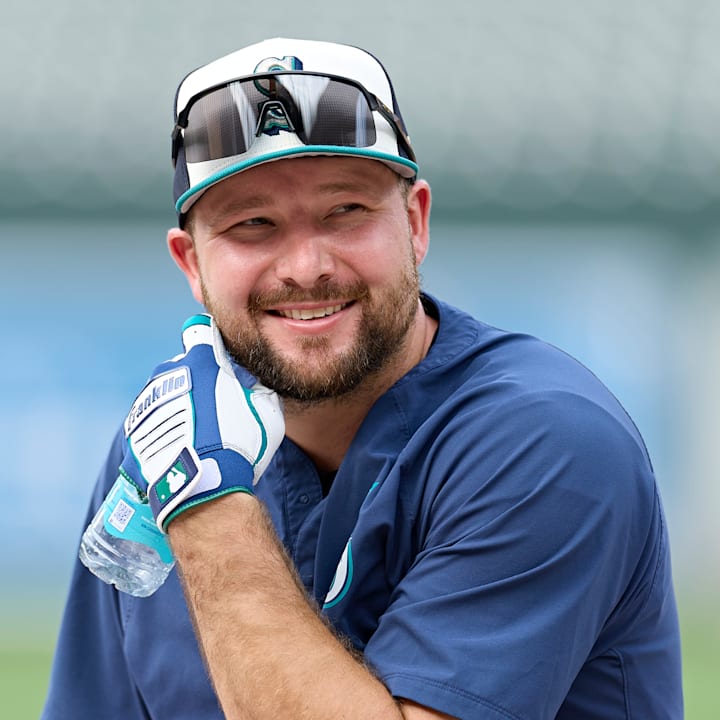
The pitch was a low dart, zipping angrily toward the very bottom of the strike zone at 98.3 mph. It was 20 inches off the ground when it arrived. Cal Raleigh had never hit a home run off a fastball that low in his five major league seasons.
Raleigh swung. He knew just what to do, thanks to a man sitting 20 rows behind the plate at T-Mobile Park on this September evening. Todd Raleigh, his dad, was wearing a Mariners cap and, like everybody else in the ballpark, was on his feet on the chance baseball history was about to happen. Cal’s mother, Stephanie, stood next to Todd. Their son was sitting on 59 home runs.
“Nose and barrel,” Todd would tell Cal in the batting cages of Western Carolina University, where Todd was the coach and Cal was a bat boy from ages 8 through 10. “Nose and barrel. Keep your nose and barrel as far apart as possible.”
“My dad,” Cal says, “was always a proponent of extension. Power comes from extension. It comes from staying behind the ball and getting the barrel in front. That’s how you drive the ball. That’s how you get the ball in the air.
“That was just something he always taught. It’s been the key for me and one of my pillars as far as what makes me successful as a hitter.”

Batting left-handed against Rockies pitcher Angel Chivilli, Raleigh, a switch-hitter since he started to walk, connected with the low pitch. He extended so far through the baseball, maximizing the distance between his nose and barrel, that he could no longer keep his top hand on the bat. He held on with one hand as the barrel whipped around and above him. History was on its way to the right-field seats.
Never did baseball see a historic home run hitter emerge the way Cal Raleigh did in 2025. He became the seventh player to hit 60 home runs in a season. He is the first switch-hitter and first catcher to do so and, at 28 years old, the second youngest. (Only Roger Maris, 26 in 1961, was younger.)
Raleigh blew past his previous career high in home runs, 34 in 2024, on the Fourth of July. He also led the American League in RBI, caught the most innings in the league (without a passed ball) and led Seattle to its first division title in 24 years and within one win of reaching the World Series for the first time in franchise history.
Throw in his championship in the All-Star Home Run Derby with its backyard vibe (his father pitched to him and his little brother caught); his Everyman appeal fostered by his humility; his dad bod and a nickname people could not stop saying with a smile on their face—“The Big Dumper,” an homage to the ample backside of that dad bod; and Raleigh is the winner of Sports Illustrated’s Breakout Star of the Year Award.
“It’s a super cool award,” Raleigh says. “It’s not just a baseball award. It’s encompassing all athletes. And there’s a lot of great, great ones out there. It’s very humbling.”
There is something Raleigh wants you to know about what it took to win this award. This was not a one-year breakout. Raleigh was never the chiseled, best-in-show, can’t-miss prospect who you expect to be the kind to hit 60 home runs. He is the first drafted player who was not a first-round pick to hit 60, a distinction he wears proudly. This is someone who was cut from his middle school baseball and basketball teams. He was a catcher who was not permitted to hit in his first year of high school ball because the coach used the DH for him, not the pitcher. He was told he was a Division III player, not Division I, was ranked by the Mariners behind 378 players in his draft class, and when he did reach the big leagues he was platooned with Tom Murphy, a career .239 hitter, because the team thought he could not hit right-handed.
“First things first,” Raleigh says. “Those hitting sessions with my dad? They weren’t always great. I think that’s the thing a lot of people always assume—that you’ve always been this really good baseball player, a really good hitter and you’ve always been super talented.
“I don’t think that’s necessarily true. It was a lot of hard work. A lot of time in the cages. It’s thousands and thousands and thousands of balls thrown and drills. It’s learning and relearning. It’s the ups and downs. That’s the cool part about this. I get to share it with my dad.
“My big league career so far and having him in the Home Run Derby is a cool part of it. But what you don’t see are all the failures and tough times and occasions I spent with him that helped me get through.”

Todd Raleigh taught his son how to switch hit as soon as the boy could stand. Cal was still in diapers, between 12 and 18 months old, when his father put an oversize, red plastic bat in his hands and showed him how to grip it. Todd flipped plastic balls underhanded for him to hit. Then he would pick up Cal, turn him around, change his grip and repeat the drill from the other side.
“Never just a day or a week or a year,” Todd says. “It was always the same every day. I never wanted my boys to think in the back of their head they were better on one side than the other.”
Todd played at Western Carolina from 1988 to ’91 and had two stints (1993–94 and 2000–07) coaching the team. The Raleighs lived in the shadow of the school’s ballpark in Cullowhee, N.C., a mountain valley town of 7,300 people and 3 ½ square miles. Little Cal suited up in a Catamounts jersey as a bat boy. He was in sixth grade when he was cut from the middle school basketball and baseball teams.
“They basically told me not even to bother to try out for the baseball team,” he says. “I was one of the younger ones, but it was a tough year. I look back and a lot of that stuff I’m thankful for now. I even go back to freshman year. I would get hit for. That’s part of it, too. It’s about not getting what you want but learning and growing from it and using it as fuel.”
A college coach told him, “You’re never going to be a Division I catcher. You’re a D-III player.”
Says Raleigh, “You don’t forget those things. Those are the kind of things that drive you.”
Raleigh worked his way to Florida State, where he followed a solid freshman season with a down sophomore year in which he hit .227 and did not play summer ball. Scouts soured on him as he entered his draft year, 2018. That year the Mariners for the first time cooked up a statistical model to evaluate draft prospects. They rated Raleigh at No. 379. But their area scout in north Florida, Rob Mummau, knew that Raleigh had played through an injury to his index finger that sapped his power. It also was the reason Raleigh skipped summer ball. Mummau rated Raleigh’s power as a 70 on the traditional scale on which 80 is the ceiling. Most scouts had Raleigh at 55 or 60 at best. Mummau had gotten to know the Raleigh family well. He filed glowing reports on the .227 hitter.
“I got off to a little bit of a slow start as a junior,” Raleigh says. “Some scouts were writing me off. I ended up coming on strong toward the end of my junior year.”
Raleigh had no idea Mummau was pushing him to the Seattle front office when he sat down to watch the first round of the draft. The Mariners finally took him in the third round. Eighty-nine players were drafted ahead of him, including five catchers, starting with the No. 2 overall pick, Joey Bart of Georgia Tech, picked by the Giants. Raleigh signed for $854,000.
“In the grand scheme of things, I got picked in a great spot,” Raleigh says. “I wouldn’t change it for anything in the world, but right at the time, as somebody getting drafted, you want to go as high as possible.”

Raleigh made his big league debut in the second half of 2021. Over his first three full seasons he hit .222 but also smashed 91 homers, including a 2022 walk-off to clinch a playoff spot, and won a 2024 Platinum Glove as the best defender in the American League. The Mariners saw the value of a switch-hitting, 30-homer catcher with elite defense and signed Raleigh to a six-year, $105 million extension in March 2025. “They took me in from Day One with kindness and respect,” Raleigh said in a statement upon the signing.
What the Mariners didn’t know they were getting was a 60-homer slugger. Neither did Raleigh. “I know that the power is there and I’m a strong guy and that’s my game,” Raleigh says. “But ultimately my goal going into the season was just to have better at-bats, sneak out another base hit here or there, another walk here or there.
“Besides that, my goal was ultimately becoming a better leader. Trying to find a way to slow the game down, help our staff, anything to help us win more games and get into the postseason.”
By June it was apparent that Raleigh was building something special. In one stretch he hit 20 home runs in 37 games. He had 38 homers at the All-Star break.
There were no swing changes. No crazy drills. Like a classical pianist, Raleigh had built success on the relentless pursuit of technique. It was all the years of working to create distance between nose and barrel. The most telling leap in Raleigh’s hitting profile can be found in how often he hit balls in the air to the pull side. It jumped from 29.5% in 2024 to 38.4% in 2025, the second highest rate in baseball. When he did hit a fly ball to the pull side, it went out of the park more than half the time (45 of 85 or 53%; the major league average is 38%).
“I think it’s just one of those things where you learn about yourself over the years of being in the big leagues,” he says. “You learn who you are as a player and you learn an approach and what kind of puts you in the right headspace, mentally and physically, to go out there and put a good swing on the ball.
“So, ultimately, it wasn’t this massive overhaul or physical change. It was just that I was more committed and more locked into my approach than I was in the last couple of years.”
Says Seattle manager Dan Wilson, a former catcher, “What he does behind the plate every day, prepping for games, handling a staff, the wear and tear, the hundreds of foul balls ... it’s amazing. Then you add 60 home runs on top of that. Amazing. But what people should know about Cal more than anything else is what drives him: winning. Everything he does is driven by winning.”
The Mariners trailed the Astros by 3 ½ games in the AL West with 21 games to play. Raleigh hit nine home runs in the next 17 games. Seattle won 16 of those 17 games, the last of which clinched the division title. It was the night Todd and Stephanie were sitting behind home plate in Seattle to watch history arrive.
On his first swing of the night, Raleigh unleashed just about as perfect a swing as he could take. He hit a home run into the upper deck at T-Mobile Park for the first time in his career, joining only seven others who reached those hinterlands in the 26-year history of the ballpark. It was home run No. 59.
His last swing of the night produced No. 60, a home run made possible only by the distance between his nose and barrel. As he rounded first base and saw the ball go out, he could not suppress the smallest of smiles. He jogged quickly and routinely around the bases, same as always.
Three hits. Two home runs, one in the upper deck, the other No. 60. A 9–2 victory. A division title. Mom and Dad watching him.
“I just remember,” he says, “how kind of perfect the night was. I mean, how much more perfect can it get than this?”
Just before he reached the dugout, Raleigh turned and raised his right arm toward the seats behind home plate, about 20 rows back. Then the son waved to his parents, same as if it were years ago, back at a Little League game in Cullowhee, where 60 all began.
More MLB on Sports Illustrated
 Add us as a preferred source on Google
Tom Verducci is a senior writer for Sports Illustrated who has covered Major League Baseball since 1981. He also serves as an analyst for FOX Sports and the MLB Network; is a New York Times best-selling author; and cohosts The Book of Joe podcast with Joe Maddon. A five-time Emmy Award winner across three categories (studio analyst, reporter, short form writing) and nominated in a fourth (game analyst), he is a three-time National Sportswriter of the Year winner, two-time National Magazine Award finalist, and a Penn State Distinguished Alumnus Award recipient. Verducci is a member of the National Sports Media Hall of Fame, Baseball Writers Association of America (including past New York chapter chairman) and a Baseball Hall of Fame voter since 1993. He also is the only writer to be a game analyst for World Series telecasts. He lives in New Jersey with his wife, with whom he has two children.