%20%20--%3E%0A%3Csvg%20version%3D%221.1%22%20id%3D%22Layer_1%22%20xmlns%3D%22http%3A%2F%2Fwww.w3.org%2F2000%2Fsvg%22%20xmlns%3Axlink%3D%22http%3A%2F%2Fwww.w3.org%2F1999%2Fxlink%22%20x%3D%220px%22%20y%3D%220px%22%0A%09%20width%3D%2239px%22%20height%3D%2240px%22%20viewBox%3D%220%200%2039%2040%22%20enable-background%3D%22new%200%200%2039%2040%22%20xml%3Aspace%3D%22preserve%22%3E%0A%3Cpath%20fill%3D%22%23FFFFFF%22%20d%3D%22M38.5%2C7H28.2v26h10.3V7z%22%2F%3E%0A%3Cpath%20fill-rule%3D%22evenodd%22%20clip-rule%3D%22evenodd%22%20fill%3D%22%23FFFFFF%22%20d%3D%22M26.1%2C25.5c0%2C5.8-4.1%2C7.5-12.9%2C7.5C3.9%2C33%2C0%2C31.2%2C0%2C25.2v-1.1h11.6%0A%09v2.4c0%2C0.7%2C0.1%2C1.4%2C1.2%2C1.4c1%2C0%2C1.2-0.4%2C1.2-1.3v-0.9c0-1.6-0.9-1.6-3.5-2.2C2.2%2C21.7%2C0%2C19.7%2C0%2C15.3v-0.9C0%2C9.3%2C5.5%2C7%2C12.9%2C7%0A%09c10.2%2C0%2C12.8%2C2.6%2C12.8%2C7.4v1.8h-11v-2.9c0-0.6-0.4-1.1-1.2-1.1c-0.6%2C0-1.2%2C0.4-1.2%2C1.1v0.9c0%2C1.5%2C0.9%2C2%2C3.3%2C2.5%0A%09c8%2C1.6%2C10.5%2C3.3%2C10.5%2C7.5V25.5z%22%2F%3E%0A%3C%2Fsvg%3E%0A)
Konnor Griffin Is the World’s Most Precocious 20-Year-Old Millionaire
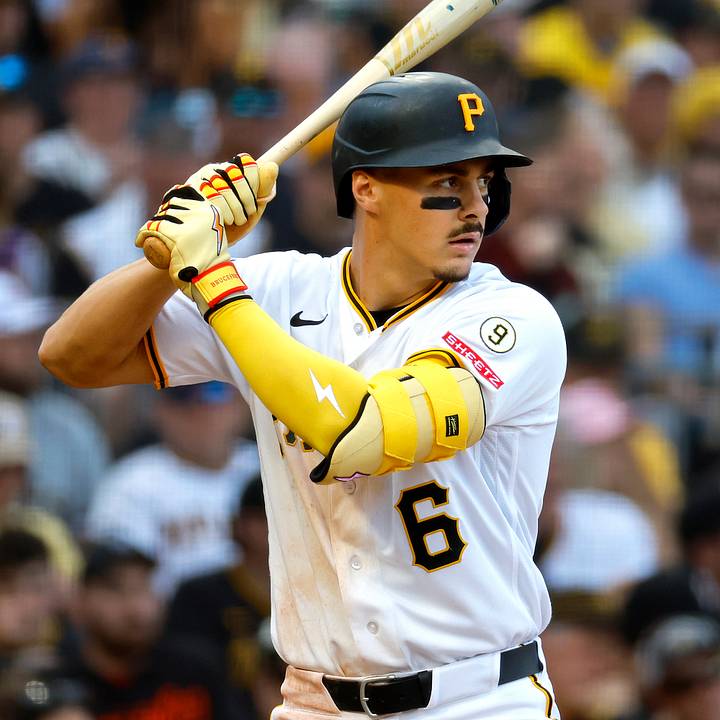
He goes to church every Sunday. He does not curse, though the proper term in Flowood, Miss., his hometown with the slogan of “Good Clean Fun,” is cuss. He calls his parents every night. He married at 19 in January to his eighth-grade sweetheart. As a teen he hired a mental skills coach. He splurges, on the rare times he does from his $140 million contract, on training and recovery tools. He says “Yes, sir” as easily and often as a first-year private.
There are many reasons why Pirates shortstop Konnor Griffin is an outlier. At 6'3" and 225 pounds, he is the fastest big man in MLB (more than 200 pounds). He has the fastest bat speed of any shortstop. Having turned 20 years old on April 24, three weeks after his big league debut, Griffin is likely to be the second-youngest player to start 125 games at shortstop in an MLB season, behind only Hall of Famer Robin Yount (1975). He is the highest-paid player in Pirates history.
Even with all those exceptionalisms, the most defining superlative adjective about Griffin is more abstract than measurable: He is the oldest 20-year-old in baseball. To watch Griffin play baseball and, more so, to listen to him describe what is important to him, is to think he passed this way years ago through the grind and pressure of the majors. One of the new faces of baseball is an old soul.

“He really has always been this way,” says his dad, Kevin, softball coach at Belhaven University in Jackson, Miss. “He’s just been real thought-provoking with everything he does. He’s always kind of analyzed. You know, he’s kind of happy-go-lucky and flies by the seat of his pants in a lot of ways, but when it comes to things that are serious, he puts in a lot of thought and analyzes it quite a good bit.
“All three of our boys are really good kids. We tried to instill at an early age to be humble and kind. My wife always told him, ‘People aren’t always going to remember your stats and how many games you won, but they’ll always remember how you treated them.’ And I think Konnor, from an early age, stuck to that philosophy and that’s the way he handles life.”
Griffin is a thoroughly modern player in this age of exceptional athleticism and technology. He has trained in the batting cage since he was a ninth-grader with a core velocity belt that provides resistance to his front hip, which helps give him his supreme core rotational speed and power. He uses red light therapy and dynamic air compression boots to assist in recovery. He communicates almost daily with mental skills expert Brian Cain, an association he began on his own at 19, without his father’s consultation.
“Honestly,” Kevin says, “that my 19-year-old kid would think enough about the mental part of the game to go reach out and talk to somebody like that, that was pretty interesting. I was proud of him for doing that.”
Griffin’s goal is not just to be a very good player. It is to be a Hall of Fame player.
“Because that’s the highest place you can go,” Griffin says. “This is who I am. I’m a competitor and I want to win and I want to be a good teammate. I want to be a good leader and win World Series and hopefully at the end of my career to be able to make it to the Hall of Fame, because that means I was a good teammate. A good leader. We won ball games. So that’s the goal. That’s the standard.”
The Pirates are one of the best early-season turnaround stories. After 10 straight seasons missing the playoffs, the last seven with losing records, they suddenly look like a contender. Led by Cy Young Award winner Paul Skenes, they have one of the hardest-throwing, fastball-dominant staffs in baseball. The offense, worst in baseball last year, has soared to a top 10 level, helped by the additions of playoff-tested veterans Ryan O’Hearn, Brandon Lowe and Marcell Ozuna. The biggest difference maker can be Griffin, who has all the hallmarks of an impact player just two years after the Pirates made the franchise-altering decision to take him with the ninth pick of the draft, money be damned, after several teams passed on Griffin rather than meet his asking price.
Griffin started this season slowly. He was hitting .182 through his first 19 games. And then he homered on his 20th birthday, one of three hits that day. It began a 12-game tear in which Griffin slashed .395/.458/.651. In those first 31 games, Griffin provided a snapshot of what he loves most about baseball.
What he can do on a baseball field looks as fun as the inflatable bounce house Skenes gave the kid for his 20th birthday. His skill set is a ridiculously full toolbox. He runs faster than all but five players, all of whom he outweighs by 25 to 60 pounds. He stole 63 bases in the minors last year while hitting 21 home runs. He has hit a baseball 113 mph this year. He swings the bat faster than Mike Trout and Shohei Ohtani. He throws harder than all but four shortstops. And yet ask him his favorite part of the game and he gives a decidedly old soul answer: conquering failure.
“You fail so much in this game—what I love most is being able to succeed after days of failure,” he says. “It’s the best feeling when you can overcome it and then you get on a hot streak and you’re just feeling really good. There’s something about it. It’s just ... it’s just different.”

It was in spring training last March when the kid approached veteran Pirates coach Tony Beasley.
“Hey, if you see something I can do better out there on defense, let me know,” Griffin told him.
Says Beasley, “Here’s a 19-year-old kid looking to get better any way he can. I’m in charge of the outfielders, but it didn’t matter. He knows I’ve been around. To have a player that young looking for feedback? Asking for it? That’s special. This kid is special. He is so mature with everything he does. They don’t come around like this often.”
One day the Pirates were playing in Fort Myers against the Red Sox. Griffin clobbered a home run his first time up. An inning or two later, he fielded three ground balls.
“The first play I made,” he says. “The second one, same. The third one, I just got lazy and made a bad throw. It was an error.”
He didn’t cuss. Of course, he didn’t. He never does. In his worst moments, Griffin might utter a “dang”—“or something like that. Something not too crazy,” he says.
“When things are tough,” he says, “I’m like, Good. I want that. I want that because it’s going to help me get better. Failure is going to help me get better.
“[After the error], I could have just broken down and felt defeated. But I was just like, All right. Good. Now we’ve got to figure out how to get out of this mindset and just continue to be confident.
“I went to the plate for my next at-bat and hit another home run. I was like, Wow, that is being able to go from potentially low confidence to maintaining confidence. That’s something I’ve been working on.”
Says Pirates manager Don Kelly, “What has impressed me the most is just the way he’s been able to handle everything that’s been thrown at him, all the circumstances of him making his major league debut at 19. The defense has been really, really good. The baserunning has been really, really good.
“The offense started slow but the adjustments that he’s been able to make in handling not just velocity but battling through some nasty stuff is impressive. I mean, you go from five games in Triple A to playing against big league pitching and he’s handled everything really well.”

An early bout with adversity nearly cost him an eye. Konnor, then 8 years old, and his older brother Kannon were visiting their grandparents in Georgia. Kevin and his wife, Kim, were back in Mississippi. (Father, mother, their three sons and two grandsons all have K.G. as initials.) One day, the boys were racing, with Konnor on a go-cart and Kannon behind him on a motorbike. Enjoying his lead, Konnor looked behind to check on his brother. The moment he turned around, he face-planted at full speed into a braided steel-support cable tethered from a telephone pole to the ground. It took 100 stitches to close the wounds in his face. Doctors were worried he might lose an eye. Ten days later, his eye healed enough to open. He could see. Konnor had one question for the doctors.
“Can I play in my baseball tournament?”
They let him play on the condition that he wear a softball-style mask as protection.
Growing up, he also played football (through ninth grade) and basketball (through junior year of high school) but gave up the other sports as his baseball future became obvious.
In his last at-bat of his junior season, he dislocated his shoulder on a home run swing. He took six weeks to heal. The next swing he took was at the MLB Prospect Development Pipeline League, a North Carolina showcase filled with top 2024 draft-eligible players. Rusty and unsure if his shoulder might pop out again, Griffin wrapped the bat around his shoulders and took tentative, poor swings. Some in the scouting community soured on him.
“So,” Kevin says, “a lot of people took that as, ‘Well, Konnor can’t hit. He’s got hit tool problems.’”
Some scouts and analysts never recovered from that impression. Many projected him as an outfielder, not a shortstop. Griffin played well in his senior season at Jackson Prep. He intended to play at LSU, where on a previous visit he met Skenes, unless a team gave him above-slot money in the first round of the draft.
“We had teams all the way to about No. 20 that told us if Konner made it to them, they were going to take him and we already knew what dollar amount that they were willing to go above their slot,” Kevin says. “So, we weren’t stressed about it a whole lot. We did have to convince Konnor that turning down the fourth, fifth or sixth pick in the draft was not a bad thing. It just came down to fit and where we felt he could thrive. We kind of slow played it and held out a little bit until Pittsburgh came along.”
The Griffins waited through eight picks. Kevin says two of the eight teams called with offers “to go like $2 million under slot.” Kevin told them, “Don’t pick him. He’ll go to LSU if you do.”
Four of the first eight teams signed players for less than slot money: the Guardians at No. 1 (Travis Bazzana), the Reds at No. 2 (Chase Burns), the Athletics at No. 4 (Nick Kurtz) and the Angels at No. 8 (Christian Moore). Teams enter each draft with a designated pool of money to sign picks. Sometimes they select a player in the first round knowing they can sign that player at below slot money and funnel the savings toward a later pick. The Pirates used the coupon-clipping strategy with the first pick of the 2021 draft when they took catcher Henry Davis. They signed him for less money than four of the next five picks (Jack Leiter, Jackson Jobe, Marcelo Mayer and Jordan Lawler).
The ninth pick of the 2024 draft became a statement and philosophical pivot by the Pirates. Griffin was highly recommended by their area scout, Darren Mazeroski, son of the late Hall of Fame second baseman. After the Angels passed on Griffin, a Pirates official called Kevin and said, “We’re taking Konnor. We want the player. We’ll worry about the money later. We’re just not going to pass him up.”
“I didn’t think we were surprised by Pittsburgh at all,” Kevin says, “because throughout the whole process leading up to the draft, they had been really honest with their feelings about Konnor. And I think it comes down to the relationship that we had with Darren Mazeroski.”
The Pirates signed him to a $6,325,025 bonus, $316,425 above the slot. They had one more surprise. They were signing him to be a shortstop.
“We never had any idea,” Kevin says. “Even though Konnor played shortstop in high school, he never played an inning of infield in travel ball from the time he was about 15 years old.”
Says Konnor, “It doesn’t matter to me, really. I’ve worked really hard at both. I’ve taken the challenge to try to be the best shortstop I can be. But if I ever need to fall back and play center field, I’ll go out there.”

There is more brutality than beauty in the way Griffin swings the bat. In bat speed (75.2 mph), attack angle (8°) and length (7.7 inches), it resembles the swing of Trout (75.1, 8°, 7.5). Both hold their hands high, bludgeon the baseball more than slash at it, and finish with two hands on the bat. They are rare fast-twitch ballplayers in an extra-large package. Taut bundles of speed and size.
Asked to identify his best hitting attribute, Griffin says, “My bat speed. Even if I’m a little late, I still have good bat speed to be kind of late on a fastball and still get the barrel out there and still be able to drive it to the off field.
“It’s really just about being an athlete. I don’t feel stuck. I feel loose. I feel aggressive.”
Of his first 29 hits, nine went to the pull side, nine went to the middle and 11 went to the opposite field. It is a swing that has been grooved over the years by his father. It is still that way. Konnor trained every day last offseason with Kevin. Konnor prefers the hitting sessions to be difficult. Kevin sometimes cranks the velocity of the pitching machine to the equivalent of 105 mph. He also will position the machine at strange offset angles, so the pitch looks as if it is coming from behind him or toward him.
“It makes me feel uncomfortable in the box,” Konnor says. “I am challenging myself in the cage and not just swinging, just to fluff my swing and feel good hitting. I love doing competitive things, like mixed BP where my dad will get in there and he’ll try to get me out by throwing curveballs, fastballs, whatever.”
Does Dad ever get it past his phenom son?
“Sometimes,” Konnor says, “he gets lucky. Yes, sir.”
Konnor interrupted his training in January to marry his longtime girlfriend, Dendy Hogan. They met in eighth grade, when Konnor transferred to her school. Three months later, they were an item. Six years later, they were married.
“She was with me before all the baseball stuff started,” he says, “and she’s been right by my side for the whole journey. I mean, we’ve been together for six years and it was definitely the right time, for sure.”
Dendy travels with Konnor during the season. Konnor makes sure he checks in regularly with his parents.
“We talk every night,” Kevin says. “I try not to talk about the game unless he brings it up and asks me questions. But usually by the time the conversation is over he’s going to ask me about his at-bats or a defensive play, if there’s something I thought he could have done differently.”
Konnor, Kevin says, “keeps such a small circle of people that he trusts.” That’s important, Kevin says, because “in this profession you can’t have a huge circle, or you’ll have people trying to get in your head all the time. So, I think he’s made a smart decision by keeping that circle small.”
As the Pirates rise and Griffin alchemizes failure into confidence, the attention on him will grow. Many will try to pierce that tight circle. It is all happening so fast, just the way he plays baseball. Just two years ago, he was playing high school ball in Flowood, a suburb of Jackson with 10,200 people and 10 churches within 16 square miles. In the first five months of this year, he got married, made his major league debut, signed a nine-year contract, became the third-youngest player with seven total bases and five times on base in a game and hit his first major league homer on his 20th birthday.
Says Kevin, “He wants to have a good, long career and have an impact not just on the Pirates but the city of Pittsburgh. That’s important to him. He wants to establish some foundations where he can give back to the community and that’s going to be his home. So, I think outside of the obvious of being a good baseball player and having a career where he can be considered at some point for the Hall of Fame, I think he wants to impact the city of Pittsburgh and be one of the faces of the franchise for a long time.”
As for what he wants to accomplish as a rookie this season, Griffin says, “I would just say to maintain being who I am every day. Like, try not to be on a roller coaster, going up and down. Just try to be consistent every day. Be the same guy. Come in the locker room ready to learn. Try to face adversity and to see where each day takes me.”
He is 20 years old, a youthfulness belied by such a cultivated outlook, as well as his temperament, size and strength. He may seem, given his baseball skills, a young man in a hurry. The reality is the kid from Flowood is a wise prodigy who is just having some good clean fun.
More MLB from Sports Illustrated
 Add us as a preferred source on Google
Tom Verducci is a senior writer for Sports Illustrated who has covered Major League Baseball since 1981. He also serves as an analyst for FOX Sports and the MLB Network; is a New York Times best-selling author; and cohosts The Book of Joe podcast with Joe Maddon. A five-time Emmy Award winner across three categories (studio analyst, reporter, short form writing) and nominated in a fourth (game analyst), he is a three-time National Sportswriter of the Year winner, two-time National Magazine Award finalist, and a Penn State Distinguished Alumnus Award recipient. Verducci is a member of the National Sports Media Hall of Fame, Baseball Writers Association of America (including past New York chapter chairman) and a Baseball Hall of Fame voter since 1993. He also is the only writer to be a game analyst for World Series telecasts. He lives in New Jersey with his wife, with whom he has two children.