
Assessing Washington Nationals' Five Worst Moves of 2025 Season
In this story:
The Washington Nationals are at a turning point in their rebuild. They have a nice, young core of players at the top of the roster and they just hired a new president of baseball operations to build a competitive roster as they move forward.
Even with a lot of positives and improvements from last season, teams as desperate at Washington are bound to make bad moves as they swing for upside on the roster. That was one of the stories of the season in Washington.
After positives such as finding a potential closer of the future in the trade market, it's time to look at some moves that doomed the Nationals in 2025.
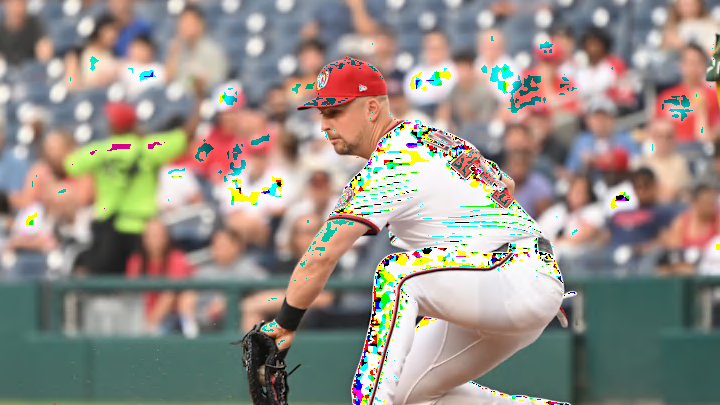
Trading for Nathaniel Lowe

In hindsight, this was the biggest mistake the Nationals made before the 2025 season. The logic was sound, though. Grabbing a veteran rental like Lowe sounded beneficial for a young lineup that was on the verge of breaking out. A 122 OPS+ hitter over the past four seasons, Lowe looked like he could be a slugger in the middle of the lineup.
It didn't work out in the Nationals favor, though. Although Lowe mashed 16 home runs, he hit .216 with a .665 OPS and 88 OPS+ in 119 games. His bWAR with Washington was -0.3 before being outright released on Aug. 16.
The Nathaniel Lowe experiment didn't last a full season, and they had to go with Josh Bell at first base for the rest of the season. Robert Garcia, who they traded away, posted a 2.95 ERA in 71 games with the Texas Rangers.
Nothing worked out in the Nationals' favor where Lowe was concerned. He could've been a candidate to re-sign with them if things had gone differently, but now Washington has to start from scratch at first base.
Standing Pat at Catcher

Coming into the season, catcher was the biggest weakness of this Nationals lineup, and it remains that way in the offseason. The vast majority of the catching duties were given to Riley Adams and Keibert Ruiz and Washington should focus on upgrading that position as soon as possible.
Adams played the most number of games this season with 83. He hit .186 with a .560 OPS, 59 OPS+ and 0.5 bWAR. Defensivley, Adams had -2 blocks above average and was in the fifth percentile in framing, according to Baseball Savant.
As for Ruiz, he hit .247 with a .595 OPS and 69 OPS+ in 68 games. He was slightly better than Adams with 0.8 bWAR. He had -6 blocks above average and was in the seventh percentile for framing. Ruiz also spent a lot of time on the IL with concussion issues.
It's pretty clear by this point that the Nationals don't have a catcher they can rely on. Drew Milas, who ended the year on the 60-day IL, was their best offensive catcher with a 129 OPS+ in 18 games.
It wasn't imperative that Washington had a catcher in order to win this season, but it's arguably the most difficult position to find at the big league level. In a lost season with catchers that the team will likely move on from, they should have been trying different options at the position.
Sticking With Mitchell Parker in the Rotation

Washington couldn't find much of anything in the rotation depth wise behind MacKenzie Gore this season. They traded away Michael Soroka, Trevor Williams got hurt and Jake Irvin was ineffective. However, they did get some nice starts from unknown prospect Andrew Alvarez, who became a member of the rotation after Parker was moved to the bullpen.
In the rotation, Parker was hurting the team rather than helping it. In 33 games and 30 starts on the season, Parker posted a -1.2 bWAR. As a starter, Parker threw 158.1 innings with a 5.7 K/9 and 1.465 WHIP. His 5.85 ERA was the worst on the team. So, at the end of the season, interim manager Miguel Cairo decided to send him to the bullpen.
But keeping the left-hander in the rotation for so long not only hurt the Nationals' pitching, but it didn't allow for them to try different options, one of which pitched really well in Alvarez. At some point before reaching the 30 start threshold, Parker should have been pulled from the rotation.
In 23.1 innings at the end of the year, Alvarez posted a 2.31 ERA and 0.7 bWAR. Had some of Parker's innings gone his way, the rookie could have helped the club win more games. Not only that, but former first round pick Cade Cavalli could have developed more, too.
Signing Lucas Sims

Just two seasons ago, Lucas Sims was one of the best relievers in baseball. In 61 innings, the right-hander posted a 3.10 ERA, 10.6 K/9 and a 1.9 bWAR. It was a career year for the then 29-year-old who came back strong the next season, posting a 3.57 ERA in his first 43 games.
Sims became a trade piece at that deadline, when he was dealt to Boston. There, he struggled, posting a 6.43 ERA in 15 games. Coming into free agency, the Nationals took a flyer and he was off of the team by May.
In just 12.1 innings, Sims gave up 19 earned runs and walked 14. His walks per nine was all the way up at 10.2 while his ERA was at 13.86. Sims was worth -0.9 in just 12.1 innings.
This was another case of good process that simply didn't work out. Like they did with Soroka, they signed Sims as flyer to become a reclamation project they could flip for a prospect or two at the deadline. It didn't work out, but the Nationals cut ties with him before he could really hurt the team.
Signing Jorge Alfaro

With the Nationals catching in such dire straights, Jorge Alfaro was the move to try to turn this around that the position. The 32-year-old last played in the Majors in 2023, but hit 15 home runs with a .715 OPS for the Milwaukee Brewers' Triple-A affiliate this season.
Alfaro represented a veteran bat who could maybe provide more pop at the position than Ruiz and Adams had. After 14 games, it was clear that it wasn't going to work. Alfaro had posted a .256 batting average with a .564 OPS. He hit two doubles, but wasn't able to get one over the fence.
Behind the plate defensively, he was not good either. In 91.2 defensive innings, Alfaro had -5 blocks above average and a -1 caught stealing above average mark, according to Baseball Savant. It was a miss on both sides of the ball.
Recommended Articles
 Add us as a preferred source on Google