%20%20--%3E%0A%3Csvg%20version%3D%221.1%22%20id%3D%22Layer_1%22%20xmlns%3D%22http%3A%2F%2Fwww.w3.org%2F2000%2Fsvg%22%20xmlns%3Axlink%3D%22http%3A%2F%2Fwww.w3.org%2F1999%2Fxlink%22%20x%3D%220px%22%20y%3D%220px%22%0A%09%20width%3D%2239px%22%20height%3D%2240px%22%20viewBox%3D%220%200%2039%2040%22%20enable-background%3D%22new%200%200%2039%2040%22%20xml%3Aspace%3D%22preserve%22%3E%0A%3Cpath%20fill%3D%22%23FFFFFF%22%20d%3D%22M38.5%2C7H28.2v26h10.3V7z%22%2F%3E%0A%3Cpath%20fill-rule%3D%22evenodd%22%20clip-rule%3D%22evenodd%22%20fill%3D%22%23FFFFFF%22%20d%3D%22M26.1%2C25.5c0%2C5.8-4.1%2C7.5-12.9%2C7.5C3.9%2C33%2C0%2C31.2%2C0%2C25.2v-1.1h11.6%0A%09v2.4c0%2C0.7%2C0.1%2C1.4%2C1.2%2C1.4c1%2C0%2C1.2-0.4%2C1.2-1.3v-0.9c0-1.6-0.9-1.6-3.5-2.2C2.2%2C21.7%2C0%2C19.7%2C0%2C15.3v-0.9C0%2C9.3%2C5.5%2C7%2C12.9%2C7%0A%09c10.2%2C0%2C12.8%2C2.6%2C12.8%2C7.4v1.8h-11v-2.9c0-0.6-0.4-1.1-1.2-1.1c-0.6%2C0-1.2%2C0.4-1.2%2C1.1v0.9c0%2C1.5%2C0.9%2C2%2C3.3%2C2.5%0A%09c8%2C1.6%2C10.5%2C3.3%2C10.5%2C7.5V25.5z%22%2F%3E%0A%3C%2Fsvg%3E%0A)

00:40:20 |
Up Next
Transcript
All right.
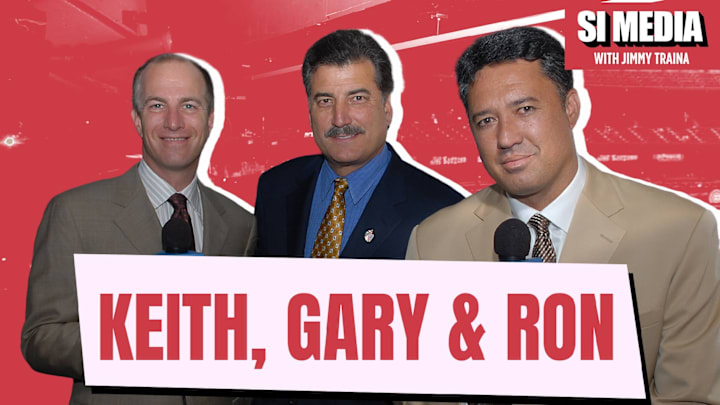
Joining me now, you got a diehard Yankee fan having the Mets booth on the SI Media podcast, but they are the best booth in baseball.
And with the season starting, couldn't think of a better trio to have on than Gary Cohen, Ron Darling, and Keith Hernandez from SNY.
Gentlemen, thank you for doing this.
I appreciate it.
Thanks for having us, Jimmy.
Our pleasure, Jimmy.
Uh, you know, I said the best booth in baseball.
I, I know awful announcing they do a poll.
You guys usually win it every year.
Does that mean anything to you guys at all?
Gary, we'll start with you and then we'll have Keith and Ron chime in.
Yeah, I think everybody's entitled to their opinion.
I think we, um, we've been together for a long time.
We have a lot of fun together, and, um, you know, one thing I learned very early in this business, and, and I think it's probably true for players as well as broadcasters, is that you can't.
Take the good stuff to heart, and you can't take the bad stuff to heart.
You have to trust the people that know you and know what we're doing, and um be as self-critical as possible and not worry about what anybody else thinks.
Rod, uh, oh, I, I feel the same.
I think a baseball career really prepares you for a booth, uh, because, you know, um, You treat a 4 for 4 like you treat an 0 for 4.
You just get ready uh for the next day.
And I think Gary's right.
I think we are so self-critical of, of how we prepare and how we do, and, um, there aren't many games in our 20 years, uh 21st year that I go home and go, wow, that was really good.
I mean, it just doesn't happen.
Keith, you, you get a lot of attention for some of your comments in the booth, which adds to the likability of the booth.
What, what's your relationship like with the fans?
Do you love the fact that you guys are so popular?
Well, I think um '86 has a lot to do with it.
Uh, it's been 40 years.
It's the 40th anniversary of the Mets World Championship, and New York fans don't forget, and it's only been two winners in, in uh New York history.
So, the fact that you've got Gary that came in in what, I think '88, and Ronnie and I have played on those teams, and, you know, Ronnie gives the really good pitching analysis, which I could never do.
And uh Ronnie's also very adept cause he played a position, you know, growing up, so he knows the game, uh, probably more than me cause I can't do the details of pitching, but it's got a good combination there, and then Gary's the moderator, and, you know, we've been there for a long time.
I've had kids that were not kids, I've had guys that are 30 years old that say, we grew up with you on on TV.
You were in our living rooms, so there's a familiarity.
And there's a, there's been a bond between us and the fans.
You know, what the people are really trying to tell you, Keith, is that you're really old.
I am.
I'm the oldest in the booth, yeah, but you know, the older you are in the booth, I think the more people like you.
Like we love the, we don't, we like to see.
The legends stay.
We don't like to see the legend.
You know, we're seeing it now in the tournament with Bill Raftery.
He's 82.
When Raftery does these games, the outpouring on social media is tremendous.
And I think it's even, you know, it's deeper for you guys because you're local.
Uh, you know, everyone loves Raf nationally, but locally, you get an even bigger bond.
Um, I'm curious, you know, you mentioned about Ron with the pitching.
One of the things I appreciate about you guys, so like I said, I'm a die-hard Yankee fan.
I watch the Yankees every night, but I always flip over to you guys because, you know, people say you don't listen for the announcers.
I always like to hear you guys call a game because I find it very entertaining, educational.
The Mets are often a train wreck, so it's good to watch, to, you know, tweak my friends who are Mets fans.
Um, I'm curious though, you guys don't do, I feel like you guys are not heavy, heavy analytics, which has turned me off to a lot of broadcasts .
Uh, I, because I do think in today, 2026, you can really, not even understand half the stuff sometimes when they're analyzing.
With all the num the analytics, what is your, Ron, I'll do it with you.
What is your philosophy on give some analytics, don't do a ton of it, balance it?
What, what, what is your perspective on that?
Well, one, you know, analytics, uh, every profession, whether you're a doctor, a dentist, uh, ballplayer, um, opaque, uh, language unique to just you.
Uh, it's a favorite trick, uh, to keep others out.
So, um, I, I figure that if they're trying to keep people out, uh, I'm trying to welcome people in.
Um, I, I, uh, one of my favorite teammates of all time is David Coe.
And I think David does as good a job as anyone in the industry being able to make, uh, the numbers, um, Work in a booth.
I, I just have not been able to find that inroad.
I just cannot do it.
And, and with, with our, and with, and with our broadcast, um, you know, uh, it, it's really, we lean on each other, uh, to present the broadcast and, and.
I think speaking about analytics or stats or any of those kinds of things, even though it's great information, uh, would kind of smother what we do.
So it's, it's not appropriate for our.
I follow up with Keith, but I want Gary to chime in on that.
There's a great understanding among fans, I think that so many of the decisions that are made by front offices and by managers are dictated by analytics.
But that doesn't mean that they want to be, as Ronnie said, smothered with them.
And I think what, what the biggest issue is, is that anytime you bring up a, you know, uh, uh, an esoteric stat of WRC plus, you have to explain it.
In total, so that people understand what you're talking about.
Otherwise, it has no meaning.
Um, and I think that it's so hard to do that in the context of a broadcast.
Now, there are certain things that we use that we didn't have before that we can demonstrate, like, you know, a, a pitcher's extension.
Right?
How, how far down the mound he releases the ball.
We can show that graphically, or we can show side by sides of two different pitchers, and people can understand what that means.
Um, we can talk about vertical or horizontal break, and we can show that.
But in terms of some of the more advanced numbers.
It's very hard to to use them because it people who you're talking to don't understand them.
So I, I think you really have to walk a very fine line when, when you do that.
And I can also say this, that in all the years we've been doing this, I have never had a fan come up to me and say, You guys don't do enough statistics.
You know what they say?
They say, what's David Wright really like?
That's what they say.
I mean, people want human.
They don't really want a math lesson when they watch a baseball game.
I'm glad you said that because I want to go to Keith on this because I also think, listen, obviously the analytics have become a big part of the game.
You can't ignore it.
It's there, like you said, the managers use it.
And maybe I'm saying this because I'm just a fan and it's a dumb take, but there's also, what doesn't seem to be there anymore is the eye test.
Like you see these guys every day.
Either someone's a good ballplayer or they're not a good ballplayer.
Am I, am I wrong about that, Keith , or is that still at the end of the day, what it's about?
Well, you know, there are some good things about analytics, um, and, and then there are some things that I feel are just overkill.
Uh, there's some things you can glean from it, but to me, I've always been a visual guy.
I mean, Ronnie as well, we were trained as little kids to follow a baseball coming in at a high rate of speed and making contact with, with a baseball bat, and um that's a lot of hand-eye coordination.
And I did not grow up with the computers.
I grew up watching in a dugout and watching guys play, and I, to this day, I'm more visual in watching a player.
I mean, I can look at the, at the center field camera, and the guns today have been proven to be, they're a little, they're they're, it's, doesn't really matter.
They're a little bit faster and maybe more accurate.
But it's all relevant.
So when I see a guy throwing a lazy sinker.
And I tell you, a right hander, especially, I used to I used to salivate on lazy sinkers.
There, there's, when you have a lazy sinker, you're not throwing 9097 MPH.
I'm sorry, this doesn't happen.
You have to have a hard sinker, but that's part of the visual for me, and I have to bite my tongue because I don't want to be negative.
But, um, as far as judging players, certainly, but you can tell, hey, can the guy run?
Can he feel?
How's his arm?
Does he have range?
That's all with your eyes watching a player as you play, and I think that, uh, I, the game is kind of getting back to it, I think, to a degree now.
I think it's making a turn, and I think it's a turn for the better.
Hey, Jimmy, just think about the word itself, analytics, just information, but it's uh sexier if you call it analytics.
Yeah, can I interrupt real quick?
Yes, I still look at you got OPS.
That's fine.
It doesn't really totally compute in my brain because I'm not of that generation.
But slugging percentage does, on base percentage does, batting average does, runs score does, hitting with runners in scoring position, that computes to me.
That to me for an offensive player is where you judge the player.
Leighton Close is also another big one with runners in scoring position.
Yeah.
Meanwhile, if you go, you know, not to use Twitter as the be all end all, but like, any, no one under 40 thinks batting average is important anymore.
If you go by what you see on social media, which I don't understand.
I still think it's important, but when I say that, people tell me, if I quote someone's batting average, I get told I'm an idiot and no one cares about that anymore.
Doesn't that add up to on-base percentage?
I mean, if you're hitting 250, you better walk 125 times to have an on-base percentage of 400.
I mean, it all, they all go hand in hand.
Um, I, I chuckled when Keith said he's not into computers.
It does, it does feel like out of the three of you, Keith, you're the most active on Twitter though, if I'm not mistaken.
No, I, I, I was when I was being self-centered and promoting my book a couple of years ago, and I got very bored with it.
How, I was gonna say, are you good with the phone if you're not good with computers, um.
That phone can be a problem.
Yes, I, I remember the story you told during the game where you got scammed, I think, yeah, with the bank.
But that's all.
Gary is such a great play by play guy, and Gary knows when to stick to the game, and he's the maestro, and when, when you need a little levity.
And I'll just follow his lead and Ronnie the same.
That's why I wanna go to Gary.
Well, let, let me ask you about that specific incident and then I'll get to some Gary, did you know Keith had gotten scammed online with a banking scam and you wanted to make sure that story.
Got on the broadcast or you didn't know about it.
How do you remember that?
I don't really remember, but I, I, I, I'll tell you this, um, when we started out in, in 2006, um, you know, it's my natural inclination to, to prod and, and, and kind of, um.
Elicit reactions from people on the air.
I've always done that with my partners and with Keith, because he's got such an offbeat sensibility about certain things, there'd be times early on when I would kind of prod him and tease him and I thought it was really working well, but I had to know if it was OK with him to, you know, kind of tweak him a little bit.
And so I asked him off the air, I said, are, are, are you OK with me doing this?
And he said, absolutely, bring it on.
And I think that was a big turning point for us because I, I, I understood that, you know, that, Keith could go in all sorts of different directions and all I had to do was just nudge him a little bit.
And, um, I, I think that part of the broadcast is, has been a big factor in our success.
I, I was gonna ask you, Gary, I think baseball is the sport that lends itself the best to a three-person booth because there's so much downtime.
Did you, going, I mean, you've been doing it for 20 years, but do you still have to navigate things differently with a three-person, even though you're so comfortable with these guys, or is it secondhand nature you don't think about?
You know, like in basketball, like I think with a 3-person booth, it's ridiculous because the analyst doesn't get any time to speak as it is because everything's so fast.
Baseball is different.
So do you prefer the 3-person?
I mean, obviously, it's worked out, but in terms of your broadcasting and you doing play by play, 3-man versus 2-man.
You know, there are certain combinations in 3-man booths that we have heard over the years, and I'm not gonna mention any names, where there's a struggle for the microphone.
And I think that that can become an issue.
Um, egos are very big in this business, and we are blessed beyond belief to have.
As low ego a booth as possible , which is stunning when you think about it, you know, you've got Keith who should be in the Hall of Fame, great player, Ronnie, one of the best pitchers in Mets history, great player.
Baseball players, athletes tend to have large egos, and, and so do a lot of broadcasters, but I think that, One thing that really helped us was that when we started out, none of us really knew what we were doing.
I was coming from radio, Ronnie had limited experience, so did Keith, and we kind of had to hold hands in the dark and, and help each other.
And I think that, that, that, that genesis really uh forged a, a, a booth where nobody has to be the star, and we're all happy to defer to each other.
And I think that That's why a 3-man booth works, not because of the sport necessarily, although baseball obviously lends itself to far more off-topic discussion than, than other sports do.
But I think that you have to have 3 people who respect each other and, and don't have to be the star.
And I, I think that's the case with us.
All right, 162 games is a lot.
It's a long , long season.
So Ron, let me ask you, is there any point in the season where you guys get on each other's nerves?
Oh, I, I'm, I'm sure we do, um.
But never really, I, I never have ever felt it on the air in 20 years.
Do we get on each other's nerves maybe before a game or traveling, maybe traveling, uh, getting in at 4 o'clock in the morning and have a day game the next day.
Certainly, um, everyone, uh, has been testy, uh, at times, but it, it never comes across in the broadcast because, um, I don't know, we just, I think we all.
We all love the game, and we might not love the travel, might not love the before and after, but we love the game, and I think we all have an appreciation for when the game starts, anything can happen.
I mean, uh, we came to the ballpark on June 1st, uh, uh, many years now ago, and we didn't think anything was gonna happen.
It's a regular game, and Santana throws the first no-hitter in Mets history.
You just don't know, and we still, as like kids have a fascination for each and every time the first pitch is thrown.
Now, Ronnie's got a good deal because If the Mets do make the playoffs, he continues on with TBS.
One of the crazy things about baseball is like for Gary and Keith, you call 100 and whatever it is, 50 , 40 games.
I know Keith may be a little less now.
Then the team makes the playoffs and you guys have to disappear.
How much is that a bummer for you guys when that happens, Keith, we'll go to you and then Gary on that.
Or is Keith like that the season's over and he can, he's done and he can go off to, you know, the east end of Long Island?
I don't mind missing the postseason.
I'll hand it off to, to the national.
I know the fans are, all, all want us to do it.
It's become a big thing.
It does make sense because, you know, national broadcasts are totally different.
Um, they're more MLB promotion.
Uh, they come in, they don't watch the team on an everyday basis, which we do, which gives us, we know what's going on with that team.
But I understand that, and it's a long year.
I mean, I'm, I'm, I was doing 110 games, now I just signed a new 3 year deal.
I'm doing 95, I cut back 15.
Gary's the one that takes the load.
He does the most games.
Uh, but when the season's over, I'm ready to get in the car and head south.
You realize the Mets fans, they're gonna notice and they're gonna be pissed you're only doing 95 games.
Be prepared.
People are gonna be mad.
Well, 95 is plenty, isn't it?
Always leave them wanting more, Keith.
Always leave them wanting more.
Yeah, it's gotta be hard for you.
Like, like he said, you do all the games basically, then the playoffs come and you're gone.
It's gotta, Jimmy, it's Jimmy, it's by far the worst part of the job.
And just honestly when When I made the move from radio, where I got to do all the postseason games, um, it was the thing my wife and I talked about the most because I knew what I was getting into, and I knew that that was part of the deal, but it never stops being painful.
Um, I have a real rough time with it every year when the Mets are in the postseason, and I know Michael K and all the other people who are in a similar situation feel the same way, but.
You know, that's part of the gig and, and, um, it, it's the, the thing we have to, we have to live with, but it's, it's not fun.
What do you make of NBC not hiring a full-time analyst?
They're gonna have Jason Bennetti do all the national games with rotating.
I mean, Gary and Keith will probably be in the mix, I would, I mean.
Um, Ronnie and Keith will probably be in the mix at some point where they're gonna use local announcers every week on the national broadcast as a play by play guy.
What do you like for Bennetti?
What is, what do you think that would be?
Oh, I, I, I mean, Jason is as, as great a young broadcaster as there is in our business, and, and it.
That's a great choice, and he works well with whoever he works with, and, and that's, that's part of his charm.
He's got such great insight and a great sense of humor, and he always brings out the best in his analysts.
So, I mean, Roku did the same thing, um, for their package over the last couple of years.
But nobody watched those games, so nobody knew what was going on.
Maybe, um, so I, I, I mean Jason's fantastic, and, and I'm sure it'll be great.
I think you, Jimmy, you just asked about the postseason, so I think it's a way for the network to curry favor, uh, with the, with the fans of that ball club, right, because, uh, you're gonna get a Keith Hernandez, uh, maybe to sit in with Jason Bennetti.
So, uh, I think it's a, it's a, it's a smart move on their part, especially in the first year.
Yeah.
Well, one of the things I like about you guys is when, when the Mets are going bad, you guys are critical.
You don't sort of pull back.
Ron, let me go, start with you on this.
Um, do you have to be cogniz cognizant of like walking a fine line because you're on the Mets network doing the Mets games.
You don't want to go over the, but I mean, they have had some, I mean, even last year, if you think about it, for that team to have that payroll and not make the playoffs is one of the biggest, Embarrassments in baseball history, I would think.
Second biggest payroll in the game.
You don't even make the playoffs.
Do you have to be careful how you criticize or are critical?
We'll go to Ron and then Keith can chime in on that.
Uh, not yet.
Uh, I think , uh, uh, if you listen to us the last, uh, a couple of, uh, weeks or 3 weeks or a month of last season, you know, uh, there definitely was a funereal, uh, air, uh, to our broadcast because sometimes, If you have enough experience, you, you know it's coming.
You know, uh, you still are an optimist and you think, you know, one hit here or one great pitched game there, it could turn it around.
But when you're following a team each and every day, um, you know where it's going.
Uh, you would like it to change, but you know what's gonna happen.
And, and we try to chronicle that, um, or be the caretakers of that moment or moments, uh, for the fan.
Um, it's a lot more enjoyable, and we've heard from players, we're a much better announcer when they win 100 games a year than we are when they don't.
Um, but, um, I, I, I think we're just, we're trying, Jimmy, as much as we can to be authentic.
That's really all we're trying to be.
And, uh, you know, if, if what we're seeing pains us, can you just imagine what it It is for the fans in Long Island or New Jersey or Connecticut that are watching the Mets as well as if they throw a shoe at the TV , we've got to have an answer for them.
And, uh, we try to.
I never thought of it that way, Ron .
What about you, Keith?
When, when you gotta be critical of the team, you just let it fly, you try to be careful.
Well, we've always been allowed, uh, with the Wilpon ownership and, and this current ownership, uh, allowed, they want us to do a, a truthful broadcast.
Now, there is a fine line.
I find out one thing, if someone's trying.
And giving it 100%.
Some people just don't have the talent to get the job done, or they, you got players I've, and it's, this is not just today's players, this is going back to the history of the game.
There's some players that aren't very smart out there and make a lot of mental mistakes.
So as long as they're trying.
You know, it, it, it, it, it's hard to get on, and you've got to remember what it was like to play on the field, and I remember I read a book about, and I gave the book to Gary, it was about the Gasho gang, and Frankie Frish took over managing.
Uh, and It, he said it was a very poignant statement for me in his first year as managing.
He was such a great player and an all-around smart player, that it, it took him a while to realize that there are just some players and a lot that can't do what I did.
It's, it was what was easy for me.
It is impossible for for for that for a lot of players.
So that really was uh stuck with me as long as they're trying.
I mean, there was one team, and I won't mention that team that I did not like at all, and, uh, I had to bite my tongue and not let personal feelings get in the way.
This is a long time ago, so it was a team I just didn't like, and they didn't like me, and , but I went up there and I had to make sure that I didn't let my personal animus, you know , infect my broadcast.
Yeah.
I, let me transition.
I should have mentioned this at the top.
Um, obviously, Gary, Ron, Keith do the Mets games on SNY.
Opening day, well, in this ridiculous streaming world, it's sort of Wednesday night with one game with the Yankees and the Giants.
Then Thursday, it gets underway.
And like I said, that game's on NBC.
Is that how much of a bummer that you don't get opening day, Gary?
Yeah, obviously, we'd prefer to be doing opening day.
Uh, it's not the first time it's happened.
We had it in, um , 2016 as well, after the Mets and Royals played in the World Series, they opened up with a Sunday night game, um, the following year in Kansas City, and we didn't do that game.
So it's, it's happened before, but it's, you know, obviously, opening day is, is one of the linchpins of the season, and we obviously wish we were there, but we'll get, we'll get the Ron Darling game, game number two.
You guys, and then, so they're off Friday and then they play Saturday.
Saturday is your first game.
All three of you together.
All right, good.
Um.
Do you guys, this is a weird one, but I'm just curious because the fans make it a thing.
I don't think you care, but I'll start on, on this.
Do you guys feel competitive with the Yankees or the Yankee booth or the Yankee broadcasts at all?
Wow.
Uh, I, I, I don't think I've ever.
Ever, a couple of things.
One, I've, I've never felt any of that, uh, with the Yankee booth.
Uh, I know how good they are, and I know how good they are not only on air, but I know a lot of the people behind the scenes that are in the truck.
So I know how, um, talented they are.
But, uh, when the Yankees are on.
The Mets are on.
So, you know, I'm doing Mets games.
I, I very, very rarely get to watch a broadcast or a full broadcast with David Coe, Paul O'Neal, and, and Michael, very, very rarely.
So, I would, I would say I haven't given one thought to that ever, uh, in 20 years.
Keith.
Uh, my feelings are the same.
Uh, we're very, we get along great with that booth and we, when we, when there's, uh, when they play each other, it's great to see them, uh, both at Yankee Stadium at home.
There's no competition, uh, whatsoever.
I mean, you have to understand that this is a very small fraternity.
There are 30 major league teams.
There are maybe at the most 150, um, broadcasters between radio and TV.
We all know each other.
We all consider the other booths friends.
We are not in competition with them.
We're only in competition with ourselves and trying to be the best broadcast we can be every day.
And, um, you know, they, they're losing is not us winning.
Us winning is us being the best we can every day.
But do, do you, I, I know, I feel like it's weird because people try to make it a thing, but it's like I don't think you're competing for the same eyeballs because the Yankee fan is watching the Yankees and the Mets fan is watching the Mets.
So like, well, there are, there are, there are people who do crossover and, and you can see it in the ratings when the team is good.
The ratings go up and when the team is bad, the ratings go down and, and you see the other one gain and the other one.
But, but that's, that's not what it's all about.
What it's all about is, and, and we, we've had this drilled into us since we started in 2006.
Our goal is to keep people watching a little longer, that when the game stinks.
Do something that that makes people continue to watch.
If the game is good, make it as compelling as you possibly can.
That's, that's what our job is, and we don't think about it that way, but that ultimately is, is what we're trying to do is, is to make it entertaining, make it interesting, um, be there to caption, caption the moment and, and, um, lend something that, that, um, value enhances it and.
That's, that's what we're there for.
Otherwise people could watch with the sound off, a couple more, a couple of more before, before we wrap it up.
I know.
The Met telecast get enormous praise because of the three of you in the booth and you're very entertaining.
It also got a lot of praise in recent years for the way the broadcast was presented.
And I know the director has left SNY now.
So let me start with you, Gary, on this.
When you, uh tell me about, How big of a, of a deal is it when you have a new director in terms of your job?
Is it, do you have to rely on that person to know what you want to do?
And I guess it's the same for Ron and Keith.
I'd like to know the, because, you know, you never really see a local telecast where the director gets all this praise, but that's what happened.
Now he's gone.
Uh, from the three of you, you could each go one at a time.
Just how that affects you now this year with a new director.
Let me just back up a little bit, OK.
The one constant in that truck over the 20 years that we've been together is our producer.
And that's Greg Picker, and he has been enormously responsible for our success.
He's creative, he knows the game, he knows how to push us in the right direction.
He has been the overarching architect of what we have done.
Um, we've had several different directors since we started, um, and each one's had a slightly different style, and our new director, Eddie Warman has been in our truck for what guys, half a dozen years at least.
Exactly, and, and so he knows exactly what the style of our broadcast is and what, um, and how to communicate with us and how to, um, be there to.
React to what we do and allow us to react to what he does.
And that's, that's what it's all about.
So we've had great continuity and um the fact that Eddie's been with us as long as he has in an associate director role and now moves up to the big chair, I think we'll.
Be seamless.
If you guys wanna weigh on that, you can if you wanna move on.
I, no, I, I, I mean, I'd like to in this sense, you know, we, we, and, uh, I wanna, uh, reiterate what Gary said about Greg Picker.
He's just, um, he's the best producer I've ever worked with, and I, I work with a lot of them.
Um, we started out with a Hall of Fame director and Bill Webb, so, um, no one, has ever done it any better than Bill Webb, um.
And then, you know, with, with Johnny, he had a different style, certainly, um, and with Eddie Warman, who's been in the booth for a long time.
I, I think because I do other broadcasts, a lot of times when I'm working a TNT or MLB broadcast, I will push the button to talk to the director.
I would love to see that.
We very rarely, and I probably never do that on the SNY broadcast.
We just do our thing in the booth, and it's on the director to kind of fill in the gaps and to show the shots if we're talking.
About, um, a certain player or whatever.
So, um, we've always been lucky at SNY that the guys who directed the shows, kind of listen to us and try to follow as we move kind of quickly.
So we've been, we've been blessed.
You know, it's funny in terms of production.
And doing the games now.
Keith, I'll start with you on this and I want to hear from Ron too because he's a partisan and Gary.
You know, one of the things now in this social media age is You get filmed.
I mean, it's not just now they broadcast the game.
They film the booth and then when there's a walk-off, we get the video of you guys reacting in the booth.
Are you, did you guys like that?
Uh, do you guys like that?
Is it annoying or do you have fun with it?
So are you, Keith.
Oh, no, start with Gary on this one.
OK , we'll start with Gary on this one.
I, I, I mean, it, it's a, It's a natural thing to have a camera focused on the booth because every once in a while, they'll put us on camera during the game.
Um, it's not something we look forward to necessarily.
But in, in terms of the, the camera capturing us doing our job, I can tell you that I have never given one second's thought to the fact that the camera is there.
And, you know, people have fun with it.
They, they enjoy watching our reactions, and, and I think that's great.
Anything that, that.
Enhances people's enjoyment of uh.
Of, of the game and the process, I think is good.
You know, one of the things that, that Greg Picker has tried to do with us over 20 years is to remove some of the mystery from the way the , uh, the sausage is made and to take people behind the scenes of, of, you know, what goes on in the booth and what goes on in the truck and how.
You get from point A to point B, and uh it was never better than when we had COVID, and we had to be in separate booths, and they put up a clothesline between the two booths for us to reel things back and forth to each other.
I mean, that's the kind of thing that that we love to do.
Um, yeah, so the, the camera in the booth is, is fine.
It's, it's not something we ever give much of a thought to though.
It does seem like when there is a walk-off, Gary's very animated , and Keith, you always look like you're writing something down.
Well, this is the one thing is that when we, when we initially, well, not we, we, we need to, when the decision was made to show us.
And the non-reaction, uh, and I'm, uh, I'm, I'm not, people expected us to be handed pom-poms and get up and doing cheers, and, you know, we have to be, um, number one, we have to continue to watch, and, you know, it's, it's a long season, so when there's a big hit in August and September, and it's a stretch run, I get more excited then.
I can't get overly excited when it's game 20.
Game 50 cause it's a long way to go, and more intense if the team's in it in August and September, and those games, I will, I will definitely be more animated.
Uh, but the fan reaction initially was, you guys don't care, you, you're not jumping up and down and doing, doing somersaults.
No, we're not.
It's funny you say that because I feel like I never, I never see a negative word about you three, ever.
No, I, I, I think that people do get a little upset, uh, that, uh, Keith and I are, are doing what we should be doing in the booth.
You know , there's nobody and, there's no one who's ever done play by play that's better than Gary Cohen.
And one of the great things that Gary does is that he knows when to punch a big moment.
And he punches it better than anyone in the game.
So that's what you're seeing at the end of the game in a big walk-off kind of fashion.
But also this peek inside of the booth is allowing you to see what the analyst does.
And at that point, my brain is working as hard as it can to come up with something that encapsulates the moment.
I'm trying to find the right words.
Um, I'm trying to find the right tenor and tone.
All of those things are going through my head as Gary is giving this impassioned call.
I want to make sure, of course, in a, in a, in a lower key way, that I'm able to say something that will also punch it in a, in a, in a baseball sense.
So, um, you know, in, in many days, it's harder than, than.
It, it, those words don't come so easy.
I'm just not one of those people that, um, words come very easy, so I really have to think about it to make sure I, I add, uh, to what Gary has just shown us.
And, and just, just for clarification, if I'm slamming my pen down or pumping my fist, I am not rooting.
I am punching the words.
I'm, I'm, I'm, I'm using my, my hands to Emphasize the words that are coming out.
Um, I think some people sometimes mistake that for cheering or, you know, exulting.
That's not what it is.
It's, it's all about punching the words out and, and.
Emphasizing the moment.
I feel like every local broadcaster roots though.
No, no, I don't think we root at all.
I think we want to see the Mets win after all, we're doing their games for 150 odd times a year, but no, rooting is not part of our job.
Keith, what go ahead.
Uh, I do feel that some, uh, broadcasts root, and there's time.
I want to root for the Mets.
I want the Mets to win.
You know, I wore the uniform, and I, I played, you know, 7 years, almost 7 years in New York, and I want the team to do well, and, uh, but we have to, uh, maintain that even keel and honest broadcast.
Uh, but certainly, definitely, there are broadcasts that, uh, root, root, root for the home team.
Let me, let me end it with this because I know you guys have given me more than enough time and I appreciate it.
Uh, I'm a, I've made it 36 minutes here without mentioning Seinfeld, and I'm a complete Seinfeld nut.
So I just wanna know, when you guys are on the road, and I want Gary and Ron to answer this, does Keith get more, hey, love you on the Mets games or loved you on Seinfeld?
There's no question that there are more people who watched him on Seinfeld than ever watched him play baseball, or watched him broadcast the Mets game.
And when Ron and I are on the road and Keith is not there, Ronnie, Take it away.
It, it is.
Hi, Gary.
Hi, Ron.
Where's Keith?
I mean, that happens every single place we go, um, and, and, uh, you know, Keith's a national star.
We're our, our local baseball announcers and, uh, but you know, it, it all, Jimmy, it's, there's so many.
Arms in this, there's so many tentacles, but boy, um.
At the end of the day, I get to work with two great friends.
I consider them my older brothers, and, um, I watch baseball, and somehow someone sends us a check every 2 weeks.
I don't think it might not be the best job in the world, but it's in the top 5.
So you notice that you noticed that Ronnie suddenly got in there that he is younger than both Keith and myself, as he should, as he should.
He also mentioned checks.
Keith, I'm gonna be bold.
If you wanna tell me to screw off, tell me to screw off.
How much was your last Seinfeld residual?
Well, it varies.
I can tell you what on an annual basis what it is.
Sure, it's close to $5000 still.
It's the, I mean, the giving that episode was like 30 years ago.
That is amazing.
I understand, but remember one thing.
I was the guest star.
I was.
So let me, let me wrap it up with this.
I'm very good friends with Sal Lucata, who's on SNY before the games.
Sal went down to spring training last week at Port Saint Lucie and through a long story that was told on last week's podcast, if someone wants to listen to it, Sal was at the game with Jerry Seinfeld.
There was a rain delay.
The game got rained out.
So Sal and Jerry are in the elevator.
Keith walks in, this is now Sal told this exact story on the, this podcast last week.
Keith walked in the elevator, head down, didn't realize Jerry was in the elevator.
So, and then someone pointed out that Jerry was in the elevator, and the comment with Keith from Keith was, and if you want us to edit this out, we can edit this out.
But Keith said, sorry.
The spring training games kill me.
My, I, I can't pay attention to anything during these spring training games.
Is that accurate?
Before that, uh, they, I was already on the elevator and they, they came in on the floor below and Jerry was sidled next to my, on my left, and I , I was, I, when I'm on the elevator with a bunch of people after a game, I have my phone.
I'm pretending like I'm on my phone looking.
That's a Seinfeld episode right there, just so you know, you have tunnel vision and then the tall guy, uh, said hello to me and then pointed to my left and I said, Jerry.
Then we had a nice, and I did say, you know, these spring training games, they did they're killers.
uh, so I guess, because you know, you got so many players, but that was great to see Jerry and I, guys, I did tell Jerry.
That we have to have him in the booth, uh, every year, once a year or twice a year, and he said he loves it in the booth.
He'd be more than happy to come in the booth.
There you go.
Well, it is the best booth already in baseball.
SNY, Gary Cohen, Ron Darling, Keith Hernandez.
Saturday is their first game against the Pirates.
Appreciate you doing this.
It was a lot of fun.
Enjoy the season.
Thank you guys.
I appreciate it, Jimmy.
You're the best, man.
OK , thank you.
Thank you.