
Where Were They Then? Part Two
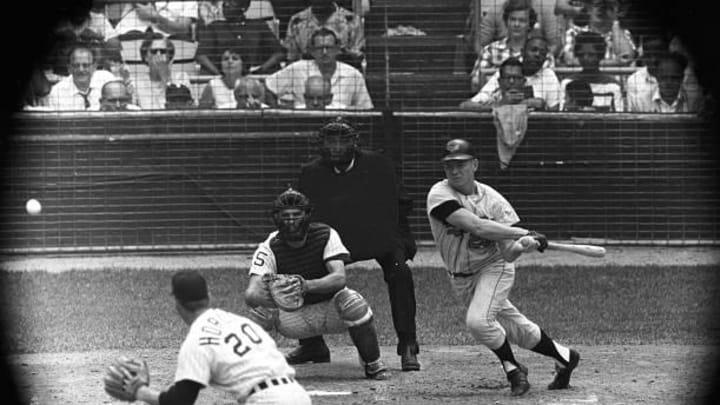
By the end of the 1958 season, the White Sox were eight years into a 17-year competitive run. Keen amateur scouting had built a flush minor league system to feed the major league team. Success orbited around a strong pitching staff, anchored by Billy Pierce. The team had a core of Sherm Lollar behind the plate, Nellie Fox and Luis Aparicio vacuuming grounders up the middle, and Jim Landis patrolling center field.
Moving up the list of Top 10 White Sox prospects from this key 1959 season, we look at two players that came from groups that were strengths of the White Sox in the late 50's: Sundry corner hitters who could be moved around the diamond, and loose arms who could shuffle in and out of the bullpen.
Both were relatively new to the system, Joe Hoerner being signed in 1957 and Jerry McNertney in 1958. Both would cross paths in Class-C Duluth-Superior of the Northern League in 1959, one quickly ascending the system ladder, the other finding himself stalled out. Both would need to choose a different path forward, however.
9. Jerry McNertney was a corner infield bat out of Iowa State University when the Sox signed him in 1958. He didn't seem to be able to impress his way out of Class-C though, at least for a 1B/OF — especially with Dick Selinger, Dean Look and Don Buford ahead of him on the depth chart. The Sox converted McNertney to catcher in the 1961 season at Class-A ball in Charleston, and his reputation as a good defensive catcher became his ticket to major-league exposure. Sherm Lollar's retirement after the 1963 season opened up the position to the three-headed catching monster of J.C. Martin, Cam Carreon and McNertney in 1964. One full season of this arrangement necessitated the trade for John Romano and others after 1964.
McNertney is probably best known as the mild-mannered, starting catcher for the 1969 Seattle Pilots. They selected him when the White Sox left him exposed for the 1968 expansion draft. McNertney led the league in caught stealing percentage that year, and nothing else. He actually had his best WAR season, with the opportunity to start in Seattle. His experience catching Chicago's various knucklers would make Jim Bouton write nice things about McNertney in Ball Four. Bouton even lamented McNertney's omission from the All-Star team as Seattle's representative.
Phil Roof would take the starting catcher job when the Pilots moved to Milwaukee for 1970, and McNertney would be sent as part of a package to the Cardinals for pitching. McNertney finally clocked in a respectable batting line as a backup for St. Louis, hitting .289/.343/.445 in 146 PAs for the 71 season. His playing time dwindled from there, and he retired from the Athletics' Triple-A Tucson team in 1973. In nine seasons, split among the South Side, Seattle, Milwaukee, St. Louis and Pittsburgh, McNertney pegged out 123 runners for 192 bases stolen on him (39% caught, career), and collected 4.0 career bWAR.
8. Joe Hoerner came from a sports-active family in Dubuque, Iowa. His older brother, Bob, played in the Cubs system, and his younger brother Jim turned down an offer from the White Sox. Hoerner starred on his high school team when he was converted to pitcher. A serious car accident after graduation left him with a separated shoulder, broken ribs, and other injuries that would alter his career.
While the southpaw was starting a game for Chicago's Class-B Davenport team in 1958, Hoerner felt his heart racing, and couldn't catch his breath. He clutched his chest and fell to the ground. At the hospital, he received last rites. It was thought he had a heart attack, but he seemingly recovered within days, and was back on the mound later that week. After repeated dizzy spells during pitching outings, doctors surmised the muscles around his heart were damaged in the accident. A suggestion of throwing sidearm to relieve the pressure on his chest alleviated the problem.
Hoerner rose to Triple-A San Diego by 1961, but the Sox left him exposed to the expansion draft, and he was taken by the Houston Colt .45's. Hoerner languished for four years. GM Paul Richards didn't see him as a starter, and doubted his ability to get righties out, even though the southpaw maintained a relatively neutral platoon split through his career. The Cardinals plucked him from the Astros in the 1965 Rule V draft and converted him to a full-time reliever, where he excelled. Hoerner ended up throwing 563 innings over the next 12 years, saving 98 games, while logging a 2.99 career ERA and 10.2 career bWAR, mostly with the Cardinals, Phillies, Braves and Royals. Hoerner has the distinction of being included in the famous Curt Flood trade that also sent Richie Allen to the Cardinals.
Next up? Perhaps the biggest loss — and gain — among the entire 1958 class.
Further reading
Where Were They Then? Part One
 Add us as a preferred source on Google
John Gorlewski has been a White Sox fan for close to 50 years. In the mid-90's, he managed the White Sox community for Real Fans Sports Network, and later CBS sports on AOL. A 16-year foray into market research had limited his written takes on South Side Sox and South Side Hit Pen to lengthy comments, and the rare article. John dabbles in song-writing and recording, and may foist the odd song upon you when you are least suspecting.
Follow @JohnGorlewski