%22%3E%0A%3Cpath%20d%3D%22M0%209.71558H5.25311L11.2311%2017.1339V9.71558H16.8043V26.5199H11.8148L5.57319%2018.7626V26.5199H0V9.71558Z%22%20fill%3D%22white%22%2F%3E%0A%3Cpath%20d%3D%22M18.2734%2020.0427V19.9957C18.2734%2016.0794%2021.0789%2013.1045%2025.0234%2013.1045C29.6834%2013.1045%2031.8393%2016.343%2031.8393%2020.3346C31.8393%2020.6264%2031.8393%2020.9559%2031.811%2021.2478H23.3853C23.7713%2022.3963%2024.6845%2022.9988%2025.8613%2022.9988C26.8498%2022.9988%2027.6594%2022.5469%2028.5255%2021.6526L31.4533%2023.9779C30.1541%2025.6536%2028.309%2026.8304%2025.4753%2026.8304C21.1824%2026.8304%2018.2734%2024.1191%2018.2734%2020.0333V20.0427ZM26.8686%2018.8377C26.7462%2017.5856%2026.0025%2016.8702%2025.0422%2016.8702C24.082%2016.8702%2023.4795%2017.6421%2023.31%2018.8377H26.8592H26.8686Z%22%20fill%3D%22white%22%2F%3E%0A%3Cpath%20d%3D%22M31.7451%2013.4152H36.9512L38.2974%2018.6966L39.879%2013.3682H44.2283L45.8381%2018.7437L47.2314%2013.4152H52.3716L48.3611%2026.6139H43.8047L42.0536%2020.9936L40.2555%2026.6139H35.7179L31.7545%2013.4152H31.7451Z%22%20fill%3D%22white%22%2F%3E%0A%3Cpath%20d%3D%22M64.6375%2020.5701L58.3018%209.71558H64.5904L67.4712%2015.2417L70.3802%209.71558H76.5935L70.2578%2020.4948V26.5199H64.6375V20.5701Z%22%20fill%3D%22white%22%2F%3E%0A%3Cpath%20d%3D%22M74.0709%2020.0145V19.9674C74.0709%2016.2677%2077.14%2013.1045%2081.4611%2013.1045C85.7822%2013.1045%2088.8041%2016.2206%2088.8041%2019.9204V19.9674C88.8041%2023.6672%2085.7351%2026.8304%2081.4046%2026.8304C77.0741%2026.8304%2074.0615%2023.7049%2074.0615%2020.0145H74.0709ZM83.5793%2020.0145V19.9674C83.5793%2018.6683%2082.619%2017.6421%2081.414%2017.6421C80.209%2017.6421%2079.3052%2018.6777%2079.3052%2019.9204V19.9674C79.3052%2021.2666%2080.2655%2022.2927%2081.4611%2022.2927C82.6567%2022.2927%2083.5698%2021.2572%2083.5698%2020.0145H83.5793Z%22%20fill%3D%22white%22%2F%3E%0A%3Cpath%20d%3D%22M90.1318%2013.4151H95.5826V16.0605C96.3264%2014.2812%2097.5314%2013.1327%2099.6872%2013.2268V19.0165H99.113C96.8065%2019.0165%2095.5826%2020.2875%2095.5826%2023.1964V26.5385H90.1318V13.4339V13.4151Z%22%20fill%3D%22white%22%2F%3E%0A%3Cpath%20d%3D%22M100.723%209H106.173V17.4539L108.979%2013.4247H114.91L110.805%2018.7531L114.985%2026.5292H109.148L107.256%2022.9236L106.173%2024.3169V26.5292H100.723V9Z%22%20fill%3D%22white%22%2F%3E%0A%3Cpath%20d%3D%22M121.895%209.71558H127.515V16.0042L132.288%209.71558H138.821L132.966%2017.0116L138.944%2026.5199H132.25L128.965%2021.1915L127.524%2022.9425V26.5199H121.904V9.71558H121.895Z%22%20fill%3D%22white%22%2F%3E%0A%3Cpath%20d%3D%22M139.377%2013.4152H144.828V15.2415C145.666%2014.1589%20146.993%2013.1045%20148.838%2013.1045C151.597%2013.1045%20153.329%2014.9308%20153.329%2017.8775V26.5197H147.878V19.6285C147.878%2018.4988%20147.21%2017.8492%20146.391%2017.8492C145.571%2017.8492%20144.828%2018.4988%20144.828%2019.6285V26.5197H139.377V13.4152Z%22%20fill%3D%22white%22%2F%3E%0A%3Cpath%20d%3D%22M154.91%209H160.549V12.4832H154.91V9ZM155.004%2013.4152H160.455V26.5198H155.004V13.4152Z%22%20fill%3D%22white%22%2F%3E%0A%3Cpath%20d%3D%22M161.82%2020.0428V19.9957C161.82%2016.3242%20164.701%2013.1328%20168.975%2013.1328C171.856%2013.1328%20173.899%2014.6203%20174.906%2016.7573L170.99%2018.9696C170.538%2018.1317%20169.954%2017.6516%20169.069%2017.6516C167.921%2017.6516%20167.055%2018.6589%20167.055%2019.9581V20.0052C167.055%2021.3702%20167.921%2022.3587%20169.003%2022.3587C169.964%2022.3587%20170.519%2021.8786%20171.046%2021.0407L175.01%2023.3001C173.833%2025.4842%20171.837%2026.8775%20168.721%2026.8775C164.739%2026.8775%20161.83%2023.7332%20161.83%2020.0616L161.82%2020.0428Z%22%20fill%3D%22white%22%2F%3E%0A%3Cpath%20d%3D%22M175.941%209H181.392V17.4539L184.198%2013.4247H190.129L186.024%2018.7531L190.204%2026.5292H184.367L182.475%2022.9236L181.392%2024.3169V26.5292H175.941V9Z%22%20fill%3D%22white%22%2F%3E%0A%3Cpath%20d%3D%22M189.601%2024.9382L191.446%2021.841C193.028%2022.8201%20194.807%2023.3002%20196.295%2023.3002C196.822%2023.3002%20197.085%2023.1778%20197.085%2022.8671V22.8201C197.085%2022.5565%20196.85%2022.387%20195.523%2022.0481C192.209%2021.2291%20190.166%2020.3441%20190.166%2017.6328V17.5858C190.166%2014.705%20192.473%2013.0952%20195.88%2013.0952C198.046%2013.0952%20200.173%2013.6507%20201.764%2014.6109L200.032%2017.8494C198.639%2017.0774%20196.963%2016.6255%20195.852%2016.6255C195.325%2016.6255%20195.08%2016.7667%20195.08%2017.0303V17.0774C195.08%2017.341%20195.372%2017.5105%20196.69%2017.8494C200.004%2018.6684%20202%2019.5816%20202%2022.2646V22.3117C202%2025.1642%20199.863%2026.8211%20196.314%2026.8211C193.772%2026.8211%20191.465%2026.1715%20189.592%2024.9288L189.601%2024.9382Z%22%20fill%3D%22white%22%2F%3E%0A%3Cpath%20fill-rule%3D%22evenodd%22%20clip-rule%3D%22evenodd%22%20d%3D%22M211.368%204.36764C217.191%20-1.45588%20226.632%20-1.45588%20232.456%204.36764C238.279%2010.1912%20238.279%2019.6324%20232.456%2025.4559L221.912%2036L211.368%2025.4559C205.544%2019.6324%20205.544%2010.1912%20211.368%204.36764ZM214.009%207.55761C213.948%207.86849%20213.916%208.39718%20213.916%209.14566V10.4189C213.916%2011.1832%20213.948%2011.7198%20214.013%2012.0267C214.078%2012.3317%20214.278%2012.6168%20214.617%2012.8762C214.956%2013.1376%20215.403%2013.3316%20215.958%2013.4623C216.512%2013.593%20217.1%2013.6584%20217.837%2013.6584C218.573%2013.6584%20219.217%2013.591%20219.769%2013.4524C220.322%2013.3158%20220.761%2013.1178%20221.086%2012.8604C221.411%2012.6029%20221.605%2012.3178%20221.666%2012.0069C221.728%2011.6961%20221.759%2011.1674%20221.759%2010.4189V9.14566C221.759%208.38134%20221.728%207.84473%20221.662%207.53781C221.597%207.23287%20221.397%206.94971%20221.058%206.68834C220.72%206.42696%20220.272%206.23291%20219.718%206.10223C219.163%205.97154%20218.536%205.90619%20217.839%205.90619C217.102%205.90619%20216.459%205.97352%20215.906%206.11213C215.352%206.24875%20214.914%206.44677%20214.589%206.70418C214.265%206.9616%20214.071%207.24673%20214.009%207.55761ZM219.276%2024.8638C222.876%2024.8638%20224.557%2024.2064%20224.557%2021.862V21.858V21.3155C224.557%2019.6581%20223.516%2018.971%20220.252%2018.3136C219.278%2018.1136%20218.908%2017.9136%20218.908%2017.3136V16.9414C218.908%2016.6543%20219.177%2016.5117%20219.413%2016.5117C219.749%2016.5117%20219.918%2016.7137%20219.918%2016.9414V18.1136H224.391V17.3988C224.391%2015.4563%20223.347%2014.4266%20219.177%2014.4266C216.15%2014.4266%20213.896%2015.3414%20213.896%2017.3711V17.7433C213.896%2019.5155%20214.805%2020.3155%20218.201%2021.0303C218.28%2021.0472%20218.355%2021.063%20218.427%2021.0781C219.329%2021.2674%20219.647%2021.3341%20219.647%2021.9174V22.2897C219.647%2022.6619%20219.546%2022.8045%20219.142%2022.8045C218.67%2022.8045%20218.637%2022.5471%20218.637%2022.262V21.2897H213.894V21.7471C213.894%2024.149%20215.476%2024.8638%20219.276%2024.8638ZM225.424%2024.5569H229.925V14.7355H225.424V24.5569ZM226.955%2013.5019H229.925V6.06064H227.092V9.411L225.193%206.06064H222.359V13.5019H225.193V10.1199L226.955%2013.5019ZM218.269%2012.152C218.204%2012.2688%20218.055%2012.3262%20217.825%2012.3262L217.827%2012.3282C217.604%2012.3282%20217.459%2012.2767%20217.398%2012.1758C217.336%2012.0748%20217.305%2011.8074%20217.305%2011.3758V7.90068C217.305%207.51852%20217.352%207.28684%20217.445%207.20962C217.538%207.13239%20217.675%207.09279%20217.851%207.09279C218.059%207.09279%20218.198%207.14031%20218.265%207.23734C218.332%207.33239%20218.366%207.55416%20218.366%207.90068V11.3203C218.366%2011.7579%20218.334%2012.0352%20218.269%2012.152Z%22%20fill%3D%22white%22%2F%3E%0A%3C%2Fg%3E%0A%3Cdefs%3E%0A%3CclipPath%20id%3D%22clip0_15229_1584%22%3E%0A%3Crect%20width%3D%22237%22%20height%3D%2236%22%20fill%3D%22white%22%2F%3E%0A%3C%2FclipPath%3E%0A%3C%2Fdefs%3E%0A%3C%2Fsvg%3E%0A)
Analyzing Tyler Nickel's Strengths, Weaknesses, and Knicks Outlook
In this story:
The Knicks came away with two players when the draft was said and done: German guard Jack Kayil and sharpshooting forward Tyler Nickel. Given Kayil's age and current talent level, he’ll likely spend much of his time next season in Westchester in the NBA G-League or riding the end of the bench in New York.
Nickel, on the other hand, could end up being in the rotation as early as this upcoming season. But what are the chances of that? Well, let’s break it down.
Offense
By now, you’ve probably heard his main strength. Nickel is a shooter. And not in the sense of, ”he can make open threes” or “he can spot up." Nickel is a shooter in every sense of the word. He’s a pure, automatic, and deadly sniper capable of stretching the defense simply by being on the court.
As I initially outlined when he was selected, Nickel can shoot in a myriad of ways. And he does so with incredible confidence and effectiveness. He’s a good shooter when able to spot up. But he’s at his best when on the move.
Nickel isn’t a great athlete. He doesn’t run around the perimeter, relocate, or snake through and around screens with the most speed. He doesn’t float around the court with the exact kind of fluidity that Steph Curry, Ray Allen, Reggie Miller, or Richard Hamilton did. But one, that’s quite a high bar. And two, it didn’t matter in college because he was still great at it nonetheless.
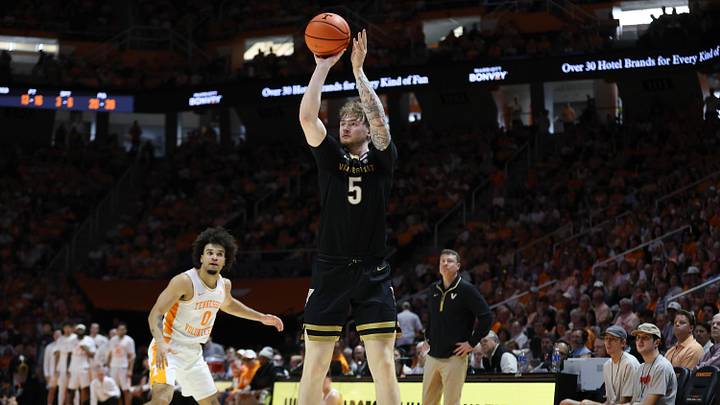
Last season at Vanderbilt, where Nickel shot 40% from three on 275 attempts, head coach Mark Byington often ran sets for his standout shooter. And Nickel excelled. He made up for his lack of high-level athleticism with craftiness, IQ, and sheer determination to do one thing: keep moving.

Even when plays broke down, Nickel continued to move. He’d cut through the paint to the other side to get open. If he didn’t get the ball there, he’d then run around a few screens to get the wings to come up. And if that wasn’t there, do you know what he did? You guessed it, he kept moving. Sure enough, Nickel would eventually find himself open many times.
But all of that moving does nothing if you can’t do anything with it. If and when he did get the ball, he was very good at making a quick decision. He has the confidence and quick release to let the ball fly instantly if the defender isn’t close enough to contest. And sometimes, even if the defender were there, he’d get the shot off. It doesn’t always look like a great shot. But different shots are good for different players. And for Nickel, sometimes, a contested three is a solid shot. That’s how good a shooter he is.
Adding to the fact that he has maybe the quickest release in this year’s draft is the ability for him to shoot on a 1-2 step and off of a hop. This does multiple things. It allows him to shoot regardless of the situation. How close the defender is or where they are coming from matters less. As if he’s coming off a V-cut, a screen, or a lateral step. He’s become adept at getting his feet ready and maintaining a good base and balance regardless of his footwork going into a shot. Another thing it allows him to do is attack closeouts differently.
When you are as good a shooter as Nickel is, being able to attack close outs can take you over the top. And defenders will close out aggressively to force him off the line. When they do, he can catch the ball on a hop and attack going either way.
If a player can only catch one in a 1-2 step, as is traditionally taught, their drives are a lot easier going in the way of whichever foot comes down second. As a righty, you catch the ball with the left foot coming down and then the right foot coming down and forward shortly after as you set up for a shot.
When attacking the basket of that setup, going right feels easy and natural. Going left, though, becomes a bit harder. For many elite athletes with explosive first steps and a certain level of flexibility, this matters less. For players like Nickel who don’t necessarily possess either of those things, being able to play off a hop helps a lot.
When defenders sprint at him, and they will, his aforementioned ability to make quick decisions also allows him to put the ball on the floor when necessary. And when he gets past that initial closeout, he’s solid.
He won’t be rising up for many dunks. Nor will he be reaching into a deep bag of tricks and pulling out Euro steps and spin moves. But Nickel possesses an adequate mid-range pull-up jumper and a nice floater game, which allows him to keep defenses somewhat honest. Opposing teams will still prioritize running him off the line, but he has the potential to be more than just a shooter.
Nickel is also a willing and reliable passer. He isn’t a playmaker. But he can routinely make connective plays that set up his playmakers to do the playmaking. Nickel also does another thing the Knicks really like. He protects the ball.
While his assist numbers were low (1.2 per game this past season), so were his turnovers (0.7). New York has long prioritized winning the possession battle. It’s something the entire league is starting to get better at. Limiting turnovers is a big part of that, and the Knicks can rest assured knowing Nickel shouldn’t have problems there.
Defense
Nickel’s shooting, ability to attack closeouts, and limited but turnover-averse connective passing make him an intriguing offensive role player. But what will likely determine his playing time will be the work he can put in on the defensive end. As is the case for many rookies, he’ll have a learning curve there. He’ll play against stronger, bigger, faster, more skilled, and smarter players.
One thing Nickel has going for him is that he tries. He battles. The 22-year-old doesn’t shy away from defensive assignments. And he fights for loose balls. Even when he gives up a basket, it isn’t because there’s a lack of care or effort.
But his defense will still be a concern. He’s by no means terrible on that end of the floor. There are and will continue to be worse defenders in the league. Nickel, though, isn’t a great defender, and there aren’t many different ways to say that. There also aren’t many ways around that, given his physical abilities.

Nickel tries and has a good feel for where he should be defensively most of the time. When guarding players of similar size and athleticism, he can hold his own. But when switched on to much bigger and stronger players, he can struggle. When switched on to quick and shifty players, he really struggles. Not only does Nickel lack raw speed and explosiveness, but he also doesn’t possess the flexibility and footwork to keep up with explosive players.
When on the court, opposing teams will go to great lengths to make him switch onto their guards. Nickel and his teammates will have to fight hard to keep him out of those actions. And when they fail to do so, Nickel must get better at being a bit more reliable in providing some resistance there.
Adding to some of his defensive concerns is his lack of defensive playmaking. Average and even subpar defenders can make up for some of their defensive deficiencies by getting deflections, forcing turnovers, and blocking shots at the rim. During his time in college, Nickel did very little of that.
Overall, Nickel's willingness to give multiple efforts, along with possessing decent positional size and defensive IQ, should make him good enough.
Outlook
When drafting a player in the second round, all you look for is one translatable skill that they're elite at. And Nickel has that.
Shooting has, and always will, play at every level of the sport. Starting from day one, Nickel’s shooting will give him a chance to play. The quick release, the movement shooting, and deep range will do wonders for him, but also for Jalen Brunson, Karl-Anthony Towns, and whoever else he plays with.
Running off-ball sets for Nickel while Brunson goes to work should give the latter a lot of room to work with. Nickel also spent time last season setting screens and popping off of them. If he could replicate that action with Brunson, it could make life easier for both parties.
You can also have Nickel playing off of Towns’ playmaking as well. Offensively, Nickel should be able to replicate a good portion of what Shamet gave them. In fact, there’s an argument to be made that he’s already a more versatile shooter given his range and movement.
Another thing that should benefit him is Mike Brown’s system. While Brown had to tinker with his system a bit throughout the year to better fit his roster, at his core, Brown still believes in and loves player movement. Even when Brown isn’t running set plays, cutting, movement, and off-ball screens are all fundamental to his offense.
Nickel’s college tape shows that he has a good grasp of spacing and movement. He knows where to be, not only to get himself shots, but to open things up for his teammates. I think Brown will love seeing that and also find ways to help him become even better at that.
Like so many other rookies, defense will dictate a lot. Offense will get him on the court early on. But just how long he stays in games will be determined by his defense. He doesn’t need to be elite on that end of the floor.
But if he can just give the Knicks some effort, his size and length should be enough to make up for his poor lateral quickness. New York has young players who may need to step up, but it could be that the newly drafted second-round rookie who ends up getting a larger role than expected.
 Add us as a preferred source on Google
A freelance writer with more than a decade of experience in digital sports media, Kento Kato covers the New York Knicks for OnSI and SB Nation's Posting and Toasting. His work has spanned Knicks coverage, esports, and the intersection of sports and technology, with previous bylines at FanSided and SportTechie. Kento's Knicks coverage has also been featured by Yahoo Sports, MSN and Yardbarker.
Follow kento_kato_