%22%3E%0A%3Cpath%20d%3D%22M0%209.71558H5.25311L11.2311%2017.1339V9.71558H16.8043V26.5199H11.8148L5.57319%2018.7626V26.5199H0V9.71558Z%22%20fill%3D%22white%22%2F%3E%0A%3Cpath%20d%3D%22M18.2734%2020.0427V19.9957C18.2734%2016.0794%2021.0789%2013.1045%2025.0234%2013.1045C29.6834%2013.1045%2031.8393%2016.343%2031.8393%2020.3346C31.8393%2020.6264%2031.8393%2020.9559%2031.811%2021.2478H23.3853C23.7713%2022.3963%2024.6845%2022.9988%2025.8613%2022.9988C26.8498%2022.9988%2027.6594%2022.5469%2028.5255%2021.6526L31.4533%2023.9779C30.1541%2025.6536%2028.309%2026.8304%2025.4753%2026.8304C21.1824%2026.8304%2018.2734%2024.1191%2018.2734%2020.0333V20.0427ZM26.8686%2018.8377C26.7462%2017.5856%2026.0025%2016.8702%2025.0422%2016.8702C24.082%2016.8702%2023.4795%2017.6421%2023.31%2018.8377H26.8592H26.8686Z%22%20fill%3D%22white%22%2F%3E%0A%3Cpath%20d%3D%22M31.7451%2013.4152H36.9512L38.2974%2018.6966L39.879%2013.3682H44.2283L45.8381%2018.7437L47.2314%2013.4152H52.3716L48.3611%2026.6139H43.8047L42.0536%2020.9936L40.2555%2026.6139H35.7179L31.7545%2013.4152H31.7451Z%22%20fill%3D%22white%22%2F%3E%0A%3Cpath%20d%3D%22M64.6375%2020.5701L58.3018%209.71558H64.5904L67.4712%2015.2417L70.3802%209.71558H76.5935L70.2578%2020.4948V26.5199H64.6375V20.5701Z%22%20fill%3D%22white%22%2F%3E%0A%3Cpath%20d%3D%22M74.0709%2020.0145V19.9674C74.0709%2016.2677%2077.14%2013.1045%2081.4611%2013.1045C85.7822%2013.1045%2088.8041%2016.2206%2088.8041%2019.9204V19.9674C88.8041%2023.6672%2085.7351%2026.8304%2081.4046%2026.8304C77.0741%2026.8304%2074.0615%2023.7049%2074.0615%2020.0145H74.0709ZM83.5793%2020.0145V19.9674C83.5793%2018.6683%2082.619%2017.6421%2081.414%2017.6421C80.209%2017.6421%2079.3052%2018.6777%2079.3052%2019.9204V19.9674C79.3052%2021.2666%2080.2655%2022.2927%2081.4611%2022.2927C82.6567%2022.2927%2083.5698%2021.2572%2083.5698%2020.0145H83.5793Z%22%20fill%3D%22white%22%2F%3E%0A%3Cpath%20d%3D%22M90.1318%2013.4151H95.5826V16.0605C96.3264%2014.2812%2097.5314%2013.1327%2099.6872%2013.2268V19.0165H99.113C96.8065%2019.0165%2095.5826%2020.2875%2095.5826%2023.1964V26.5385H90.1318V13.4339V13.4151Z%22%20fill%3D%22white%22%2F%3E%0A%3Cpath%20d%3D%22M100.723%209H106.173V17.4539L108.979%2013.4247H114.91L110.805%2018.7531L114.985%2026.5292H109.148L107.256%2022.9236L106.173%2024.3169V26.5292H100.723V9Z%22%20fill%3D%22white%22%2F%3E%0A%3Cpath%20d%3D%22M121.895%209.71558H127.515V16.0042L132.288%209.71558H138.821L132.966%2017.0116L138.944%2026.5199H132.25L128.965%2021.1915L127.524%2022.9425V26.5199H121.904V9.71558H121.895Z%22%20fill%3D%22white%22%2F%3E%0A%3Cpath%20d%3D%22M139.377%2013.4152H144.828V15.2415C145.666%2014.1589%20146.993%2013.1045%20148.838%2013.1045C151.597%2013.1045%20153.329%2014.9308%20153.329%2017.8775V26.5197H147.878V19.6285C147.878%2018.4988%20147.21%2017.8492%20146.391%2017.8492C145.571%2017.8492%20144.828%2018.4988%20144.828%2019.6285V26.5197H139.377V13.4152Z%22%20fill%3D%22white%22%2F%3E%0A%3Cpath%20d%3D%22M154.91%209H160.549V12.4832H154.91V9ZM155.004%2013.4152H160.455V26.5198H155.004V13.4152Z%22%20fill%3D%22white%22%2F%3E%0A%3Cpath%20d%3D%22M161.82%2020.0428V19.9957C161.82%2016.3242%20164.701%2013.1328%20168.975%2013.1328C171.856%2013.1328%20173.899%2014.6203%20174.906%2016.7573L170.99%2018.9696C170.538%2018.1317%20169.954%2017.6516%20169.069%2017.6516C167.921%2017.6516%20167.055%2018.6589%20167.055%2019.9581V20.0052C167.055%2021.3702%20167.921%2022.3587%20169.003%2022.3587C169.964%2022.3587%20170.519%2021.8786%20171.046%2021.0407L175.01%2023.3001C173.833%2025.4842%20171.837%2026.8775%20168.721%2026.8775C164.739%2026.8775%20161.83%2023.7332%20161.83%2020.0616L161.82%2020.0428Z%22%20fill%3D%22white%22%2F%3E%0A%3Cpath%20d%3D%22M175.941%209H181.392V17.4539L184.198%2013.4247H190.129L186.024%2018.7531L190.204%2026.5292H184.367L182.475%2022.9236L181.392%2024.3169V26.5292H175.941V9Z%22%20fill%3D%22white%22%2F%3E%0A%3Cpath%20d%3D%22M189.601%2024.9382L191.446%2021.841C193.028%2022.8201%20194.807%2023.3002%20196.295%2023.3002C196.822%2023.3002%20197.085%2023.1778%20197.085%2022.8671V22.8201C197.085%2022.5565%20196.85%2022.387%20195.523%2022.0481C192.209%2021.2291%20190.166%2020.3441%20190.166%2017.6328V17.5858C190.166%2014.705%20192.473%2013.0952%20195.88%2013.0952C198.046%2013.0952%20200.173%2013.6507%20201.764%2014.6109L200.032%2017.8494C198.639%2017.0774%20196.963%2016.6255%20195.852%2016.6255C195.325%2016.6255%20195.08%2016.7667%20195.08%2017.0303V17.0774C195.08%2017.341%20195.372%2017.5105%20196.69%2017.8494C200.004%2018.6684%20202%2019.5816%20202%2022.2646V22.3117C202%2025.1642%20199.863%2026.8211%20196.314%2026.8211C193.772%2026.8211%20191.465%2026.1715%20189.592%2024.9288L189.601%2024.9382Z%22%20fill%3D%22white%22%2F%3E%0A%3Cpath%20fill-rule%3D%22evenodd%22%20clip-rule%3D%22evenodd%22%20d%3D%22M211.368%204.36764C217.191%20-1.45588%20226.632%20-1.45588%20232.456%204.36764C238.279%2010.1912%20238.279%2019.6324%20232.456%2025.4559L221.912%2036L211.368%2025.4559C205.544%2019.6324%20205.544%2010.1912%20211.368%204.36764ZM214.009%207.55761C213.948%207.86849%20213.916%208.39718%20213.916%209.14566V10.4189C213.916%2011.1832%20213.948%2011.7198%20214.013%2012.0267C214.078%2012.3317%20214.278%2012.6168%20214.617%2012.8762C214.956%2013.1376%20215.403%2013.3316%20215.958%2013.4623C216.512%2013.593%20217.1%2013.6584%20217.837%2013.6584C218.573%2013.6584%20219.217%2013.591%20219.769%2013.4524C220.322%2013.3158%20220.761%2013.1178%20221.086%2012.8604C221.411%2012.6029%20221.605%2012.3178%20221.666%2012.0069C221.728%2011.6961%20221.759%2011.1674%20221.759%2010.4189V9.14566C221.759%208.38134%20221.728%207.84473%20221.662%207.53781C221.597%207.23287%20221.397%206.94971%20221.058%206.68834C220.72%206.42696%20220.272%206.23291%20219.718%206.10223C219.163%205.97154%20218.536%205.90619%20217.839%205.90619C217.102%205.90619%20216.459%205.97352%20215.906%206.11213C215.352%206.24875%20214.914%206.44677%20214.589%206.70418C214.265%206.9616%20214.071%207.24673%20214.009%207.55761ZM219.276%2024.8638C222.876%2024.8638%20224.557%2024.2064%20224.557%2021.862V21.858V21.3155C224.557%2019.6581%20223.516%2018.971%20220.252%2018.3136C219.278%2018.1136%20218.908%2017.9136%20218.908%2017.3136V16.9414C218.908%2016.6543%20219.177%2016.5117%20219.413%2016.5117C219.749%2016.5117%20219.918%2016.7137%20219.918%2016.9414V18.1136H224.391V17.3988C224.391%2015.4563%20223.347%2014.4266%20219.177%2014.4266C216.15%2014.4266%20213.896%2015.3414%20213.896%2017.3711V17.7433C213.896%2019.5155%20214.805%2020.3155%20218.201%2021.0303C218.28%2021.0472%20218.355%2021.063%20218.427%2021.0781C219.329%2021.2674%20219.647%2021.3341%20219.647%2021.9174V22.2897C219.647%2022.6619%20219.546%2022.8045%20219.142%2022.8045C218.67%2022.8045%20218.637%2022.5471%20218.637%2022.262V21.2897H213.894V21.7471C213.894%2024.149%20215.476%2024.8638%20219.276%2024.8638ZM225.424%2024.5569H229.925V14.7355H225.424V24.5569ZM226.955%2013.5019H229.925V6.06064H227.092V9.411L225.193%206.06064H222.359V13.5019H225.193V10.1199L226.955%2013.5019ZM218.269%2012.152C218.204%2012.2688%20218.055%2012.3262%20217.825%2012.3262L217.827%2012.3282C217.604%2012.3282%20217.459%2012.2767%20217.398%2012.1758C217.336%2012.0748%20217.305%2011.8074%20217.305%2011.3758V7.90068C217.305%207.51852%20217.352%207.28684%20217.445%207.20962C217.538%207.13239%20217.675%207.09279%20217.851%207.09279C218.059%207.09279%20218.198%207.14031%20218.265%207.23734C218.332%207.33239%20218.366%207.55416%20218.366%207.90068V11.3203C218.366%2011.7579%20218.334%2012.0352%20218.269%2012.152Z%22%20fill%3D%22white%22%2F%3E%0A%3C%2Fg%3E%0A%3Cdefs%3E%0A%3CclipPath%20id%3D%22clip0_15229_1584%22%3E%0A%3Crect%20width%3D%22237%22%20height%3D%2236%22%20fill%3D%22white%22%2F%3E%0A%3C%2FclipPath%3E%0A%3C%2Fdefs%3E%0A%3C%2Fsvg%3E%0A)
Knicks Avoiding Second Apron Is More Harmful Than Entering It
In this story:
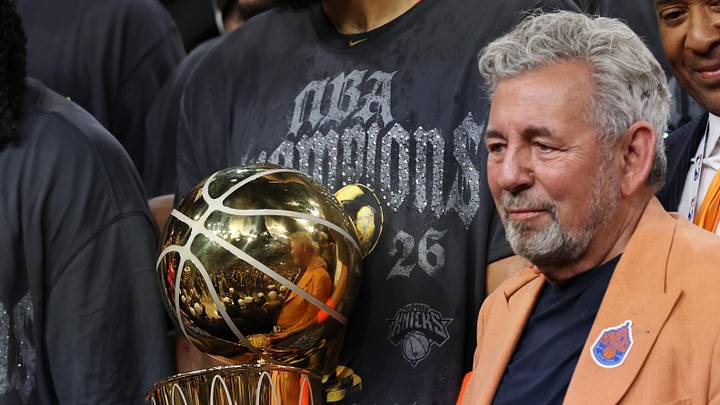
New York Knicks fans only got to bask in the glory of the championship for about a week before concerns turned to the team’s immediate future, as James Dolan publicly denounced going into the second apron.
It’s worth noting that it’s not as if the Knicks can’t go into the second apron—they can. The Knicks can re-sign Robinson and Shamet to market-value deals and keep the rotation of the championship together; doing so will just send the Knicks above the second apron, where they’d be subject to the harsh team-building penalties.
The Athletic’s Fred Katz reported on Friday that the Knicks front office would prefer to go into the second apron if it means keeping the team together, but no one has been able to change Dolan’s mind yet.
While many fans are upset about this development and what it means for the reigning champions’ bench next season, there’s some who are more accepting, citing some of those harsh second apron penalties as too severe. It’s understandable, as being above the second apron would indeed hamper the Knicks’ abilities to make certain trades or free agent signings.
However, it takes just a bit of nuance and time to reason that some of those concerns shouldn’t be concerns at all. Below, we’ll break down some of the arguments for avoiding the second apron and debunk them, explaining why it’s better to spend the money now to keep the team together.
Claim 1: Top-end talent is more important than a deep bench
The Knicks’ top six players — the starting five, plus Miles McBride — are all locked into contract for next season. Some would argue that as long as those top six are in place, the other bench pieces are replaceable.
However, the last two postseasons have shown that deep benches are as valuable as ever in today’s NBA. Deep benches can not only keep starters’ minutes low during the regular season, they provide flexibility and relief during the postseason. A deep bench allows players to withstand the rigors of modern basketball.
The Oklahoma City Thunder and Indiana Pacers regularly went nine, 10, even 11 players deep in the 2025 Finals. The Knicks’ bench consistently swung games for them last season. Losing that depth hurts optionality and has ripple effects up and down the roster.
Claim 2: The Knicks can easily replace their bench
Letting Robinson and Shamet walk in free agency would be worthwhile if the Knicks had the means to easily replace them. They don’t.
If the Knicks remain under the second apron, their best free-agency spending tool is the taxpayer mid-level exception, worth about $6 million next season. They could use that to find a decent bench player, perhaps a backup center, but it would mean letting Shamet walk. Or perhaps they could use the TPMLE on Shamet, but it would mean using the veteran’s minimum to replace Robinson.
The Knicks’ front office has earned a lot of trust in their ability to find value up and down the roster, but put simply, there’s a reason why Robinson could command a $15 million salary next season or why Shamet could command more than the TPMLE: they’re better players.
Shamet was frequently called the most valuable veteran’s minimum signing in the league last season. Betting on hitting like that again is a tall task for the Knicks’ front office.
Going into the second apron would only allow the Knicks to use the veteran’s minimum to sign free agents. That isn’t as damaging, however, when the bench would already be filled out with players like McBride, Robinson, Shamet, Alvarado (if he stays), and Mohamed Diawara.
Claim 3: The Knicks will have no flexibility to make moves if something goes wrong
There is concern that being in the second apron will leave a team high-and-dry if something goes awry, like, say, an injury.
If one of the Knicks’ key pieces were to get injured, the Knicks would have virtually no way to find a replacement. Teams in the second apron cannot aggregate salaries in trades and they cannot take on more money than they’re sending out in a trade. In essence, the Knicks would be limited to 1-to-1 trades where they’d have to take back a lower-salaried player.
Injuries are a harsh reality of the NBA. If one of the Knicks’ best players suffered a season-ending injury, the reality is that the team could probably not withstand it and their hopes of being repeat champions would take a massive hit. That is true, regardless of whether a team is above or below the second apron.
Second, there aren’t many examples in NBA history of teams trading for meaningful injury replacements after one of their best players got hurt. Admittedly, this is a tough transaction type to search, but nothing comes to mind. (Yell at me on X if I’m missing someone obvious).
If one of the Knicks’ core rotation players got injured next season, who would they trade to find a replacement? Likely not the injured player. Would it mean trading another rotation piece, just to add someone new to replace the injured player? One of the benefits of being below the second apron is the ability to aggregate contracts in a trade. But doing so in this scenario just means losing more depth to find an injury replacement.
In another scenario, there is concern that if the Knicks fall out of contention, they will be stuck with an expensive roster that will be harder to unload. This is a concern for all expensive championship contenders. There is the possibility that something doesn’t add up, and suddenly, the team needs to find a way to pivot, without many options.
If things got so dire for the Knicks that they needed to pivot, then they will have to take a deep breath and do what needs to be done to offload pieces. That could mean trading one of their starting five players, or that could mean attaching assets to offload a big contract.
If the team is in such a bad place where they are not worth keeping together anymore, then fans shouldn’t worry about how they break up the team.
Claim 4: The Knicks need to reserve their second apron years for expensive extensions down the line
This is a reasonable argument. For as expensive as the Knicks could be if they retain everyone this offseason, they are set to become even more expensive in a few years.
Karl-Anthony Towns is extension-eligible this offseason and could command well over $200 million. McBride is also due for an extension that will likely average at least triple the $3.9 million he’s set to make this season. Josh Hart is also soon to be extension-eligible. And then there’s Jalen Brunson, who after taking a four-year, $156 million extension in 2024 rather than waiting for a $269 million contract in 2025, seems unlikely to take another discount.
If all of those extensions happen, it will become untenable to keep the team together for long.
Here’s the thing: that is a concern for later on down the road. Those extensions will not kick in for at least a year or, in some cases, two years from now. Nobody knows what the team will look like in two years or how some of these players will age.
The Knicks have a chance to repeat as champions this season. They can keep together a bench that goes 10-deep, even if it is costly from a tax standpoint and in their transactional flexibility. The Knicks would not be restricted from improving their team if they go into the second apron; it would just be much harder.
It’s worth dealing with that headache to keep a championship team together, regardless of the potential concerns.
 Add us as a preferred source on Google
Scott Davis has covered sports, with a heavy focus on the New York Knicks and NBA, for over a decade. His work has appeared on Business Insider, The Sporting News, Athlon Sports, SB Nation, and FanSided, covering everything from free agency news, blockbuster trades, in-depth analysis, and inside scoops on historic seasons and breakout stars.
Follow WScottDavis