%22%3E%0A%3Cpath%20d%3D%22M0%209.71558H5.25311L11.2311%2017.1339V9.71558H16.8043V26.5199H11.8148L5.57319%2018.7626V26.5199H0V9.71558Z%22%20fill%3D%22white%22%2F%3E%0A%3Cpath%20d%3D%22M18.2734%2020.0427V19.9957C18.2734%2016.0794%2021.0789%2013.1045%2025.0234%2013.1045C29.6834%2013.1045%2031.8393%2016.343%2031.8393%2020.3346C31.8393%2020.6264%2031.8393%2020.9559%2031.811%2021.2478H23.3853C23.7713%2022.3963%2024.6845%2022.9988%2025.8613%2022.9988C26.8498%2022.9988%2027.6594%2022.5469%2028.5255%2021.6526L31.4533%2023.9779C30.1541%2025.6536%2028.309%2026.8304%2025.4753%2026.8304C21.1824%2026.8304%2018.2734%2024.1191%2018.2734%2020.0333V20.0427ZM26.8686%2018.8377C26.7462%2017.5856%2026.0025%2016.8702%2025.0422%2016.8702C24.082%2016.8702%2023.4795%2017.6421%2023.31%2018.8377H26.8592H26.8686Z%22%20fill%3D%22white%22%2F%3E%0A%3Cpath%20d%3D%22M31.7451%2013.4152H36.9512L38.2974%2018.6966L39.879%2013.3682H44.2283L45.8381%2018.7437L47.2314%2013.4152H52.3716L48.3611%2026.6139H43.8047L42.0536%2020.9936L40.2555%2026.6139H35.7179L31.7545%2013.4152H31.7451Z%22%20fill%3D%22white%22%2F%3E%0A%3Cpath%20d%3D%22M64.6375%2020.5701L58.3018%209.71558H64.5904L67.4712%2015.2417L70.3802%209.71558H76.5935L70.2578%2020.4948V26.5199H64.6375V20.5701Z%22%20fill%3D%22white%22%2F%3E%0A%3Cpath%20d%3D%22M74.0709%2020.0145V19.9674C74.0709%2016.2677%2077.14%2013.1045%2081.4611%2013.1045C85.7822%2013.1045%2088.8041%2016.2206%2088.8041%2019.9204V19.9674C88.8041%2023.6672%2085.7351%2026.8304%2081.4046%2026.8304C77.0741%2026.8304%2074.0615%2023.7049%2074.0615%2020.0145H74.0709ZM83.5793%2020.0145V19.9674C83.5793%2018.6683%2082.619%2017.6421%2081.414%2017.6421C80.209%2017.6421%2079.3052%2018.6777%2079.3052%2019.9204V19.9674C79.3052%2021.2666%2080.2655%2022.2927%2081.4611%2022.2927C82.6567%2022.2927%2083.5698%2021.2572%2083.5698%2020.0145H83.5793Z%22%20fill%3D%22white%22%2F%3E%0A%3Cpath%20d%3D%22M90.1318%2013.4151H95.5826V16.0605C96.3264%2014.2812%2097.5314%2013.1327%2099.6872%2013.2268V19.0165H99.113C96.8065%2019.0165%2095.5826%2020.2875%2095.5826%2023.1964V26.5385H90.1318V13.4339V13.4151Z%22%20fill%3D%22white%22%2F%3E%0A%3Cpath%20d%3D%22M100.723%209H106.173V17.4539L108.979%2013.4247H114.91L110.805%2018.7531L114.985%2026.5292H109.148L107.256%2022.9236L106.173%2024.3169V26.5292H100.723V9Z%22%20fill%3D%22white%22%2F%3E%0A%3Cpath%20d%3D%22M121.895%209.71558H127.515V16.0042L132.288%209.71558H138.821L132.966%2017.0116L138.944%2026.5199H132.25L128.965%2021.1915L127.524%2022.9425V26.5199H121.904V9.71558H121.895Z%22%20fill%3D%22white%22%2F%3E%0A%3Cpath%20d%3D%22M139.377%2013.4152H144.828V15.2415C145.666%2014.1589%20146.993%2013.1045%20148.838%2013.1045C151.597%2013.1045%20153.329%2014.9308%20153.329%2017.8775V26.5197H147.878V19.6285C147.878%2018.4988%20147.21%2017.8492%20146.391%2017.8492C145.571%2017.8492%20144.828%2018.4988%20144.828%2019.6285V26.5197H139.377V13.4152Z%22%20fill%3D%22white%22%2F%3E%0A%3Cpath%20d%3D%22M154.91%209H160.549V12.4832H154.91V9ZM155.004%2013.4152H160.455V26.5198H155.004V13.4152Z%22%20fill%3D%22white%22%2F%3E%0A%3Cpath%20d%3D%22M161.82%2020.0428V19.9957C161.82%2016.3242%20164.701%2013.1328%20168.975%2013.1328C171.856%2013.1328%20173.899%2014.6203%20174.906%2016.7573L170.99%2018.9696C170.538%2018.1317%20169.954%2017.6516%20169.069%2017.6516C167.921%2017.6516%20167.055%2018.6589%20167.055%2019.9581V20.0052C167.055%2021.3702%20167.921%2022.3587%20169.003%2022.3587C169.964%2022.3587%20170.519%2021.8786%20171.046%2021.0407L175.01%2023.3001C173.833%2025.4842%20171.837%2026.8775%20168.721%2026.8775C164.739%2026.8775%20161.83%2023.7332%20161.83%2020.0616L161.82%2020.0428Z%22%20fill%3D%22white%22%2F%3E%0A%3Cpath%20d%3D%22M175.941%209H181.392V17.4539L184.198%2013.4247H190.129L186.024%2018.7531L190.204%2026.5292H184.367L182.475%2022.9236L181.392%2024.3169V26.5292H175.941V9Z%22%20fill%3D%22white%22%2F%3E%0A%3Cpath%20d%3D%22M189.601%2024.9382L191.446%2021.841C193.028%2022.8201%20194.807%2023.3002%20196.295%2023.3002C196.822%2023.3002%20197.085%2023.1778%20197.085%2022.8671V22.8201C197.085%2022.5565%20196.85%2022.387%20195.523%2022.0481C192.209%2021.2291%20190.166%2020.3441%20190.166%2017.6328V17.5858C190.166%2014.705%20192.473%2013.0952%20195.88%2013.0952C198.046%2013.0952%20200.173%2013.6507%20201.764%2014.6109L200.032%2017.8494C198.639%2017.0774%20196.963%2016.6255%20195.852%2016.6255C195.325%2016.6255%20195.08%2016.7667%20195.08%2017.0303V17.0774C195.08%2017.341%20195.372%2017.5105%20196.69%2017.8494C200.004%2018.6684%20202%2019.5816%20202%2022.2646V22.3117C202%2025.1642%20199.863%2026.8211%20196.314%2026.8211C193.772%2026.8211%20191.465%2026.1715%20189.592%2024.9288L189.601%2024.9382Z%22%20fill%3D%22white%22%2F%3E%0A%3Cpath%20fill-rule%3D%22evenodd%22%20clip-rule%3D%22evenodd%22%20d%3D%22M211.368%204.36764C217.191%20-1.45588%20226.632%20-1.45588%20232.456%204.36764C238.279%2010.1912%20238.279%2019.6324%20232.456%2025.4559L221.912%2036L211.368%2025.4559C205.544%2019.6324%20205.544%2010.1912%20211.368%204.36764ZM214.009%207.55761C213.948%207.86849%20213.916%208.39718%20213.916%209.14566V10.4189C213.916%2011.1832%20213.948%2011.7198%20214.013%2012.0267C214.078%2012.3317%20214.278%2012.6168%20214.617%2012.8762C214.956%2013.1376%20215.403%2013.3316%20215.958%2013.4623C216.512%2013.593%20217.1%2013.6584%20217.837%2013.6584C218.573%2013.6584%20219.217%2013.591%20219.769%2013.4524C220.322%2013.3158%20220.761%2013.1178%20221.086%2012.8604C221.411%2012.6029%20221.605%2012.3178%20221.666%2012.0069C221.728%2011.6961%20221.759%2011.1674%20221.759%2010.4189V9.14566C221.759%208.38134%20221.728%207.84473%20221.662%207.53781C221.597%207.23287%20221.397%206.94971%20221.058%206.68834C220.72%206.42696%20220.272%206.23291%20219.718%206.10223C219.163%205.97154%20218.536%205.90619%20217.839%205.90619C217.102%205.90619%20216.459%205.97352%20215.906%206.11213C215.352%206.24875%20214.914%206.44677%20214.589%206.70418C214.265%206.9616%20214.071%207.24673%20214.009%207.55761ZM219.276%2024.8638C222.876%2024.8638%20224.557%2024.2064%20224.557%2021.862V21.858V21.3155C224.557%2019.6581%20223.516%2018.971%20220.252%2018.3136C219.278%2018.1136%20218.908%2017.9136%20218.908%2017.3136V16.9414C218.908%2016.6543%20219.177%2016.5117%20219.413%2016.5117C219.749%2016.5117%20219.918%2016.7137%20219.918%2016.9414V18.1136H224.391V17.3988C224.391%2015.4563%20223.347%2014.4266%20219.177%2014.4266C216.15%2014.4266%20213.896%2015.3414%20213.896%2017.3711V17.7433C213.896%2019.5155%20214.805%2020.3155%20218.201%2021.0303C218.28%2021.0472%20218.355%2021.063%20218.427%2021.0781C219.329%2021.2674%20219.647%2021.3341%20219.647%2021.9174V22.2897C219.647%2022.6619%20219.546%2022.8045%20219.142%2022.8045C218.67%2022.8045%20218.637%2022.5471%20218.637%2022.262V21.2897H213.894V21.7471C213.894%2024.149%20215.476%2024.8638%20219.276%2024.8638ZM225.424%2024.5569H229.925V14.7355H225.424V24.5569ZM226.955%2013.5019H229.925V6.06064H227.092V9.411L225.193%206.06064H222.359V13.5019H225.193V10.1199L226.955%2013.5019ZM218.269%2012.152C218.204%2012.2688%20218.055%2012.3262%20217.825%2012.3262L217.827%2012.3282C217.604%2012.3282%20217.459%2012.2767%20217.398%2012.1758C217.336%2012.0748%20217.305%2011.8074%20217.305%2011.3758V7.90068C217.305%207.51852%20217.352%207.28684%20217.445%207.20962C217.538%207.13239%20217.675%207.09279%20217.851%207.09279C218.059%207.09279%20218.198%207.14031%20218.265%207.23734C218.332%207.33239%20218.366%207.55416%20218.366%207.90068V11.3203C218.366%2011.7579%20218.334%2012.0352%20218.269%2012.152Z%22%20fill%3D%22white%22%2F%3E%0A%3C%2Fg%3E%0A%3Cdefs%3E%0A%3CclipPath%20id%3D%22clip0_15229_1584%22%3E%0A%3Crect%20width%3D%22237%22%20height%3D%2236%22%20fill%3D%22white%22%2F%3E%0A%3C%2FclipPath%3E%0A%3C%2Fdefs%3E%0A%3C%2Fsvg%3E%0A)
Projecting the Knicks' Full Rotation in Second Season Under Mike Brown
In this story:
It’s almost that time of year again. Summer winds down and basketball creeps back in. And with most of the offseason moves behind us, it's time to start thinking about real on-court factors like rotations.
Rotation building isn’t easy, and I don’t envy Mike Brown or his coaching staff one bit: having to manage minutes, lineup combinations, and talent barely scratches the surface of what goes into it. But with everything we do know about those factors, we can still get a very good idea of what this rotation will look like.
Two key factors
Before I get into the specific rotation itself, there are two crucial principles that need to be applied to any understanding of who the Knicks will have on the court.
Staggering stars
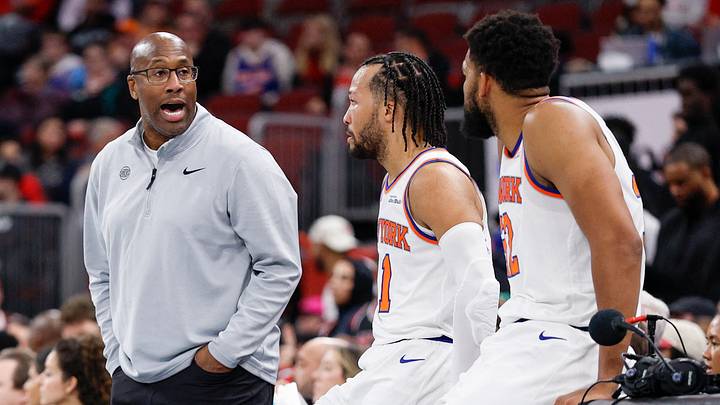
The most obvious starting point is New York’s two stars, Jalen Brunson and Karl-Anthony Towns. Brown’s lineups throughout the regular season and into the postseason reflected a clear vision for how he deploys his stars, one I don’t expect to change heading into next season, even accounting for the brief adjustment made during the first round.

Brown made it clear that he'll split Towns and Brunson's time across a game. Specifically, he looks to have Brunson play much if not all of the first quarter, with Towns staggered out. The second quarter belongs to Towns's group, with Brunson off the floor. Once Brunson returns, Towns might stay on for a bit or head to the bench. This same pattern repeats itself, with Towns earning a longer leash in fourth quarters if needed. Game situation and foul trouble factor heavily into this, and matchups might impact it too, but for the most part, this rotation of Brown's stars is his go-to.
This isn't to say that Brunson and Towns won't play together outside of the starting lineup—they will. But their time together may be limited compared to the other groupings. I do wonder if Brown wants to explore this, though, using OG Anunoby or Mikal Bridges as a first option in certain stretches while Brunson and Towns are both off the floor.
Wing flexibility
The trio of Bridges, Anunoby, and Josh Hart allows for flexible lineups, since Brown doesn't shy away from playing any of them at the four, or going small with multiple guards on the floor.

Hart at the four signals this flexibility, serving as a fantastic rebounding guard in the 100th percentile(!) in defensive rebounding percentage at his position. With Hart at the four, the Knicks continue to win on the glass through his strong rebounding influence. Across the 318 minutes with both Anunoby and Bridges off the floor, opponents had just a 21% offensive rebound percentage, surprisingly lower than any other combination of the three.
Building the rotation
Starting Lineup: Brunson-Hart-Bridges-Anunoby-Towns
New York's starting five drew plenty of attention across two seasons. By the end of last season, they seemed to have figured it out.
Hart found his shot enough to discourage teams from guarding him with their center. Brown’s offensive attack proved to be stronger than the previous year. Because of these developments, the starting lineup gets more leeway, and Hart becomes the perfect player to play in a spaced floor when Towns draws the center matchup in this lineup. Hart's rebounding, pace-pushing, point-of-attack defense, and handling all fill the gaps alongside the other wings. Overall, Brown will stick with the lineup he ended last season with.
Two subs: Brunson-McBride-Hart-Bridges-Drummond (Anunoby, Towns out, McBride, Drummond in) — approx. 6:00 remaining in the first quarter
Brown wants to test different combinations of point-of-attack defenders and movement shooters, Shamet and/or McBride, with Brunson. The wings checking out or staying on the floor can vary based on what Brown wants at this stage. Anunoby checks out early, leaving Hart and Bridges on the floor. Brown gives Brunson full rein over the offense here, spamming pick-and-roll and hunting matchups. Drummond simply steps into the role Robinson had alongside Brunson, serving as a possession-maxing big, there to clean both ends of the glass and set strong screens to free up the star point guard.
Three subs: Brunson-Shamet-Anunoby-Diawara-Drummond (Hart, Bridges, McBride out, Anunoby, Diawara, Shamet in) — approx. 3:00 remaining in the first quarter
Diawara gets his first minutes on the floor towards the end of the first quarter, not sure if Brown does this, but I expect the minutes for the higher rotation guys to soften up in the first half. I also expect Brown to cycle back in Anunoby, given his upcoming second quarter stint, and his tendency to do that.
Second unit: Alvarado-Bridges-Anunoby-Diawara-Towns — beginning of second quarter
Alvarado checks in for Brunson and joins Anunoby, Bridges and Diawara, a defensive wing trio that the Knicks used regularly late in the season. The whole idea of this lineup is to highlight Towns, and that relies heavily on Alvarado as the lead guard.

Brown has mixed it up when it comes to who plays alongside Towns to begin second quarters. It could be based on a number of different in-game factors, along with rotations in the previous quarter. I’m going to start with Anunoby (and Bridges) since Brown had been more inclined to play them together in this time frame.
Three subs: Alvarado-McBride-Shamet-Hart-Towns (Anunoby, Bridges, Diawara out, Shamet, McBride, Hart in) — approx. 9:00 remaining in the second quarter
Another bridge lineup, this one mostly mixes things up within the Towns group, adding a duo of sharpshooters and point-of-attack guys. Again, Brown could order this in a different fashion. Maybe we see Brown go 11-deep with Jordan Clarkson or Tyler Kolek in this spot. Maybe he’s shuffling the wings a bit differently to have either Shamet or McBride play with one of Anunoby or Bridges.
Three subs: Brunson-McBride-Shamet-Anunoby-Drummond (Alvarado, Hart, Towns out, Brunson, Anunoby, Drummond in) — approx. 5:00 remaining in the second quarter
Brunson gets the second stint with Drummond, though I want to point out that this time interval could vanish completely in the second half, with Brown relying mostly on starters and Towns playing much of the fourth quarter. This explains why it's important to either use a larger rotation early in the game or use extended bench minutes.
Approx. 2:00 remaining in the second quarter: The full starting lineup checks back in, or Brown rides with whatever currently works, something he's done time and time again.
Key takeaways
Minutes leaders

Brunson and Anunoby stand out as the players who might be more heavily relied on this season. I think with Robinson gone, pairing Anunoby with Drummond to provide the support of an athletic, tall wing could matter a lot. Drummond plays more like a tank, leaning on his strength to grab boards and lacking any kind of vertical explosiveness. Anunoby can make up for some of that, especially on the defensive end off the ball, where he’s sure to see a lot of time away from the point of attack.

Bench run and wing split
The bench can see even more run, since plenty of combinations strike me as worth trying, like Alvarado-Brunson playing together or Brunson-Towns playing more together in the first half.
Part of this projected rotation centers less on specific lineups and more on the rhythmic distribution of players across the roster. Some of these lineups will definitely show up, but most of the changes, especially involving the three key wings, stay very flexible within the construct of Towns and Brunson splitting time.
Consider last year's wing splits:
- Brunson on/Towns off: Bridges logged 643 minutes, Hart 581, Anunoby 560
- Towns on/Brunson off: Bridges logged 628 minutes, Anunoby 464, Hart 389

Some things stay the same
What I don't see changing, ironically, is Brown's need to consistently change and experiment during the regular season.
He enters only his second year with this group, reaffirming just how much of a luxury winning a championship in a head coach's first season, in any sport, truly represents. Brown had to get accustomed to the players, get to know them on a personal and professional level and integrate them into his system. That includes figuring out a ton of rotational decisions.
It can only get easier for him from here.
Get Knicks On SI straight to your inbox: sign up for our free newsletter here.
 Add us as a preferred source on Google
-d35bcc43f30b1db3cd20b4d1573c5b0f.jpeg "Shaz Ally")
Shaz Ally (Shax) is a freelance contributor who digs into NBA data analytics and offense/defense strategy, with a heavy focus on the New York Knicks. Shaz pairs original data work, shot quality metrics, tracking studies, film breakdowns, with editorial writing that explains what the numbers mean on the floor.
Follow ShaxNBA